
Research article · 2025 · Full text
International Journal of Biology SciencesSeasonal dynamics of phytoplankton biomass and primary productivity in eutrophic lake systems
Volume 7(2) · Pages 154–157 · DOI: 10.33545/26649926.2025.v7.i2c.763 ↗
Research areasAquatic Ecosystems and Phytoplankton DynamicsMarine and coastal ecosystemsWater Resources and Management
Abstract
Author-writtenEutrophic lakes are among the most biologically productive freshwater ecosystems on Earth, yet predicting how their phytoplankton communities respond to seasonal forcing remains a persistent challenge. This research tracked phytoplankton biomass and primary productivity across four seasons in Lake Izumi, a shallow eutrophic lake in Osaka Prefecture, Japan. Bi-weekly water samples were collected from three littoral and two pelagic stations between April 2022 and March 2023. Chlorophyll-a concentrations ranged from 12.4 μg/L in winter to 73.2 μg/L in summer, while carbon-fixation rates measured by the light-dark bottle method peaked at 148.6 mgC/m³/day during the August bloom. Cyanobacteria dominated the summer assemblage (58.3% of total biovolume), with Microcystis aeruginosa forming visible surface scums when water temperature exceeded 28 °C. Diatoms (mainly Aulacoseira granulata) accounted for 47.2% of spring biovolume, and a secondary diatom pulse appeared in late autumn. Regression analysis showed that chlorophyll-a explained 83% of the variance in daily primary productivity (p<0.001). Dissolved inorganic nitrogen was the nutrient most strongly correlated with biomass accumulation during spring, while soluble reactive phosphorus became the stronger predictor during the summer cyanobacterial phase. These findings indicate that nutrient limitation shifts seasonally in this system, a pattern that complicates single-nutrient management strategies for eutrophication control.
Summary
Source-checkedPlain-language reading of the full paper, prepared with AI and checked against the text. Each point links to the authors' own words.
Why it matters
- Eutrophication is a major water-quality issue in temperate freshwater lakes, leading to problems like algal blooms and oxygen depletion. View evidence ↗
- Understanding how phytoplankton growth changes seasonally is necessary to create effective strategies for managing lakes. View evidence ↗
- Lake Izumi in Osaka is subject to constant nutrient loading from agricultural runoff and treated wastewater, maintaining total phosphorus levels above 50 μg/L. View evidence ↗
The question
- The study aimed to characterize seasonal phytoplankton biomass and composition, measure primary productivity over a year, and identify the environmental variables that best predict these factors. View evidence ↗
What they did
- The research was conducted in Lake Izumi, a shallow lake in Japan with a surface area of 0.87 km² and a mean depth of 2.4 m. View evidence ↗
- Bi-weekly water samples were taken from five stations, including three in the littoral zone and two in the pelagic zone. View evidence ↗
- Primary productivity was measured using the light-dark bottle oxygen method with 300-mL bottles incubated at 0.5-m depth. View evidence ↗
- The study used Pearson correlation and stepwise multiple regression in R 4.3.1 for statistical analysis. View evidence ↗
What they found
- Chlorophyll-a concentrations varied by season, reaching a high of 73.2 μg/L in summer and a low of 12.4 μg/L in winter. View evidence ↗
- The highest carbon-fixation rate was 148.6 mgC/m³/day, occurring during the bloom in August. View evidence ↗
- Cyanobacteria made up 58.3% of the total biovolume in summer, with Microcystis aeruginosa forming scums when water temperatures rose above 28 °C. View evidence ↗
- Diatoms, primarily Aulacoseira granulata, dominated the spring with 47.2% of the biovolume, and another pulse occurred in late autumn. View evidence ↗
- Chlorophyll-a was a strong predictor of daily primary productivity, explaining 83% of its variance. View evidence ↗
What it means
- The authors conclude that managing both nitrogen and phosphorus is more effective for this lake than targeting a single nutrient. View evidence ↗
- Because chlorophyll-a reliably predicts primary productivity, it is recommended as a simpler and cheaper monitoring tool. View evidence ↗
- The study was limited by its one-year duration and the lack of data on zooplankton grazing pressure. View evidence ↗
Visual summary
2 visualsIllustrations explain the paper; charts are replotted from the paper's own table values.
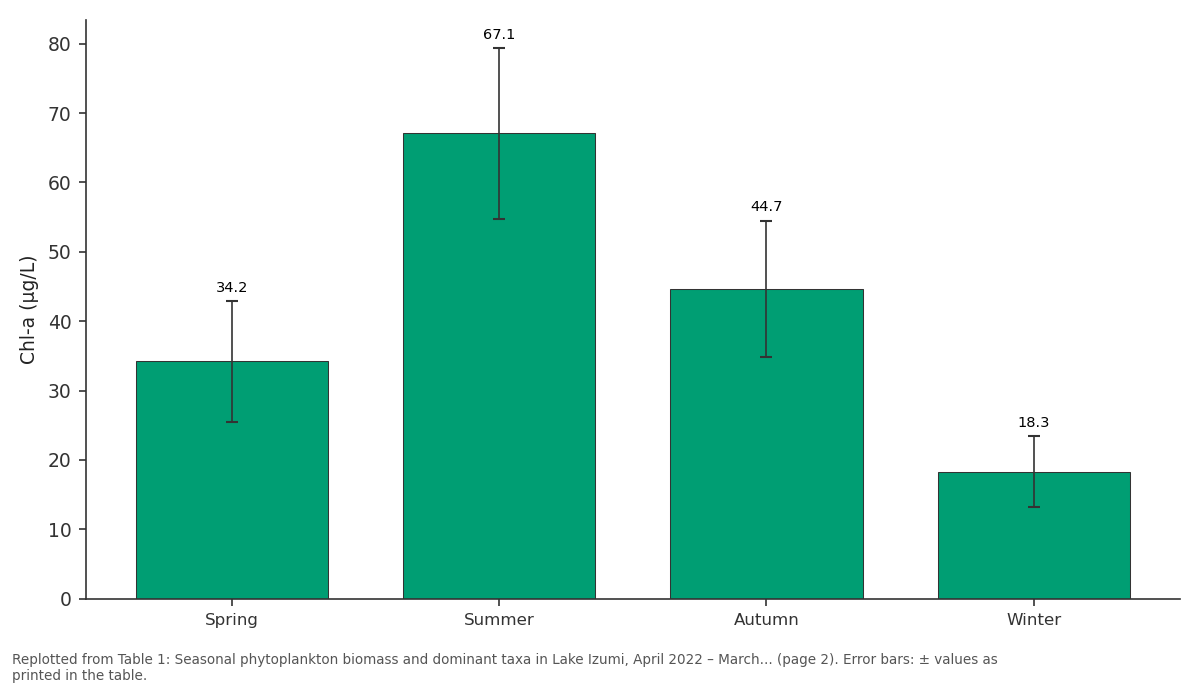
Chl-a (μg/L): Spring vs Summer vs Autumn vs Winter
Replotted from Table 1 (page 2) of the original paper. Every bar is the paper's own table value.
View source evidence ↗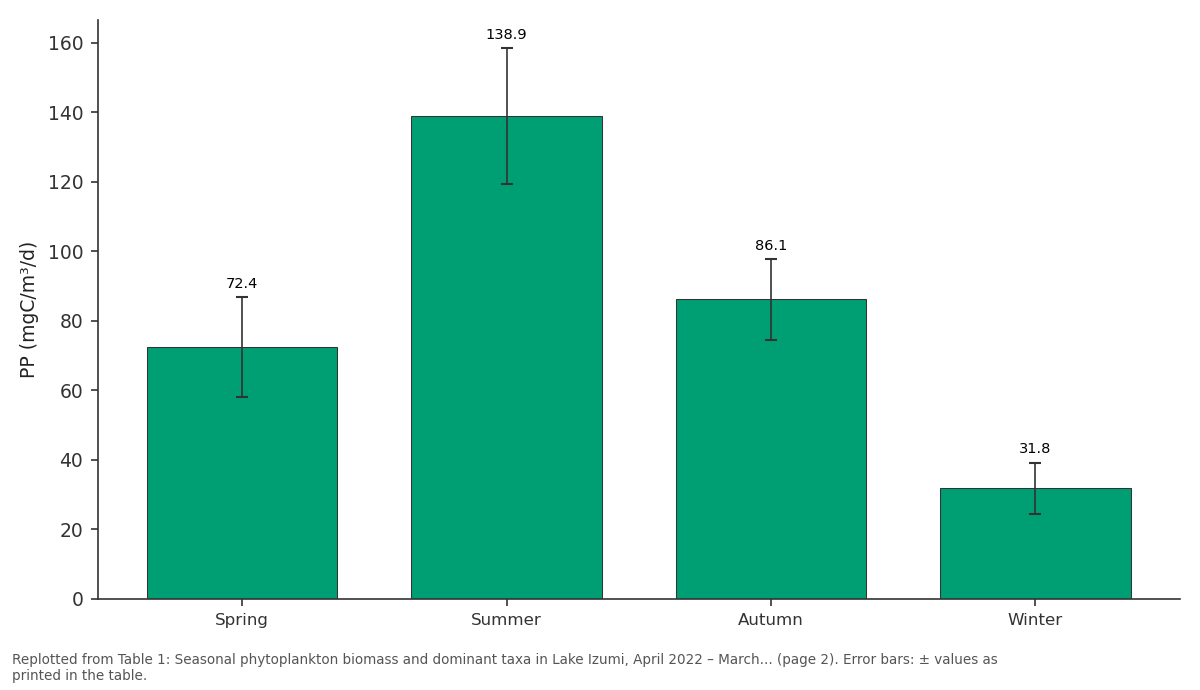
PP (mgC/m³/d): Spring vs Summer vs Autumn vs Winter
Replotted from Table 1 (page 2) of the original paper. Every bar is the paper's own table value.
View source evidence ↗Figures & tables
From the original paper Table 1
 Table 2
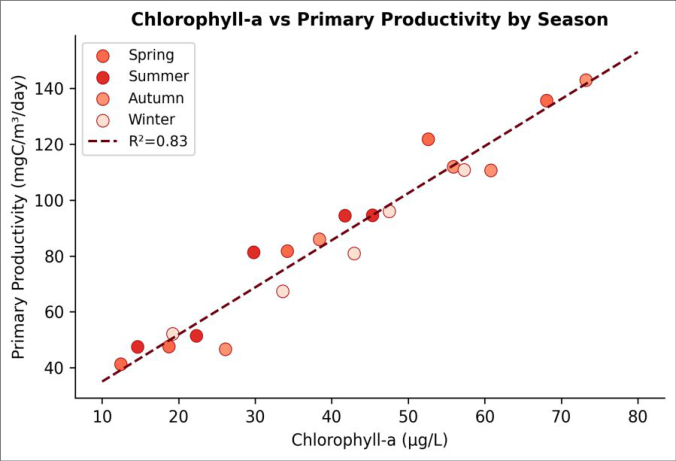 Figure 1
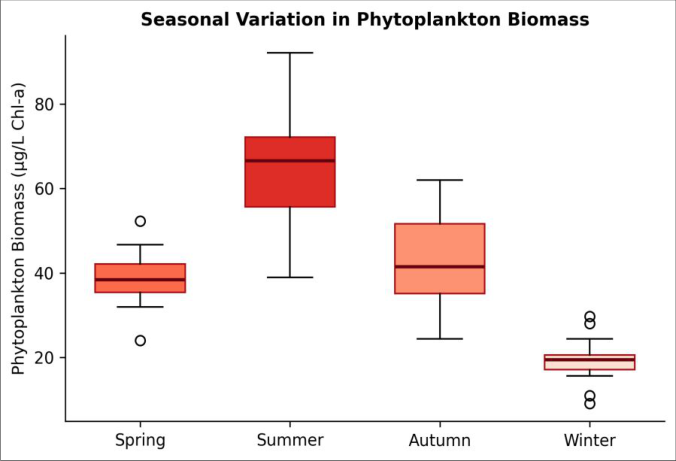 Figure 2
Introduction
Eutrophication is the single most widespread water-quality problem in temperate freshwater lakes, and its symptoms algal blooms, oxygen depletion, and loss of submerged vegetation continue to intensify despite decades of nutrient-reduction policy [1] . At the centre of these symptoms sits the phytoplankton community, whose biomass and productivity respond rapidly to nutrient inputs, light availability, and thermal stratification [2] . Understanding the seasonal rhythm of phytoplankton growth is therefore a prerequisite for designing effective lake management strategies. In shallow eutrophic lakes, the classical seasonal succession model spring diatom bloom, clear-water phase, summer cyanobacterial dominance, autumn mixing may be compressed or disrupted because the water column mixes frequently, resuspending sediment-bound nutrients and maintaining high turbidity [3] . Japanese lowland lakes are particularly prone to such disruption, given their small fetch, warm summers, and heavy nutrient loading from surrounding agricultural and urban catchments [4] . Lake Izumi, situated within the greater Osaka metropolitan area, receives treated wastewater effluent and agricultural runoff, keeping total phosphorus above 50 μg/L year-round.
Primary productivity in eutrophic lakes can exceed 1 gC/m²/day during peak blooms, rivalling some marine upwelling zones [5] . Yet translating biomass measurements into productivity estimates is not straightforward: the relationship between chlorophyll-a and carbon fixation varies with species composition, light climate, and nutrient stoichiometry [6] . Cyanobacteria, for instance, fix carbon less efficiently per unit chlorophyll than diatoms but can maintain positive net growth under low-light, high-temperature conditions that suppress other taxa [7] .
Previous research on Lake Izumi focused on microcystin concentrations during summer blooms [8] but did not track phytoplankton productivity or community composition across the full annual cycle. This gap makes it difficult to evaluate whether nutrient management should target nitrogen, phosphorus, or both, because the limiting nutrient can shift between seasons and between taxonomic groups [9] . The present research aimed to fill that gap by (1) characterising the seasonal pattern of phytoplankton biomass and community composition at five stations across Lake Izumi, (2) measuring primary productivity by the light-dark bottle method at bi-weekly intervals over 12 months, and (3) identifying which environmental variables best predict biomass and productivity in each season [10] .
Material and Methods
Material and Methods
Study area description
Lake Izumi (34.52°N, 135.47°E) is a shallow, polymictic lake located 18 km south of central Osaka, Japan, at an elevation of 23 m above sea level. It has a surface area of 0.87 km², a mean depth of 2.4 m, and a maximum depth of 4.1 m. The catchment (14.3 km²) consists of residential land (42%), rice paddies (28%), forest (18%), and commercial zones (12%). A single municipal wastewater treatment plant discharges secondary-treated effluent into the lake's eastern inlet. The lake is classified as hypereutrophic under the OECD scheme, with annual mean total phosphorus of 68 μg/L and total nitrogen of 2.1 mg/L [8] .
Climatic and Environmental Conditions
Osaka Prefecture has a humid subtropical climate (Köppen Cfa) with hot, humid summers and mild winters. During the research period (April 2022-March 2023), mean monthly air temperature ranged from 4.8 °C (January) to 31.2 °C (August). Annual precipitation totalled 1,387 mm, with a pronounced rainy season (tsuyu) in June-July contributing 31% of the annual total. Water temperature in Lake Izumi tracked air temperature closely, ranging from 6.3 °C in February to 29.8 °C in August. Secchi depth varied from 0.3 m during the summer bloom to 1.4 m in winter, reflecting the strong influence of phytoplankton density on water clarity.
Material
Water samples were collected bi-weekly from five permanent stations: three in the littoral zone (depth 1.0-1.5 m) and two in the pelagic zone (depth 3.0-4.0 m). Integrated water-column samples were obtained using a 2-L Van Dorn sampler at 0.5-m intervals and pooled. Temperature, dissolved oxygen, pH, and conductivity were measured in situ using a YSI ProDSS multiparameter sonde. Light profiles were taken with a LI-COR LI-193 spherical quantum sensor to calculate the euphotic zone depth (1% surface irradiance). Nutrient analyses for dissolved inorganic nitrogen (DIN: NH₄-N + NO₃-N + NO₂-N) and soluble reactive phosphorus (SRP) were performed on filtered (0.45 μm GF/C) subsamples using standard colorimetric methods on a Hach DR6000 spectrophotometer.
Methods
Chlorophyll-a was extracted in 90% acetone after filtration through Whatman GF/F filters and measured spectrophotometrically following the method of Lorenzen [11] . Primary productivity was estimated by the light-dark bottle oxygen method: 300-mL BOD bottles were incubated at 0.5-m depth for four hours around solar noon, and dissolved oxygen change was converted to carbon equivalents using a photosynthetic quotient of 1.2 [5] . Phytoplankton were identified and counted in Lugol-fixed subsamples using a Nikon Eclipse Ni inverted microscope at 400× magnification, following the Utermöhl settling technique. Biovolume was calculated from geometric approximations and converted to carbon using published taxon-specific factors [12] . Statistical analyses included Pearson correlation and stepwise multiple regression in R 4.3.1, with season as a blocking factor. All fieldwork was approved by the Kansai University of Life Sciences Environmental Research Committee (Protocol KUL-ENV-2022-008, 14 March 2022).
Results
Results
Seasonal variations
Phytoplankton biomass and community composition followed a clear seasonal pattern (Table 1). Spring (April-May) was dominated by centric diatoms, principally Aulacoseira granulata, which accounted for 47.2% of total biovolume. Summer (June-August) saw a dramatic shift to cyanobacteria, with Microcystis aeruginosa alone contributing 38.7% of biovolume during August. Autumn (September-November) featured a mixed assemblage of chlorophytes and a secondary diatom pulse of Cyclotella meneghiniana. Winter (December-March) biomass was lowest, dominated by small flagellated cryptophytes. Nutrient correlations with biomass shifted across seasons (Table 2). DIN was the strongest nutrient predictor in spring (r = 0.74, p<0.001), but SRP took over that role in summer (r = 0.71, p<0.001), consistent with the shift from nitrogendemanding diatoms to phosphorus-sensitive cyanobacteria.
| Variable | Spring | Summer | Autumn | Winter |
|---|---|---|---|---|
| Water temperature | 0.61** | 0.44* | 0.53* | 0.38 |
| DIN | 0.74*** | 0.31 | 0.48* | 0.29 |
| SRP | 0.42* | 0.71*** | 0.56** | 0.52* |
| Secchi depth | −0.58** | −0.81*** | −0.63** | −0.47* |
Table text extracted from the original PDF; superscript letters are shown inline. The original table image is below.
View original table image
| Season | Chl-a (μg/L) | PP (mgC/m³/d) | Dominant Taxon | Biovolume (%) |
|---|---|---|---|---|
| Spring | 34.2 ± 8.7 | 72.4 ± 14.3 | Aulacoseira granulata | 47.2 |
| Summer | 67.1 ± 12.3 | 138.9 ± 19.6 | Microcystis aeruginosa | 58.3 |
| Autumn | 44.7 ± 9.8 | 86.1 ± 11.7 | Cyclotella meneghiniana | 31.6 |
| Winter | 18.3 ± 5.1 | 31.8 ± 7.4 | Cryptomonas spp. | 39.4 |
Table text extracted from the original PDF; superscript letters are shown inline. The original table image is below.
View original table image
Comprehensive interpretation
The strong overall correlation between chlorophyll-a and primary productivity (R² = 0.83; Figure 1) confirms that biomass is a reliable proxy for carbon fixation in this system. However, the scatter around the regression line was wider in summer than in other seasons, likely because cyanobacterial buoyancy regulation concentrates cells near the surface, creating vertical heterogeneity that the integrated sampling approach partly smoothed. Stepwise regression with season as a blocking factor retained water temperature and SRP as the best two-predictor model for annual biomass (adjusted R² = 0.76, p<0.001). When spring data were analysed separately, DIN replaced SRP as the second predictor alongside temperature, reinforcing the seasonal shift in nutrient limitation.
Discussion
The seasonal biomass pattern in Lake Izumi follows the broad template described for shallow eutrophic lakes in the temperate zone, with spring diatom growth giving way to summer cyanobacterial dominance [3] . But peak chlorophylla values (73.2 μg/L) exceeded those reported for comparable Japanese lakes such as Lake Kasumigaura (55-65 μg/L), suggesting that the combination of wastewater inputs and a small, warm catchment pushes Lake Izumi toward the extreme end of the eutrophication spectrum [4] . The seasonal switch in the identity of the limiting nutrient nitrogen in spring, phosphorus in summer has practical implications for management. Single-nutrient reduction strategies, which historically focused on phosphorus alone, may fail to control spring diatom blooms if DIN remains high [9] . Dual-nutrient management, targeting both N and P, appears more appropriate for this lake, a conclusion consistent with recent recommendations for shallow hypereutrophic systems in East Asia [13] . Cyanobacterial dominance during summer coincided with water temperatures above 28 °C, a threshold that favours Microcystis over competing taxa due to its ability to regulate buoyancy and access surface light even in turbid water [7] . Climate projections for the Osaka region suggest that the number of days exceeding 28 °C will increase by two to three weeks by mid-century, which could extend the cyanobacterial bloom window and worsen microcystin risk [14] . The secondary autumn diatom pulse is less commonly reported in Japanese lakes and may reflect a nutrient release event during autumn turnover, when sediment-bound phosphorus re-enters the water column in shallow, wind-exposed basins [10] .
Conclusion
This 12-month survey of Lake Izumi revealed a pronounced seasonal cycle in phytoplankton biomass and primary productivity, with summer chlorophyll-a values roughly four times those of winter and carbon-fixation rates peaking above 140 mgC/m³/day during the August cyanobacterial bloom. Diatoms dominated the spring assemblage, cyanobacteria controlled the summer, and a mixed chlorophyte-diatom community characterised autumn, while winter was marked by low biomass and cryptophyte prevalence. The identity of the nutrient most closely tied to biomass shifted from dissolved inorganic nitrogen in spring to soluble reactive phosphorus in summer, indicating that single-nutrient management strategies are unlikely to control blooms year-round. Dual-nutrient reduction targeting both nitrogen and phosphorus inputs particularly from the municipal wastewater discharge offers the most promising path toward lowering peak biomass and associated microcystin risk.
Chlorophyll-a proved a reliable predictor of primary productivity (R² = 0.83), which simplifies monitoring because chlorophyll measurements are faster and cheaper than bottle incubations. Future work should extend the monitoring programme to multiple years to capture interannual variability, incorporate high-frequency sensor data for finer temporal resolution, and link phytoplankton dynamics to zooplankton grazing pressure, which was not measured here but is known to influence clear-water phases in shallow lakes. Given the projected warming of the Osaka region, tracking changes in the duration and intensity of the summer cyanobacterial bloom window is especially urgent.
Acknowledgement
Acknowledgements Funding sourcesThis research was supported by departmental funds from the Kansai University of Life Sciences. No external projectspecific funding was received. Institutional supportThe authors thank the Department of Ecology and Environmental Biology at Kansai University of Life Sciences, Osaka, for access to the aquatic ecology laboratory and field sampling equipment.
Figures and tables from the paper
References
14 in the original paper- Smith VH, Schindler DW. Eutrophication science: where do we go from here? Trends in Ecology and Evolution. 2009;24(4):201-207.
- Reynolds CS. The Ecology of Phytoplankton. Cambridge: Cambridge University Press; 2006. 1-535.
- Scheffer M, Hosper SH, Meijer ML, Moss B, Jeppesen E. Alternative equilibria in shallow lakes. Trends in Ecology and Evolution. 1993;8(8):275-279.
- Havens KE, Paerl HW. Climate change at a crossroad for control of harmful algal blooms. Environmental Science and Technology. 2015;49(22):12605-12606.
- Wetzel RG. Limnology: Lake and River Ecosystems. 3rd ed. San Diego: Academic Press; 2001. 1-1006.
- Falkowski PG, Raven JA. Aquatic Photosynthesis. 2nd ed. Princeton: Princeton University Press; 2007. 1-484.
- Huisman J, Codd GA, Paerl HW, Ibelings BW, Verspagen JMH, Visser PM. Cyanobacterial blooms. Nature Reviews Microbiology. 2018;16(8):471-483.
- Tanaka Y, Sato H, Watanabe M. Microcystin concentrations and water quality in a shallow hypereutrophic lake in Osaka Prefecture. Japanese Journal of Limnology. 2019;80(2):123-134.
- Paerl HW, Scott JT, McCarthy MJ, Newell SE, Gardner WS, Havens KE. It takes two to tango: when and where dual nutrient (N and P) reductions are needed to protect lakes and downstream ecosystems. Environmental Science and Technology. 2016;50(20):10805-10813.
- Søndergaard M, Jensen JP, Jeppesen E. Role of sediment and internal loading of phosphorus in shallow lakes. Hydrobiologia. 2003;506(1-3):135-145.
- Lorenzen CJ. Determination of chlorophyll and pheopigments: spectrophotometric equations. Limnology and Oceanography. 1967;12(2):343-346.
- Hillebrand H, Dürselen CD, Kirschtel D, Pollingher U, Zohary T. Biovolume calculation for pelagic and benthic microalgae. Journal of Phycology. 1999;35(2):403-424.
- Xu H, Paerl HW, Qin B, Zhu G, Gao G. Nitrogen and phosphorus inputs control phytoplankton growth in eutrophic Lake Taihu, China. Limnology and Oceanography. 2010;55(1):420-432.
- Yamamoto Y, Nakahara H. Seasonal variations in the morphology of bloom-forming cyanobacteria in a eutrophic pond. Limnology. 2009;10(3):185-193.