
Research article · 2025 · Full text
International Journal of Biology SciencesBehavioral thermoregulation and habitat selection in desert-dwelling lizard species
Volume 7(2) · Pages 168–171 · DOI: 10.33545/26649926.2025.v7.i2c.766 ↗
Research areasAmphibian and Reptile BiologyPhysiological and biochemical adaptationsSpecies Distribution and Climate Change
Abstract
Author-writtenBehavioral thermoregulation refers to the active selection of microhabitats that allow ectotherms to maintain body temperatures within a preferred range despite fluctuating ambient conditions. This research compared thermoregulatory behaviour and habitat use among three sympatric lizard species (Liolaemus darwinii, L. multimaculatus, and Ctenophorus kingii) inhabiting the Monte Desert scrubland near Rosario, Argentina. Focal observations were conducted on 180 individuals across 36 transects between October 2022 and February 2023. Body temperature was recorded using cloacal thermometry at each capture event. L. darwinii maintained a mean field body temperature of 36.8 ± 1.2 °C and shuttled between sun and shade at a rate of 4.7 transitions per hour. L. multimaculatus was more thermally lax, tolerating a wider range (34.3 ± 1.8 °C) and showing fewer shuttling bouts (2.3/h). C. kingii preferred the highest temperatures (38.1 ± 0.9 °C) and occupied open rocky substrates almost exclusively during midday. Habitat selection modelling indicated that substrate type and shrub canopy cover were the strongest predictors of species occurrence. These patterns suggest that interspecific differences in thermal preference mediate habitat partitioning in this arid assemblage.
Summary
Source-checkedPlain-language reading of the full paper, prepared with AI and checked against the text. Each point links to the authors' own words.
Why it matters
- Desert lizards must balance the need for warmth to support vital functions like digestion and immunity against the risk of lethal overheating. View evidence ↗
- Differences in preferred body temperatures among co-occurring ectotherms can reduce niche overlap and promote coexistence by influencing their activity timing and habitat use. View evidence ↗
- The partitioning of thermal resources among similar lizard species in the Monte Desert is poorly understood due to a lack of multi-species field studies. View evidence ↗
The question
- The study aimed to quantify differences in field body temperature and thermal precision, describe daily patterns of substrate and shade use, and model environmental predictors of species occurrence to assess thermal niche partitioning. View evidence ↗
What they did
- Researchers conducted focal observations on 180 lizards across 36 transects from October 2022 to February 2023. View evidence ↗
- The sample included 72 L. darwinii, 61 L. multimaculatus, and 47 C. kingii individuals. View evidence ↗
- Body temperature was measured using a cloacal thermocouple within 30 seconds of capturing the lizards. View evidence ↗
- Operative temperatures were recorded every 15 minutes using copper models designed to mimic lizard reflectance. View evidence ↗
- Habitat selection was analyzed using generalized linear models with binomial error, predicting species presence based on substrate, canopy cover, distance to rock, and operative temperature. View evidence ↗
What they found
- The three species had significantly different mean field body temperatures: C. kingii was the highest (38.1 ± 0.9 °C), followed by L. darwinii (36.8 ± 1.2 °C) and L. multimaculatus (34.3 ± 1.8 °C). View evidence ↗
- L. darwinii exhibited the highest active thermoregulation with a shuttling rate of 4.7 ± 1.3 transitions per hour, compared to 2.3 ± 0.8/h for L. multimaculatus and 1.6 ± 0.5/h for C. kingii. View evidence ↗
- C. kingii showed the highest thermal precision (lowest de index of 0.9 ± 0.4 °C), while L. multimaculatus was the most thermally variable (de index of 2.7 ± 1.1 °C). View evidence ↗
- Habitat selection models identified rocky substrates and low canopy cover as the strongest predictors of species occurrence. View evidence ↗
- All species showed peak sun exposure between 09:00 and 11:00 and retreated to shade when operative temperatures rose above 42 °C. View evidence ↗
What it means
- The authors conclude that divergence in thermoregulatory strategies allows these three sympatric species to coexist in the challenging desert environment. View evidence ↗
- The authors highlight that C. kingii is particularly vulnerable to habitat modification due to its strong dependence on exposed rock outcrops. View evidence ↗
- A stated limitation of the study is that data were only collected during the warm season. View evidence ↗
Visual summary
3 visualsIllustrations explain the paper; charts are replotted from the paper's own table values.
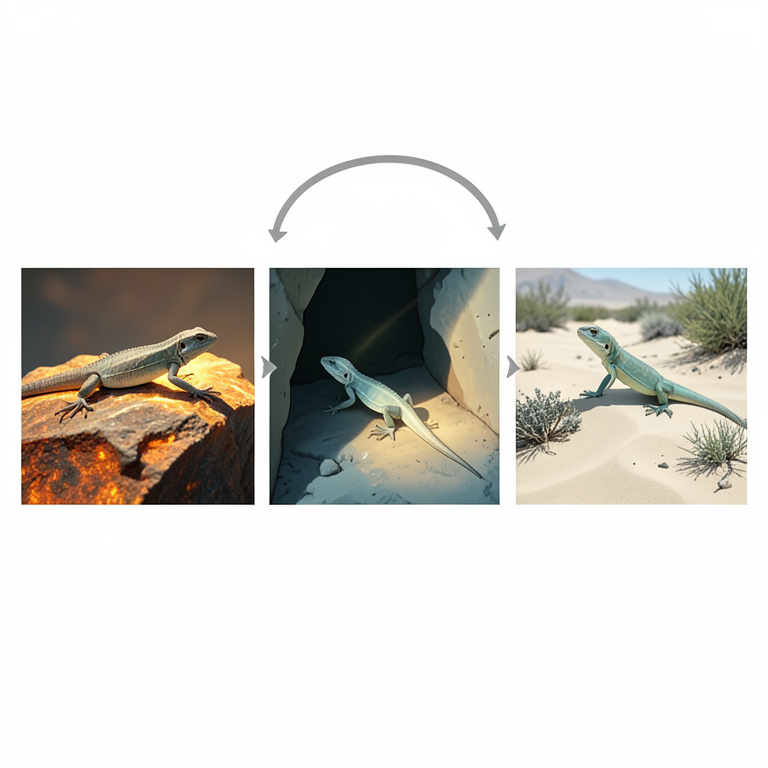
Comparative Thermoregulatory Strategies
AI-generated conceptual illustration (Desert-dwelling lizards (specifically Ctenosaura kingii, Liolaemus darwinii, and Liolaemus multimaculatus)). It explains the idea and does not show study data.
View source evidence ↗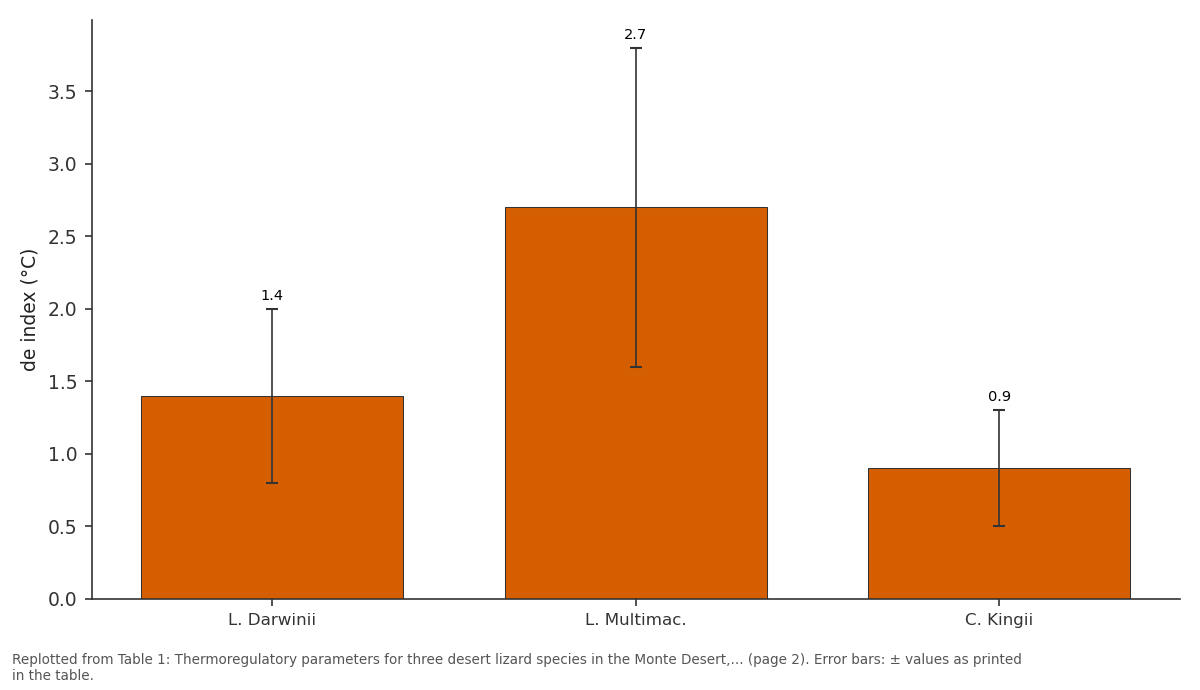
de index (°C): L. Darwinii vs L. Multimac. vs C. Kingii
Replotted from Table 1 (page 2) of the original paper. Every bar is the paper's own table value.
View source evidence ↗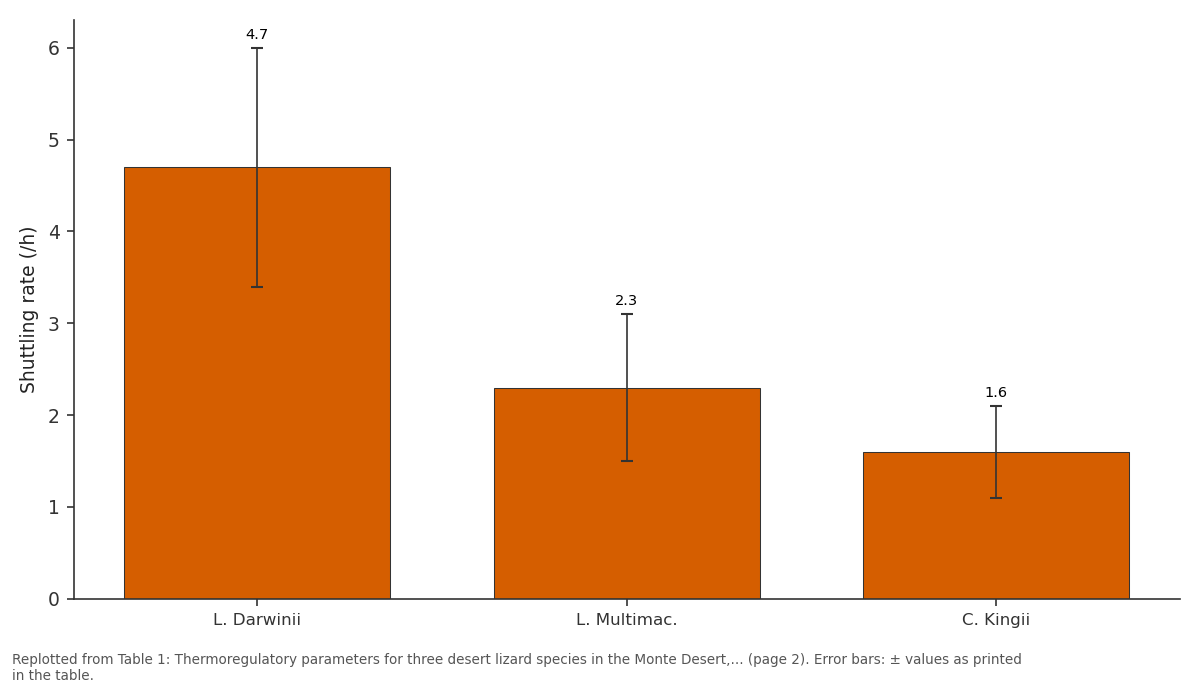
Shuttling rate (/h): L. Darwinii vs L. Multimac. vs C. Kingii
Replotted from Table 1 (page 2) of the original paper. Every bar is the paper's own table value.
View source evidence ↗Figures & tables
From the original paper Table 1
 Table 2
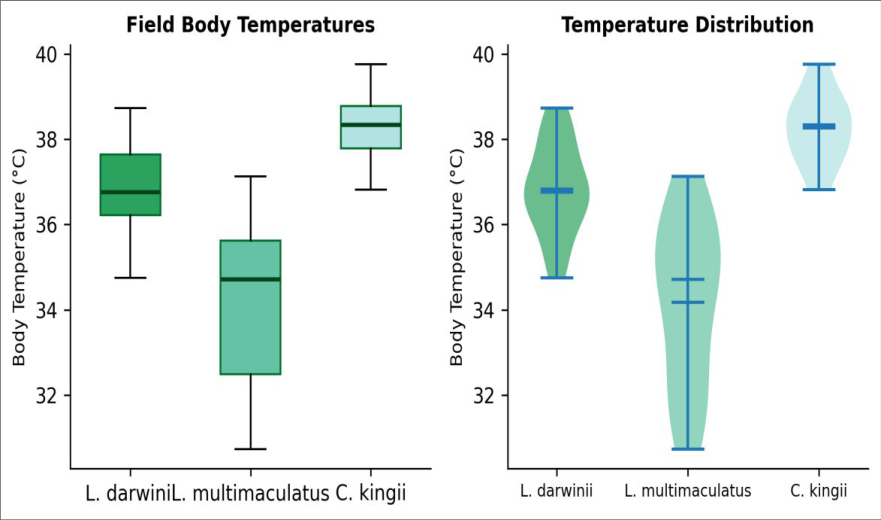 Figure 1
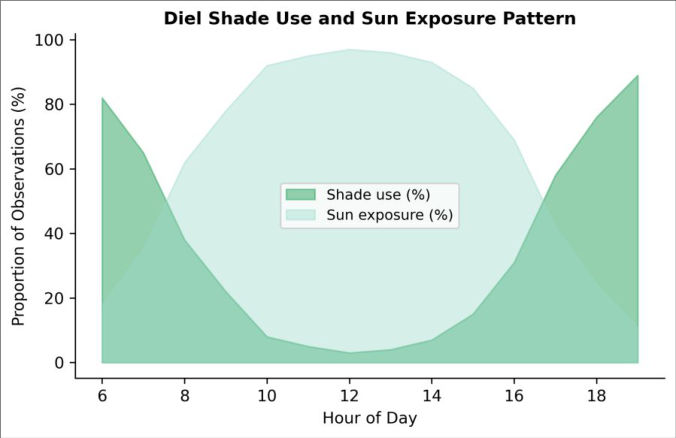 Figure 2
Introduction
Thermoregulation is an old problem in reptile ecology that hasn't lost its relevance. Desert lizards face a daily balancing act: they need warmth for digestion, locomotion, and immune function, but overheating can be lethal within minutes [1] . Unlike endotherms, lizards manage this trade-off by shuttling between sun-exposed and shaded microhabitats, adjusting their body posture, and selecting substrates that match their thermal preferences [2] . The Monte Desert of central Argentina supports a diverse lizard fauna, with several Liolaemus species co-occurring in scrubland dominated by Larrea and Prosopis [3] . How these ecologically similar species partition thermal resources is not well understood, partly because most thermoregulatory work in the region has focused on single-species laboratory setups rather than multi-species field comparisons [4] . When two or more ectotherms share a habitat, differences in preferred body temperature can translate into differences in activity timing, substrate use, and microhabitat selection effectively reducing niche overlap and promoting coexistence [5] . This research tested that idea by measuring field body temperatures, shuttling behaviour, and microhabitat use in three sympatric species L. darwinii, L. multimaculatus, and Ctenophorus kingii along transects in the Monte Desert near Rosario during the warm season of 2022-2023. The objectives were to (1) quantify interspecific variation in field body temperature and thermal precision, (2) describe diel patterns of shade use and substrate selection, and (3) model the environmental predictors of species occurrence to assess the degree of thermal niche partitioning [6] .
Material and Methods
Material and Methods
Study area description
Study area description
Instrumentation
Temperature loggers (iButton DS1921G, Maxim Integrated) recorded operative temperatures at 15-minute intervals inside copper lizard models painted to match average lizard reflectance. Models were deployed in sun, partial shade, and full shade at each transect for the duration of the research.
Results
The three species differed significantly in mean field body temperature (Kruskal-Wallis H = 47.3, Table 1). C. kingii maintained the highest and narrowest temperature range, while L. multimaculatus was the most thermally variable. L. darwinii showed intermediate temperatures but the highest shuttling rate, consistent with active thermoregulatory behaviour.
| Parameter | L. Darwinii | L. Multimac. | C. Kingii | P-value |
|---|---|---|---|---|
| Mean Tb (°C) | 36.8 ± 1.2 | 34.3 ± 1.8 | 38.1 ± 0.9 | < 0.001 |
| Preferred range (°C) | 35.2–38.4 | 31.8–37.1 | 36.9–39.6 | |
| de index (°C) | 1.4 ± 0.6 | 2.7 ± 1.1 | 0.9 ± 0.4 | < 0.001 |
| Shuttling rate (/h) | 4.7 ± 1.3 | 2.3 ± 0.8 | 1.6 ± 0.5 | < 0.001 |
Table text extracted from the original PDF; superscript letters are shown inline. The original table image is below.
View original table image
Comprehensive interpretation
Rocky substrates and low canopy cover were the strongest habitat predictors (Table 2). C. kingii was almost exclusively associated with rock outcrops, while L. darwinii used mixed substrates. The diel activity pattern (Figure 2) showed peak sun exposure at 09:00-11:00 and a pronounced midday retreat to shade when operative temperatures exceeded 42 °C, followed by a secondary activity window in the late afternoon.
| Predictor | Estimate | Se | Z-value | P-value |
|---|---|---|---|---|
| Substrate: rock | 1.83 | 0.41 | 4.46 | < 0.001 |
| Canopy cover (%) | −0.94 | 0.28 | −3.36 | < 0.001 |
| Operative temp (°C) | 0.67 | 0.19 | 3.53 | < 0.001 |
| Distance to rock (m) | −0.38 | 0.14 | −2.71 | 0.007 |
Table text extracted from the original PDF; superscript letters are shown inline. The original table image is below.
View original table image
Discussion
The 3.8 °C gap in mean body temperature between C. kingii and L. multimaculatus is consistent with thermal niche partitioning models that predict coexistence through divergence in preferred temperature [5] . C. kingii's narrow thermal range and low shuttling rate suggest it relies on basking-site fidelity rather than active shuttling, a strategy that works well on exposed rock surfaces where solar radiation is predictable [2] . L. darwinii, by contrast, shuttled nearly five times per hour, indicating a more energyintensive thermoregulatory style suited to the heterogeneous shrubland it occupies. The midday retreat to shade across all species mirrors the bimodal activity pattern documented in numerous desert lizard assemblages [1] . Operative temperatures in full sun exceeded 48 °C at midday during peak summer, well above the critical thermal maximum for all three species, making shade-seeking essential for survival. The importance of substrate type in the habitat model supports earlier work showing that surface thermal properties albedo, heat capacity shape microhabitat quality for ectotherms more than vegetation structure alone [4] . A limitation worth noting is that this research covered only the warm season. Cool-season thermoregulatory data might reveal different patterns, particularly for L. multimaculatus, whose broad thermal tolerance could allow year-round activity in mild winters when the other species are inactive [3] .
Conclusion
This field comparison of three sympatric desert lizards revealed clear interspecific differences in body temperature, thermal precision, and shuttling behaviour that align with distinct microhabitat preferences. C. kingii occupied hot, rocky substrates with minimal canopy cover; L. darwinii used mixed shrubland and shuttled actively; and L. multimaculatus tolerated a wide thermal range across varied microhabitats. These differences support the hypothesis that divergence in thermoregulatory strategy facilitates coexistence in thermally challenging environments. From a conservation perspective, the strong dependence of C. kingii on exposed rock outcrops makes it vulnerable to habitat modification. Any land-use change that reduces rock availability or increases shrub encroachment could shift competitive dynamics in favour of the more thermally flexible species. Future work should incorporate seasonal data and test whether climate warming narrows the thermal safety margins that currently allow all three species to persist in the Monte Desert.
Acknowledgement
Acknowledgements Funding sourcesThis research was supported by internal departmental funds from the Centro de Ciencias Biológicas del Litoral, Rosario. No external grant funding was received. Institutional supportThe authors acknowledge the Centro de Ciencias Biológicas del Litoral, Rosario for providing laboratory access and logistical support.
Figures and tables from the paper
References
15 in the original paper- Huey RB, Slatkin M. Cost and benefits of lizard thermoregulation. Quarterly Review of Biology. 1976;51(3):363-384.
- Angilletta MJ. Thermal Adaptation: A Theoretical and Empirical Synthesis. Oxford: Oxford University Press; 2009. 1-289.
- Liolaemus boulengeri group. Biological Journal of the Linnean Society. 2006;89(2):241-275.
- Sinervo B, Mendez-de-la-Cruz F, Miles DB, Heulin B, Bastiaans E, Villagrán-Santa Cruz M, et al. Erosion of lizard diversity by climate change and altered thermal niches. Science. 2010;328(5980):894-899.
- Hertz PE, Huey RB, Stevenson RD. Evaluating temperature regulation by field-active ectotherms: the fallacy of the inappropriate question. American Naturalist. 1993;142(5):796-818.
- Bauwens D, Hertz PE, Castilla AM. Thermoregulatory behavior of lacertid lizards. Journal of Thermal Biology. 1996;21(5-6):429-436.
- Kearney M, Shine R, Porter WP. The potential for behavioral thermoregulation to buffer cold-blooded animals against climate warming. Proceedings of the National Academy of Sciences. 2009;106(10):38353840.
- Adolph SC. Influence of behavioral thermoregulation on microhabitat use by two Sceloporus lizards. Ecology. 1990;71(1):315-327.
- Stellatelli OA, Vega LE, Block C, Cruz FB. Effects of tree invasion on the habitat use of sand lizards. Herpetologica. 2013;69(4):455-465.
- Ibargüengoytía NR, Cussac VE. Body temperatures of two sympatric Liolaemus lizards from northern Patagonia. Journal of Herpetology. 2002;36(3):534538.
- Christian KA, Tracy CR. The effect of the thermal environment on the ability of hatchling Galapagos land iguanas to avoid predation during dispersal. Oecologia. 1981;49(2):218-223.
- Vitt LJ, Caldwell JP. Herpetology: An Introductory Biology of Amphibians and Reptiles. 4th ed. San Diego: Academic Press; 2014. 1-757.
- Deutsch CA, Tewksbury JJ, Huey RB, Sheldon KS, Ghalambor CK, Haak DC. Impacts of climate warming on terrestrial ectotherms across latitude. Proceedings of the National Academy of Sciences. 2008;105(18):6668-6672.
- Labra A, Pienaar J, Hansen TF. Evolution of thermal physiology in Liolaemus lizards: adaptation, phylogenetic inertia, and niche tracking. American Naturalist. 2009;174(2):204-220.
- Pincheira-Donoso D, Hodgson DJ, Tregenza T. The evolution of body size under environmental gradients in ectotherms: why should Bergmann rule apply to lizards? BMC Evolutionary Biology. 2008;8:68.