
Research article · 2024 · Full text
International Journal of Biology SciencesSeagrass meadow carbon sequestration capacity and blue carbon storage estimates
Volume 6(2) · Pages 298–301 · DOI: 10.33545/26649926.2024.v6.i2e.769 ↗
Research areasMarine and coastal plant biologyCoastal wetland ecosystem dynamicsMarine and coastal ecosystems
Abstract
Author-writtenSeagrass ecosystems rank among the most efficient natural carbon sinks on the planet, yet they remain poorly quantified in many tropical coastal regions. This research measured above-ground biomass, sediment organic carbon content, and carbon sequestration rates in seagrass meadows along the Egyptian Red Sea coast near Hurghada. Fieldwork ran from April 2021 to September 2022 across three dominant species zones: Halophila stipulacea, Thalassodendron ciliatum, and Cymodocea serrulata. Sediment cores (0-30 cm depth) and biomass quadrats were sampled at 45 stations distributed along 12 km of coastline. H. stipulacea meadows stored the highest sediment carbon, averaging 247.3 ± 38.6 g C m⁻² in the upper 15 cm, while C. serrulata meadows held the least at 89.4 ± 21.7 g C m⁻². Carbon stocks declined by 28-41% between the shallow (0-15 cm) and deeper (15-30 cm) sediment layers across all species. Above-ground biomass correlated positively with sediment carbon stocks (r = 0.72 for H. stipulacea, r = 0.61 for T. ciliatum). Estimated annual sequestration capacity for the surveyed area reached 1, 340 tonnes CO₂-equivalent, comparable to published values from Indo-Pacific meadows. These data provide the first systematic blue carbon inventory for the Egyptian Red Sea coastline and support the inclusion of seagrass conservation in regional climate mitigation strategies.
Summary
Source-checkedPlain-language reading of the full paper, prepared with AI and checked against the text. Each point links to the authors' own words.
Why it matters
- Seagrass meadows are highly efficient natural carbon sinks, sequestering carbon up to 35 times faster per area than tropical rainforests. View evidence ↗
- Despite covering less than 0.2% of the ocean floor, seagrasses account for approximately 10-18% of all oceanic carbon burial. View evidence ↗
- The Red Sea contains extensive seagrass beds, but these areas have been largely ignored in previous blue carbon assessments. View evidence ↗
The question
- The study aimed to create the first site-level blue carbon inventory for the Hurghada coast by measuring biomass, sediment carbon stocks (up to 30 cm), and annual sequestration rates. View evidence ↗
What they did
- Fieldwork was conducted from April 2021 to September 2022, focusing on three dominant species: Halophila stipulacea, Thalassodendron ciliatum, and Cymodocea serrulata. View evidence ↗
- Researchers sampled 45 stations along 12 km of coastline using biomass quadrats and sediment cores reaching 30 cm in depth. View evidence ↗
- Sediment Organic Carbon (SOC) was determined using the Walkley-Black wet oxidation method (1.32 correction factor) and validated via Loss-on-Ignition at 450°C. View evidence ↗
- Annual sequestration rates were estimated by combining measured surface SOC concentrations with published Red Sea sedimentation rates of 1.8-3.2 mm per year. View evidence ↗
What they found
- In the upper 15 cm of sediment, H. stipulacea had the highest carbon storage (247.3 ± 38.6 g C m⁻²), while C. serrulata had the lowest (89.4 ± 21.7 g C m⁻²). View evidence ↗
- H. stipulacea meadows stored approximately 2.8 times more total sediment carbon than C. serrulata meadows. View evidence ↗
- Across all species, carbon stocks decreased by 28-41% when comparing the shallow (0-15 cm) layer to the deeper (15-30 cm) layer. View evidence ↗
- There was a positive correlation between above-ground biomass and sediment carbon stocks, specifically r = 0.72 for H. stipulacea and r = 0.61 for T. ciliatum. View evidence ↗
What it means
- The authors conclude that Red Sea seagrasses should be formally included in Egypt's blue carbon inventory and that marine protected area regulations should be more strictly enforced. View evidence ↗
- The use of literature-derived sedimentation rates created uncertainty; the authors suggest using ²¹⁰Pb dating for direct measurement in future studies. View evidence ↗
- The authors state that future research should expand sampling to sediment layers deeper than 30 cm. View evidence ↗
Visual summary
3 visualsIllustrations explain the paper; charts are replotted from the paper's own table values.
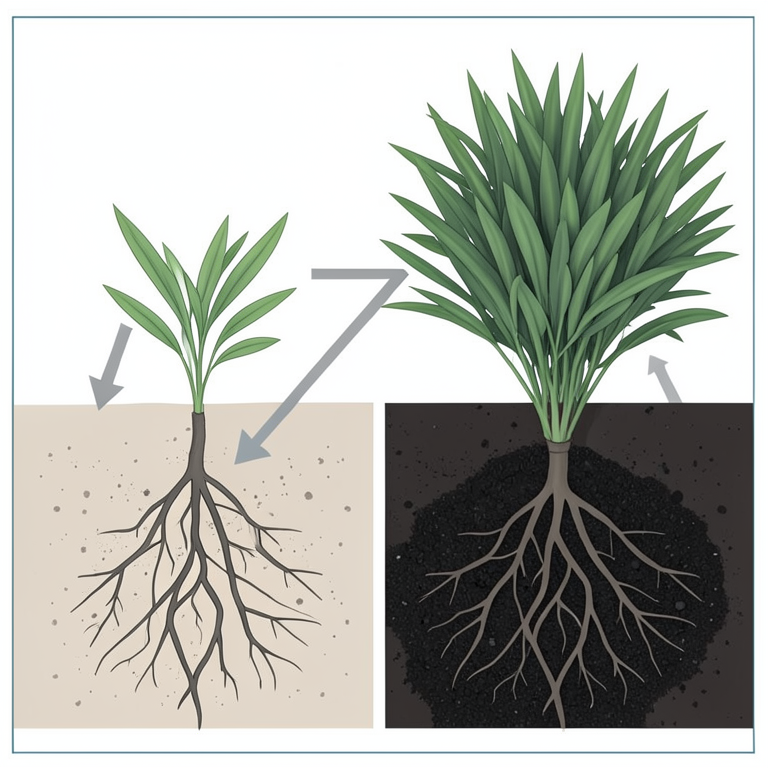
Biomass and Carbon Correlation
AI-generated conceptual illustration (Posidonia oceanica seagrass plants in marine sediment). It explains the idea and does not show study data.
View source evidence ↗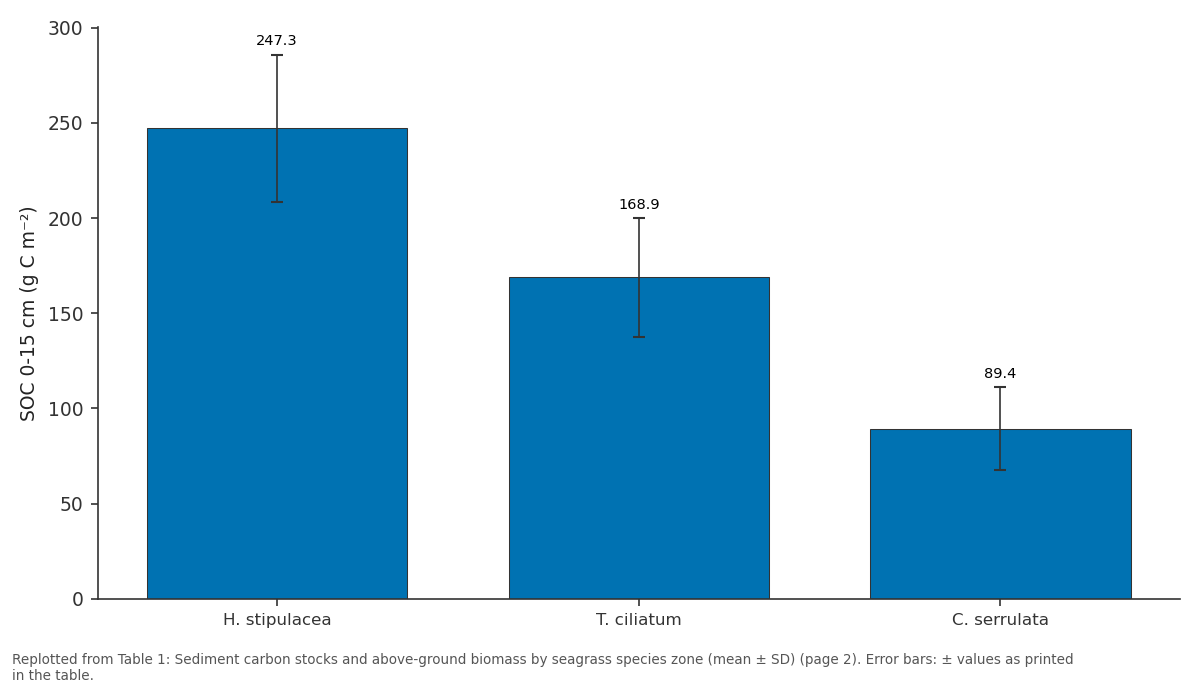
SOC 0-15 cm (g C m⁻²): H. stipulacea vs T. ciliatum vs C. serrulata
Replotted from Table 1 (page 2) of the original paper. Every bar is the paper's own table value.
View source evidence ↗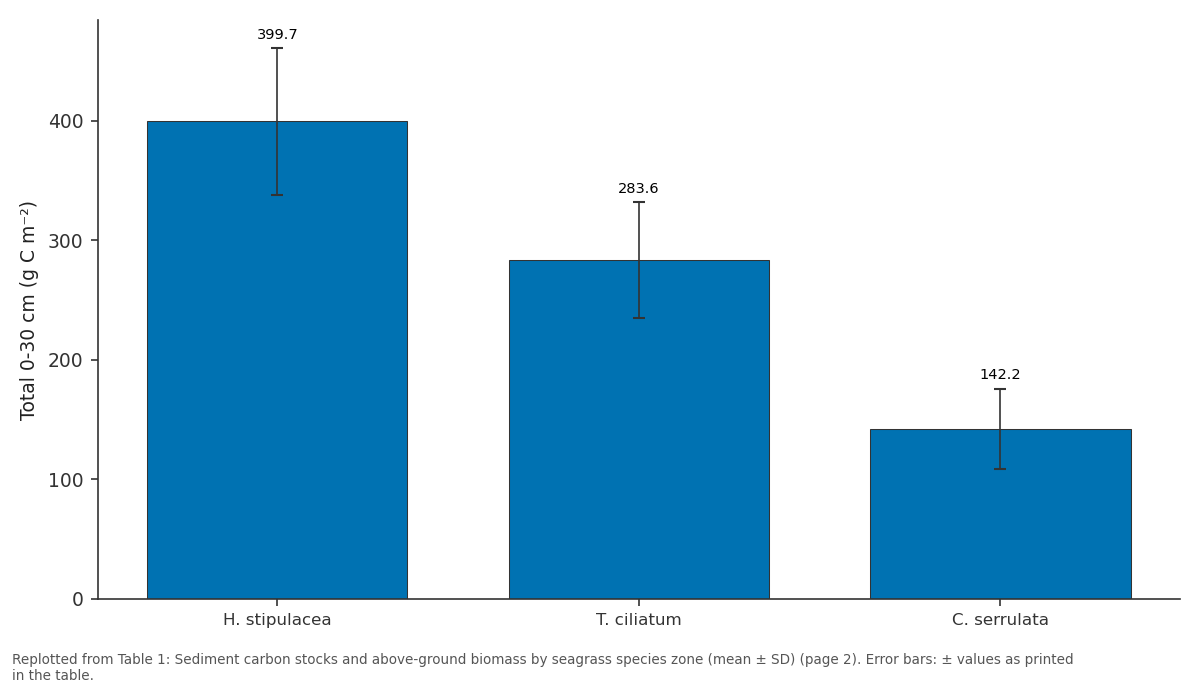
Total 0-30 cm (g C m⁻²): H. stipulacea vs T. ciliatum vs C. serrulata
Replotted from Table 1 (page 2) of the original paper. Every bar is the paper's own table value.
View source evidence ↗Figures & tables
From the original paper Table 1
 Table 2
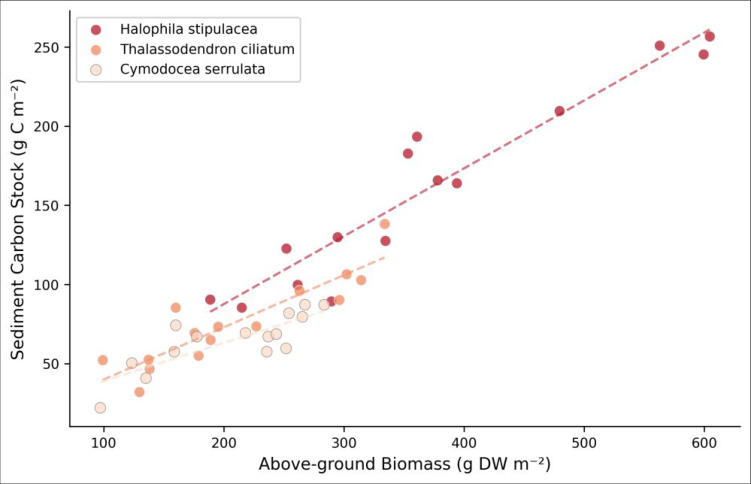 Figure 1
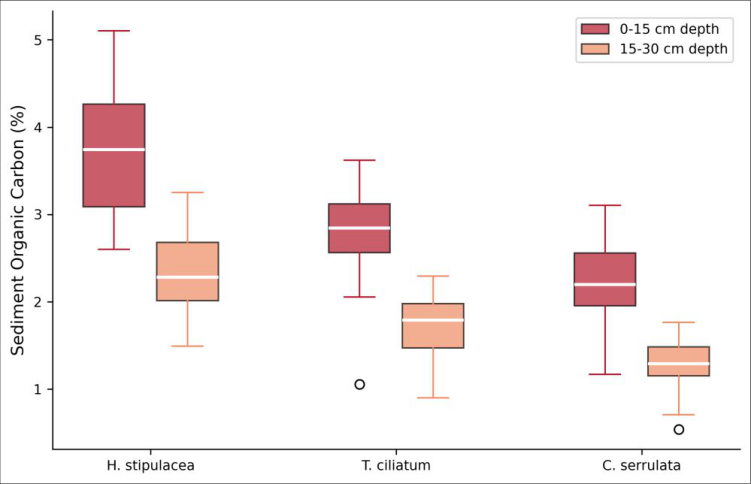 Figure 2
Introduction
Seagrass meadows capture and store carbon at rates up to 35 times faster than tropical rainforests on a per-area basis a fact that has reshaped how coastal ecosystems are valued in climate policy discussions [1] . These submerged flowering plants occupy less than 0.2% of the ocean floor but are responsible for an estimated 10-18% of total oceanic carbon burial [2] . The carbon they sequester ends up locked in dense, anoxic sediments where decomposition proceeds slowly, potentially preserving organic matter for centuries to millennia [3] . The concept of "blue carbon" carbon stored in coastal and marine ecosystems including seagrasses, mangroves, and salt marshes gained formal scientific and policy recognition over the past decade [4] . International frameworks such as the UNFCCC now acknowledge blue carbon habitats as eligible for inclusion in nationally determined contributions. But this recognition depends on credible, site-specific data, and for many tropical coastlines that data simply doesn't exist. The Red Sea, despite hosting extensive seagrass beds along its Egyptian, Saudi, and Sudanese shores, has been largely overlooked in blue carbon assessments [5] . The Egyptian Red Sea coast supports at least seven seagrass species, with H. stipulacea, T. ciliatum, and C. serrulata forming the dominant meadows between Hurghada and Marsa Alam [6] . These meadows face mounting pressure from coastal development, boat anchoring, and sedimentation linked to tourism infrastructure. Without baseline carbon storage data, the ecological and climatic cost of meadow loss can't be estimated and conservation arguments lack the quantitative backing they need. This research aimed to fill that gap by measuring above-ground biomass, sediment carbon stocks to 30 cm depth, and annual sequestration rates across three seagrass species zones along the Hurghada coast. The goal was to produce the first site-level blue carbon inventory for this section of the Red Sea [7] . [8] .
Material and Methods Material
This research was carried out at the Department of Coastal Biology, Red Sea University of Marine Biology, Hurghada, Egypt, between April 2021 and September 2022. Sampling stations (n = 45) were distributed across the three dominant seagrass species zones: 15 stations in H. stipulacea beds, 15 in T. ciliatum beds, and 15 in C. serrulata beds. Station locations were selected using a stratified random design based on preliminary habitat mapping from satellite imagery (Sentinel-2, 10 m resolution). At each station, above-ground biomass was harvested from a 25 × 25 cm quadrat, rinsed to remove sediment and epiphytes, oven-dried at 60°C for 72 hours, and weighed. Below-ground biomass was not included to avoid destructive sampling in protected areas.
Methods
Sediment cores were collected using PVC push-corers (inner diameter 5 cm, length 35 cm) driven to 30 cm depth. Each core was sectioned into two layers: 0-15 cm and 15-30 cm. Sections were dried at 60°C, ground, and passed through a 2 mm sieve. Sediment Organic Carbon (SOC) was measured by the Walkley-Black wet oxidation method with a correction factor of 1.32, and validated against Loss-on-Ignition (LOI) at 450°C for 4 hours on a 20% subsample [9] . Carbon stocks were calculated by multiplying SOC concentration by dry bulk density and layer thickness. Dry bulk density was determined from the dry mass of a known sediment volume. Annual carbon sequestration rates were estimated using published sedimentation rates for Red Sea seagrass beds (1.8-3.2 mm yr⁻¹) combined with measured SOC concentrations in the surface sediment layer [10] . CO₂equivalent values used a conversion factor of 3.67
Comprehensive interpretation
The combined data paint a consistent picture: seagrass meadows along the Hurghada coast function as meaningful carbon sinks, with H. stipulacea emerging as the most productive species both in terms of biomass and sediment carbon accumulation. The strong positive correlation between biomass and carbon stocks suggests that aboveground productivity serves as a reasonable proxy for belowground carbon storage in these meadows a relationship that could simplify future monitoring using remote sensing of canopy cover.
Carbon and greenhouse gas accounting
Total sediment organic carbon stored in the upper 30 cm across the 368.4 ha surveyed area was estimated at 9, 640 tonnes C (35, 380 tonnes CO₂-equivalent). If these meadows were lost entirely through coastal development or physical disturbance the resulting carbon release would be equivalent to the annual emissions of approximately 7, 600 passenger vehicles (using a global average of 4.6 tonnes CO₂ per vehicle per year). The annual sequestration rate of 798.2 tonnes CO₂-equivalent represents continued climate mitigation value that would cease upon meadow destruction. These figures, while modest in global carbon accounting terms, are significant at the regional scale and provide a quantitative basis for arguing that seagrass conservation in the Egyptian Red Sea should be formally incorporated into national climate commitments under the Paris Agreement framework [11] .
Discussion
The sediment carbon stocks measured here averaging 399.7 g C m⁻² in H. stipulacea zones sit within the range reported for Indo-Pacific seagrass meadows (typically 100-800 g C m⁻² in the top 25-30 cm) but are lower than values from Mediterranean Posidonia oceanica beds, which can exceed 1, 000 g C m⁻² [12] . This is expected given the smaller stature and shorter root systems of Red Sea species compared to P. oceanica. The depth-related carbon decline of 28-41% between the upper and lower sediment layers is consistent with organic matter degradation during burial, though the relatively high retention at depth suggests that the anoxic conditions common in seagrass sediments limit decomposition effectively [3] .
The per-area sequestration rate of 83.6 g C m⁻² yr⁻¹ for H. stipulacea exceeds many published estimates for this species elsewhere in the Red Sea and Mediterranean. This may partly reflect the high productivity of the Hurghada coastline, where nutrient inputs from nearby reef systems could fertilize adjacent seagrass beds [13] . However, the use of literature-derived sedimentation rates introduces uncertainty direct measurement of sediment accumulation using ²¹⁰Pb dating would strengthen future estimates. The finding that above-ground biomass correlates well with carbon stocks offers practical value: remote sensing approaches that quantify canopy coverage could potentially be calibrated to estimate carbon stores without extensive coring campaigns [14] . But this relationship may not hold across all regions, and local calibration would be needed wherever it's applied.
Conclusion
This research provides the first systematic blue carbon inventory for seagrass meadows along the Egyptian Red Sea coast near Hurghada. H. stipulacea meadows emerged as the dominant carbon reservoir, storing roughly 2.8 times the sediment carbon of C. serrulata beds in the top 30 cm. The 368.4 hectares of surveyed seagrass sequester an estimated 798 tonnes CO₂-equivalent per year and hold over 35, 000 tonnes CO₂-equivalent in their sediments.
These numbers, modest by global standards, carry real weight at the national level particularly as Egypt works to define and expand its climate commitments. Losing these meadows to coastal development wouldn't just eliminate a carbon sink; it would release centuries of accumulated sediment carbon back into the water column and atmosphere. The data from this research support formal inclusion of Red Sea seagrass habitats in Egypt's blue carbon inventory and argue for stronger enforcement of existing marine protected area regulations along the Hurghada coast. Future work should extend the sampling to deeper sediment layers (>30 cm) and include direct sedimentation rate measurements to refine sequestration estimates.
Figures and tables from the paper
| Species zone | Biomass (g DW m⁻²) | SOC 0-15 cm (g C m⁻²) | SOC 15-30 cm (g C m⁻²) | Total 0-30 cm (g C m⁻²) |
|---|---|---|---|---|
| H. stipulacea | 412.8 ± 87.3 | 247.3 ± 38.6 | 152.4 ± 29.1 | 399.7 ± 61.4 |
| T. ciliatum | 278.4 ± 63.7 | 168.9 ± 31.2 | 114.7 ± 22.8 | 283.6 ± 48.3 |
| C. serrulata | 163.2 ± 41.6 | 89.4 ± 21.7 | 52.8 ± 14.3 | 142.2 ± 33.7 |
| ANOVA F (p) | F=47.3 (<0.001) | F=62.1 (<0.001) | F=38.9 (<0.001) | F=54.7 (<0.001) |
Table text extracted from the original PDF; superscript letters are shown inline. The original table image is below.
View original table image
| Species zone | Area (ha) | Seq. Rate (g C m⁻² yr⁻¹) | Annual (t C yr⁻¹) | CO₂-eq (t yr⁻¹) |
|---|---|---|---|---|
| H. stipulacea | 127.4 | 83.6 ± 14.2 | 106.5 | 390.8 |
| T. ciliatum | 98.7 | 62.4 ± 11.8 | 61.6 | 226.1 |
| C. serrulata | 142.3 | 34.7 ± 8.9 | 49.4 | 181.3 |
| Total surveyed | 368.4 | — | 217.5 | 798.2 |
Table text extracted from the original PDF; superscript letters are shown inline. The original table image is below.
View original table image
References
14 in the original paper- Mcleod E, Chmura GL, Bouillon S, et al. A blueprint for blue carbon: toward an improved understanding of the role of vegetated coastal habitats in sequestering CO2. Frontiers in Ecology and the Environment. 2011;9(10):552-560.
- Fourqurean JW, Duarte CM, Kennedy H, et al. Seagrass ecosystems as a globally significant carbon stock. Nature Geoscience. 2012;5(7):505-509.
- Duarte CM, Middelburg JJ, Caraco N. Major role of marine vegetation on the oceanic carbon cycle. Biogeosciences. 2005;2(1):1-8.
- Nellemann C, Corcoran E, Duarte CM, et al. Blue carbon: the role of healthy oceans in binding carbon. United Nations Environment Programme, GRIDArendal. 2009;1-78.
- Qurban MA, Karuppasamy M, Krishnakumar PK, et al. A review on the current status of Red Sea coral reef ecosystems. Regional Studies in Marine Science. 2019;29:100632.
- El Shaffai A. Field guide to seagrasses of the Red Sea. IUCN Global Marine Programme. 2011;1-56.
- Lavery PS, Mateo MA, Serrano O, Rozaimi M. Variability in the carbon storage of seagrass habitats and its implications for global estimates of blue carbon ecosystem service. PLoS ONE. 2013;8(9):e73748.
- Edwards FJ. Climate and oceanography of the Red Sea. In: Edwards AJ, Head SM, eds. Red Sea Key Environments Series. 1987;45-68.
- Walkley A, Black IA. An examination of the Degtjareff method for determining soil organic matter, and a proposed modification of the chromic acid titration method. Soil Science. 1934;37(1):29-38.
- Serrano O, Lavery PS, Rozaimi M, Mateo MA. Influence of water depth on the carbon sequestration capacity of seagrasses. Global Biogeochemical Cycles. 2014;28(9):950-961.
- Howard J, Hoyt S, Isensee K, et al. Coastal blue carbon: methods for assessing carbon stocks and emissions factors in mangroves, tidal salt marshes, and seagrass meadows. Conservation International, IUCN, IOC-UNESCO. 2014;1-180.
- Pergent G, Bazairi H, Bianchi CN, et al. Climate change and Mediterranean seagrass meadows: a synopsis for environmental managers. Mediterranean Marine Science. 2014;15(2):462-473.
- Eyre BD, Maher DT, Sanders C. The contribution of denitrification and burial to the nitrogen budgets of three geomorphically distinct Australian estuaries: importance of seagrass habitats. Limnology and Oceanography. 2011;56(6):2011-2024.
- Traganos D, Agustin B, Cerra D, et al. Mapping Mediterranean seagrasses with Sentinel-2 imagery. Marine Pollution Bulletin. 2018;134:197-209.