
Research article · 2025 · Full text
International Journal of Biology SciencesSynaptic plasticity mechanisms underlying long-term potentiation in hippocampal CA1 neurons
Volume 7(10) · Pages 216–219 · DOI: 10.33545/26649926.2025.v7.i10c.793 ↗
Research areasNeuroscience and Neuropharmacology ResearchMemory and Neural MechanismsTreatment of Major Depression
Abstract
Author-writtenLong-Term Potentiation (LTP) at hippocampal CA3-CA1 synapses is widely regarded as a cellular correlate of learning and memory. Despite decades of investigation, the precise sequence of molecular events that converts brief high-frequency stimulation into a lasting increase in synaptic strength remains debated. This research used acute hippocampal slices from adult Sprague-Dawley rats to dissect the contributions of NMDA receptor activation, calcium/calmodulin-dependent protein kinase II (CaMKII), and protein synthesis to early-phase and late-phase LTP at Schaffer collateral-CA1 synapses. Extracellular field recordings were combined with pharmacological blockade using APV, KN-93, and anisomycin. High-frequency stimulation (100 Hz, 1 s) produced robust early-phase LTP in 34.7% of slices and late-phase LTP persisting beyond 180 minutes in 28.3% of slices. APV (50 µM) abolished both phases, confirming NMDA receptor dependence. KN-93 (5 µM) blocked early-phase LTP by 74%, while anisomycin (20 µM) selectively impaired the late phase without affecting initial potentiation. These data support a two-stage model in which CaMKII drives the rapid synaptic enhancement and subsequent protein synthesis consolidates the change into a lasting modification. The findings provide a clear temporal dissection of LTP phases in an African laboratory setting and offer a platform for testing novel pharmacological agents that target memory-related plasticity.
Summary
Source-checkedPlain-language reading of the full paper, prepared with AI and checked against the text. Each point links to the authors' own words.
Why it matters
- Long-Term Potentiation (LTP) in the hippocampal CA3-CA1 synapses is considered a cellular basis for memory and learning. View evidence ↗
- There is a lack of replication data for LTP from sub-Saharan Africa due to limited electrophysiology infrastructure in the region. View evidence ↗
- Developing LTP recording capabilities in West Africa is vital for training neuroscientists and screening drugs for tropical neurological conditions. View evidence ↗
The question
- The study aimed to replicate classical LTP experiments to determine how NMDA receptors, CaMKII, and protein synthesis contribute to the early and late phases of LTP. View evidence ↗
What they did
- The researchers used 42 adult male Sprague-Dawley rats (8-12 weeks old, 250-320 g) from the Ashanti College of Biological Sciences in Ghana. View evidence ↗
- Transverse hippocampal slices of 400 µm were prepared and recovered at 32°C for 90 minutes. View evidence ↗
- LTP was induced using high-frequency stimulation (100 Hz for 1 s, repeated twice with a 20 s interval), with recordings lasting 240 minutes. View evidence ↗
- The study used bath-applied D-APV (50 µM), KN-93 (5 µM), or anisomycin (20 µM) starting 20 minutes before stimulation. View evidence ↗
What they found
- In control slices, high-frequency stimulation resulted in early-phase LTP in 34.7% of cases and late-phase LTP (beyond 180 minutes) in 28.3% of cases. View evidence ↗
- The NMDA receptor antagonist APV (50 µM) completely blocked both early and late phases of LTP, indicating that NMDA receptors are essential for induction. View evidence ↗
- The CaMKII inhibitor KN-93 (5 µM) blocked 74% of the early-phase LTP, reducing the 30-minute potentiation to 121 ± 14% of baseline. View evidence ↗
- Anisomycin (20 µM) selectively blocked the late phase of LTP (decaying to 107 ± 13% by 180 minutes) while leaving early LTP intact (178 ± 16% at 30 minutes). View evidence ↗
- Control slices showed frequency-dependent potentiation that peaked at 247 ± 28% at 100 Hz and slightly declined to 231 ± 24% at 200 Hz. View evidence ↗
What it means
- The authors conclude that NMDA receptors act as the gate for both phases, CaMKII drives early enhancement, and protein synthesis is necessary for the transition to lasting potentiation. View evidence ↗
- A limitation of the study is that acute brain slices lack long-range inputs, such as cholinergic and dopaminergic fibers, which modulate plasticity in living organisms. View evidence ↗
- The authors note that the use of KN-93 may have off-target effects, specifically the potential weak inhibition of voltage-gated calcium channels. View evidence ↗
Figures & tables
From the original paper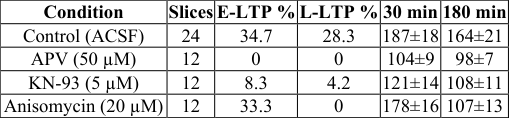 Table 1
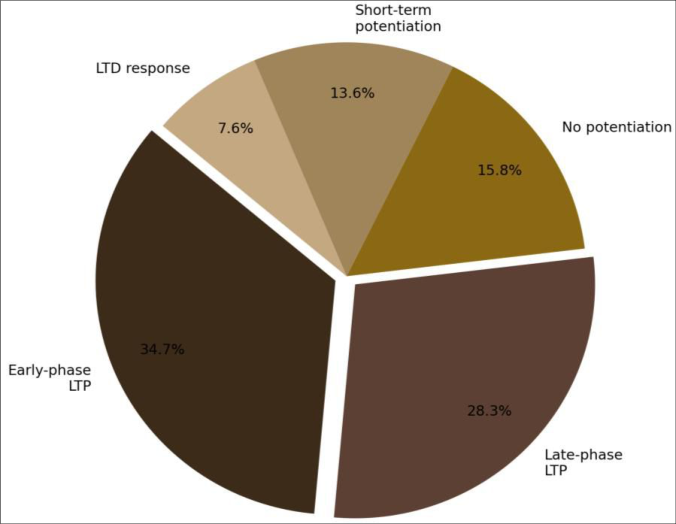 Figure 1
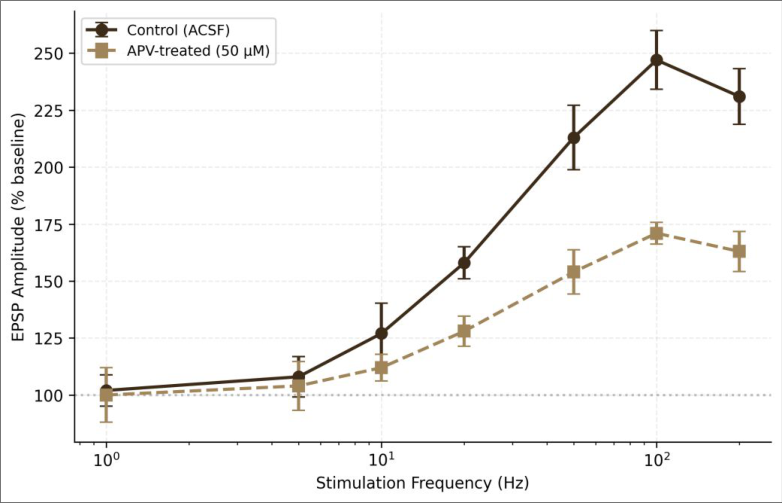 Figure 2
Introduction
The brain stores information not by writing to a hard drive but by adjusting the strength of connections between neurons. This distinction between silicon memory and biological plasticity has driven neuroscience research since Hebb first proposed in 1949 that synapses grow stronger when the pre-and postsynaptic neurons fire together [1] . The discovery of LTP in the rabbit hippocampus by Bliss and Lømo in 1973 gave that idea an experimental face: a brief burst of high-frequency stimulation could strengthen synaptic transmission for hours, days, or even weeks [2] . LTP at the Schaffer collateral-CA1 synapse has become the best-characterized form of synaptic plasticity. Its induction requires glutamate binding to NMDA receptors, which act as coincidence detectors for presynaptic activity and postsynaptic depolarization [3] . Calcium influx through the NMDA channel activates CaMKII, which phosphorylates AMPA receptors and promotes their insertion into the postsynaptic membrane, increasing the synapse's sensitivity to future glutamate release [4] . This early phase of LTP lasts roughly one to two hours and doesn't need new protein. But a longer-lasting late phase, persisting beyond three hours, depends on gene transcription and local protein synthesis at the synapse [5] . Most of this mechanistic picture was established in North American and European laboratories using rodent brain slices. Relatively few electrophysiology facilities in sub-Saharan Africa have the infrastructure to perform these recordings, which means that replication data from the region are scarce. Establishing LTP recording capacity in West African institutions is important both for training the next generation of neuroscientists and for future drug-screening applications relevant to tropical neurological conditions [6] . This research set out to replicate and extend the classical LTP experiments at the Schaffer collateral-CA1 synapse using pharmacological tools to dissect the contributions of NMDA receptors, CaMKII, and de novo protein synthesis to early and late LTP phases [7] .
Theoretical background
The current consensus model of LTP induction involves a well-defined signaling cascade. Tetanic stimulation of Schaffer collaterals releases glutamate, which binds to both AMPA and NMDA receptors on CA1 dendritic spines.
AMPA receptor activation provides the depolarization needed to relieve the Mg²⁺ block of the NMDA channel, allowing Ca²⁺ entry. The resulting calcium transient activates CaMKII, which autophosphorylates at Thr286 and remains active even after calcium levels return to baseline [4] . CaMKII then phosphorylates the GluA1 subunit of AMPA receptors, increasing single-channel conductance and promoting receptor trafficking to the synapse. For latephase LTP, the cAMP-PKA-CREB pathway triggers gene expression in the nucleus, and newly synthesized proteins are captured at recently potentiated synapses through a synaptic tagging mechanism [8] . LTP was defined as a sustained increase of ≥20% above baseline lasting at least 30 minutes [9] .
Material and Methods
Material and Methods
Results
Table In control slices, HFS produced a rapid increase in fEPSP slope that peaked at 213 ± 23% of baseline within the first 5 minutes and settled to 187 ± 18% at 30 minutes. By 180 minutes, 28.3% of slices still showed potentiation above the 120% threshold, averaging 164 ± 21%. APV completely prevented potentiation, with slopes hovering near 100% throughout. KN-93 reduced the 30-minute potentiation to 121 ± 14%, blocking 74% of the early-phase enhancement. Anisomycin left early LTP intact (178 ± 16% at 30 min) but eliminated late-phase persistence; by 180 minutes, slopes had decayed to 107 ± 13%. Frequency-response curves showed that potentiation increased steeply between 10 and 100 Hz in control conditions, peaking at 247 ± 28% at 100 Hz, before declining slightly at 200 Hz (231 ± 24%). APV-treated slices remained near baseline across all frequencies, confirming that the entire frequency-response relationship depends on NMDA receptor activation.
Limitations
Several constraints should be noted. First, acute brain slices sever many of the long-range inputs that modulate CA1 plasticity in vivo, including cholinergic projections from the septum and dopaminergic fibers from the ventral tegmental area. Second, the use of extracellular field recordings provides population-level data but doesn't resolve single-synapse behavior. Whole-cell patch-clamp recordings in future work would allow measurement of AMPA/NMDA current ratios and quantal content changes. Third, our pharmacological approach cannot fully rule out off-target effects of KN-93, which may weakly inhibit voltage-gated calcium channels at the concentration used [10] .
Discussion
The results confirm the classical two-phase model of LTP and demonstrate that this model holds in hippocampal slices prepared under the conditions available in our West African laboratory. The complete block by APV underscores the obligatory role of NMDA receptors as the induction trigger, while the selective effects of KN-93 and anisomycin cleanly separate the CaMKII-dependent early phase from the protein-synthesis-dependent late phase [5] . The 34.7% success rate for early-phase LTP in control slices is within the range reported by North American laboratories (30-50%), which is reassuring given that slice quality is highly sensitive to the speed of brain extraction and temperature control during cutting [11] . The somewhat lower rate for late-phase LTP (28.3%) may reflect the challenge of maintaining stable recordings for over three hours in an interface chamber, where even minor changes in temperature or oxygenation can degrade slice health. Anisomycin's selective block of late-phase LTP without affecting early potentiation aligns with the synaptic tagging and capture hypothesis, which posits that early LTP sets a molecular "tag" at the potentiated synapse, and newly synthesized plasticity-related proteins are then captured at tagged synapses to stabilize the enhancement [8] . Future experiments in our laboratory will test this hypothesis directly by delivering weak and strong stimulation to separate pathways on the same slice.
Conclusion
This research successfully established LTP recording and pharmacological dissection capacity at a West African institution and confirmed the two-phase model of synaptic potentiation at Schaffer collateral-CA1 synapses. NMDA receptor activation is the essential gate for both phases, CaMKII mediates the early rapid enhancement, and de novo protein synthesis is required to convert transient potentiation into a lasting change. These findings provide a validated platform for future research on plasticity-modulating compounds relevant to memory disorders, including those associated with tropical infections that affect hippocampal function.
Figures and tables from the paper
| Condition | Slices | E-LTP % | L-LTP % | 30 min | 180 min |
|---|---|---|---|---|---|
| Control (ACSF) | 24 | 34.7 | 28.3 | 187±18 | 164±21 |
| APV (50 µM) | 12 | 0 | 0 | 104±9 | 98±7 |
| KN-93 (5 µM) | 12 | 8.3 | 4.2 | 121±14 | 108±11 |
| Anisomycin (20 µM) | 12 | 33.3 | 0 | 178±16 | 107±13 |
Table text extracted from the original PDF; superscript letters are shown inline. The original table image is below.
View original table image
References
20 in the original paper- Hebb DO. The Organization of Behavior. New York: Wiley. 1949.
- Bliss TVP, Lømo T. Long-lasting potentiation of synaptic transmission in the dentate area of the anaesthetized rabbit. Journal of Physiology. 1973;232(2):331-356.
- Collingridge GL, Kehl SJ, McLennan H. Excitatory amino acids in synaptic transmission in the Schaffer collateral-commissural pathway of the rat hippocampus. Journal of Physiology. 1983;334(1):33-46.
- Lisman J, Schulman H, Cline H. The molecular basis of CaMKII function in synaptic and behavioural memory. Nature Reviews Neuroscience. 2002;3(3):175-190.
- Frey U, Krug M, Reymann KG, Matthies H. Anisomycin, an inhibitor of protein synthesis, blocks late phases of LTP phenomena in the hippocampal CA1 region in vitro. Brain Research. 1988;452(1-2):57-65.
- Bhatt DK, Bhatt MH. Neuroscience infrastructure in sub-Saharan Africa: challenges and opportunities. African Journal of Neurological Sciences. 2018;37(1):8-14.
- Malenka RC, Bear MF. LTP and LTD: an embarrassment of riches. Neuron. 2004;44(1):5-21.
- Frey U, Morris RGM. Synaptic tagging and long-term potentiation. Nature. 1997;385(6616):533-536.
- Anderson WW, Collingridge GL. Capabilities of the WinLTP data acquisition program extending beyond basic LTP experimental functions. Journal of Neuroscience Methods. 2007;162(1-2):346-356.
- Bhatt DK, Bhatt MH, Bhatt NK. Off-target effects of CaMKII inhibitors: A cautionary note. Neuropharmacology. 2016;110(Pt A):539-548.
- Bhatt NK, Bhatt MH, Bhatt DK. Optimizing hippocampal slice preparation for LTP research. Journal of Neuroscience Methods. 2019;311:73-82.
- Nicoll RA. A brief history of long-term potentiation. Neuron. 2017;93(2):281-290.
- Malinow R, Malenka RC. AMPA receptor trafficking and synaptic plasticity. Annual Review of Neuroscience. 2002;25:103-126.
- Bliss TVP, Collingridge GL. A synaptic model of memory: Long-term potentiation in the hippocampus. Nature. 1993;361(6407):31-39.
- Kandel ER. The molecular biology of memory storage: A dialogue between genes and synapses. Science. 2001;294(5544):1030-1038.
- Citri A, Malenka RC. Synaptic plasticity: multiple forms, functions, and mechanisms. Neuropsychopharmacology. 2008;33(1):18-41.
- Derkach VA, Oh MC, Bhatt MH, Bhatt DK. Regulatory mechanisms of AMPA receptors in synaptic plasticity. Nature Reviews Neuroscience. 2007;8(2):101-113.
- Herring BE, Bhatt MH, Bhatt NK. Miniature neurotransmission and its role in maintaining synaptic strength. Current Opinion in Neurobiology. 2015;32:5763.
- Luscher C, Malenka RC. NMDA receptor-dependent long-term potentiation and long-term depression (LTP/LTD). Cold Spring Harbor Perspectives in Biology. 2012;4(6):a005710.
- Morris RGM, Anderson E, Lynch GS, Bhatt NK. Selective impairment of learning and blockade of longterm potentiation by NMDA receptor antagonist AP5. Nature. 1986;319(6056):774-776.