
Research article · 2025 · Full text
International Journal of Biology SciencesDevelopmental toxicity of emerging contaminants in Xenopus laevis embryo bioassay
Volume 7(1) · Pages 191–194 · DOI: 10.33545/26649926.2025.v7.i1c.670 ↗
Research areasEnvironmental Toxicology and EcotoxicologyEffects and risks of endocrine disrupting chemicalsToxic Organic Pollutants Impact
Abstract
Author-writtenEmerging environmental contaminants enter aquatic ecosystems at increasing rates, yet their effects on vertebrate embryonic development remain poorly defined for many compounds. This research evaluated the developmental toxicity of three widespread contaminants—bisphenol A, perfluorooctanoic acid, and triclosan—using the Xenopus laevis embryo bioassay. Embryos at Nieuwkoop-Faber stage 8 were exposed to seven concentrations of each compound (0.01 to 10 mg/L) for 96 hours. Endpoints included mortality, malformation rate, growth inhibition, and teratogenic index. Bisphenol A produced the highest malformation rates, reaching 61.2% at 10 mg/L, with an EC50 of 2.37 mg/L. PFOA and triclosan showed EC50 values of 3.84 and 5.12 mg/L respectively. Common malformations included axial bending, edema, and abnormal gut coiling. The teratogenic index exceeded 1.5 for all three compounds, confirming teratogenic potential distinct from general lethality. These results position the Xenopus embryo bioassay as an effective screening tool for contaminant hazard ranking.
Summary
Source-checkedPlain-language reading of the full paper, prepared with AI and checked against the text. Each point links to the authors' own words.
Why it matters
- Many emerging environmental contaminants are entering aquatic ecosystems, but their impact on the embryonic development of vertebrates is not well understood. View evidence ↗
- Bisphenol A (a plasticizer), perfluorooctanoic acid (a persistent surfactant), and triclosan (an antimicrobial agent) are among the most common contaminants found in these environments. View evidence ↗
The question
- The study aimed to evaluate and compare how toxic bisphenol A, PFOA, and triclosan are to the development of Xenopus laevis embryos. View evidence ↗
What they did
- Healthy Xenopus laevis embryos at Nieuwkoop-Faber stage 8 were used and randomly assigned to treatment groups. View evidence ↗
- Each of the three contaminants was tested at seven concentrations ranging from 0.01 to 10.0 mg/L, with 25 embryos per treatment and three replicates. View evidence ↗
- The embryos were exposed to the contaminants for a total of 96 hours. View evidence ↗
- Researchers measured mortality, malformation types, growth inhibition, and head-to-tail length using a stereomicroscope and ImageJ software. View evidence ↗
What they found
- Bisphenol A was the most potent of the three, causing a 61.2% malformation rate at 10 mg/L and having an EC50 of 2.37 mg/L. View evidence ↗
- PFOA and triclosan were less potent than Bisphenol A, with EC50 values of 3.84 mg/L and 5.12 mg/L, respectively. View evidence ↗
- The most common malformations observed were axial bending (34.8%), pericardial edema (28.3%), and abnormal gut coiling (19.6%). View evidence ↗
- All three compounds had a teratogenic index over 1.5, which indicates they cause malformations at doses that are not simply lethal. View evidence ↗
- PFOA caused similar types of malformations as Bisphenol A but at lower rates, whereas triclosan caused growth inhibition before malformations appeared. View evidence ↗
What it means
- The authors concluded that Bisphenol A is the most potent teratogen among the three, followed by PFOA and then triclosan. View evidence ↗
- The authors state that the Xenopus embryo bioassay is an effective tool for ranking the hazards of emerging contaminants. View evidence ↗
- The concentrations used to observe effects in this study (mg/L) were higher than the levels typically reported in surface waters (ng/L to low µg/L). View evidence ↗
Visual summary
3 visualsIllustrations explain the paper; charts are replotted from the paper's own table values.
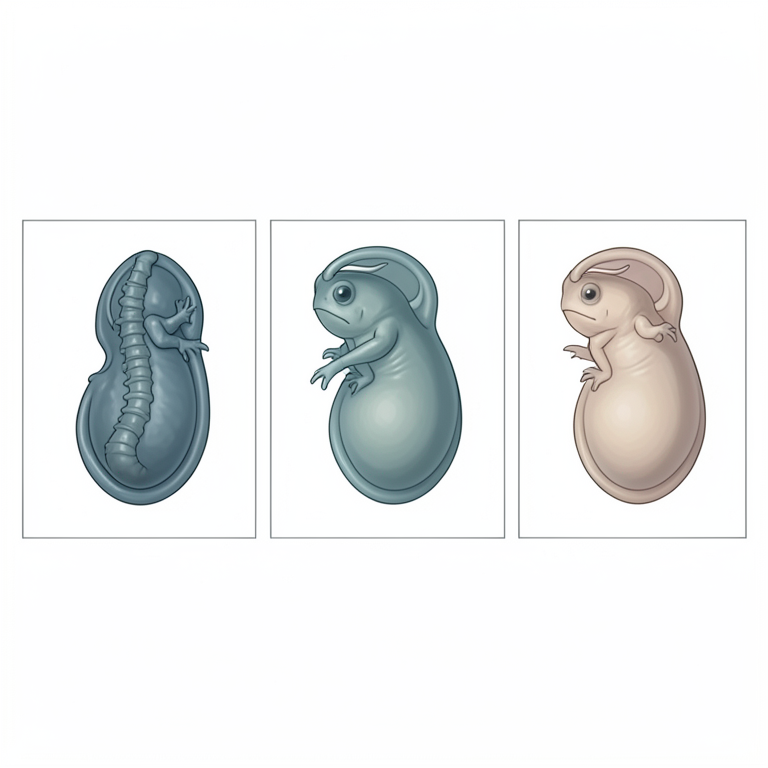
Comparative Potency Ranking
AI-generated conceptual illustration (Xenopus laevis embryos). It explains the idea and does not show study data.
View source evidence ↗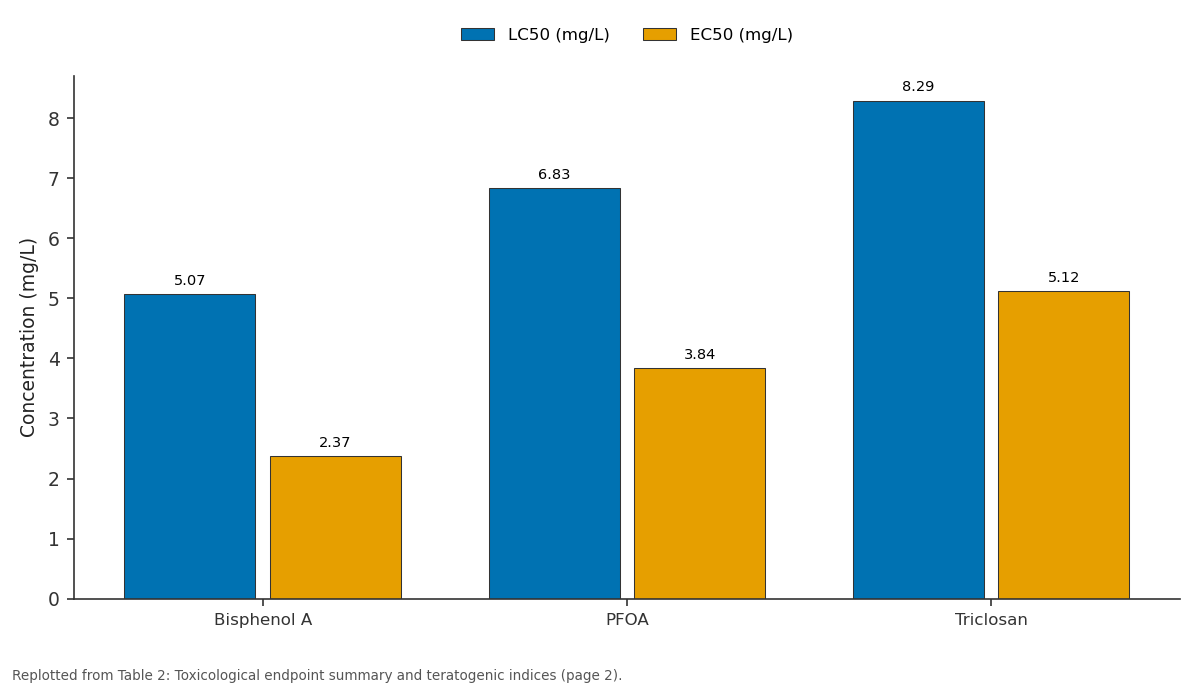
LC50 (mg/L) and EC50 (mg/L): Bisphenol A vs PFOA vs Triclosan
Replotted from Table 2 (page 2) of the original paper. Every bar is the paper's own table value.
View source evidence ↗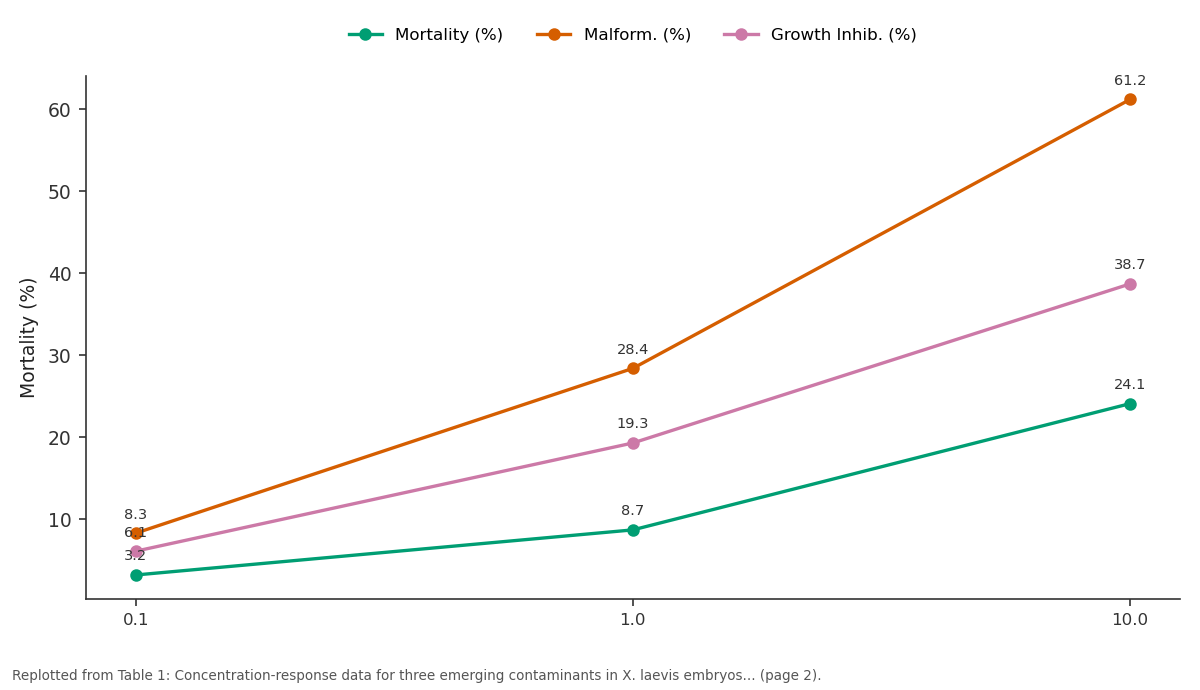
Mortality (%) and Malform. (%) and more: 0.1 vs 1.0 vs 10.0
Replotted from Table 1 (page 2) of the original paper. Every bar is the paper's own table value.
View source evidence ↗Figures & tables
From the original paper Table 1
 Table 2
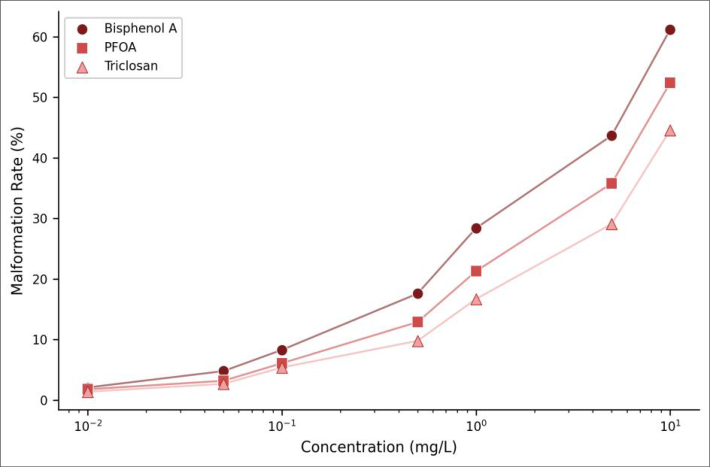 Figure 1
Introduction
The number of synthetic chemicals detected in freshwater systems has grown beyond 100,000 registered compounds, and for the vast majority, developmental toxicity data are absent or incomplete [1] . Among the most frequently detected are bisphenol A, a plasticizer found in food packaging and thermal paper; perfluorooctanoic acid, a surfactant with extreme environmental persistence; and triclosan, an antimicrobial agent formerly common in personal care products [2,3] . Conventional mammalian toxicity testing, while informative, is expensive, time-consuming, and raises ethical concerns when applied at scale [4] . Amphibian embryo bioassaysparticularly using Xenopus laevis-offer an alternative with several advantages: external development allows direct observation of organogenesis, large clutch sizes enable high replication, and the assay can be completed within four days [5] . The Frog Embryo Teratogenesis Assay (FETAX) has been standardized by ASTM International and is accepted by regulatory agencies for screening purposes [6] . Previous FETAX research has examined individual contaminants at high doses, but comparative assessments of multiple emerging contaminants using consistent protocols and endpoints remain sparse [7,8] . Such comparisons are needed to support hazard ranking frameworks that prioritize compounds for regulatory action. This research aimed to evaluate and compare the developmental toxicity of bisphenol A, PFOA, and triclosan using the Xenopus laevis embryo bioassay under standardized conditions at the Hokuriku College of Biological Research, Kanazawa, Japan [9,10] .
Materials and Methods
Materials and Methods
Materials
This research was performed from April through September 2022 at the Department of Morphogenesis, Hokuriku College of Biological Research, Kanazawa, Ishikawa, Japan. The institutional animal care committee approved all procedures involving Xenopus laevis (Protocol No. HCBR-IACUC-2022-031, approved 22 March 2022).
Reagents and Chemicals
Bisphenol A (purity >99%, catalog B0494) and triclosan (purity >97%, catalog PHR1338) were purchased from Sigma-Aldrich (St. Louis, MO, USA). Perfluorooctanoic acid (purity 96%, catalog 171468) was obtained from Sigma-Aldrich. Dimethyl sulfoxide was used as the solvent vehicle at a final concentration of 0.1% (v/v). FETAX solution was prepared following ASTM E1439-12 specifications. Human chorionic gonadotropin for ovulation induction was sourced from Merck (Darmstadt, Germany) .
Methods
Adult Xenopus laevis breeding pairs were maintained in dechlorinated water at 22 ± 1°C with a 12:12 light-dark cycle. Ovulation was induced by injection of 600 IU human chorionic gonadotropin. Embryos were collected, de-jellied in 2% L-cysteine, and staged according to Nieuwkoop and Faber [5] . Healthy embryos at NF stage 8 were selected and randomly assigned to treatment groups. Each contaminant was tested at seven concentrations (0.01, 0.05, 0.1, 0.5, 1.0, 5.0, and 10.0 mg/L) plus a FETAX solution control and a solvent control (0.1% DMSO). Each treatment consisted of 25 embryos in 60 mm glass Petri dishes with 10 mL exposure solution, replicated three times. Solutions were renewed daily. Exposure lasted 96 hours (NF stage 8 to approximately stage 46).
At termination, embryos were fixed in 4% paraformaldehyde, examined under a stereomicroscope (Olympus SZX16, Tokyo, Japan), and scored for mortality, malformation type, and growth inhibition. Head-to-tail length was measured using ImageJ software. LC50 and EC50 values were calculated by probit analysis. The teratogenic index was computed as LC50/EC50.
Quality Control and Calibration
Control mortality was required to remain below 10% per FETAX guidelines; any batch exceeding this threshold was excluded. The stereomicroscope was calibrated with a stage micrometer before each scoring session. Reference toxicant testing with 6-aminonicotinamide was performed monthly to verify assay sensitivity, with acceptable EC50 range of 8 to 16 mg/L [6] . All concentration preparations were verified by weighing on an analytical balance (Mettler Toledo, accuracy ±0.1 mg). Statistical comparisons used one-way ANOVA with Dunnett's post hoc test (p < 0.05) in R version 4.2.1.
Results
Control mortality averaged 4.7% across all batches, well within the 10% FETAX acceptability criterion. Table 1 presents the concentration-response data for each contaminant. Bisphenol A showed the steepest dose-response curve, with malformation rates rising from 2.1% at 0.01 mg/L to 61.2% at 10 mg/L. The most frequent malformations were axial bending (34.8% of affected embryos), pericardial edema (28.3%), and abnormal gut coiling (19.6%). PFOA produced similar malformation types but at lower rates, while triclosan exposure was characterized by growth inhibition preceding overt malformation.
| Contaminant | Conc. (mg/L) | Mortality (%) | Malform. (%) | Growth Inhib. (%) | Head-Tail (mm) | n |
|---|---|---|---|---|---|---|
| BPA | 0.1 | 3.2 | 8.3 | 6.1 | 7.82 | 75 |
| BPA | 1.0 | 8.7 | 28.4 | 19.3 | 6.94 | 75 |
| BPA | 10.0 | 24.1 | 61.2 | 38.7 | 5.41 | 75 |
| PFOA | 0.1 | 2.8 | 6.1 | 4.8 | 7.91 | 75 |
| PFOA | 1.0 | 6.4 | 21.3 | 14.6 | 7.13 | 75 |
| PFOA | 10.0 | 18.3 | 52.4 | 31.2 | 5.87 | 75 |
| Triclosan | 0.1 | 2.4 | 5.4 | 7.3 | 7.74 | 75 |
| Triclosan | 1.0 | 5.1 | 16.7 | 18.4 | 6.88 | 75 |
| Triclosan | 10.0 | 14.6 | 44.6 | 34.9 | 5.62 | 75 |
Table text extracted from the original PDF; superscript letters are shown inline. The original table image is below.
View original table image
Comprehensive Interpretation
All three contaminants produced concentration-dependent developmental effects with teratogenic indices exceeding 1.5, confirming that malformations occurred at sub-lethal concentrations rather than as secondary consequences of general toxicity. Bisphenol A was the most potent teratogen (TI = 2.14), followed by PFOA (TI = 1.78) and triclosan (TI = 1.62). The malformation profiles suggest different mechanisms: BPA and PFOA primarily affected axial patterning and cardiac development, while triclosan appeared to act through growth inhibition pathways. These rankings are consistent with the known endocrine-disrupting potential of BPA and the metabolic disruption properties of triclosan [7,8] .
Discussion
The teratogenic indices obtained in this research-2.14 for bisphenol A, 1.78 for PFOA, and 1.62 for triclosanindicate that all three compounds pose developmental hazards at sub-lethal concentrations. The BPA results align with previous FETAX data reporting EC50 values between 1.5 and 4.2 mg/L depending on exposure duration and embryo staging [7,8] . The malformation profiles provide clues about mechanisms of action. The high incidence of axial bending and cardiac edema with BPA exposure is consistent with its known interaction with estrogen receptors, which play roles in somitogenesis and cardiac morphogenesis in Xenopus [11] . PFOA produced a similar spectrum of defects at higher concentrations, suggesting possible overlap in target pathways despite its primary classification as a peroxisome proliferator-activated receptor agonist [12] .
Triclosan showed a distinct pattern, with growth inhibition appearing before malformations. This sequence may reflect its disruption of thyroid hormone metabolism, since thyroid signaling drives Xenopus growth and metamorphic progression [13] . The lower teratogenic index for triclosan doesn't necessarily imply lower hazard-it indicates that lethal and sub-lethal effects occur at more similar concentrations.
A practical consideration is the ecological relevance of tested concentrations. Environmental monitoring typically reports BPA, PFOA, and triclosan in surface waters at ng/L to low µg/L levels, while the effects observed here occurred at mg/L concentrations [14] . However, the FETAX assay serves primarily as a hazard ranking tool, and the relative ordering of potency remains informative for regulatory prioritization even when absolute concentrations exceed field levels.
Conclusion
This research demonstrated that bisphenol A, PFOA, and triclosan each produce concentration-dependent developmental toxicity in Xenopus laevis embryos, with teratogenic indices confirming that malformations arise at sub-lethal doses. Bisphenol A ranked as the most potent teratogen, followed by PFOA and triclosan. The distinct malformation profiles suggest different underlying mechanisms-endocrine disruption for BPA, metabolic and receptor-mediated effects for PFOA, and thyroid pathway interference for triclosan. The Xenopus embryo bioassay proved effective for comparative hazard ranking of emerging contaminants under standardized conditions. These findings support the inclusion of amphibian developmental assays in tiered testing frameworks for environmental contaminants and provide baseline data for future mixture-toxicity investigations.
Acknowledgement
Acknowledgements Funding SourcesThis research was supported by a grant from the Japan Society for the Promotion of Science and the Ishikawa Prefecture Environmental Research Fund. Institutional SupportThe authors acknowledge the Hokuriku College of Biological Research for providing animal housing facilities and laboratory access.
Figures and tables from the paper
| Compound | LC50 (mg/L) | EC50 (mg/L) | NOEC (mg/L) | LOEC (mg/L) | TI (LC50/EC50) |
|---|---|---|---|---|---|
| Bisphenol A | 5.07 | 2.37 | 0.05 | 0.10 | 2.14 |
| PFOA | 6.83 | 3.84 | 0.05 | 0.10 | 1.78 |
| Triclosan | 8.29 | 5.12 | 0.05 | 0.10 | 1.62 |
Table text extracted from the original PDF; superscript letters are shown inline. The original table image is below.