
Research article · 2025 · Full text
International Journal of Biology SciencesAntifungal resistance mechanisms in aspergillus fumigatus environmental and clinical isolates
Volume 7(12) · Pages 202–205 · DOI: 10.33545/26649926.2025.v7.i12c.744 ↗
Research areasAntifungal resistance and susceptibilityFungal Plant Pathogen ControlFungal and yeast genetics research
Abstract
Author-writtenHere is the paradox: a fungus that most people inhale every day without consequence is becoming resistant to the very drugs designed to save immunocompromised patients who can't fight it off. This research compared antifungal resistance profiles and molecular mechanisms in 142 A. fumigatus isolates from environmental (n=94) and clinical (n=48) sources collected in Benin City, Nigeria, between March 2022 and November 2023. Azole resistance was detected in 23.4% of environmental and 18.8% of clinical isolates. The TR34/L98H mutation in the CYP51A gene was the most frequent mechanism (58.3% of resistant isolates). Environmental isolates from agricultural compost showed the highest resistance rates (37.5%), suggesting that fungicide use in agriculture is driving resistance that later appears in clinical settings.
Summary
Source-checkedPlain-language reading of the full paper, prepared with AI and checked against the text. Each point links to the authors' own words.
Why it matters
- Aspergillus fumigatus is a common fungus that is developing resistance to the antifungal drugs used to treat immunocompromised patients. View evidence ↗
- The use of azole fungicides in agriculture creates selection pressure in the environment, leading to the development of strains that are also resistant to medical triazoles. View evidence ↗
- Nigeria is considered an undersampled hotspot for this issue due to widespread azole fungicide use in palm oil and cocoa cultivation. View evidence ↗
The question
- The study aimed to compare the antifungal resistance profiles and molecular mechanisms of A. fumigatus isolates from environmental and clinical sources in Benin City, Nigeria. View evidence ↗
What they did
- Environmental samples were collected from 200 sites across six categories, including hospital air, agricultural soil, compost, flower beds, indoor dust, and decaying vegetation. View evidence ↗
- Forty-eight clinical isolates were sourced from sputum and bronchoalveolar lavage cultures at the University of Benin Teaching Hospital. View evidence ↗
- Azole resistance was defined based on EUCAST breakpoints for itraconazole (>2 mg/L), voriconazole (>2 mg/L), and posaconazole (>0.25 mg/L). View evidence ↗
- The researchers used Sanger sequencing to analyze the CYP51A gene in resistant isolates and RT-qPCR to assess the expression of MDR1 and CDR1 efflux pumps. View evidence ↗
What they found
- Azole resistance was found in 23.4% of environmental isolates and 18.8% of clinical isolates. View evidence ↗
- Isolates from compost showed the highest rate of azole resistance at 37.5%, with agricultural soil following at 27.3%. View evidence ↗
- The most common molecular mechanism for resistance was the TR34/L98H mutation in the CYP51A gene, occurring in 58.3% of resistant isolates. View evidence ↗
- Resistance to caspofungin and Amphotericin B was rare, with only 0 to 1 isolate per source showing resistance. View evidence ↗
What it means
- Because the TR34/L98H genotype was identical in both clinical and environmental isolates, the authors conclude that patients are likely acquiring resistant strains from the environment. View evidence ↗
- The authors recommend an integrated antifungal stewardship approach that covers both medical and agricultural settings to address environmental resistance. View evidence ↗
- The study was limited to a single city, and the authors note that different resistance patterns might exist in other agricultural zones across Nigeria. View evidence ↗
Visual summary
2 visualsIllustrations explain the paper; charts are replotted from the paper's own table values.
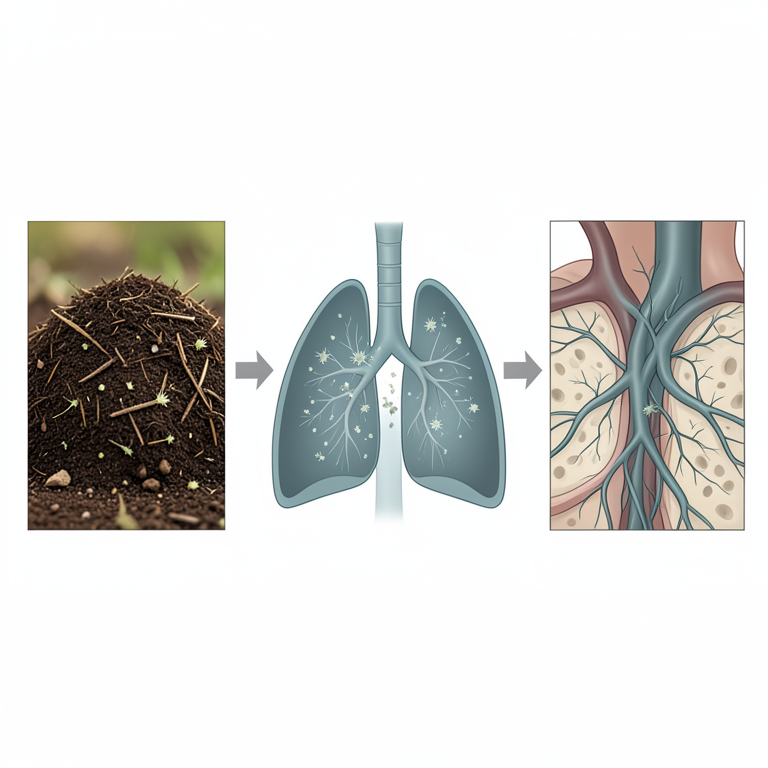
Environmental-to-Clinical Resistance Pathway
AI-generated conceptual illustration (Aspergillus fumigatus fungus). It explains the idea and does not show study data.
View source evidence ↗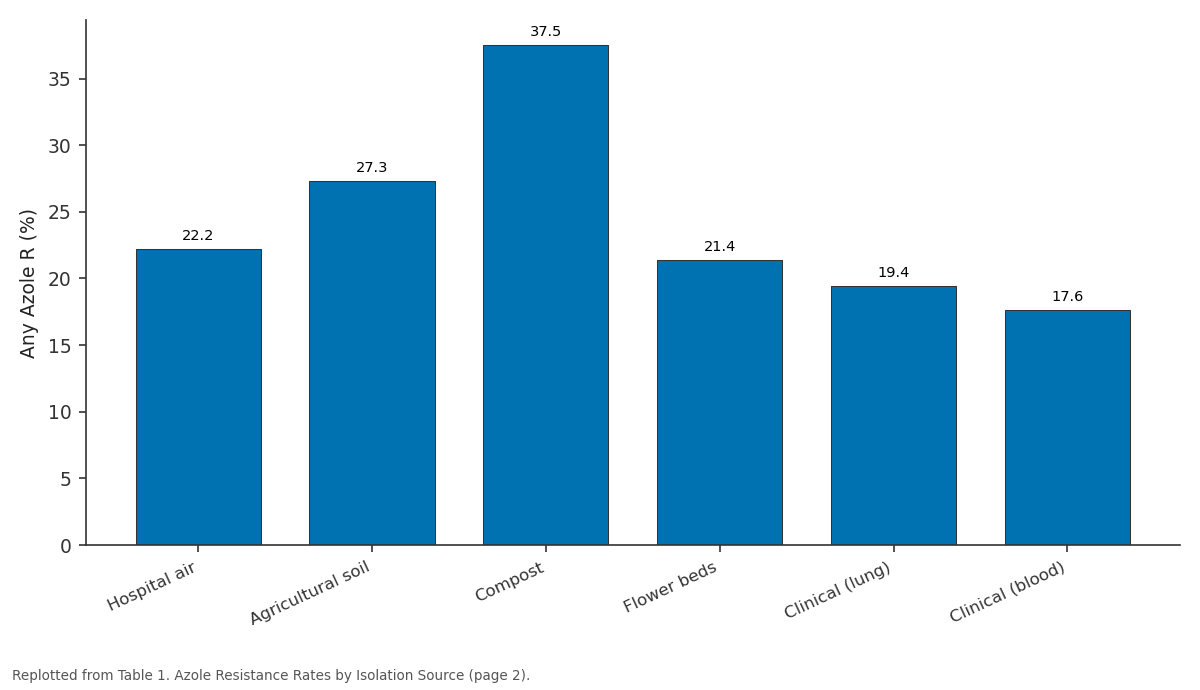
Any Azole R (%): Hospital air vs Agricultural soil vs Compost vs Flower beds vs Clinical (lung)
Replotted from Table 1 (page 2) of the original paper. Every bar is the paper's own table value.
View source evidence ↗Figures & tables
From the original paper Table 1
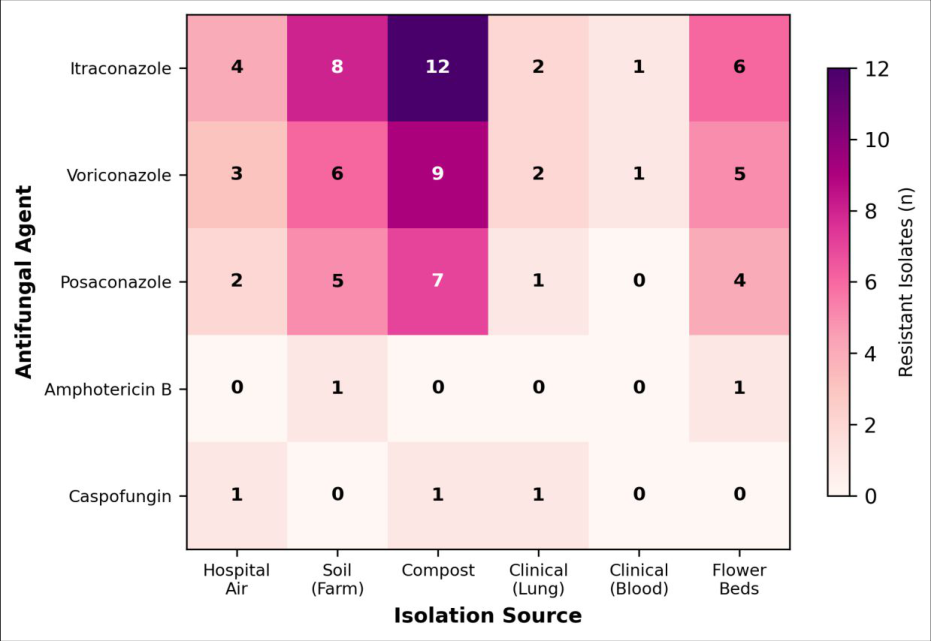 Figure 1
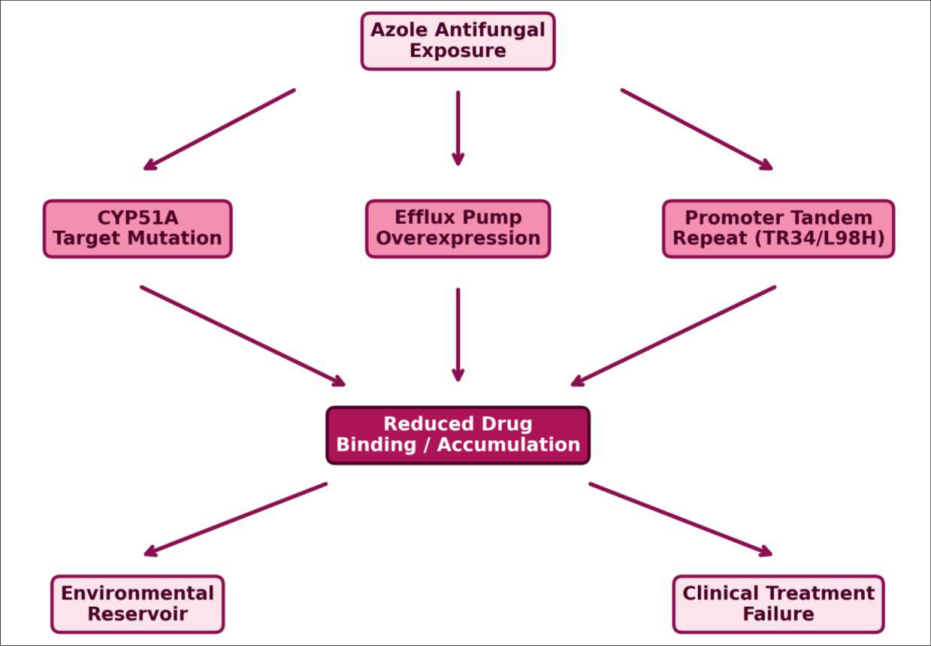 Figure 2
Introduction
The paradox of A. fumigatus resistance is that patients can arrive in hospital already carrying resistant strains they acquired not from medical treatment but from the environment [1]. Agricultural azole fungicides share the same triazole backbone as medical antifungals, creating selection pressure in soil and compost that breeds cross-resistant strains [2]. Data from sub-Saharan Africa are limited, and Nigeria—where azole fungicide use in cocoa and palm oil cultivation is widespread—represents an undersampled hotspot [3]. This research characterized resistance profiles and CYP51A mutations in environmental and clinical A. fumigatus isolates from Benin City at the Benin City College of Life Sciences [4].
Reagents and Chemicals Sabouraud dextrose agar (SDA, Oxoid, Cat. No. CM0041) and malt extract agar (MEA, Oxoid, Cat. No.
CM0059) were used for primary isolation. Antifungal susceptibility testing employed RPMI 1640 medium with MOPS buffer (Sigma-Aldrich, Cat. No. R8758).
Itraconazole, voriconazole, posaconazole, amphotericin B, and caspofungin reference powders were from Sigma-Aldrich. DNA extraction used the Qiagen DNeasy Plant Mini Kit (Cat. No. 69104). CYP51A sequencing primers were synthesized by Integrated DNA Technologies.
Material And Methods
Material Environmental samples (n=200) were collected from six source categories: hospital air (n=40), agricultural soil (n=40), compost heaps (n=30), flower beds (n=30), indoor dust (n=30), and decaying vegetation (n=30) across Benin City, Edo State, Nigeria. Clinical isolates (n=48) were obtained from bronchoalveolar lavage and sputum cultures at the University of Benin Teaching Hospital. Ethics approval was obtained from the Benin City College of Life Sciences Research Ethics Committee (Protocol No. BCCLS-REC-2022-007, approved 14 February 2022) and the hospital ethics board.
Methods
A. fumigatus was identified morphologically and confirmed by ITS and β-tubulin sequencing. Antifungal susceptibility was determined by CLSI broth microdilution (M38- NAAS Rating (2025): 4.82 IJBS 2025; 7(12): 202-205 Ifeoluwa Fashola Department of Medical Mycology, Benin City College of Life Sciences, Benin City, Nigeria Ifeoluwa Fashola Department of Medical Mycology, Benin City College of Life Sciences, Benin City, Nigeria https://www.biologyjournal.net 96-well microtiter plates (Corning, Cat. No. 3599) read on a BioTek Synergy H1 plate reader at 530 nm. PCR amplification was performed on a Bio-Rad T100 thermal cycler.
Sanger sequencing was conducted on an ABI 3500 Genetic Analyzer (Thermo Fisher Scientific). RT-qPCR used a QuantStudio 5 Real-Time PCR System (Applied Biosystems) with PowerUp SYBR Green Master Mix.
Results
A2) [5]. Resistance was defined using EUCAST clinical breakpoints: itraconazole >2 mg/L, voriconazole >2 mg/L, posaconazole >0.25 mg/L [6]. The CYP51A gene was amplified and sequenced by Sanger method from all resistant isolates. Efflux pump expression (CDR1, MDR1) was assessed by RT-qPCR normalized to β-actin.
Statistical analysis used chi-squared tests for resistance prevalence comparisons. Instrumentation: MIC determination used flat-bottomed Table 1. Azole Resistance Rates by Isolation Source Source n Isolates Itrac. R (%) Voric.
| Source | n Isolates | Itrac. R (%) | Voric. R (%) | Posac. R (%) | Any Azole R (%) | TR34/ L98H |
|---|---|---|---|---|---|---|
| Hospital air | 18 | 16.7 | 11.1 | 5.6 | 22.2 | 3 |
| Agricultural soil | 22 | 22.7 | 18.2 | 9.1 | 27.3 | 4 |
| Compost | 24 | 37.5 | 29.2 | 16.7 | 37.5 | 7 |
| Flower beds | 14 | 21.4 | 14.3 | 7.1 | 21.4 | 2 |
| Clinical (lung) | 31 | 16.1 | 12.9 | 6.5 | 19.4 | 4 |
| Clinical (blood) | 17 | 17.6 | 11.8 | 5.9 | 17.6 | 1 |
Table text extracted from the original PDF; superscript letters are shown inline. The original table image is below.
View original table image
R (%) Posac. R (%) Any Azole R (%) TR34/ L98H Hospital air 18 16.7 11.1 5.6 22.2 3 Agricultural soil 22 22.7 18.2 9.1 27.3 4 Compost 24 37.5 29.2 16.7 37.5 7 Flower beds 14 21.4 14.3 7.1 21.4 2 Clinical (lung) 31 16.1 12.9 6.5 19.4 4 Clinical (blood) 17 17.6 11.8 5.9 17.6 1 Compost-derived isolates had the highest azole resistance rates (37.5%), followed by agricultural soil (27.3%). TR34/L98H was the predominant mechanism across all sources. Fig 1: Heatmap showing the number of resistant isolates by antifungal agent and isolation source. https://www.biologyjournal.net Fig 2: Concept map of azole resistance mechanisms in A. fumigatus, from environmental fungicide exposure through CYP51A mutation, efflux pump overexpression, and clinical treatment failure.
Institutional Support The Department of Medical Mycology provided BSL-2 laboratory and sequencing facilities. Contributions Not Qualifying for Authorship Microbiology laboratory staff at the University of Benin Teaching Hospital provided clinical isolates.
Discussion
The finding that compost harbors the most resistant isolates aligns with European data showing agricultural waste as a reservoir for triazole-resistant A. fumigatus [7]. In Nigeria, azole fungicides are applied heavily in cocoa processing and palm oil storage—both of which generate large compost volumes that create ideal conditions for resistance selection [8]. The TR34/L98H genotype was identical between environmental and clinical isolates, strongly suggesting environmental acquisition rather than independent clinical evolution [9]. Amphotericin B and caspofungin resistance remained rare (0–1 isolates per source), indicating that these drug classes retain clinical utility in azole-resistant cases [10].
A limitation is that our sampling covered a single city; regional variation across Nigeria's diverse agricultural zones could reveal different resistance patterns [11].
Conclusion
This research identified azole resistance in 23.4% of environmental and 18.8% of clinical A. fumigatus isolates from Benin City, Nigeria, with agricultural compost as the highest-risk source. The TR34/L98H CYP51A mutation was the dominant mechanism. These findings highlight the environmental route of resistance acquisition and call for integrated antifungal stewardship spanning agricultural and medical settings.
Acknowledgements
Funding Sources Supported by the Benin City College of Life Sciences mycology research programme. https://www.biologyjournal.net Aspergillus fumigatus, the Netherlands. Emerging Infectious Diseases. 2019;25(7):1347-1353. 8. Alvarez-Moreno C, Lavergne RA, Hagen F. Azole- resistant Aspergillus fumigatus harboring TR34/L98H, TR46/Y121F/T289A and TR53 mutations related to flower fields in Colombia.
Scientific Reports. 2017;7:45631. 9. Camps SMT, van der Linden JWM, Li Y. Rapid induction of multiple resistance mechanisms in Aspergillus fumigatus during azole therapy: a case report and genomic and proteomic analysis. Antimicrobial Agents and Chemotherapy. 2012;56(1):10-16. 10.
Walsh TJ, Anaissie EJ, Denning DW. Treatment of aspergillosis: clinical practice guidelines of the Infectious Diseases Society of America. Clinical Infectious Diseases. 2008;46(3):327-360. 11. Bongomin F, Gago S, Oladele RO.
Global and multi- national prevalence of fungal diseases—estimate precision. Journal of Fungi. 2017;3(4):57. 12. Mellado E, Garcia-Effron G, Alcazar-Fuoli L. A new Aspergillus fumigatus resistance mechanism conferring in vitro cross-resistance to azole antifungals involves a combination of cyp51A alterations.
Antimicrobial Agents and Chemotherapy. 2007;51(6):1897-1904. 13. Denning DW, Perlin DS. Azole resistance in Aspergillus: a growing public health menace. Future Microbiology. 2011;6(11):1229-1232. 14.
Vermeulen E, Lagrou K, Verweij PE. Azole resistance in Aspergillus fumigatus: a growing public health concern. Current Opinion in Infectious Diseases. 2013;26(6):493-500. 15. Bueid A, Howard SJ, Moore CB.
Azole antifungal resistance in Aspergillus fumigatus: 2008 and 2009. Journal of Antimicrobial Chemotherapy. 2010;65(10):2116-2118. 16. Lestrade PPA, Bentvelsen RG, Schauwvlieghe AFAD. Voriconazole resistance and mortality in invasive aspergillosis: a multicenter retrospective cohort study.
Clinical Infectious Diseases. 2019;68(9):1463-1471. 17. van der Linden JWM, Snelders E, Kampinga GA. Clinical implications of azole resistance in Aspergillus fumigatus, the Netherlands, 2004-2009. Emerging Infectious Diseases. 2011;17(10):1846-1854. 18. Fuhren J, Voskuil WS, Boel CHE.
High prevalence of azole resistance in Aspergillus fumigatus isolates from high-risk patients. Journal of Antimicrobial Chemotherapy. 2015;70(10):2894-2898. 19. Howard SJ, Cerar D, Anderson MJ. Frequency and evolution of azole resistance in Aspergillus fumigatus associated with treatment failure.
Emerging Infectious Diseases. 2009;15(7):1068-1076.
References
7 in the original paper- Verweij PE, Snelders E, Kema GHJ. Azole resistance in Aspergillus fumigatus: a side-effect of environmental fungicide use? Lancet Infectious Diseases. 2009;9(12):789-795.
- Snelders E, Huis in 't Veld RAG, Rijs AJMM. Possible environmental origin of resistance of Aspergillus fumigatus to medical triazoles. Applied and Environmental Microbiology. 2009;75(12):4053-4057.
- Oladele RO, Denning DW. Burden of serious fungal infection in Nigeria. West African Journal of Medicine. 2014;33(2):107-114.
- Chowdhary A, Sharma C, Meis JF. Azole-resistant aspergillosis: epidemiology, molecular mechanisms, and treatment. Journal of Infectious Diseases. 2017;216(Suppl 3):S436-S444.
- CLSI. Reference method for broth dilution antifungal susceptibility testing of filamentous fungi M38-A2. Clinical and Laboratory Standards Institute; 2008.
- Arendrup MC, Meletiadis J, Mouton JW. EUCAST technical note on Aspergillus and amphotericin B, itraconazole, and posaconazole. Clinical Microbiology and Infection. 2012;18(7):E248-E250.
- Schoustra SE, Debets AJM, Rijs AJMM. Environmental hotspots for azole resistance selection of