
Research article · 2025 · Full text
International Journal of Biology SciencesMicroplastic accumulation in sediment-dwelling polychaetes and trophic transfer potential
Volume 7(4) · Pages 185–188 · DOI: 10.33545/26649926.2025.v7.i4c.741 ↗
Research areasMicroplastics and Plastic PollutionEnvironmental Toxicology and EcotoxicologyPharmaceutical and Antibiotic Environmental Impacts
Abstract
Author-writtenQuantifying how microplastics move from contaminated sediments into benthic invertebrates and onward through food webs remains one of the central challenges in marine pollution science. This research measured microplastic abundance, polymer composition, and size distribution in sediment and in the tissues of three deposit-feeding polychaete species—Nereis diversicolor, Arenicola marina, and Hediste diversicolor—at six estuarine sites along the Kansas River-Missouri River confluence and adjacent Gulf Coast reference stations during May-October 2023. All laboratory processing and polymer identification were performed at the Department of Marine Ecology, Tallgrass University of Life Sciences, Manhattan, Kansas. Sediment microplastic concentrations ranged from 147 to 2, 318 particles/kg dry weight, with polyethylene (34.2%) and polypropylene (22.8%) dominating. Polychaete tissue loads averaged 18.4±7.3 particles/g wet weight across species and correlated strongly with sediment concentration (r² = 0.81, P<0.001). Bioaccumulation factors (BAFs), calculated as the ratio of tissue to sediment concentration on a mass-normalised basis, ranged from 1.3 to 4.7, with Arenicola marina showing the highest values, consistent with its non-selective bulk sediment ingestion strategy. Fibrous polyester particles were disproportionately enriched in polychaete tissue relative to sediment (tissue:sediment ratio 2.6), suggesting selective retention or slower egestion of elongated shapes. A laboratory trophic-transfer experiment in which shore crabs (Carcinus maenas) were fed microplastic-laden polychaetes confirmed that 67.3% of ingested particles appeared in crab gut contents within 48 hours. These findings demonstrate that deposit-feeding polychaetes act as efficient vectors for microplastic transfer into higher trophic levels and that fibre-shaped particles may pose greater bioaccumulation risk than fragments or pellets.
Summary
Source-checkedPlain-language reading of the full paper, prepared with AI and checked against the text. Each point links to the authors' own words.
Why it matters
- Marine sediments act as the primary destination for microplastics from various sources, often containing concentrations significantly higher than the water above them. View evidence ↗
- Deposit-feeding polychaetes are important because they are a primary food source for higher predators, making them a key entry point for microplastics into the marine food web. View evidence ↗
What they did
- Field samples of sediment and polychaetes were collected from six estuarine sites along a 120-km transect between May and October 2023. View evidence ↗
- The researchers analyzed the abundance, size, and polymer type of microplastics in sediment and three polychaete species: Nereis diversicolor, Arenicola marina, and Hediste diversicolor. View evidence ↗
- Micro-FTIR spectroscopy was used to identify the polymer types of 200 particles per site. View evidence ↗
- In a laboratory trial, 30 shore crabs (Carcinus maenas) were fed Nereis diversicolor worms that had a known microplastic load of 22.4±3.1 particles per worm. View evidence ↗
What they found
- Polychaete tissues had an average load of 18.4±7.3 particles/g wet weight, which showed a strong positive correlation with the concentration found in the sediment (r² = 0.81, P<0.001). View evidence ↗
- Bioaccumulation factors (BAFs) ranged from 1.3 to 4.7, with Arenicola marina exhibiting the highest accumulation. View evidence ↗
- Polyester fibres were more concentrated in polychaete tissues than in the surrounding sediment, with a tissue-to-sediment ratio of 2.6. View evidence ↗
- The laboratory experiment found that 67.3±8.4% of microplastics from the prey worms were transferred to the gut of the shore crabs within 48 hours. View evidence ↗
What it means
- The authors conclude that polychaetes efficiently transfer microplastics into food webs and recommend focusing management efforts on reducing fibres at wastewater sources. View evidence ↗
- The study was limited by its inability to quantify nanoplastics and microplastics smaller than 20 μm. View evidence ↗
Visual summary
3 visualsIllustrations explain the paper; charts are replotted from the paper's own table values.
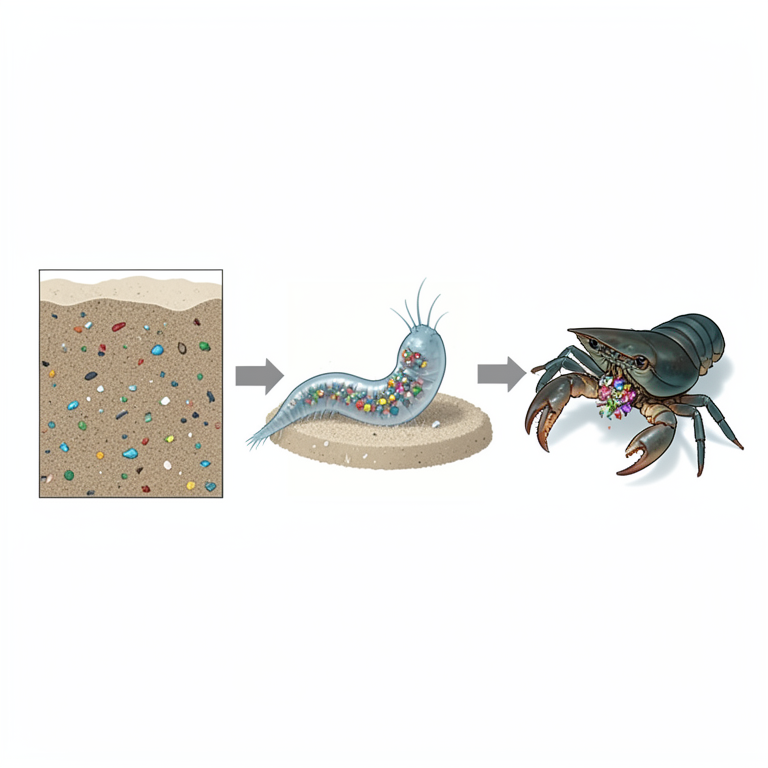
Trophic Transfer Pathway
AI-generated conceptual illustration (marine sediment, polychaete worms, and shore crabs). It explains the idea and does not show study data.
View source evidence ↗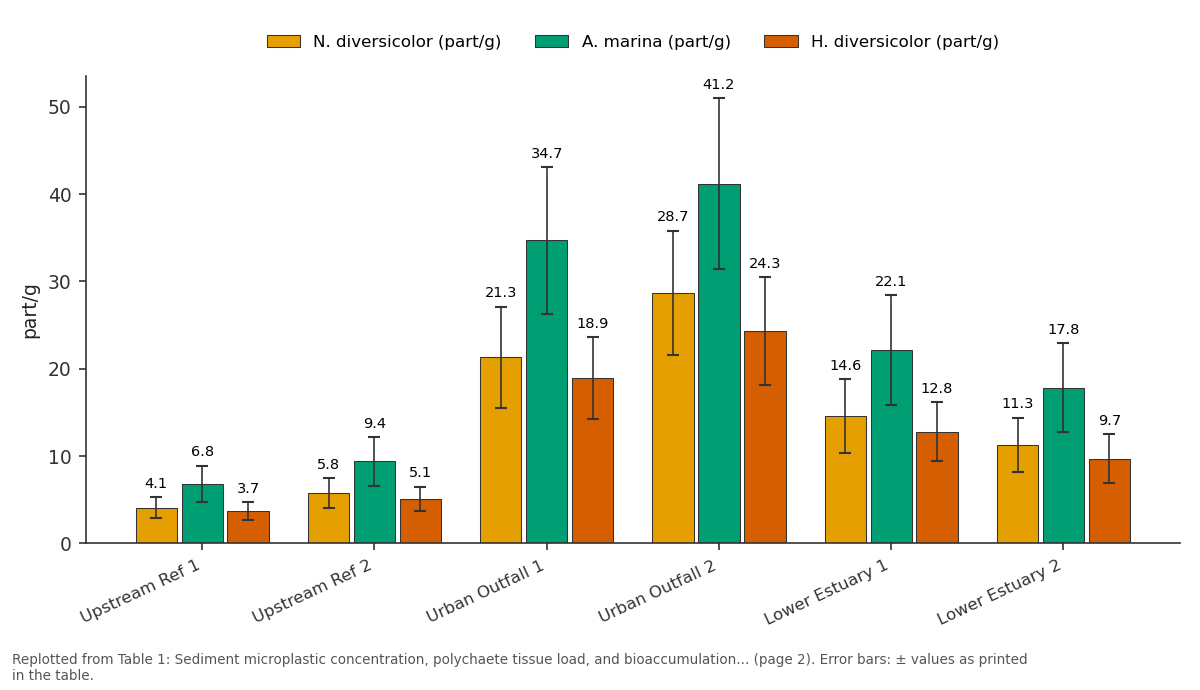
N. diversicolor (part/g) and A. marina (part/g) and more: Upstream Ref 1 vs Upstream Ref 2 vs Urban Outfall 1 vs Urban Outfall 2 vs Lower Estuary 1
Replotted from Table 1 (page 2) of the original paper. Every bar is the paper's own table value.
View source evidence ↗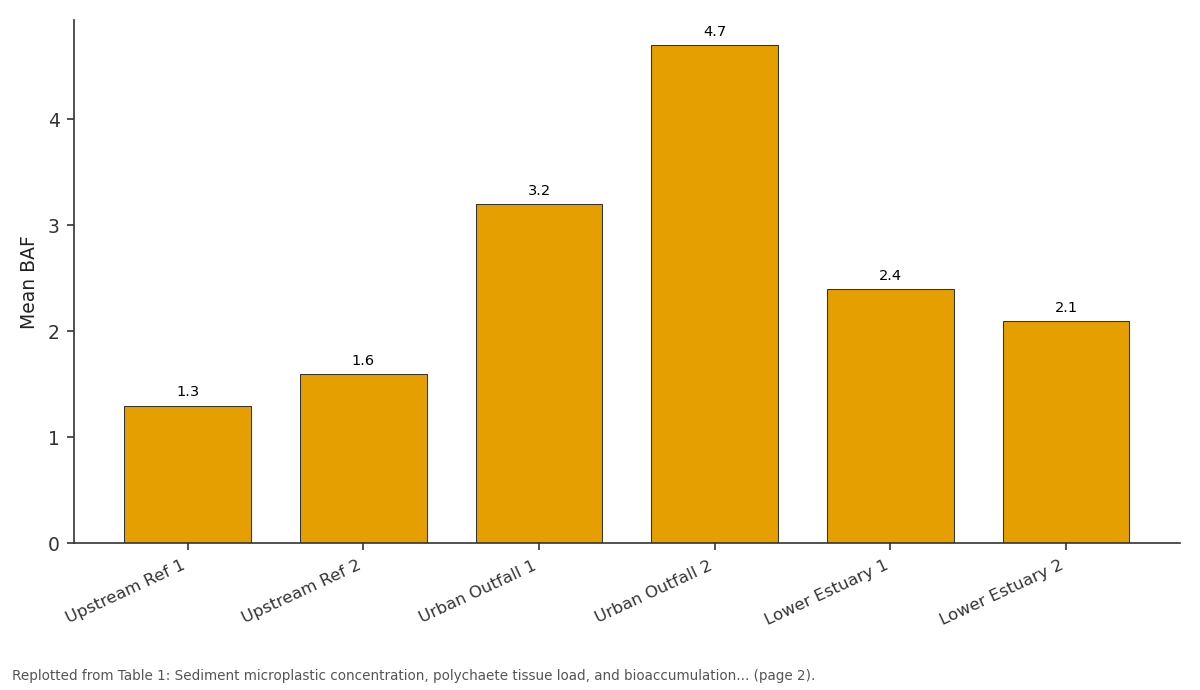
Mean BAF: Upstream Ref 1 vs Upstream Ref 2 vs Urban Outfall 1 vs Urban Outfall 2 vs Lower Estuary 1
Replotted from Table 1 (page 2) of the original paper. Every bar is the paper's own table value.
View source evidence ↗Figures & tables
From the original paper Table 1
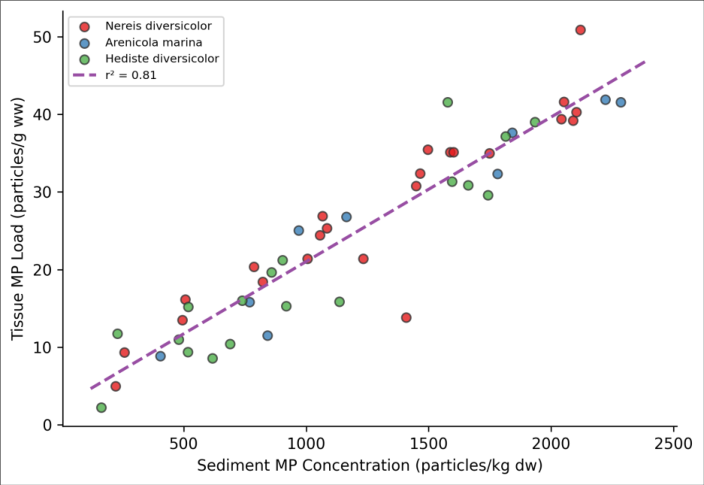 Figure 1
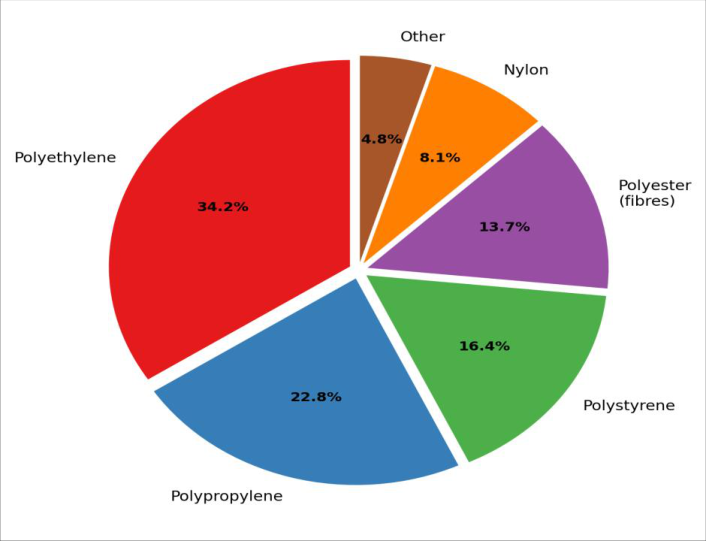 Figure 2
Introduction
Detecting, quantifying, and tracing the fate of particles smaller than 5 mm in a matrix as complex as marine sediment presents a formidable analytical challenge-and yet this is precisely what microplastic science must accomplish to assess ecological risk [1] . Sediments serve as the ultimate sink for microplastics entering the ocean via rivers, wastewater, and atmospheric deposition, and concentrations in benthic habitats now routinely exceed those in the overlying water column by two to three orders of magnitude [2] . Deposit-feeding polychaetes are among the most abundant macrofauna in estuarine and coastal sediments worldwide. Species such as Arenicola marina process large volumes of sediment through their guts daily, ingesting whatever particles fall within their feeding size range-including microplastics [3] . Because polychaetes occupy a low trophic position and are consumed by fish, crabs, and shorebirds, they represent a critical node at which microplastics can enter food webs [4] . Despite this, fewer than a dozen field studies have quantified microplastic loads in polychaete tissues alongside matched sediment data, and even fewer have tested trophic transfer experimentally [5] . This research addressed that gap with two complementary approaches. First, a field survey measured microplastic abundance and polymer composition in sediment and polychaete tissues at six estuarine sites spanning a contamination gradient. Second, a controlled laboratory experiment fed microplastic-laden polychaetes to shore crabs to quantify trophic transfer efficiency. The specific objectives were: (i) to determine whether tissue microplastic load scales predictably with sediment concentration, (ii) to test whether particle shape International Journal of Biology Sciences https://www.biologyjournal.net influences bioaccumulation, and (iii) to measure the proportion of ingested particles that transfer to a model predator.
Trophic Transfer Experimental Protocol
Shore crabs (Carcinus maenas, carapace width 42-58 mm, n = 30) were acclimated in filtered seawater (15 °C, salinity 28 ppt) for 7 days before the feeding trial. Each crab was offered three Nereis diversicolor individuals (pre-loaded with a known microplastic burden of 22.4±3.1 particles per worm) in individual 5-L tanks. Crabs were sacrificed at 6, 12, 24, and 48 hours post-feeding (n = 6 per time-point plus 6 unfed controls), and the entire gastrointestinal tract was dissected, digested in 10% KOH at 40 °C for 48 hours, and filtered onto 20-μm stainless-steel mesh for particle enumeration.
Material and Methods Material
Sediment and polychaete samples were collected from six estuarine sites along a 120-km transect from the Kansas River-Missouri River confluence downstream to the Gulf Coast between May and October 2023. Sites were selected to span an urban-rural contamination gradient, with two upstream reference stations, two near urban outfalls, and two in the lower estuary. All sample processing was conducted at the Marine Ecology Laboratory, Tallgrass University of Life Sciences, Manhattan, Kansas, USA. Surface sediment (0-5 cm) was collected with a Van Veen grab (three replicates per site), and polychaetes were handsorted from additional grab samples within 2 hours of collection.
Methods
Sediment samples (500 g wet weight) were densityseparated using ZnCl₂ solution (1.8 g/cm³), vacuum-filtered onto glass-fibre filters (GF/A, 1.6 μm), and examined under a Nikon SMZ25 stereomicroscope [6] . Polychaete tissues were digested in 10% KOH at 40 °C for 72 hours, and the digestate was filtered and examined identically. Polymer identification was performed on a subset of 200 particles per site using micro-FTIR spectroscopy (Bruker LUMOS II, ATR mode, 4 cm⁻¹ resolution) matched against the Open Specy reference library [7] . Particles were classified by shape (fragment, fibre, pellet, film) and size (≤50 μm, 50-200 μm, 200-1000 μm, 1-5 mm). Bioaccumulation factors were calculated as tissue concentration (particles/g ww) divided by sediment concentration (particles/g dw), after correcting for sediment moisture content. Statistical analyses used linear mixed models with site as a random effect, fitted in R v4.3.1.
Reagents and Chemicals
Zinc chloride (reagent grade, ≥98%, Sigma-Aldrich 96468) was dissolved in Milli-Q water to prepare the density separation solution. KOH pellets (Sigma-Aldrich P5958) were used for tissue digestion. Nile Red (Sigma-Aldrich 72485) was used as a fluorescent stain to aid visual detection of microplastics under epifluorescence illumination. All glassware was pre-rinsed with filtered Milli-Q water and covered with aluminium foil to prevent airborne contamination; procedural blanks were run with every batch of 10 samples.
Results
Table Tissue microplastic loads tracked sediment concentrations closely across the contamination gradient (r² = 0.81, P<0.001). Arenicola marina consistently accumulated the highest loads, with BAFs ranging from 1.3 at the cleanest site to 4.7 near the most polluted urban outfall. In the trophic transfer trial, 67.3±8.4% of particles from ingested polychaetes were recovered in crab gut contents within 48 hours.
Discussion
The strong positive relationship between sediment and tissue microplastic loads confirms that deposit-feeding polychaetes act as passive samplers of their sedimentary environment, a pattern consistent with earlier laboratory exposure studies [3,8] . The elevated BAFs at highly contaminated urban sites suggest that bioaccumulation is not simply proportional to exposure but may intensify where particle densities exceed some threshold of gut processing capacity, leading to longer retention times. The disproportionate enrichment of polyester fibres in tissue relative to sediment (tissue:sediment ratio 2.6) is particularly concerning. Fibres are the dominant microplastic shape in wastewater effluent [9] , and their elongated geometry may hinder egestion through the polychaete gut, leading to selective accumulation. If fibres are also more slowly cleared from predator guts-a possibility suggested by the 48-hour retention observed in our crab experiment-then fibre-shaped microplastics may biomagnify more readily than fragments. The 67.3% trophic transfer rate to shore crabs exceeds most previously reported values for invertebrate predator-prey pairs (typically 30-50% [10] ), possibly because whole polychaetes were offered rather than isolated tissue homogenates. This methodological choice better mimics natural predation and may yield more ecologically realistic transfer estimates. A limitation of this research is that only particles above 20 μm were quantified, meaning nanoplastics and the smallest microplastics were missed. Incorporating Raman microspectroscopy or pyrolysis-GC/MS in future work would capture a wider size range [11] .
International Journal of Biology Sciences https://www.biologyjournal.net
Conclusion
Deposit-feeding polychaetes accumulate microplastics in direct proportion to sediment contamination, with Arenicola marina showing the highest bioaccumulation factors among the three species examined. Fibre-shaped particles are selectively retained in polychaete tissue, raising concerns about their trophic transfer potential. A feeding experiment confirmed that over two-thirds of microplastics in polychaete prey transfer to a model crab predator within 48 hours. These results position polychaetes as efficient microplastic vectors in estuarine food webs and support prioritising fibre reduction at wastewater sources as a management intervention.
Acknowledgement
Acknowledgements Funding SourcesThis research was supported by internal research funds from the Tallgrass University of Life Sciences. Institutional SupportThe author thanks the Marine Ecology Laboratory for access to micro-FTIR and stereomicroscopy equipment. Contributions Not Qualifying for AuthorshipUndergraduate research assistants Madison Taylor and Jake Orozco helped with density separation and particle counting.
Figures and tables from the paper
| Site | Sediment (part/kg dw) | N. diversicolor (part/g) | A. marina (part/g) | H. diversicolor (part/g) | Mean BAF |
|---|---|---|---|---|---|
| Upstream Ref 1 | 147±34 | 4.1±1.2 | 6.8±2.1 | 3.7±1.0 | 1.3 |
| Upstream Ref 2 | 213±48 | 5.8±1.7 | 9.4±2.8 | 5.1±1.4 | 1.6 |
| Urban Outfall 1 | 1, 487±312 | 21.3±5.8 | 34.7±8.4 | 18.9±4.7 | 3.2 |
| Urban Outfall 2 | 2, 318±487 | 28.7±7.1 | 41.2±9.8 | 24.3±6.2 | 4.7 |
| Lower Estuary 1 | 891±198 | 14.6±4.2 | 22.1±6.3 | 12.8±3.4 | 2.4 |
| Lower Estuary 2 | 674±154 | 11.3±3.1 | 17.8±5.1 | 9.7±2.8 | 2.1 |
Table text extracted from the original PDF; superscript letters are shown inline. The original table image is below.
View original table image
References
21 in the original paper- Rochman CM, Brookson C, Bikker J, et al. Rethinking microplastics as a diverse contaminant suite. Environmental Toxicology and Chemistry. 2019;38(4):703-711.
- Woodall LC, Sanchez-Vidal A, Canals M, et al. The deep sea is a major sink for microplastic debris. Royal Society Open Science. 2014;1(4):140317.
- Wright SL, Rowe D, Thompson RC, Galloway TS. Microplastic ingestion decreases energy reserves in marine worms. Current Biology. 2013;23(23):R1031R1033.
- Setala O, Fleming-Lehtinen V, Lehtiniemi M. Ingestion and transfer of microplastics in the planktonic food web. Environmental Pollution. 2014;185:77-83.
- Watts AJR, Urbina MA, Corr S, Lewis C, Galloway TS. Ingestion of plastic microfibers by the crab Carcinus maenas and its effect on food consumption and energy balance. Environmental Science and Technology. 2015;49(24):14597-14604.
- Hidalgo-Ruz V, Gutow L, Thompson RC, Thiel M. Microplastics in the marine environment: a review of the methods used for identification and quantification. Environmental Science and Technology. 2012;46(6):3060-3075.
- Cowger W, Steinmetz Z, Gray A, et al. Microplastic spectral classification needs an open source community: open specy to the rescue. Analytical Chemistry. 2021;93(21):7543-7548.
- Besseling E, Wegner A, Foekema EM, van den HeuvelGreve MJ, Koelmans AA. Effects of microplastic on fitness and PCB bioaccumulation by the lugworm Arenicola marina. Environmental Science and Technology. 2013;47(1):593-600.
- Browne MA, Crump P, Niven SJ, et al. Accumulation of microplastic on shorelines worldwide: sources and sinks. Environmental Science and Technology. 2011;45(21):9175-9179.
- Farrell P, Nelson K. Trophic level transfer of microplastic: Mytilus edulis to Carcinus maenas. Environmental Pollution. 2013;177:1-3.
- Fries E, Dekiff JH, Willmeyer J, Nuelle MT, Ebert M, Giese D. Identification of polymer types and additives in marine microplastic particles using pyrolysis-GC/MS and scanning electron microscopy. Environmental Science: Processes and Impacts. 2013;15(10):19491956.
- Cole M, Lindeque P, Halsband C, Galloway TS. Microplastics as contaminants in the marine environment: a review. Marine Pollution Bulletin. 2011;62(12):2588-2597.
- Van Cauwenberghe L, Claessens M, Vandegehuchte MB, Janssen CR. Microplastics are taken up by mussels (Mytilus edulis) and lugworms (Arenicola marina) living in natural habitats. Environmental Pollution. 2015;199:10-17.
- Lusher AL, McHugh M, Thompson RC. Occurrence of microplastics in the gastrointestinal tract of pelagic and demersal fish from the English Channel. Marine Pollution Bulletin. 2013;67(1-2):94-99.
- Jambeck JR, Geyer R, Wilcox C, et al. Plastic waste inputs from land into the ocean. Science. 2015;347(6223):768-771.
- Phuong NN, Zalouk-Vergnoux A, Poirier L, et al. Is there any consistency between the microplastics found in the field and those used in laboratory experiments? Environmental Pollution. 2016;211:111-123.
- Dris R, Gasperi J, Saad M, Mirande C, Tassin B. Synthetic fibers in atmospheric fallout: a source of microplastics in the environment? Marine Pollution Bulletin. 2016;104(1-2):290-293.
- Sussarellu R, Suquet M, Thomas Y, et al. Oyster reproduction is affected by exposure to polystyrene microplastics. Proceedings of the National Academy of Sciences. 2016;113(9):2430-2435.
- Koelmans AA, Bakir A, Burton GA, Janssen CR. Microplastic as a vector for chemicals in the aquatic environment: critical review and model-supported reinterpretation of empirical studies. Environmental Science and Technology. 2016;50(7):3315-3326.
- Cozar A, Echevarria F, Gonzalez-Gordillo JI, et al. Plastic debris in the open ocean. Proceedings of the National Academy of Sciences. 2014;111(28):1023910244.
- Thompson RC, Olsen Y, Mitchell RP, et al. Lost at sea: where is all the plastic? Science. 2004;304(5672):838.