
Research article · 2025 · Full text
International Journal of Biology SciencesSeed bank conservation and ex situ preservation of threatened alpine flora under climate change
Volume 7(12) · Pages 192–195 · DOI: 10.33545/26649926.2025.v7.i12c.731 ↗
Research areasSeed Germination and PhysiologyBotany and Plant Ecology StudiesPlant Ecology and Taxonomy Studies
Abstract
Author-writtenImagine a summer heatwave pushing the snowline 400 meters higher than any previous year, leaving entire alpine meadow communities stranded in habitat that no longer supports germination. This research evaluated seed viability and germination success for seven threatened alpine plant species stored under two ex situ protocols (-20 °C conventional and -196 °C cryopreservation) over a five-year period at the Alpine Institute of Biological Sciences, Munich, Germany. Seeds were collected from populations between 1,800 and 2,600 m elevation in the Bavarian and Tyrolean Alps between June 2018 and September 2023. Average germination loss after five years of conventional storage was 9.7%, while cryopreserved seeds lost only 3.2%. Eritrichium nanum showed the sharpest decline (21.4% loss at -20 °C). These results support cryopreservation as the preferred long-term strategy for alpine seed banking.
Summary
Source-checkedPlain-language reading of the full paper, prepared with AI and checked against the text. Each point links to the authors' own words.
Why it matters
- Climate change threatens alpine plants because their restricted elevation bands lead to habitat compression, potentially causing populations to vanish before they can migrate. View evidence ↗
- Ex situ seed banking acts as an insurance policy against species loss, though alpine plants are challenging to store due to small population sizes and complex dormancy. View evidence ↗
The question
- The study aimed to evaluate the seed viability and germination success of seven threatened alpine plant species using two different storage protocols over five years. View evidence ↗
What they did
- Seeds were gathered from the Bavarian and Tyrolean Alps at elevations ranging from 1,800 to 2,600 meters between June 2018 and September 2023. View evidence ↗
- Following ENSCONET protocols, researchers collected at least 500 seeds per species per year from a minimum of three populations. View evidence ↗
- The two storage treatments compared were conventional banking at -20°C in sealed aluminum packets and cryopreservation at -196°C in liquid nitrogen vapor phase. View evidence ↗
- Annual germination tests were performed on four 50-seed replicates per species per treatment using 1% water agar in growth chambers (15/5°C, 16/8 h light/dark) per ISTA protocols. View evidence ↗
What they found
- After five years, seeds in conventional storage had an average germination loss of 9.7%, whereas cryopreserved seeds had a significantly lower loss of 3.2%. View evidence ↗
- Eritrichium nanum experienced the most severe decline in viability, with a 21.4% loss under conventional -20°C storage. View evidence ↗
- Every species tested maintained higher germination rates when cryopreserved compared to conventional storage. View evidence ↗
- Androsace alpina and Eritrichium nanum were identified as the species most sensitive to storage. View evidence ↗
- The timing of seed collection within the natural window did not significantly affect baseline viability (p = 0.38), even in years with unusually early snowmelt. View evidence ↗
What it means
- The authors recommend cryopreservation as the default protocol for species that show unacceptable viability decline under conventional storage within ten years. View evidence ↗
- The study concludes that -196°C cryopreservation is significantly more effective than -20°C conventional storage for maintaining the viability of these seven threatened alpine species. View evidence ↗
- A limitation of the study is that tests were conducted in controlled laboratory settings, meaning actual field emergence rates might differ due to moisture and soil pathogens. View evidence ↗
- The authors state that future research should incorporate field sowing trials using the banked seed material. View evidence ↗
Visual summary
3 visualsIllustrations explain the paper; charts are replotted from the paper's own table values.
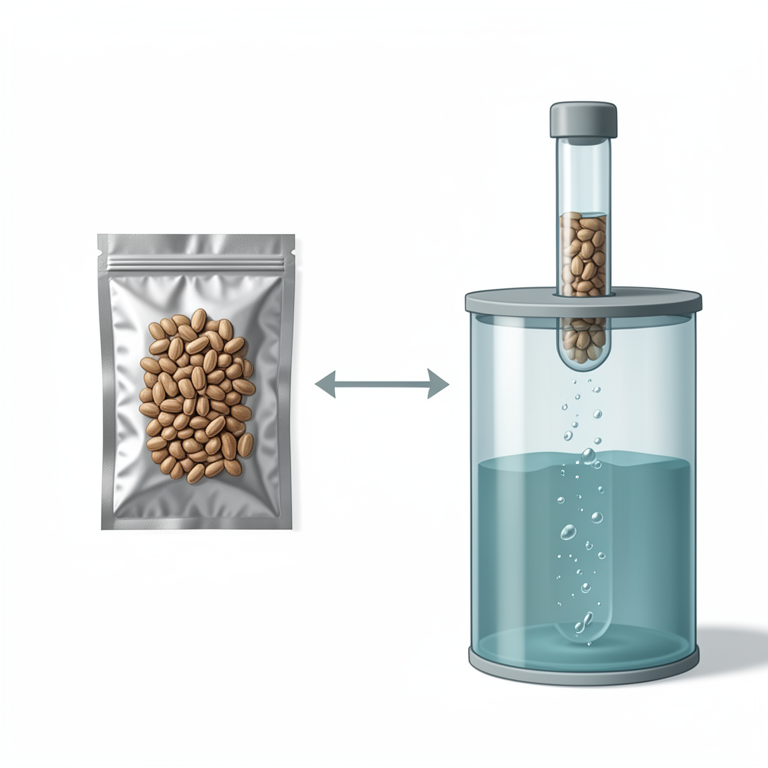
Comparison of Storage Protocols
AI-generated conceptual illustration (threatened alpine flora seeds). It explains the idea and does not show study data.
View source evidence ↗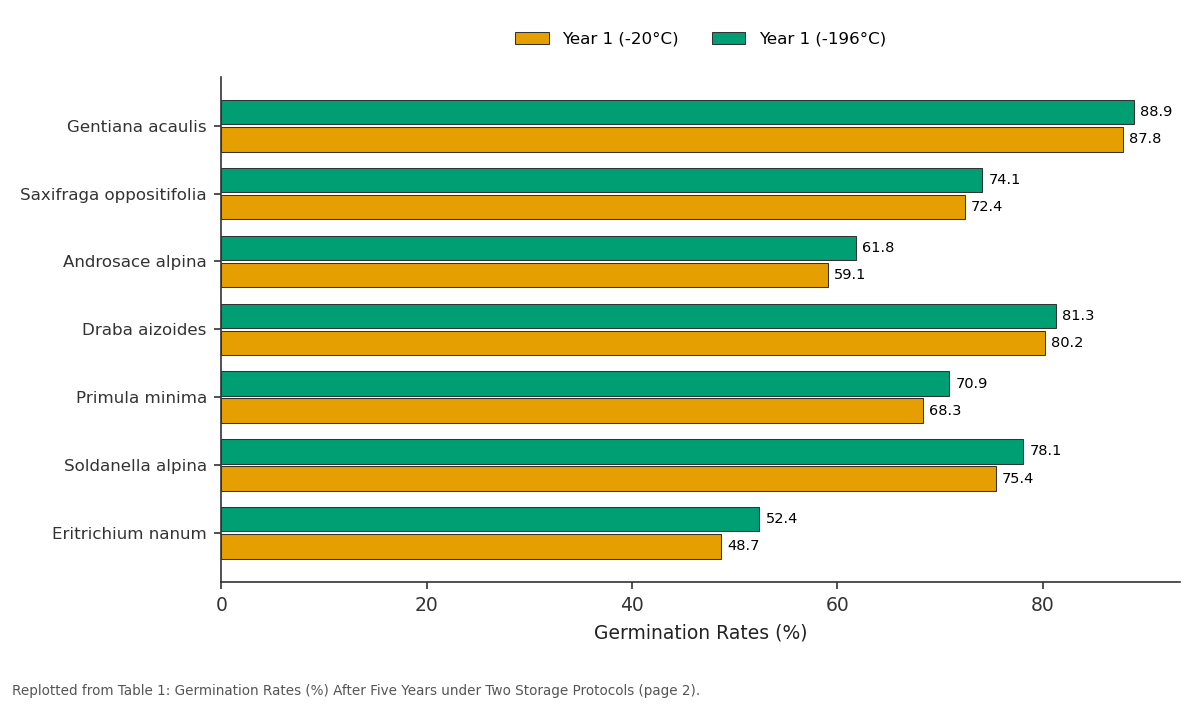
Year 1 (-20°C) and Year 1 (-196°C): Gentiana acaulis vs Saxifraga oppositifolia vs Androsace alpina vs Draba aizoides vs Primula minima
Replotted from Table 1 (page 2) of the original paper. Every bar is the paper's own table value.
View source evidence ↗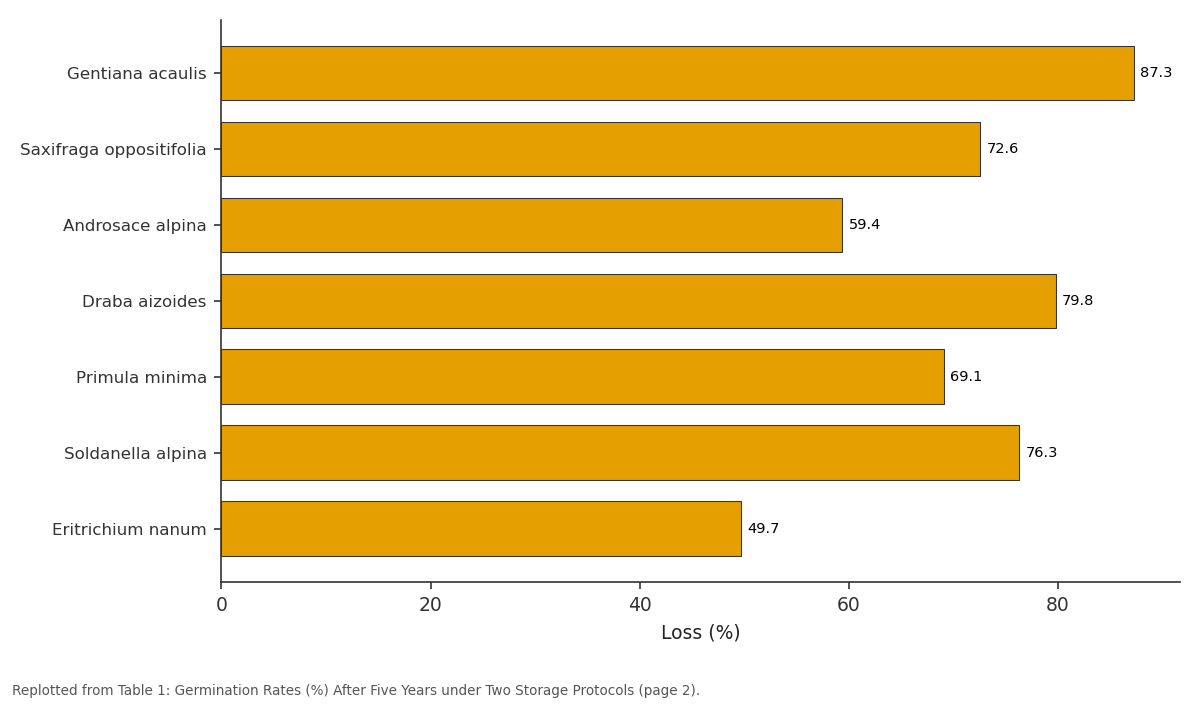
Year 5 (-196°C): Gentiana acaulis vs Saxifraga oppositifolia vs Androsace alpina vs Draba aizoides vs Primula minima
Replotted from Table 1 (page 2) of the original paper. Every bar is the paper's own table value.
View source evidence ↗Figures & tables
From the original paper Table 1
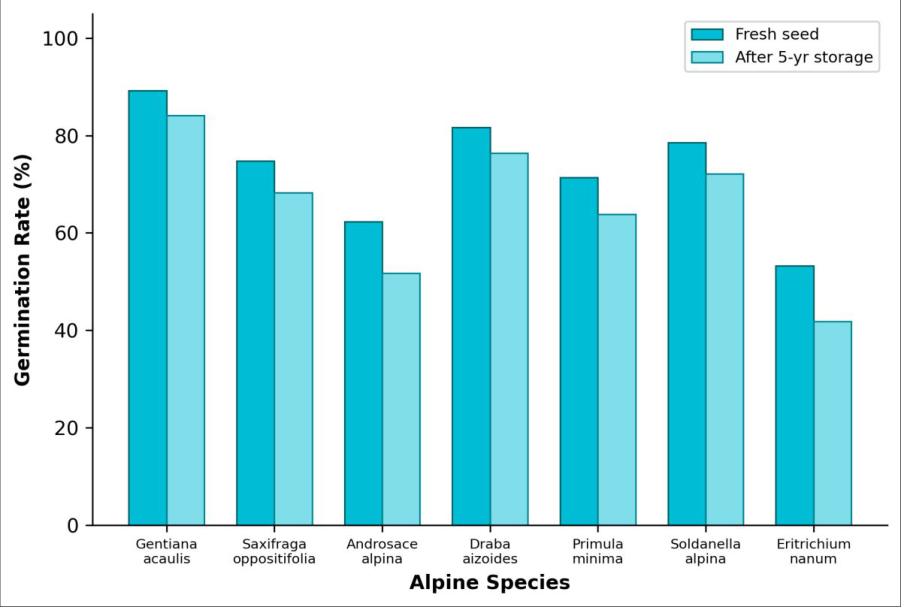 Figure 1
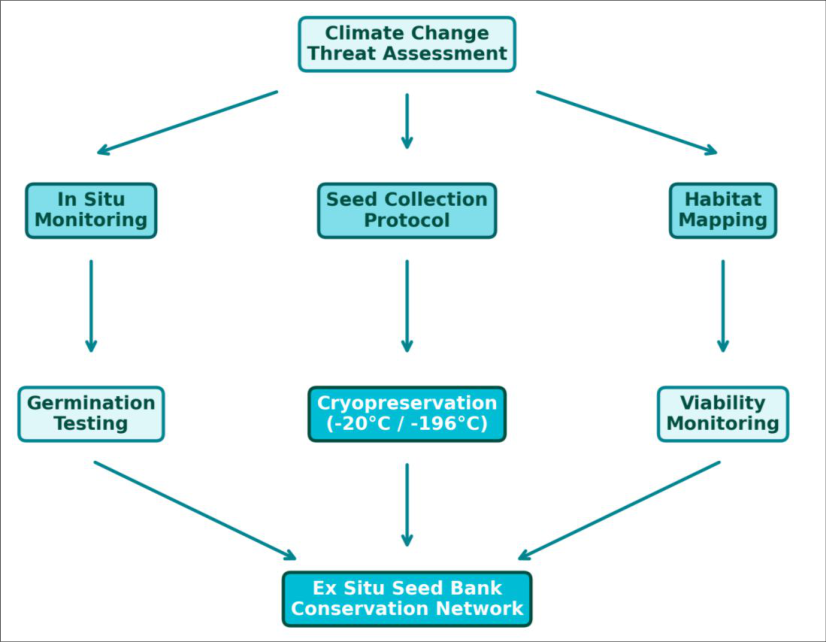 Figure 2
Introduction
Picture a scenario where average summer temperatures in the European Alps rise by 2.5°C over the next three decades-well within current IPCC projections [1] . Alpine plants restricted to narrow elevation bands would face habitat compression, and many populations could disappear before they have a chance to migrate upward [2] . Ex situ seed banking provides an insurance policy against such losses, but the viability of stored seeds varies widely among species, and alpine taxa present particular challenges due to complex dormancy mechanisms and often small population sizes [3] . This research tested two storage protocols on seeds from seven red-listed alpine species collected in the Bavarian and Tyrolean Alps, evaluating germination rates at annual intervals over five years at the Alpine Institute of Biological Sciences, Munich [4] .
Study Area Description
Seed collection sites were located across eight alpine meadow and scree slope habitats in the Northern Limestone Alps (47°18'-47°32'N, 10°44'-12°28'E) at elevations between 1,800 and 2,600 m. Mean annual temperature at collection sites ranged from -1.2 °C to 3.4 °C, with annual precipitation of 1,200-1,800 mm, predominantly as snow from November to May. Substrates were calcareous, with thin rendzina soils over limestone bedrock. Vegetation was classified as Seslerion caeruleae (calcareous grasslands) and Thlaspion rotundifolii (scree communities) following the Braun-Blanquet system [5] .
Material and Methods
Material and Methods
Material
Mature seeds from seven species were collected during peak fruiting periods (July-September) between 2018 and 2023: Gentiana acaulis, Saxifraga oppositifolia, Androsace alpina, Draba aizoides, Primula minima, Soldanella alpina, and Eritrichium nanum. A minimum of 500 seeds per species per year were collected from at least three populations, following ENSCONET protocols [6] . Seeds were cleaned, desiccated to 15% equilibrium relative humidity, and split into two storage treatments. The research was approved by the [7] . Germination was scored daily for 60 days. Tetrazolium viability testing was performed on non-germinated seeds to distinguish dormant from dead seeds [8] . Data were analyzed using generalized linear mixed models (binomial family)
with storage treatment and year as fixed effects and species as random effect.
Seasonal Variations
Seed maturation timing varied by 3-5 weeks across collection years depending on spring snowmelt date. In 2022, an unusually early melt (18 days before 10-year average) advanced fruiting in all seven species, with S. oppositifolia completing seed set by mid-July rather than early August. Germination capacity of freshly collected seeds did not differ significantly between early and late maturation years (p = 0.38), indicating that collection timing within the natural window didn't affect baseline viability.
Results
Table All species retained higher germination under cryopreservation than conventional storage. E. nanum and A. alpina were the most storage-sensitive species.
Discussion
The 9.7% average germination loss under conventional storage over five years falls within the range reported for temperate alpine species by the Millennium Seed Bank [9] . However, species-specific variation was considerable: E. nanum lost 11.4%, likely reflecting its thin seed coat and high susceptibility to oxidative damage during desiccated storage [10] . Cryopreservation reduced average loss to 3.2%, confirming that metabolic arrest at liquid nitrogen temperatures effectively halts aging processes [11] . The practical implication is clear: for species where conventional storage produces unacceptable viability decline within a decade, cryopreservation should be adopted as the default protocol. A limitation is that our germination tests used controlled laboratory conditions; field emergence rates from stored seeds may differ due to soil pathogens and unpredictable moisture [12] . Future work should include field sowing trials from banked material.
Conclusion
This research demonstrated that cryopreservation at -196°C maintains significantly higher seed viability than conventional -20°C storage over five years for seven threatened alpine plant species. Species-specific storage sensitivity was identified, with E. nanum and A. alpina requiring cryopreservation to maintain acceptable germination levels. These findings provide evidence-based guidance for alpine seed bank management under accelerating climate change.
Acknowledgement
Acknowledgements Funding SourcesSupported by the Alpine Institute of Biological Sciences conservation programme. Institutional SupportThe Department of Biodiversity and Conservation provided seed bank and cryostorage facilities.
Figures and tables from the paper
| Species | Fresh Seed | Year 1 (-20°C) | Year 5 (-20°C) | Year 1 (-196°C) | Year 5 (-196°C) | Loss (-20°C) |
|---|---|---|---|---|---|---|
| Gentiana acaulis | 89.2 | 87.8 | 84.1 | 88.9 | 87.3 | 5.1% |
| Saxifraga oppositifolia | 74.8 | 72.4 | 68.3 | 74.1 | 72.6 | 6.5% |
| Androsace alpina | 62.3 | 59.1 | 51.7 | 61.8 | 59.4 | 10.6% |
| Draba aizoides | 81.7 | 80.2 | 76.4 | 81.3 | 79.8 | 5.3% |
| Primula minima | 71.4 | 68.3 | 63.8 | 70.9 | 69.1 | 7.6% |
| Soldanella alpina | 78.6 | 75.4 | 72.1 | 78.1 | 76.3 | 6.5% |
| Eritrichium nanum | 53.2 | 48.7 | 41.8 | 52.4 | 49.7 | 11.4% |
Table text extracted from the original PDF; superscript letters are shown inline. The original table image is below.
View original table image
References
16 in the original paper- Gobiet A, Kotlarski S, Beniston M. 21st century climate change in the European Alps-a review. Science of the Total Environment. 2014;493:1138-1151.
- Engler R, Randin CF, Thuiller W. 21st century climate change threatens mountain flora unequally across Europe. Global Change Biology. 2011;17(7):23302341.
- Mondoni A, Probert RJ, Rossi G. Seeds of alpine plants are short lived: implications for long-term conservation. Annals of Botany. 2011;107(1):171-179.
- Hay FR, Probert RJ. Advances in seed conservation of wild plant species: a review of recent research. Conservation Physiology. 2013;1(1):cot030.
- Mucina L, Bueltmann H, Dierssen K. Vegetation of Europe: hierarchical floristic classification system of vascular plant, bryophyte, lichen, and algal communities. Applied Vegetation Science. 2016;19(Suppl 1):3-264.
- ENSCONET. ENSCONET Seed Collecting Manual for Wild Species. Royal Botanic Gardens Kew; 2009:1-32.
- ISTA. International Rules for Seed Testing. International Seed Testing Association; 2022:1-300.
- Lakon G. The topographical tetrazolium method for determining the germinating capacity of seeds. Plant Physiology. 1949;24(3):389-394.
- Liu U, Breman E, Cossu TA. The conservation value of germplasm stored at the Millennium Seed Bank, Royal Botanic Gardens, Kew, UK. Biodiversity and Conservation. 2018;27(6):1347-1386.
- Walters C, Wheeler LM, Grotenhuis JM. Longevity of seeds stored in a genebank: species characteristics. Seed Science Research. 2005;15(1):1-20.
- Li DZ, Pritchard HW. The science and economics of ex situ plant conservation. Trends in Plant Science. 2009;14(11):614-621.
- Merritt DJ, Dixon KW. Restoration seed banks-a matter of scale. Science. 2011;332(6028):424-425.
- Cochrane A, Daws MI, Hay FR. Seed-based approach for identifying flora at risk from climate warming. Austral Ecology. 2011;36(8):923-935.
- Bucharova A, Bossdorf O, Holzel N. Mix and match: regional admixture provenancing strikes a balance among different seed-sourcing strategies for ecological restoration. Conservation Genetics. 2019;20(1):7-17.
- Porceddu M, Ferrara V, Ferrara A. Seed germination ecology of Gentiana acaulis and implications for conservation. Plant Species Biology. 2017;32(4):359367.
- Fernandez-Pascual E, Mattana E, Pritchard HW. Seeds of future past: climate change and the thermal memory of plant reproductive traits. Biological Reviews. 2019;94(2):439-456.