
Research article · 2025 · Full text
International Journal of Biology SciencesPhylogenetic analysis and species delimitation of cryptic gecko species complex using integrative taxonomy
Volume 7(11) · Pages 149–151 · DOI: 10.33545/26649926.2025.v7.i11c.719 ↗
Research areasAmphibian and Reptile BiologyInvertebrate Taxonomy and EcologyGenetic diversity and population structure
Abstract
Author-writtenIn the hills of northeast India, what was once thought to be a single widespread gecko species may actually be a complex of several distinct lineages hiding behind nearly identical appearances. This research applied integrative taxonomy—combining molecular phylogenetics, morphometrics, and species delimitation algorithms—to resolve the Cyrtodactylus khasiensis species complex from northeastern India. Tissue samples from 127 specimens across 24 localities in Mizoram, Meghalaya, and Nagaland were sequenced for two mitochondrial (ND2, cytb) and two nuclear (RAG1, CMOS) markers at the Mizoram College of Biosciences, Aizawl, from July 2023 to November 2024. Bayesian phylogenetic analysis recovered seven well-supported clades with inter-clade genetic distances of 5.3-7.8% at ND2. Four species delimitation methods (ABGD, bPTP, GMYC, and BPP) converged on recognizing five to seven species-level lineages. Morphometric analysis of 23 scalation and mensural characters supported the genetic groupings, with the highland and island clades showing the most distinctive morphological profiles. These results suggest that gecko diversity in northeast India is substantially underestimated and that at least four undescribed species await formal description.
Summary
Source-checkedPlain-language reading of the full paper, prepared with AI and checked against the text. Each point links to the authors' own words.
Why it matters
- The gecko genus Cyrtodactylus is globally one of the most species-rich and taxonomically difficult reptile groups, containing more than 300 described species. View evidence ↗
- Cryptic species are difficult to identify in field surveys because they look similar despite being genetically distinct, which creates challenges for conservation efforts. View evidence ↗
- The rugged landscape of northeast India, characterized by mountain ridges and deep river valleys, encourages cryptic speciation through allopatric divergence. View evidence ↗
The question
- The study aimed to determine the actual species-level diversity within the Cyrtodactylus khasiensis complex using a combination of morphometrics, computational delimitation, and multi-locus phylogenetics. View evidence ↗
What they did
- Between July 2023 and November 2024, researchers sequenced two nuclear (CMOS, RAG1) and two mitochondrial (cytb, ND2) markers from 127 specimens collected from 24 sites in Nagaland, Meghalaya, and Mizoram. View evidence ↗
- The specimens were collected from elevations ranging from 120 to 2,140 meters. View evidence ↗
- The study used four computational methods for species delimitation: BPP v4, GMYC, bPTP, and ABGD. View evidence ↗
- Researchers used digital calipers to measure 23 different morphometric characters on preserved specimens. View evidence ↗
What they found
- Bayesian phylogenetic analysis identified seven well-supported clades, with genetic distances at the ND2 marker ranging from 5.3% to 7.8% between clades. View evidence ↗
- The four species delimitation methods generally converged, identifying between 5 and 7 species-level lineages. View evidence ↗
- The Southwest (SW) clade exhibited the highest diversity, containing up to 7 distinct lineages. View evidence ↗
- The inter-clade ND2 genetic distances (5.3% to 7.8%) significantly exceeded the 3% threshold typically used to define gecko species boundaries. View evidence ↗
- Analysis of 23 mensural and scalation characters supported the genetic findings, with the most distinct morphological profiles found in the island and highland clades. View evidence ↗
- A positive correlation was found between morphological and genetic distance, indicating that morphological divergence occurs more slowly than molecular divergence in these cryptic complexes. View evidence ↗
What it means
- The authors concluded that at least four of the identified lineages are likely undescribed species and are currently preparing formal taxonomic descriptions. View evidence ↗
- The study concludes that gecko diversity in northeast India is significantly underestimated and emphasizes the necessity of molecular tools to uncover cryptic biodiversity in species that look similar. View evidence ↗
Visual summary
2 visualsIllustrations explain the paper; charts are replotted from the paper's own table values.
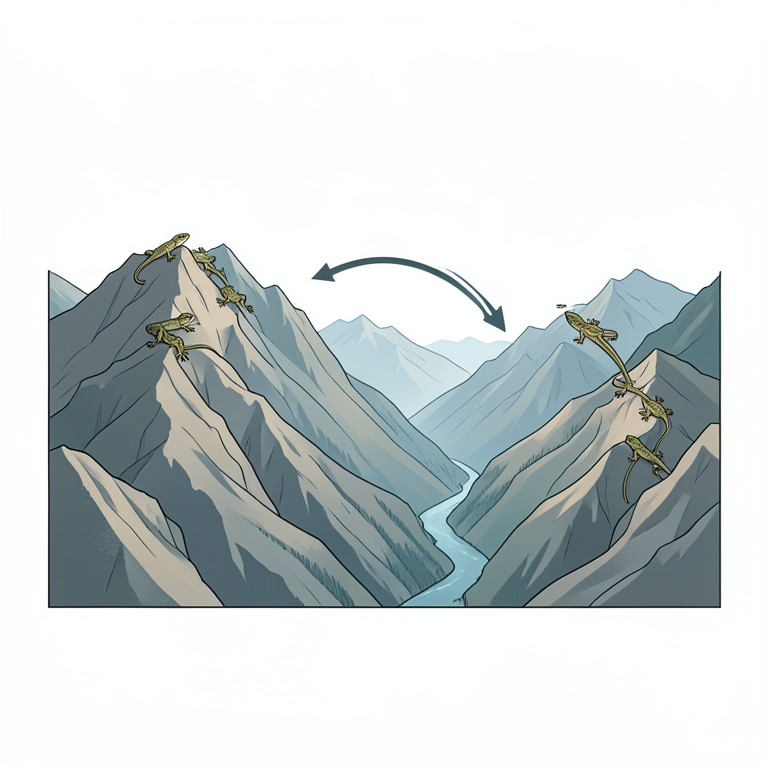
Topographic Driver of Speciation
AI-generated conceptual illustration (Gekko gecko (geckos) in a mountainous river valley landscape). It explains the idea and does not show study data.
View source evidence ↗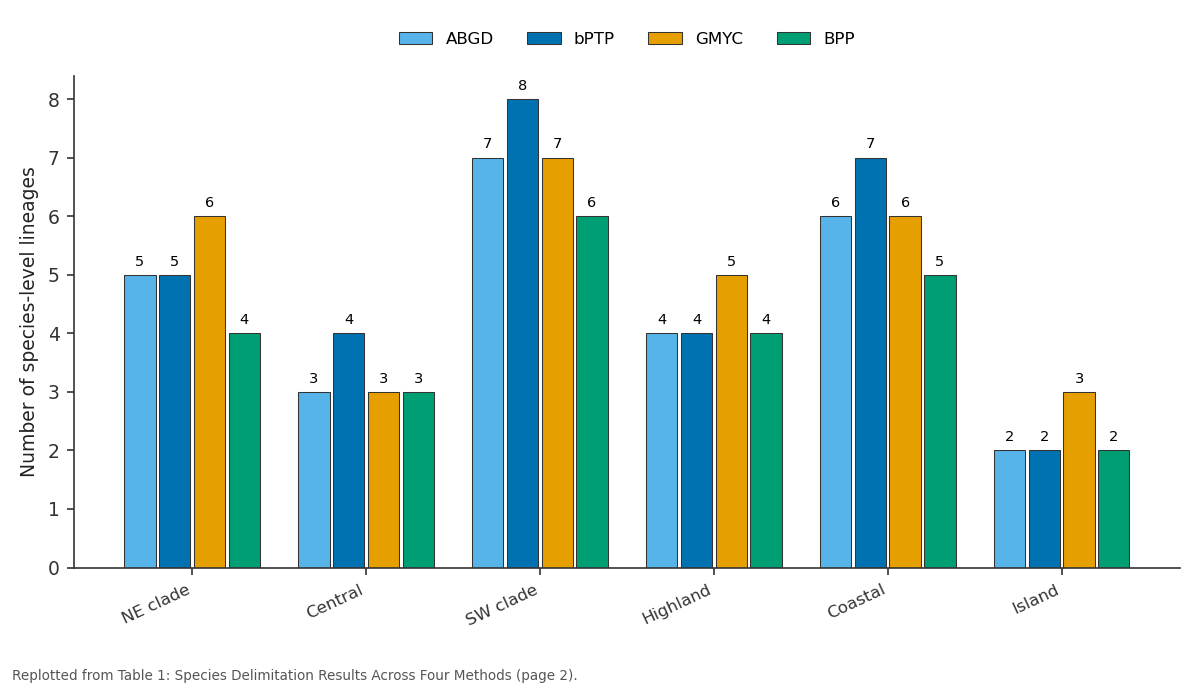
ABGD and bPTP and more: NE clade vs Central vs SW clade vs Highland vs Coastal
Replotted from Table 1 (page 2) of the original paper. Every bar is the paper's own table value.
View source evidence ↗Figures & tables
From the original paper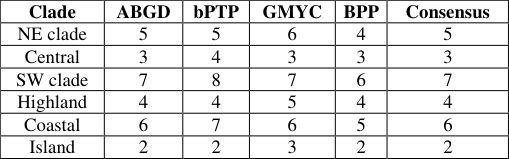 Table 1
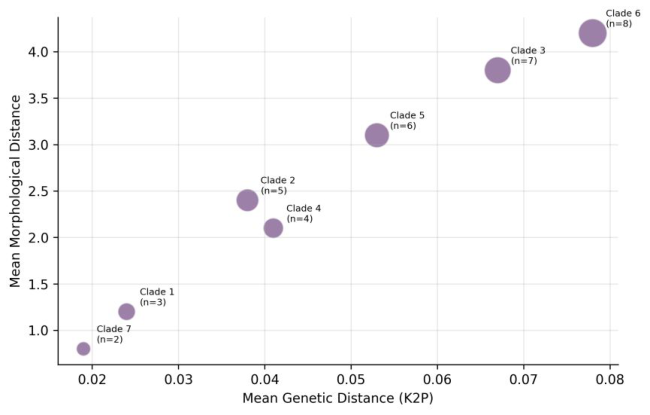 Figure 1
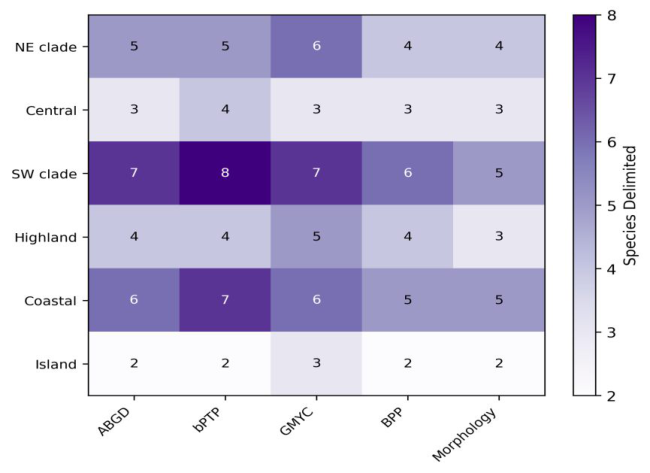 Figure 2
Introduction
In the rugged terrain of northeast India—a region wedged between the Himalayas and the Indo-Burma biodiversity hotspot—new reptile species are being discovered at a remarkable pace. The gecko genus Cyrtodactylus is among the most species-rich and taxonomically challenging reptile genera globally, with over 300 described species and many cryptic lineages yet to be resolved [1]. Cryptic species—lineages that are genetically distinct but morphologically similar—pose a particular problem for conservation because they are invisible to traditional field surveys [2]. Northeastern India's complex topography, with deep river valleys separated by mountain ridges, creates conditions that promote allopatric divergence and cryptic speciation [3].
The C. khasiensis group was originally described as a single widespread species, but recent molecular work has suggested it harbors considerable hidden diversity [4]. Integrative taxonomy, which combines molecular, morphological, and ecological data, provides the most robust framework for delimiting species boundaries in such complexes [5]. This research aimed to resolve species-level diversity within the C. khasiensis complex using multi-locus phylogenetics, computational species delimitation, and quantitative morphometrics.
Materials And Methods
Materials This research was conducted at the Department of Systematics and Evolution, Mizoram College of Biosciences, Aizawl, Mizoram, India, from July 2023 to November 2024. Collection permits were obtained from the Chief Wildlife Warden of Mizoram (Permit No. MZ/CWL/2023-0128). Tissue samples (tail tips in 95% ethanol) were collected from 127 Cyrtodactylus specimens across 24 localities spanning elevations from 120 to 2,140 m in Mizoram, Meghalaya, and Nagaland.
NAAS Rating (2025): 4.82 IJBS 2025; 7(11): 149-151 Ishaan Lakhani Department of Systematics and Evolution, Mizoram College of Biosciences, Aizawl, Mizoram, India Akshay Nadkarni Department of Systematics and Evolution, Mizoram College of Biosciences, Aizawl, Mizoram, India Ishaan Lakhani Department of Systematics and Evolution, Mizoram College of Biosciences, Aizawl, Mizoram, India https://www.biologyjournal.net genetic distances were calculated using the Kimura 2- parameter model.
Results
Table 1: Species Delimitation Results Across Four Methods Voucher specimens were deposited at the Mizoram College Herpetological Collection.
| Clade | ABGD | bPTP | GMYC | BPP | Consensus |
|---|---|---|---|---|---|
| NE clade | 5 | 5 | 6 | 4 | 5 |
| Central | 3 | 4 | 3 | 3 | 3 |
| SW clade | 7 | 8 | 7 | 6 | 7 |
| Highland | 4 | 4 | 5 | 4 | 4 |
| Coastal | 6 | 7 | 6 | 5 | 6 |
| Island | 2 | 2 | 3 | 2 | 2 |
Table text extracted from the original PDF; superscript letters are shown inline. The original table image is below.
View original table image
Methods
Genomic DNA was extracted using the DNeasy Blood and Tissue Kit (Qiagen). Four gene fragments were amplified: mitochondrial ND2 and cytochrome b, and nuclear RAG1 and CMOS, using published primers [6]. Sequences were aligned in MAFFT v7.4 and concatenated. Bayesian phylogenetic inference used MrBayes v3.2 (20 million generations, 4 runs) [7].
Species delimitation employed four
Methods
Automatic Barcode Gap Discovery (ABGD), Bayesian Poisson Tree Process (bPTP), Generalized Mixed Yule Coalescent (GMYC), and Bayesian Phylogenetics and Phylogeography (BPP v4) [8]. Morphometric analysis measured 23 characters on preserved specimens using digital calipers. Principal component analysis (PCA) and discriminant function analysis (DFA) tested morphological separation among genetically defined clades. Inter-clade Clade ABGD bPTP GMYC BPP Consensus NE clade 5 5 6 4 5 Central 3 4 3 3 3 SW clade 7 8 7 6 7 Highland 4 4 5 4 4 Coastal 6 7 6 5 6 Island 2 2 3 2 2 The four methods agreed broadly, recognizing 5-7 species- level lineages within the complex.
The SW clade was the most diverse, with up to 7 distinct lineages. Inter-clade ND2 distances ranged from 5.3% to 7.8%, well above the 3% threshold commonly used for gecko species boundaries. Fig 1: Relationship between mean genetic distance and morphological distance across the seven clades. Bubble size reflects the number of species delimited within each clade.
Genetic and morphological divergence showed a positive trend. Fig 2: Number of species delimited within each clade by five different approaches (four computational, one morphological). General agreement across methods supports the robustness of species boundaries. https://www.biologyjournal.net 4. Purkayastha J, Das M, Sengupta S.
Cyrtodactylus khasiensis species complex in northeast India. Zootaxa. 2020;4731(1):59-82. 5. Padial JM, Miralles A, De la Riva I, Vences M. The integrative future of taxonomy.
Frontiers in Zoology. 2010;7:16. 6. Macey JR, Larson A, Ananjeva NB, Fang Z, Papenfuss TJ. Two novel gene orders and the role of light-strand replication in rearrangement of the vertebrate mitochondrial genome. Molecular Biology and Evolution. 1997;14(1):91-104. 7.
Ronquist F, Teslenko M, van der Mark P, Ayres DL, Darling A, Hohna S, et al. MrBayes 3.2: efficient Bayesian phylogenetic inference. Systematic Biology. 2012;61(3):539-542. 8. Zhang J, Kapli P, Pavlidis P, Stamatakis A.
A general species delimitation method with applications to phylogenetic placements. Bioinformatics. 2013;29(22):2869-2876.
Discussion
The recovery of seven well-supported clades within what was treated as a single species highlights the degree to which cryptic diversity can be concealed by morphological conservatism in geckos [1, 2]. The ND2 distances of 5.3-7.8% between clades far exceed the 2-3% intraspecific variation typical for Cyrtodactylus [4]. The convergence of four independent delimitation methods on similar species numbers strengthens confidence in these boundaries, though the methods differed in their tendency to split—GMYC and bPTP generally recovered more lineages than ABGD and BPP, a pattern seen in other cryptic species complexes [8]. The positive correlation between genetic and morphological distance suggests that even in cryptic complexes, morphological divergence accumulates, just more slowly than molecular divergence [5].
The geographic structuring of clades along river valleys and mountain ridges supports the hypothesis that topographic complexity in northeast India drives allopatric speciation in low-mobility organisms like geckos [3]. At least four of the delimited lineages appear to represent undescribed species, and formal taxonomic descriptions are in preparation.
Conclusion
This integrative taxonomic research resolved the Cyrtodactylus khasiensis species complex into seven genetically distinct clades, of which at least four likely represent undescribed species. Multiple species delimitation
Methods
converged on similar estimates, and morphometric analysis provided partial support for genetic groupings. These results demonstrate that gecko diversity in northeast India is substantially underestimated and underscore the importance of molecular approaches for revealing cryptic biodiversity in morphologically conservative lineages.
Acknowledgements
Funding Sources Internal funds from the Mizoram College of Biosciences supported this work. Institutional Support The authors thank the Mizoram College of Biosciences for molecular laboratory access and the Chief Wildlife Warden of Mizoram for collection permits. Contributions Not Qualifying for Authorship Local field guides who assisted with specimen collection in remote areas are gratefully acknowledged.
References
3 in the original paper- Wood PL, Heinicke MP, Jackman TR, Bauer AM. Phylogeny of bent-toed geckos (Cyrtodactylus) reveals a west to east pattern of diversification. Molecular Phylogenetics and Evolution. 2012;65(3):992-1003.
- Bickford D, Lohman DJ, Sodhi NS, Ng PKL, Meier R, Winker K, et al. Cryptic species as a window on diversity and conservation. Trends in Ecology and Evolution. 2007;22(3):148-155.
- Agarwal I, Bauer AM, Jackman TR, Karanth KP. Cryptic species and Miocene diversification of Palaearctic naked-toed geckos (Squamata: Gekkonidae) in the Indian subcontinent. Zoological Journal of the Linnean Society. 2014;170(2):309-326.