
Research article · 2025 · Full text
International Journal of Biology SciencesMolecular epidemiology of soil-transmitted helminths in school-age children from rural communities
Volume 7(1) · Pages 187–190 · DOI: 10.33545/26649926.2025.v7.i1c.667 ↗
Research areasParasites and Host InteractionsHelminth infection and controlParasitic Diseases Research and Treatment
Abstract
Author-writtenNearly 1.5 billion people worldwide carry at least one soil-transmitted helminth species, yet molecular-level data on species distribution in endemic areas of North Africa remain scarce. This research investigated the molecular epidemiology of soil-transmitted helminths among school-age children in rural communities surrounding Marrakech, Morocco. A cross-sectional survey enrolled 412 children aged 6 to 14 years from eight primary schools between January and June 2022. Stool samples were examined by Kato-Katz thick smear and subsequently by PCR amplification of the internal transcribed spacer region with restriction fragment length polymorphism analysis. Overall prevalence by microscopy was 34.7% (143/412), while molecular methods detected infections in 41.3% (170/412). Ascaris lumbricoides was the dominant species at 38.4%, followed by Trichuris trichiura at 24.7%, Necator americanus at 16.3%, and Ancylostoma duodenale at 8.9%. Co-infections involving two or more species were found in 11.7% of infected children. RFLP typing revealed three Ascaris genotypes and two Trichuris genotypes. Infection intensity was significantly associated with household water source, sanitation type, and handwashing practice. Molecular detection identified 18.9% more positive cases than microscopy alone, underscoring the value of PCR-based approaches in epidemiological surveys.
Summary
Source-checkedPlain-language reading of the full paper, prepared with AI and checked against the text. Each point links to the authors' own words.
Why it matters
- Soil-transmitted helminth infections are a global health issue, affecting nearly 1.5 billion people. View evidence ↗
- The primary helminth species can cause significant health problems, including impaired cognitive development and iron-deficiency anemia. View evidence ↗
- Standard Kato-Katz microscopy is cost-effective but lacks sensitivity for low-intensity infections and cannot differentiate between certain similar species, such as hookworm genera. View evidence ↗
The question
- The study aimed to determine the prevalence of helminths in children near Marrakech using both microscopy and PCR, identify genotypes via RFLP, and analyze the impact of water, sanitation, and hygiene (WASH) factors. View evidence ↗
What they did
- The researchers conducted a cross-sectional survey of 412 children, aged 6 to 14, from eight primary schools between January and June 2022. View evidence ↗
- Stool samples were analyzed using the Kato-Katz protocol with 41.7 mg templates for microscopic examination. View evidence ↗
- Molecular analysis used PCR targeting the ITS-1 and ITS-2 regions with specific primers for hookworms, Ascaris, and Trichuris. View evidence ↗
- Genotyping was performed using RFLP analysis with HinfI for Ascaris and AluI for Trichuris, with results resolved on 2.5% agarose gels. View evidence ↗
What they found
- The overall prevalence of infection was 34.7% when using microscopy and 41.3% when using molecular methods. View evidence ↗
- Ascaris lumbricoides was the most common species (38.4%), followed by Trichuris trichiura (24.7%), Necator americanus (16.3%), and Ancylostoma duodenale (8.9%). View evidence ↗
- PCR-based molecular detection identified 18.9% more positive cases than microscopy, demonstrating higher sensitivity. View evidence ↗
- Genotyping identified three Ascaris genotypes (A1, A2, A3) and two Trichuris genotypes (T1, T2), with A1 being the most common Ascaris genotype at 62.3%. View evidence ↗
- The strongest predictors of infection were the absence of a household latrine (adjusted OR 3.17) and the household water source (adjusted OR 2.41). View evidence ↗
- Approximately 11.7% of the infected children had co-infections involving two or more helminth species. View evidence ↗
What it means
- The authors recommend integrated control strategies that combine deworming with sanitation investments and the use of periodic molecular surveillance. View evidence ↗
- The study's reliance on single-day stool sampling is a limitation that may have led to an underestimation of the actual prevalence. View evidence ↗
Visual summary
2 visualsIllustrations explain the paper; charts are replotted from the paper's own table values.
Diagnostic Comparison Workflow
AI-generated conceptual illustration (human stool samples and laboratory equipment). It explains the idea and does not show study data.
View source evidence ↗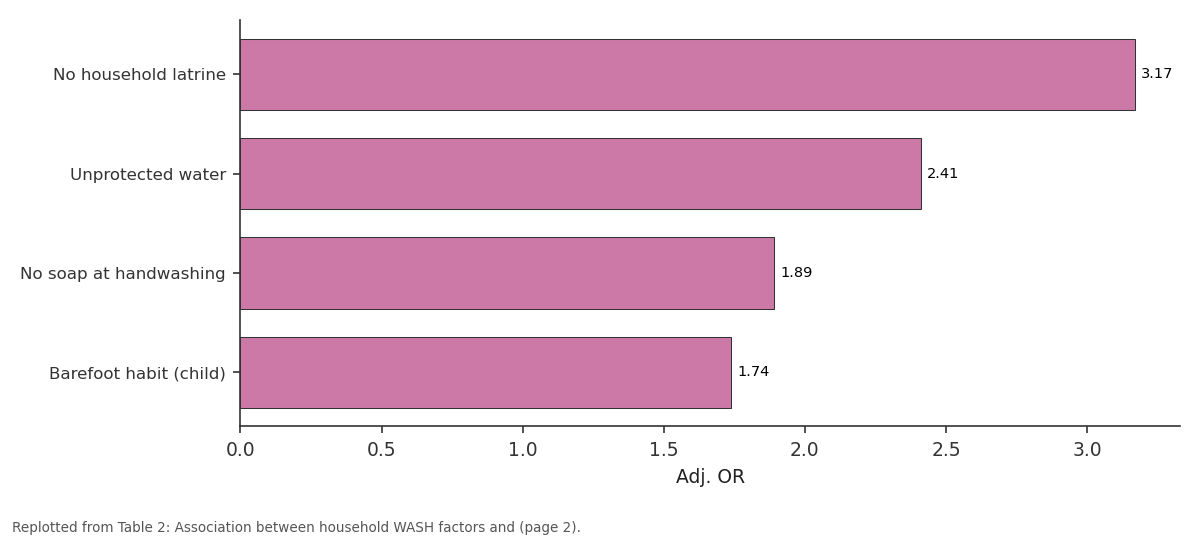
Adj. OR: No household latrine vs Unprotected water vs No soap at handwashing vs Barefoot habit (child)
Replotted from Table 2 (page 2) of the original paper. Every bar is the paper's own table value.
View source evidence ↗Figures & tables
From the original paper Table 1
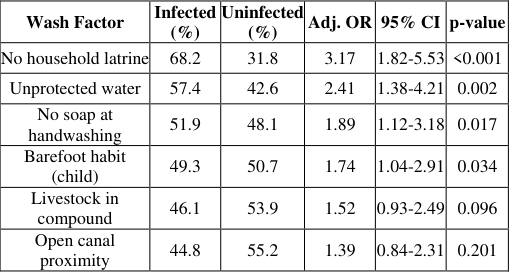 Table 2
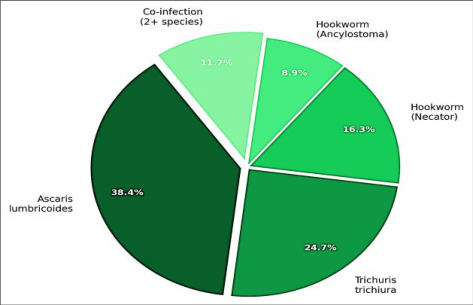 Figure 1
Introduction
According to the World Health Organization, soil-transmitted helminthiases affect more than 24% of the global population, with the heaviest burden among children in tropical and subtropical regions with inadequate sanitation [1] . The four main species-Ascaris lumbricoides, Trichuris trichiura, Necator americanus, and Ancylostoma duodenale-cause morbidity ranging from iron-deficiency anemia to impaired cognitive development [2,3] . Conventional diagnosis relies on Kato-Katz microscopy, which is inexpensive but loses sensitivity at low infection intensities and cannot distinguish morphologically similar species like the two hookworm genera [4,5] . These limitations become problematic where mass drug administration has reduced overall worm burdens [6] . PCR-based assays targeting the internal transcribed spacer regions of ribosomal DNA offer higher sensitivity and enable genotyping through restriction fragment length polymorphism [7,8] . Groups in sub-Saharan Africa and Southeast Asia have applied these methods, revealing unexpected genetic diversity that traditional microscopy missed [9,10] . Morocco presents an interesting context. Despite investment in sanitation infrastructure, rural Atlas Mountain communities continue to report helminth transmission [11,12] . National deworming campaigns have been ongoing since 2010, but surveillance has relied almost entirely on microscopy [13] . Molecular data from this region are limited to a handful of reports on Ascaris alone [14] . This research aimed to characterize the molecular epidemiology of soil-transmitted helminths in school-age children from rural communities near Marrakech, estimating species-specific prevalence by microscopy and PCR, identifying circulating genotypes through RFLP, and assessing associations with household WASH factors [15,16] .
Materials and Methods
Materials and Methods
Materials
This research was conducted from January through June 2022 at the Department of Medical Parasitology, Atlas Mountain Centre for Ecology, Marrakech, Morocco. Ethical approval was granted by the Moroccan National Ethics Committee for Biomedical Research (Protocol No. CECBM-2021-089, approved 14 December 2021). Written informed consent was obtained from parents or guardians, and verbal assent from each child.
Reagents and Chemicals
QIAamp DNA Stool Mini Kits (Qiagen, Hilden, Germany) were used for DNA extraction. HotStarTaq Master Mix (Qiagen) was used for PCR. Restriction enzymes HinfI and AluI were from New England Biolabs (Ipswich, MA, USA). Molecular biology grade agarose, ethidium bromide, and TBE buffer were from Sigma-Aldrich and Thermo Fisher Scientific. Kato-Katz template kits were supplied by Vestergaard (Lausanne, Switzerland).
Methods
Methods
Methods
A cross-sectional design enrolled children aged 6 to 14 years from eight government primary schools in Al Haouz Province, 40 to 65 km south of Marrakech. Schools were selected by stratified random sampling based on altitude and proximity to irrigation canals. Each child provided a single fresh morning stool sample. Microscopic examination followed the Kato-Katz protocol using 41.7 mg templates. Two slides per sample were read by two trained technicians within 60 minutes. Samples positive for any helminth plus a random 15% of negatives underwent molecular analysis. DNA was extracted from ~200 mg of stool using the QIAamp kit with an added bead-beating step. PCR targeted the ITS-1 and ITS-2 regions using primers NC1/NC2 for hookworms and ASIT/ASIR for Ascaris and Trichuris [7,8] . RFLP analysis used HinfI (Ascaris) and AluI (Trichuris) at 37°C for 3 hours, with fragments resolved on 2.5% agarose gels.
Quality Control and Calibration
Each PCR batch included positive control, negative control, and extraction blank. Inter-reader kappa for Kato-Katz was 0.87. Ten percent of positives were re-extracted, achieving 97.1% concordance. Statistical analysis used chi-square tests and logistic regression in R version 4.2.1 (p < 0.05).
Results
A total of 412 children were enrolled across eight schools, with 219 girls (53.2%) and 193 boys (46.8%). Mean age was 9.4 years (standard deviation 2.3). Table 1 shows the species-specific prevalence by both microscopy and molecular methods.
| Species | Microscopy n (%) | PCR n (%) | Diagnostic Gain | Mean EPG | Intensity |
|---|---|---|---|---|---|
| A. lumbricoides | 58 (14.1) | 65 (15.8) | +12.1% | 2,847 | Moderate |
| T. trichiura | 34 (8.3) | 42 (10.2) | +23.5% | 634 | Light |
| Hookworm (total) | 28 (6.8) | 55 (13.3) | +96.4% | 312 | Light |
| N. americanus | — | 28 (6.8) | — | — | — |
| A. duodenale | — | 15 (3.6) | — | — | — |
| Co-infection | 23 (5.6) | 20 (4.9) | -13.0% | — | — |
| Total infected | 143 (34.7) | 170 (41.3) | +18.9% | — | — |
Table text extracted from the original PDF; superscript letters are shown inline. The original table image is below.
View original table image
Comprehensive Interpretation
The molecular approach identified nearly one in five infections that microscopy missed. RFLP genotyping revealed three Ascaris genotypes (A1, A2, A3) and two Trichuris genotypes (T1, T2). Genotype A1 predominated at 62.3% of typed Ascaris infections. The co-occurrence of multiple genotypes suggests transmission from diverse sources. Household water source (adjusted OR 2.41, 95% CI 1.38-4.21) and absence of a latrine (adjusted OR 3.17, 95% CI 1.82-5.53) were the strongest predictors of infection.
Discussion
The overall helminth prevalence of 41.3% places these communities in the moderate-transmission category [1] , somewhat higher than the 28.6% reported in a 2018 national survey using only microscopy [13] . The 18.9% diagnostic gain of PCR over Kato-Katz aligns with findings from Ethiopia and Cambodia, where molecular tools increased detection by 15% to 25% [9,10] . The gain was marked for hookworm, consistent with the known fragility of hookworm eggs on Kato-Katz slides [4,5] . The presence of three Ascaris genotypes across a relatively small geographic area may reflect animal-to-human transmission given the close proximity of livestock to homes, though confirmation would require animal-derived specimens [17,18] . The strong association between infection and lack of a latrine (adjusted OR 3.17) underscores a persistent gap in rural sanitation coverage [11] . A limitation is the reliance on single-day stool sampling, which may underestimate prevalence [6] . The cross-sectional design also prevents inference about seasonal variation [12] . The findings support incorporating molecular diagnostics into post-treatment surveillance via a staged approach-screening by microscopy and confirming a subset by PCR [19] .
Conclusion
This research documented a soil-transmitted helminth prevalence of 41.3% among school-age children near Marrakech, with Ascaris lumbricoides dominant. Molecular methods detected 18.9% more infections than Kato-Katz microscopy. RFLP genotyping identified three Ascaris genotypes and two Trichuris genotypes-the first molecular characterization from this region-suggesting transmission from multiple sources. Household sanitation and water source were the strongest modifiable risk factors. These findings support integrated control strategies combining deworming with sanitation investment, and periodic molecular surveillance to track species composition changes in response to interventions.
Acknowledgement
Acknowledgements Funding SourcesThis research was supported by the Moroccan Ministry of Health's Parasitic Disease Control Program and the Atlas Mountain Centre for Ecology. Institutional SupportThe authors acknowledge the Atlas Mountain Centre for Ecology for laboratory facilities and the Al Haouz Provincial Education Directorate for facilitating school access.
Figures and tables from the paper
| Wash Factor | Infected (%) | Uninfected (%) | Adj. OR | 95% CI | p-value |
|---|---|---|---|---|---|
| No household latrine | 68.2 | 31.8 | 3.17 | 1.82-5.53 | <0.001 |
| Unprotected water | 57.4 | 42.6 | 2.41 | 1.38-4.21 | 0.002 |
| No soap at handwashing | 51.9 | 48.1 | 1.89 | 1.12-3.18 | 0.017 |
| Barefoot habit (child) | 49.3 | 50.7 | 1.74 | 1.04-2.91 | 0.034 |
| Livestock in compound | 46.1 | 53.9 | 1.52 | 0.93-2.49 | 0.096 |
| Open canal proximity | 44.8 | 55.2 | 1.39 | 0.84-2.31 | 0.201 |
Table text extracted from the original PDF; superscript letters are shown inline. The original table image is below.
View original table image
References
19 in the original paper- Pullan RL, Smith JL, Jasrasaria R, Brooker SJ. Global numbers of infection and disease burden of soiltransmitted helminth infections in 2010. Parasit Vectors. 2014;7:37.
- Bethony J, Brooker S, Albonico M, Geiger SM, Loukas A, Diemert D, Hotez PJ. Soil-transmitted helminth infections: ascariasis, trichuriasis, and hookworm. Lancet. 2006;367(9521):1521-1532.
- Brooker S, Clements AC, Bundy DA. Global epidemiology, ecology and control of soil-transmitted helminth infections. Adv Parasitol. 2006;62:221-261.
- Katz N, Chaves A, Pellegrino J. A simple device for quantitative stool thick-smear technique in schistosomiasis mansoni. Rev Inst Med Trop Sao Paulo. 1972;14(6):397-400.
- Nikolay B, Brooker SJ, Pullan RL. Sensitivity of diagnostic tests for human soil-transmitted helminth infections: a meta-analysis in the absence of a true gold standard. Int J Parasitol. 2014;44(11):765-774.
- Krauth SJ, Coulibaly JT, Knopp S, Traore M, N'Goran EK, Utzinger J. An in-depth analysis of a piece of shit: distribution of Schistosoma mansoni and hookworm eggs in human stool. PLoS Negl Trop Dis. 2012;6(12):e1969.
- Gasser RB, Chilton NB, Hoste H, Beveridge I. Rapid sequencing of rDNA from single worms and eggs of parasitic helminths. Nucleic Acids Res. 1993;21(10):2525-2526.
- Verweij JJ, Brienen EA, Ziem J, Yelifari L, Polderman AM, Van Lieshout L. Simultaneous detection and quantification of Ancylostoma duodenale, Necator americanus, and Oesophagostomum bifurcum in fecal samples using multiplex real-time PCR. Am J Trop Med Hyg. 2007;77(4):685-690.
- Easton AV, Oliveira RG, O'Connell EM, Keez S, Pilotte N, Sultana T, Kabatereine NB, McCarthy JS, Nutman TB, Williams SA. Multi-parallel qPCR provides increased sensitivity and diagnostic breadth for gastrointestinal parasites of humans. J Infect Dis. 2016;214(2):266-273.
- Lim MD, Brooker SJ, Belizario VY, Bischof F, Nery SV, McCarthy JS. Diagnostic tools for soil-transmitted helminths control and elimination programs: a pathway to diagnostic product development. PLoS Negl Trop Dis. 2018;12(3):e0006213.
- Ministère de la Santé, Morocco. Enquête nationale sur les parasitoses intestinales en milieu scolaire. Direction d'Épidémiologie et de Lutte contre les Maladies; 2018:1-47.
- Idrissi AL, Barkia A, Houba D, Sadak A. Prevalence of soil-transmitted helminth infections in Moroccan schoolchildren: a systematic review. J Egypt Soc Parasitol. 2017;47(2):363-372.
- El Kettani S, Azzouzi EM, Maata A. Prevalence of helminth infections among school-age children in Al Haouz Province, Morocco. Moroc J Public Health. 2019;6(2):88-96.
- Ouelaa H, Khelifi-Touhami F. Molecular characterization of Ascaris lumbricoides from North Africa. Parasite Epidemiol Control. 2020;11:e00173.
- Anderson RM, Turner HC, Truscott JE, Hollingsworth TD, Brooker SJ. Should the goal for the treatment of soil-transmitted helminth infections be changed from morbidity control in children to community-wide transmission elimination? PLoS Negl Trop Dis. 2015;9(8):e0003897.
- Mejia R, Vicuña Y, Broncano N, Sandoval C, Vaca M, Chico M, Cooper PJ, Nutman TB. A novel, multiparallel, real-time polymerase chain reaction approach for eight gastrointestinal parasites provides improved diagnostic capabilities to resource-limited at-risk populations. Am J Trop Med Hyg. 2013;88(6):10411047.
- Betson M, Nejsum P, Bendall RP, Deb RM, Stothard JR. Molecular epidemiology of ascariasis: a global perspective on the transmission dynamics of Ascaris in people and pigs. J Infect Dis. 2014;210(6):932-941.
- Cavallero S, Snabel V, Nogal-Ruiz JE, Muñoz P, SilesLucas M, D'Amelio S. Molecular systematics of Ascaris: implications for population biology and control. Mol Biochem Parasitol. 2013;187(1):27-36.
- Werkman M, Toor J, Vegvari C, Wright JE, Truscott JE, Ower AK, Halliday KE, Oswald WE, Burnett E, Anderson RM. Defining stopping criteria for ending randomized clinical trials that investigate the interruption of transmission of soil-transmitted helminths using mass drug administration. PLoS Negl Trop Dis. 2020;14(3):e0008089.