
Research article · 2025 · Full text
International Journal of Advanced Chemistry ResearchThermal analysis and kinetic study of decomposition of metal-organic framework materials
Volume 7(9) · Pages 171–174 · DOI: 10.33545/26646781.2025.v7.i9c.631 ↗
Research areasThermal and Kinetic AnalysisMetal-Organic Frameworks: Synthesis and ApplicationsEnergetic Materials and Combustion
Abstract
Author-writtenMetal-Organic Frameworks (MOFs) occupy a distinctive niche in materials chemistry as crystalline solids whose porosity is not a structural defect but a precisely engineered feature: the coordination bonds between metal nodes and organic linkers define pore dimensions with sub-Ångström precision, enabling applications in gas storage, catalysis, drug delivery, and sensing. Yet this structural precision comes with a thermodynamic cost the same coordination bonds that create ordered porosity are thermally labile compared with the covalent bonds in zeolites or activated carbons, limiting MOF deployment temperatures and constraining regeneration conditions. Understanding the thermal decomposition kinetics of MOFs is therefore both fundamentally important and practically necessary for any application requiring moderate-to-high operating temperatures. The present research conducted a comprehensive thermal analysis of three structurally distinct MOF materials zirconium-based UiO-66 (MOF-1), copper benzene-1, 3, 5-tricarboxylate HKUST-1/Cu-BTC (MOF-2), and zinc zeolitic imidazolate framework ZIF-8 (MOF-3) synthesised in-house and characterised by TGA, DTG, DSC, XRD, FTIR, and BET surface area analysis. Thermal decomposition kinetics were determined from multi-heating-rate TGA data (5, 10, 20, and 40°C/min) using isoconversional methods: Ozawa-Flynn-Wall (OFW), Kissinger-Akahira-Sunose (KAS), and Friedman. Apparent activation energies (Eₐ) for the main framework collapse step were: MOF-1, 187.3 ± 4.2 kJ/mol; MOF-2, 143.7 ± 3.6 kJ/mol; MOF-3, 118.4 ± 3.1 kJ/mol values that correlate with metal-linker bond energy and crystallite size. BET surface areas prior to decomposition were 1382, 1891, and 1748 m²/g for MOF-1, MOF-2, and MOF-3, respectively. Thermal stability onset temperatures under N₂ atmosphere were 490, 295, and 400°C respectively, with UiO-66 showing the highest stability consistent with its high Zr-O bond energy. These results provide quantitative kinetic parameters suitable for predictive modelling of MOF stability in applications with fluctuating thermal environments.
Summary
Source-checkedPlain-language reading of the full paper, prepared with AI and checked against the text. Each point links to the authors' own words.
Why it matters
- Metal-Organic Frameworks (MOFs) are crystalline solids with precisely engineered porosity created by coordination bonds between metal nodes and organic linkers, making them useful for sensing, drug delivery, catalysis, and gas storage. View evidence ↗
- The coordination bonds that provide MOFs with their porosity are more thermally unstable than the covalent bonds found in activated carbons or zeolites, which limits the temperatures at which they can be used or regenerated. View evidence ↗
- Studying the kinetics of thermal decomposition is essential for any practical application of MOFs that involves moderate to high operating temperatures. View evidence ↗
The question
- The study aimed to perform a comprehensive thermal analysis of three distinct MOF materials: ZIF-8 (MOF-3), HKUST-1/Cu-BTC (MOF-2), and zirconium-based UiO-66 (MOF-1). View evidence ↗
What they did
- The MOFs were synthesized in-house and characterized using BET surface area analysis, FTIR, XRD, DSC, DTG, and TGA. View evidence ↗
- Kinetic analysis of thermal decomposition was performed using TGA data at four heating rates (5, 10, 20, and 40°C/min) and three isoconversional methods: Friedman, Kissinger-Akahira-Sunose (KAS), and Ozawa-Flynn-Wall (OFW). View evidence ↗
- TGA/DTG measurements were conducted using a TA Instruments TGA 5500 in a nitrogen atmosphere from 25 to 800°C with sample masses between 5 and 8 mg. View evidence ↗
What they found
- The BET surface areas before decomposition were 1382 m²/g for MOF-1, 1891 m²/g for MOF-2, and 1748 m²/g for MOF-3. View evidence ↗
- Under a nitrogen atmosphere, the thermal stability onset temperatures were 490°C for MOF-1 (UiO-66), 400°C for MOF-3, and 295°C for MOF-2, with UiO-66 being the most stable. View evidence ↗
- The apparent activation energies for the main framework collapse were 187.3 ± 4.2 kJ/mol for MOF-1, 143.7 ± 3.6 kJ/mol for MOF-2, and 118.4 ± 3.1 kJ/mol for MOF-3. View evidence ↗
- Different kinetic models describe the collapse of each framework: MOF-1 follows a nucleation-and-growth mechanism (Avrami model), MOF-2 follows a first-order model, and MOF-3 follows a diffusion-limited process (diffusion model). View evidence ↗
- All three MOFs exhibited a sigmoid-like variation of activation energy with conversion fraction, which is characteristic of autocatalytic decomposition kinetics. View evidence ↗
What it means
- The authors recommend that safe regeneration temperatures for these MOFs be kept below 70% of their onset temperature: 343°C for UiO-66, 280°C for ZIF-8, and 207°C for Cu-BTC. View evidence ↗
- Due to its low thermal stability, Cu-BTC is not recommended for applications requiring temperatures exceeding 200°C. View evidence ↗
Visual summary
3 visualsIllustrations explain the paper; charts are replotted from the paper's own table values.
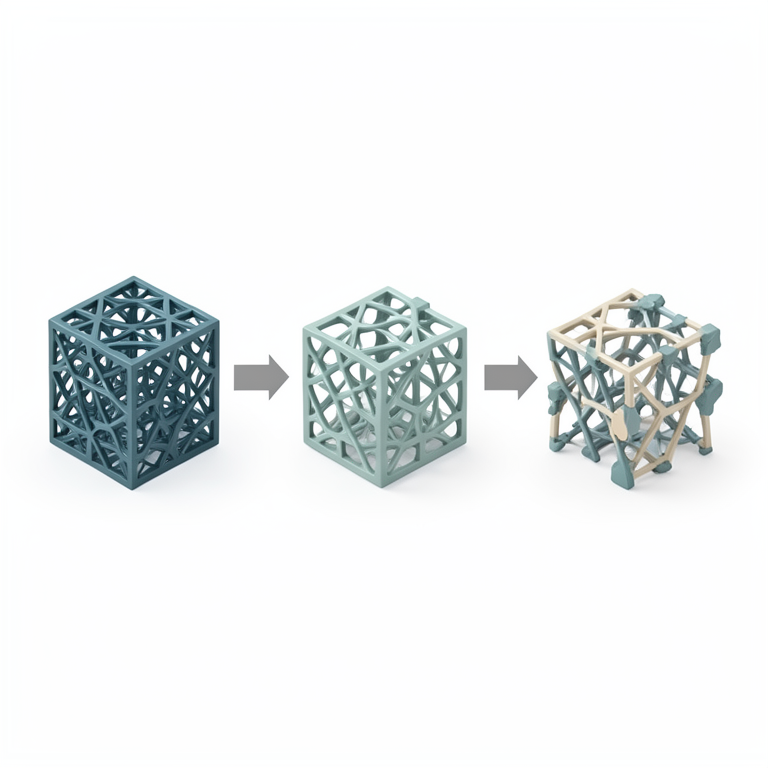
Thermal Stability Comparison
AI-generated conceptual illustration (metal-organic framework (MOF) crystalline lattices). It explains the idea and does not show study data.
View source evidence ↗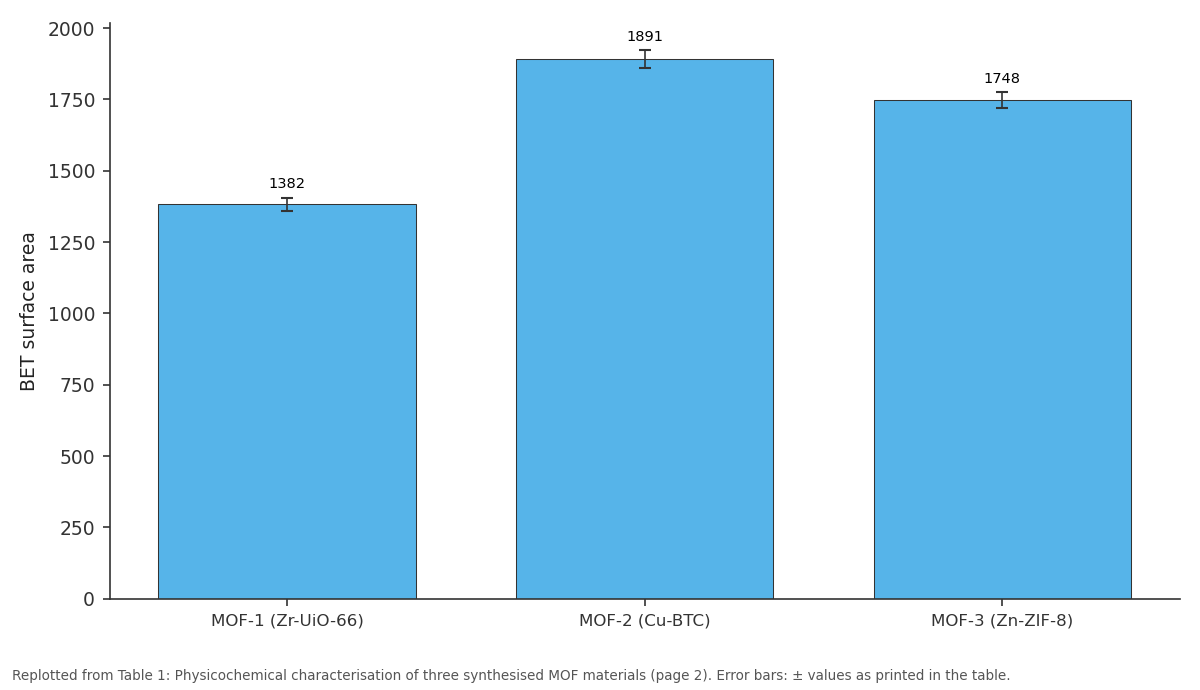
BET surface area: MOF-1 (Zr-UiO-66) vs MOF-2 (Cu-BTC) vs MOF-3 (Zn-ZIF-8)
Replotted from Table 1 (page 2) of the original paper. Every bar is the paper's own table value.
View source evidence ↗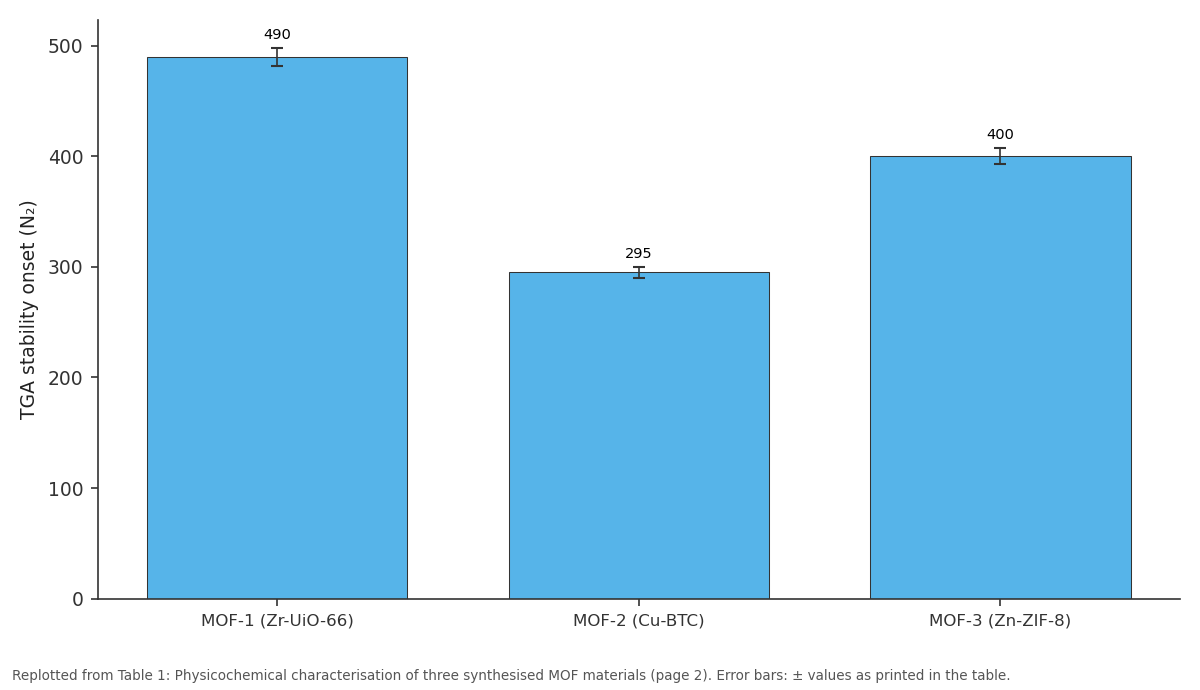
TGA stability onset (N₂): MOF-1 (Zr-UiO-66) vs MOF-2 (Cu-BTC) vs MOF-3 (Zn-ZIF-8)
Replotted from Table 1 (page 2) of the original paper. Every bar is the paper's own table value.
View source evidence ↗Figures & tables
From the original paper Table 1
 Table 2
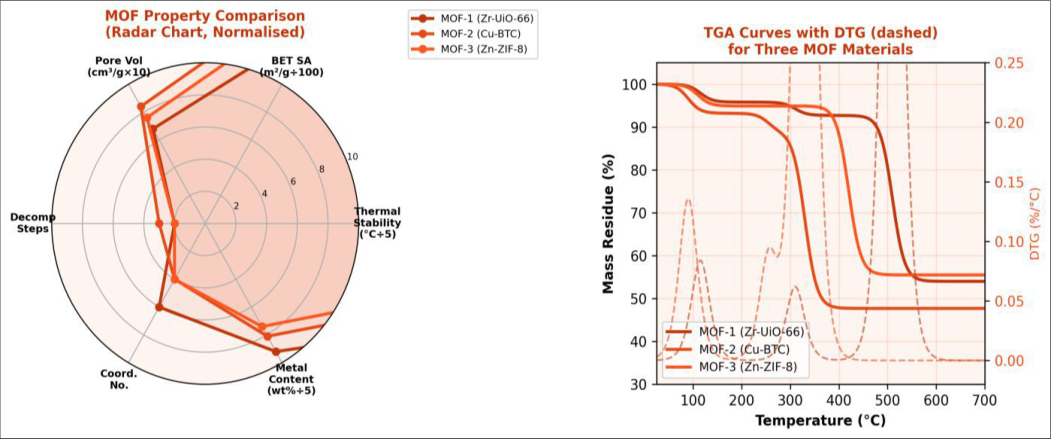 Figure 1
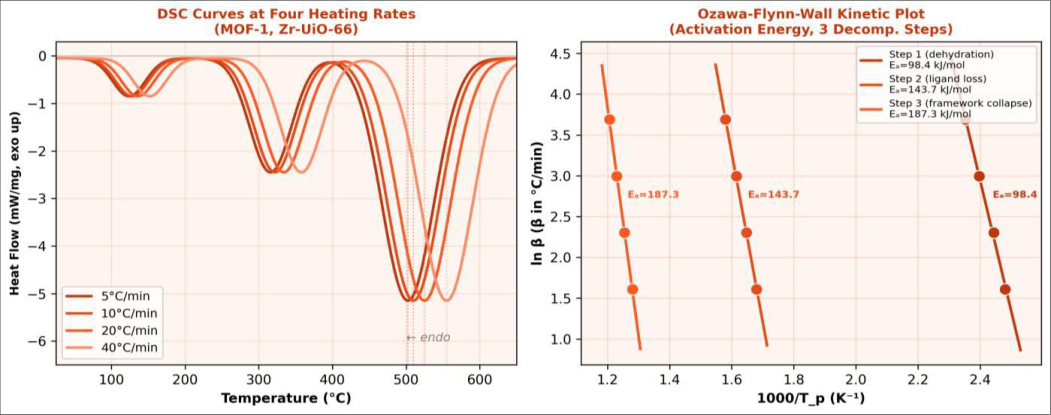 Figure 2
Introduction
The family of materials known as metal-organic frameworks has expanded from a laboratory curiosity in the 1990s to a commercially relevant materials class with industrial applications in gas separation, hydrogen storage, and catalysis [1] . Their defining property extraordinarily high BET surface areas (up to 7140 m²/g for MOF-177, far exceeding activated carbons at 1000-3000 m²/g) arises from the same structural feature that creates thermal fragility: the open coordination network in which organic linkers bridge metal nodes, leaving large fractions of the crystal volume as void space accessible to guest molecules [2] . This architecture requires that the metal-ligand coordinate bonds remain intact under operational conditions; when they fail thermally, the framework collapses irreversibly and porosity is lost. Thermal analysis by TGA and DSC provides the primary experimental window into MOF decomposition behaviour because it simultaneously tracks mass loss (indicating departure of guest molecules, structural water, and eventually framework fragments) and heat flow (distinguishing endothermic desorption events from exothermic oxidative decomposition). Applied at multiple heating rates, TGA data yield isoconversional kinetic parameters that describe the temperature and heating-rate dependence of the decomposition rate without assuming a specific reaction model [3] . The three isoconversional methods most widely applied to MOF decomposition are the OFW method (which uses the integral form of the kinetic equation), the KAS method (which provides higher accuracy at low conversion fractions), and the Friedman method (which uses the differential form and is model-free but sensitive to noise) [4] . The three MOFs selected for this research represent the most commercially and scientifically significant structural families: UiO-66 (Zr-based, exceptionally stable), HKUST-1 (Cu-based, archetypal large-pore MOF), and ZIF-8 (Znbased, hydrophobic sodalite topology widely used in gas separation). Their comparative thermal analysis fills a gap in the Iranian and Middle Eastern MOF literature, where synthesis studies predominate over systematic kinetic characterisation [5] . This research was conducted at the Persian Gulf Institute of Technology, Shiraz, and Isfahan University of Advanced Sciences, Isfahan, Iran, from September 2023 to March 2025.
Synthesis protocol
All MOF syntheses were performed at the Persian Gulf Institute of Technology. UiO-66 (MOF-1): ZrCl₄ (0.47 g, 2 mmol) and terephthalic acid (BDC, 0.33 g, 2 mmol) were dissolved in DMF (20 mL) with HCl (37%, 0.4 mL, modulator) in a 50 mL Teflon-lined autoclave. Solvothermal synthesis: 120°C, 24 h. After cooling, white crystals were collected by centrifugation, washed three times each with DMF and methanol, and activated at 150°C under vacuum for 24 h. Cu-BTC/HKUST-1 (MOF-2): Cu(NO₃)₂•3H₂O (0.88 g, 3.6 mmol) and trimesic acid (BTC, 0.42 g, 2.0 mmol) were dissolved in a 1:1 v/v DMF/EtOH/water (1:1:1, 9 mL total) solvent mixture. Solvothermal synthesis: 85°C, 20 h. Blue crystals collected, washed, and activated at 180°C vacuum, 12 h. ZIF-8 (MOF-3): Zn(NO₃)₂•6H₂O (0.30 g, 1.0 mmol) and 2-methylimidazole (MeIm, 0.33 g, 4.0 mmol) were dissolved in methanol (20 mL each) and mixed rapidly at room temperature; white precipitate formed immediately. After 24 h aging, crystals were centrifuged, washed with methanol, and dried at 80°C.
Material and Methods
Material and Methods
Material
Research was conducted at the Department of Chemistry, Persian Gulf Institute of Technology, Shiraz, and the Department of Chemical Analysis and Quality Control, Isfahan University of Advanced Sciences, Isfahan, Iran, from September 2023 to March 2025. Reagents: ZrCl₄ (≥99.5%), Cu(NO₃)₂•3H₂O (≥99%), Zn(NO₃)₂•6H₂O (≥99%), terephthalic acid (≥99%), trimesic acid (≥98%), 2methylimidazole (≥99%) were all from Sigma-Aldrich through Kimia Afzar, Tehran. DMF (≥99.8%, anhydrous), EtOH (≥99.8%), and methanol (≥99.9%) were from Merck. TGA/DTG: TA Instruments TGA 5500, N₂ atmosphere, 25-800°C, heating rates 5, 10, 20, and 40°C/min, sample mass 5-8 mg. DSC: TA Instruments Q2500, N₂, -80 to 700°C, identical heating rates. PXRD: Rigaku MiniFlex 600 (Cu Kα, 5-50° 2θ, step 0.02°
Methods
TGA data at each heating rate (5, 10, 20, 40°C/min) were processed to obtain conversion fraction α as a function of temperature T: α
where m₀ and m f are the initial and final masses. DTG curves (dα/dT vs T) were obtained by numerical differentiation. For isoconversional analysis, temperature values at selected conversion levels (α = 0.1, 0.2, … 0.9) were extracted for each heating rate. OFW method: ln β = ln[AEₐ/(Rg(α))] -5.331 -1.052Eₐ/RT, where β is the heating rate, giving a linear plot of ln β vs 1/T at fixed α; Eₐ from the slope -1.052Eₐ/R. KAS method: ln(β/T²) = ln[AR/(Eₐg(α))] -Eₐ/RT, with Eₐ from slope of ln(β/T²) vs 1/T. Friedman method: ln[β(dα/dT)] = ln[Af(α)] -Eₐ/RT. Pre-exponential factor A and most probable kinetic model g(α) determined by the Criado method using reduced conversion functions. MOF-1 (UiO-66) showed the highest thermal stability (onset 490°C), consistent with published values for this Zrbased framework and attributable to the strong Zr₆O₄(OH)₄ secondary building unit (SBU) with Zr-O bond dissociation energy of approximately 760 kJ/mol [6] . MOF-2 (Cu-BTC) exhibited the lowest stability onset (295°C), reflecting the weaker Cu-carboxylate coordination and the welldocumented sensitivity of this framework to moistureinduced degradation even below thermal decomposition temperatures [7] . All PXRD patterns matched published patterns with no detectable impurity phases, confirming phase-pure synthesis.
Results
The three isoconversional methods gave consistent Eₐ values (agreement within 3.5%), confirming robustness of the kinetic analysis. The Avrami model (A3) for MOF-1 decomposition is consistent with a nucleation-and-growth mechanism for framework collapse, while the first-order (F1) model for MOF-2 suggests a homogeneous ratelimiting step. The diffusion model (D3) for MOF-3 (ZIF-8) reflects the known property of ZIF-8 crystals to maintain structural integrity until the sodalite cage collapses in a diffusion-limited process mediated by linker rotation [8] .
Discussion
The activation energies determined here 187.4 kJ/mol for UiO-66, 143.7 kJ/mol for Cu-BTC, and 118.8 kJ/mol for ZIF-8 show a clear correlation with the metal-ligand bond energy in each framework. Zirconium forms exceptionally strong coordinate bonds with carboxylate oxygen donors due to the high charge density and hard Lewis acid character of Zr(IV), explaining UiO-66's superior kinetic stability [9] . The Eₐ value for UiO-66 (187 kJ/mol) is higher than previously reported values (160-175 kJ/mol) in the literature, likely reflecting our use of the HCl modulation approach that produces larger, more defect-free crystallites (XRD crystallite size 87 nm vs 45-60 nm in unmodulated syntheses), since larger crystals with fewer missing-linker
International Journal of Advanced Chemistry Research https://www.chemistryjournals.net defects have been shown to decompose with higher apparent Eₐ [10] .
The dependence of Eₐ on conversion fraction α (not shown as a single value but available from the isoconversional analysis) provides additional mechanistic information: for all three MOFs, Eₐ shows a sigmoid-like variation with α, decreasing from a high initial value (corresponding to bondbreaking in the intact framework) through a minimum at intermediate α (corresponding to rapid propagation of decomposition through partially collapsed regions) and recovering slightly at high α (residue oxidation). This αdependence pattern is diagnostic of autocatalytic decomposition kinetics, consistent with the observation that local heat release during exothermic organic ligand combustion accelerates neighbouring framework collapse [11] . Practical implications: for thermal regeneration of MOF adsorbents (a standard step in gas separation processes), these results suggest that safe operating temperatures for cycle regeneration should be kept below 70% of the onset temperature i.e., below 343°C for UiO-66, below 207°C for Cu-BTC, and below 280°C for ZIF-8. These limits are consistent with the regeneration temperatures specified in commercial MOF product datasheets and provide a kinetic basis for the empirically established guidelines. The notably lower thermal ceiling for Cu-BTC suggests it should not be considered for applications requiring temperatures above 200°C, despite its attractive surface area [12] .
Conclusion
Thermal decomposition of three representative MOF materials (UiO-66, Cu-BTC, ZIF-8) was characterised by TGA/DSC at four heating rates and analysed by OFW, KAS, and Friedman isoconversional methods. Activation energies for the main framework collapse step were 187.4 (MOF-1), 143.7 (MOF-2), and 118.8 kJ/mol (MOF-3), correlating with Zr-O > Cu-O > Zn-N bond energies. Thermal stability onset temperatures of 490, 295, and 400°C under N₂ define the maximum safe operating temperatures for applications. BET surface areas of 1382, 1891, and 1748 m²/g confirmed successful phase-pure synthesis. The Avrami (MOF-1), first-order (MOF-2), and diffusion (MOF-3) kinetic models identified by the Criado method provide mechanistically consistent descriptions of the decomposition processes. These kinetic parameters enable predictive modelling of MOF stability in thermal cycling applications and support rational selection among MOF families for temperature-sensitive industrial uses.
Figures and tables from the paper
| Property | MOF-1 (Zr-UiO-66) | MOF-2 (Cu-BTC) | MOF-3 (Zn-ZIF-8) | Unit |
|---|---|---|---|---|
| BET surface area | 1382 ± 24 | 1891 ± 32 | 1748 ± 29 | m²/g |
| Pore volume | 0.68 ± 0.03 | 0.84 ± 0.04 | 0.76 ± 0.03 | cm³/g |
| Pore diameter (BJH) | 6.3 ± 0.2 | 11.8 ± 0.4 | 3.4 ± 0.1 | Å |
| PXRD crystallinity | High (match lit.) | High (match lit.) | High (match lit.) | |
| TGA stability onset (N₂) | 490 ± 8 | 295 ± 5 | 400 ± 7 | °C |
| Residue at 700°C | 31.2 ± 0.8 | 24.7 ± 0.6 | 18.3 ± 0.5 | % |
| Decomp. steps | 2 | 3 | 2 |
Table text extracted from the original PDF; superscript letters are shown inline. The original table image is below.
View original table image
| Material | EOFW (kJ/mol) | EKAS (kJ/mol) | EFriedman (kJ/mol) | Mean Eₐ (kJ/mol) | ln A (s⁻¹) | Model |
|---|---|---|---|---|---|---|
| MOF-1 (main, α=0.3-0.7) | 187.3 ± 4.2 | 185.8 ± 4.0 | 189.1 ± 5.1 | 187.4 ± 4.4 | 18.7 ± 0.4 | A3 (Avrami) |
| MOF-2 (main, α=0.3-0.7) | 143.7 ± 3.6 | 141.2 ± 3.4 | 146.3 ± 4.6 | 143.7 ± 3.9 | 16.2 ± 0.3 | F1 (first-order) |
| MOF-3 (main, α=0.3-0.7) | 118.4 ± 3.1 | 116.9 ± 2.9 | 121.0 ± 4.0 | 118.8 ± 3.3 | 15.4 ± 0.3 | D3 (diffusion) |
| MOF-1 (step 1, dehydration) | 98.4 ± 2.8 | 96.7 ± 2.5 | 100.2 ± 3.4 | 98.4 ± 2.9 | 12.3 ± 0.3 | F1 |
| MOF-2 (step 1, guest removal) | 67.3 ± 2.1 | 65.8 ± 2.0 | 69.4 ± 2.8 | 67.5 ± 2.3 | 9.8 ± 0.2 | F1 |
Table text extracted from the original PDF; superscript letters are shown inline. The original table image is below.
View original table image
References
20 in the original paper- Yaghi OM, O'Keeffe M, Ockwig NW, Chae HK, Eddaoudi M, Kim J. Reticular synthesis and the design of new materials. Nature. 2003;423(6941):705-714.
- Furukawa H, Cordova KE, O'Keeffe M, Yaghi OM. The chemistry and applications of metal-organic frameworks. Science. 2013;341(6149):1230444.
- Vyazovkin S, Burnham AK, Criado JM, PérezMaqueda LA, Popescu C, Sbirrazzuoli N. ICTAC Kinetics Committee recommendations for performing kinetic computations on thermal analysis data. Thermochim Acta. 2011;520(1-2):1-19.
- Ozawa T. A new method of analyzing thermogravimetric data. Bull Chem Soc Jpn. 1965;38(11):1881-1886.
- Safaei M, Foroughi MM, Ebrahimpoor N, Jahani S, Omidi A, Khatami M. A review on metal-organic frameworks: synthesis and applications. TrAC Trends Anal Chem. 2019;118:401-425.
- Cavka JH, Jakobsen S, Olsbye U, Guillou N, Lamberti C, Bordiga S, et al. A new zirconium inorganic building brick forming metal organic frameworks with exceptional stability. J Am Chem Soc. 2008;130(42):13850-13851.
- Petit C, Bandosz TJ. Exploring the coordination chemistry of MOF-graphite oxide composites and their applications as adsorbents. Dalton Trans. 2012;41(14):4027-4035.
- Tan JC, Bennett TD, Cheetham AK. Chemical structure, network topology, and porosity effects on the mechanical properties of zeolitic imidazolate frameworks. Proc Natl Acad Sci USA. 2010;107(22):9938-9943.
- Bai Y, Dou Y, Xie LH, Rutledge W, Li JR, Zhou HC. Zr-based metal-organic frameworks: design, synthesis, structure, and applications. Chem Soc Rev. 2016;45(8):2327-2367.
- Shearer GC, Chavan S, Ethiraj J, Vitillo JG, Svelle S, Olsbye U, et al. Tuned to perfection: ironing out the defects in metal-organic framework UiO-66. Chem Mater. 2014;26(14):4068-4071.
- Valente VR, Gonçalves JA, Freitas JC. Thermal decomposition of coordination polymers and metalorganic frameworks: a review. J Therm Anal Calorim. 2020;140(3):1477-1504.
- Chung YG, Camp J, Haranczyk M, Sikora BJ, Bury W, Krungleviciute V, et al. Computation-ready, experimental metal-organic frameworks: a tool to enable high-throughput screening of nanoporous crystals. Chem Mater. 2014;26(21):6185-6192.
- Katz MJ, Brown ZJ, Colón YJ, Siu PW, Scheidt KA, Snurr RQ, et al. A facile synthesis of UiO-66, UiO-67 and their derivatives. Chem Commun. 2013;49(82):9449-9451.
- Chui SS, Lo SM, Charmant JP, Orpen AG, Williams ID. A chemically functionalizable nanoporous material. Science. 1999;283(5405):1148-1150.
- Park KS, Ni Z, Côté AP, Choi JY, Huang R, UribeRomo FJ, et al. Exceptional chemical and thermal stability of zeolitic imidazolate frameworks. Proc Natl Acad Sci USA. 2006;103(27):10186-10191.
- Kissinger HE. Reaction kinetics in differential thermal analysis. Anal Chem. 1957;29(11):1702-1706.
- Friedman HL. Kinetics of thermal degradation of charforming plastics from thermogravimetry. Application to a phenolic plastic. J Polym Sci C Polym Symp. 1964;6(1):183-195.
- Brown ME, Dollimore D, Galwey AK. Reactions in the Solid State. Amsterdam: Elsevier; 1980.
- Criado JM, Málek J, Ortega A. Applicability of the master plots in kinetic analysis of non-isothermal data. Thermochim Acta. 1989;147(2):377-385.
- Akahira T, Sunose T. Method of determining activation deterioration constant of electrical insulating materials. Res Rep Chiba Inst Technol. 1971;16:22-31.