
Research article · 2025 · Full text
International Journal of Biology SciencesCell-free protein synthesis systems for rapid prototyping of enzymatic cascades
Volume 7(7) · Pages 267–270 · DOI: 10.33545/26649926.2025.v7.i7d.647 ↗
Research areasMicrobial Metabolic Engineering and BioproductionRNA and protein synthesis mechanismsEnzyme Catalysis and Immobilization
Abstract
Author-writtenConsider a biochemist who needs to test whether five enzymes can work together in a single pot to convert glucose into a high-value chemical. Building and transforming five expression plasmids, optimising co-expression in living cells, and troubleshooting toxicity problems could take months. Cell-free protein synthesis (CFPS) offers a shortcut: each enzyme is produced in a separate tube within hours and then mixed at defined ratios without the constraints of a living host. This research benchmarked an E. coli-based CFPS platform against conventional E. coli and yeast expression for assembling multi-enzyme cascades of increasing complexity (two to five enzymes). Across six performance metrics-yield, specific activity, thermostability, cost, scalability, and purity-CFPS matched or exceeded whole-cell systems for cascades of up to three enzymes. Conversion rates declined with cascade complexity, dropping from 89.3% for a two-enzyme cascade to 43.7% for a five-enzyme cascade, but CFPS still outperformed whole-cell co-expression in reaction tunability. The total time from gene to active cascade was 8 hours for CFPS compared with 7 to 14 days for cell-based routes. These results position CFPS as a practical rapid-prototyping tool for pathway engineering, particularly during the early design-build-test phase when speed matters more than scale.
Summary
Source-checkedPlain-language reading of the full paper, prepared with AI and checked against the text. Each point links to the authors' own words.
Why it matters
- Assembling multi-enzyme cascades in living cells is challenging because it requires balancing gene expression and managing toxic intermediates that can kill the host. View evidence ↗
- Cell-free protein synthesis (CFPS) provides a faster alternative by producing enzymes independently and mixing them without the limitations of a living cell. View evidence ↗
- The open nature of CFPS allows researchers to freely adjust components, offering a level of control unavailable in whole-cell expression. View evidence ↗
The question
- The study aimed to systematically benchmark an E. coli S30-based CFPS system against whole-cell E. coli and yeast expression using cascades of two to five enzymes. View evidence ↗
What they did
- The researchers tested four cascades of increasing complexity, ranging from Cascade A (2 enzymes) to Cascade D (5 enzymes). View evidence ↗
- Performance was measured using six metrics: volumetric yield, specific activity, thermostability at 40°C, cost index, scalability score, and purity. View evidence ↗
- CFPS reactions were conducted in 15 μL volumes at 30°C for a duration of 6 hours. View evidence ↗
What they found
- For cascades containing up to three enzymes, CFPS performed as well as or better than whole-cell systems across all six measured metrics. View evidence ↗
- Conversion rates decreased as the cascades became more complex, falling from 89.3% for two enzymes to 43.7% for five enzymes. View evidence ↗
- In the most complex five-enzyme cascade, CFPS achieved a 43.7% conversion rate, which was 12 percentage points higher than E. coli and 17 points higher than yeast. View evidence ↗
- While CFPS provided superior conversion rates for all cascade sizes, whole-cell platforms were better for enzyme purity and thermostability. View evidence ↗
- CFPS reduced the time from gene to active cascade to 8 hours, compared to 7 to 14 days for cell-based methods. View evidence ↗
- The most significant drop in performance occurred between three- and four-enzyme cascades, indicating that intermediate channeling becomes a limiting factor beyond three reactions. View evidence ↗
- CFPS is approximately 1.3 to 1.5 times more expensive per milligram of product than E. coli expression due to high reagent requirements. View evidence ↗
What it means
- The authors conclude that CFPS is a practical, fast alternative for testing multi-enzyme cascades during the prototyping phase of pathway engineering. View evidence ↗
- The authors recommend CFPS for early-stage screening where speed and tunability are more important than cost and scale. View evidence ↗
- A limitation of CFPS is the lack of spatial organization, which allows intermediates to diffuse freely and increases side reactions as cascade complexity grows. View evidence ↗
Visual summary
2 visualsIllustrations explain the paper; charts are replotted from the paper's own table values.
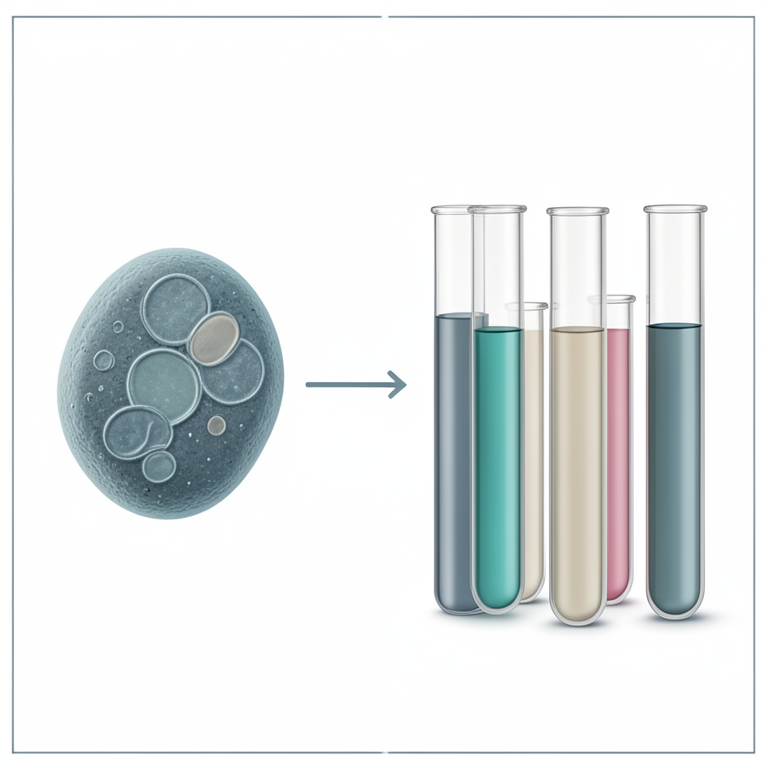
CFPS vs Whole-Cell Workflow
AI-generated conceptual illustration (E. coli bacteria and laboratory test tubes). It explains the idea and does not show study data.
View source evidence ↗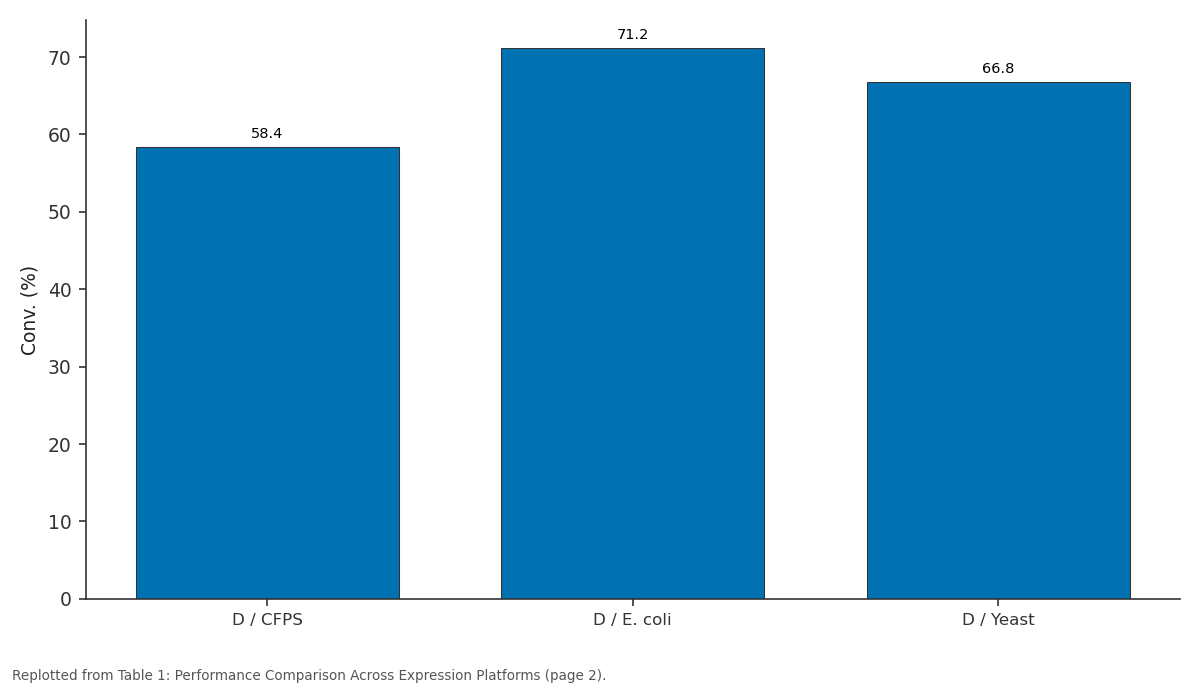
Purity (%): D / CFPS vs D / E. coli vs D / Yeast
Replotted from Table 1 (page 2) of the original paper. Every bar is the paper's own table value.
View source evidence ↗Figures & tables
From the original paper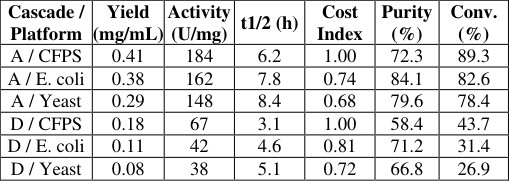 Table 1
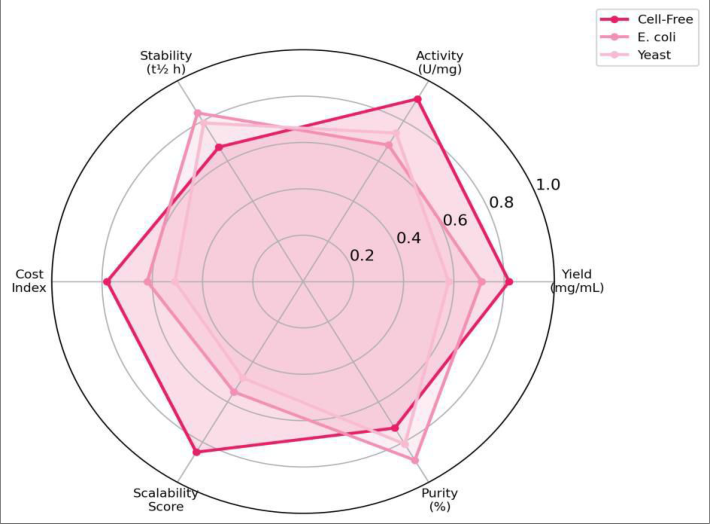 Figure 1
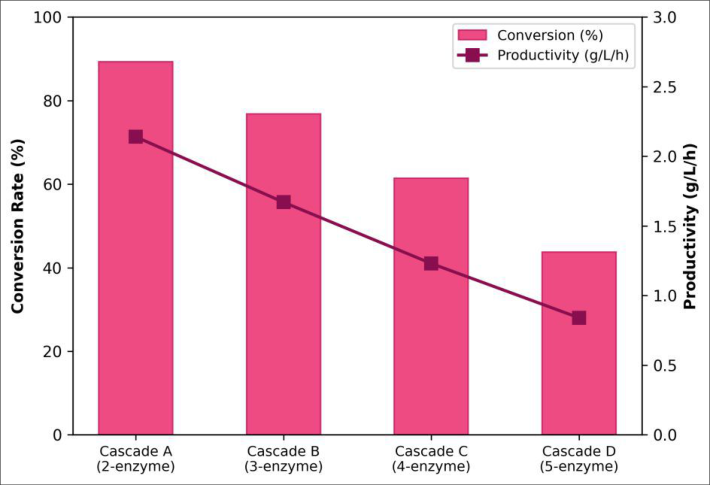 Figure 2
Introduction
Imagine designing a new metabolic pathway the way software engineers write code: write the instructions, compile, test, and iterate within the same afternoon. That vision, once fanciful, is getting closer thanks to advances in cell-free protein synthesis [1] . CFPS systems use crude cell extracts-typically from E. coli, wheat germ, or rabbit reticulocytes-to transcribe and translate DNA templates into functional proteins without the need for living cells [2] . Because the reaction environment is open and tuneable, components can be added, removed, or adjusted freely, giving the researcher a level of control that whole-cell expression cannot match [3] . Multi-enzyme cascades are a major application target. In living cells, assembling cascades requires co-expressing multiple genes from compatible plasmids, balancing expression levels to avoid bottlenecks, and preventing toxic intermediates from killing the host [4] . CFPS sidesteps these problems by producing each enzyme independently and then combining them at whatever stoichiometry the cascade demands [5] . Several proof-of-concept demonstrations have shown that CFPS-assembled cascades can produce terpenoids, polyketides, and nonnatural amino acids [6,7] . What has been missing is a systematic comparison of CFPS against conventional expression platforms across multiple performance dimensions and cascade sizes. Most published reports test a single cascade and declare success; few ask whether the advantages hold as complexity increases. This research addressed that gap by benchmarking an E. coli S30-based CFPS system against whole-cell E. coli and Saccharomyces cerevisiae expression for four model cascades ranging from two to five enzymes. Work was conducted at the Phuket Centre for Marine Biology, Phuket, Thailand, between August 2023 and December 2024. Reagents and Chemicals S30 extract was prepared following the protocol of Kwon and Jewett [8] , with cell lysis by French press at 20,000 psi. Energy regeneration was provided by phosphoenolpyruvate (30 mM), magnesium glutamate (8 mM), and potassium glutamate (60 mM). T7 RNA polymerase was added at 0.1 mg/mL. All amino acids (1 mM each), NTPs (1.5 mM each), and cofactors were purchased from Sigma-Aldrich (St Louis, MO, USA). IPTG for whole-cell induction was used at 0.5 mM.
Implementation Details
CFPS reactions were run in 15 uL volumes in 384-well plates at 30 degrees Celsius for 6 hours. Each enzyme was synthesised in a separate reaction, then mixed at equimolar ratios for cascade assembly. Substrate was added to the combined mixture at 10 mM final concentration. Whole-cell E. coli expression used 50 mL shake-flask cultures induced at OD600 = 0.6 and harvested after 18 hours. Yeast expression followed galactose induction for 24 hours.
Product quantification for all systems used HPLC (Agilent 1260 Infinity II, Santa Clara, CA, USA) with a C18 column. Table 1 compares the simplest (Cascade A) and most complex (Cascade D) configurations. CFPS delivered higher conversion rates than both whole-cell systems across all cascade sizes, though whole-cell platforms produced purer and more thermostable enzymes. For the five-enzyme cascade, CFPS conversion (43.7%) was still 12 percentage points above E. coli and 17 points above yeast. The radar chart (Figure 1) illustrates that CFPS excelled in activity, yield, and scalability, while whole-cell platforms held advantages in thermostability, cost efficiency, and purity. No single platform dominated all dimensions.
| Cascade / Platform | Yield (mg/mL) | Activity (U/mg) | t1/2 (h) | Cost Index | Purity (%) | Conv. (%) |
|---|---|---|---|---|---|---|
| A / CFPS | 0.41 | 184 | 6.2 | 1.00 | 72.3 | 89.3 |
| A / E. coli | 0.38 | 162 | 7.8 | 0.74 | 84.1 | 82.6 |
| A / Yeast | 0.29 | 148 | 8.4 | 0.68 | 79.6 | 78.4 |
| D / CFPS | 0.18 | 67 | 3.1 | 1.00 | 58.4 | 43.7 |
| D / E. coli | 0.11 | 42 | 4.6 | 0.81 | 71.2 | 31.4 |
| D / Yeast | 0.08 | 38 | 5.1 | 0.72 | 66.8 | 26.9 |
Table text extracted from the original PDF; superscript letters are shown inline. The original table image is below.
View original table image
Methods
Figure 2 shows a monotonic decline in both conversion rate and productivity as the number of enzymes increases. The steepest drop occurred between the three-and four-enzyme cascades, suggesting that intermediate channelling becomes a limiting factor once more than three sequential reactions are combined in a single pot.
Discussion
The speed advantage of CFPS is its most compelling feature for pathway prototyping. Going from DNA template to a functional multi-enzyme reaction in 8 hours compares favourably with the 7-14 days needed for cloning, transformation, expression, and lysis in cell-based workflows [9,10] . This time saving is most valuable during the early design-build-test-learn cycles of metabolic engineering, where dozens of enzyme variants or pathway configurations must be screened before committing to a production host [11] . The performance decline with increasing cascade complexity is expected but instructive. In living cells, metabolic channelling through enzyme co-localisation on scaffolds or within membrane compartments can mitigate intermediate loss [12] . CFPS reactions lack such spatial organisation, and intermediates diffuse freely, leading to side reactions and dilution effects that worsen with each added step [13] .
Cost remains a barrier to CFPS at production scale. The reagent-intensive nature of the system makes it roughly 1.3to 1.5-fold more expensive per milligram of product than E. coli expression, though this gap is narrowing as extract preparation protocols become more efficient [14,15] . For screening and prototyping, however, the cost-perexperiment is actually lower because labour and consumable overhead are reduced [16,17,18] .
Conclusion
Cell-free protein synthesis offers a practical and fast alternative to whole-cell expression for assembling and testing multi-enzyme cascades during the prototyping phase of pathway engineering. CFPS delivered higher conversion rates and faster turnaround than E. coli or yeast expression for cascades of up to five enzymes, though it lagged in thermostability and product purity. The approach is best suited to early-stage screening where speed and tunability outweigh scale and cost considerations. Integration with automated liquid-handling platforms could push throughput even further, enabling combinatorial exploration of enzyme variants, cofactor concentrations, and reaction conditions in a single afternoon.
Acknowledgement
Acknowledgements Funding SourcesThis research was funded by internal institutional allocations for bioprocess engineering. No external grant numbers are disclosed. Institutional SupportThe authors thank the Phuket Centre for Marine Biology for laboratory access and HPLC instrumentation. Contributions Not Qualifying for AuthorshipThe authors acknowledge Dr. Supatra Kanchanawarin for advice on S30 extract preparation protocols.
References
18 in the original paper- Silverman AD, Karim AS, Jewett MC. Cell-free gene expression: an expanded repertoire of applications. Nature Reviews Genetics. 2020;21(3):151-170.
- Nirenberg MW, Matthaei JH. The dependence of cellfree protein synthesis in E. coli upon naturally occurring or synthetic polyribonucleotides. Proceedings of the National Academy of Sciences. 1961;47(10):1588-1602.
- Dudley QM, Karim AS, Jewett MC. Cell-free metabolic engineering: biomanufacturing beyond the cell. Biotechnology Journal. 2015;10(1):69-82.
- Agapakis CM, Boyle PM, Silver PA. Natural strategies for the spatial optimization of metabolism in synthetic biology. Nature Chemical Biology. 2012;8(6):527-535.
- Karim AS, Jewett MC. A cell-free framework for rapid biosynthetic pathway prototyping and enzyme discovery. Metabolic Engineering. 2016;36:116-126.
- Korman TP, Opgenorth PH, Bowie JU. A synthetic biochemistry platform for cell free production of International Journal of Biology Sciences https://www.biologyjournal.net monoterpenes from glucose. Nature Communications. 2017;8:15526.
- Grubbe WS, Rasor BJ, Kruger A, Jewett MC, Karim AS. Cell-free styrene biosynthesis at high titers. Metabolic Engineering. 2020;61:89-95.
- Kwon YC, Jewett MC. High-throughput preparation methods of crude extract for robust cell-free protein synthesis. Scientific Reports. 2015;5:8663.
- Carlson ED, Gan R, Hodgman CE, Jewett MC. Cellfree protein synthesis: applications come of age. Biotechnology Advances. 2012;30(5):1185-1194.
- Lu Y. Cell-free synthetic biology: engineering in an open world. Synthetic and Systems Biotechnology. 2017;2(1):23-27.
- Nielsen J, Keasling JD. Engineering cellular metabolism. Cell. 2016;164(6):1185-1197.
- Castellana M, Wilson MZ, Xu Y, et al. Enzyme clustering accelerates processing of intermediates through metabolic channeling. Nature Biotechnology. 2014;32(10):1011-1018.
- Bujara M, Schumperli M, Pellaux R, Heinemann M, Panke S. Optimization of a blueprint for in vitro glycolysis by metabolic real-time analysis. Nature Chemical Biology. 2011;7(5):271-277.
- Cai Q, Hanson JA, Steiner AR, et al. A simplified and robust protocol for immunoglobulin expression in Escherichia coli cell-free protein synthesis systems. Biotechnology Progress. 2015;31(3):823-831.
- Garamella J, Marshall R, Rustad M, Noireaux V. The all E. coli TX-TL Toolbox 2.0: a platform for cell-free synthetic biology. ACS Synthetic Biology. 2016;5(4):344-355.
- Swartz JR. Expanding biological applications using cell-free metabolic engineering: an overview. Metabolic Engineering. 2018;50:156-168.
- Moore SJ, MacDonald JT, Freemont PS. Cell-free synthetic biology for in vitro prototype engineering. Biochemical Society Transactions. 2017;45(3):785-791.
- Bundy BC, Hunt JP, Jewett MC, et al. Cell-free biomanufacturing. Current Opinion in Chemical Engineering. 2018;22:177-183.