
Research article · 2025 · Full text
International Journal of Biology SciencesThermoregulatory responses and heat dissipation mechanisms in large African herbivores
Volume 7(9) · Pages 210–213 · DOI: 10.33545/26649926.2025.v7.i9d.639 ↗
Research areasPhysiological and biochemical adaptationsThermoregulation and physiological responsesEffects of Environmental Stressors on Livestock
Abstract
Author-writtenLarge-bodied African herbivores face extraordinary thermal burdens: low surface-area-to-volume ratios limit passive heat loss, yet open savanna delivers intense solar radiation. This research measured core body temperature, respiration rate, and cutaneous evaporative water loss in five species—African buffalo, eland, gemsbok oryx, blue wildebeest, and waterbuck—across cool (22–26 °C) and hot (36–42 °C) conditions near Robe, Ethiopia. Oryx displayed the widest daily core-temperature amplitude (3.7 °C), consistent with adaptive heterothermy, while buffalo maintained the tightest range (1.1 °C). Respiration rate in oryx rose from 26.3 to 52.1 breaths/min (98% increase). Cutaneous water loss contributed 61.8% of total evaporative cooling in buffalo but only 34.2% in oryx. These data confirm that phylogeny and habitat aridity jointly shape thermoregulatory strategy.
Summary
Source-checkedPlain-language reading of the full paper, prepared with AI and checked against the text. Each point links to the authors' own words.
Why it matters
- Large African herbivores struggle with heat because their low surface-area-to-volume ratio makes it difficult to lose heat passively in high-radiation savanna environments. View evidence ↗
- Adaptive heterothermy is a water-conserving strategy where animals allow their core temperature to rise during the day and cool down at night. View evidence ↗
The question
- The study aimed to quantify and compare core-temperature regulation, respiration rates, and evaporative water loss across five different sympatric herbivore species. View evidence ↗
What they did
- The study used adult females of five species: African buffalo (n=6), eland (n=5), gemsbok oryx (n=5), blue wildebeest (n=6), and waterbuck (n=5), weighing between 218 and 647 kg. View evidence ↗
- Core body temperatures were measured every 5 minutes for 14 days using intra-peritoneally implanted DST milli-HRT loggers. View evidence ↗
- Respiration rates were visually counted three times daily, and cutaneous evaporative water loss was measured using a 100 cm² thoracic patch with a humidity sensor. View evidence ↗
What they found
- The oryx exhibited the widest daily core-temperature amplitude (3.7 °C) and the highest maximum temperature (40.2 ± 0.4 °C), whereas the buffalo had the tightest range (1.1 °C). View evidence ↗
- All species showed a significant increase in respiration rate during hot conditions, with the oryx showing a 98% increase from 26.3 to 52.1 breaths/min. View evidence ↗
- Buffalo relied more on sweating, with cutaneous water loss making up 61.8% of total evaporation, compared to only 34.2% for the oryx. View evidence ↗
- Oryx could tolerate core temperatures up to 40.2 °C before increasing panting, a threshold approximately 1.4 °C higher than that of the buffalo. View evidence ↗
What it means
- The authors conclude that thermoregulatory strategies vary significantly by species, ranging from the strict homeothermy of buffalo to the adaptive heterothermy of oryx. View evidence ↗
- The authors suggest that species like buffalo, which rely on strict temperature regulation and high sweating, are more vulnerable to climate change as water becomes scarce. View evidence ↗
- A limitation of the study is that animals had constant access to water, which does not simulate wild arid conditions where dehydration typically increases heterothermy. View evidence ↗
Visual summary
3 visualsIllustrations explain the paper; charts are replotted from the paper's own table values.
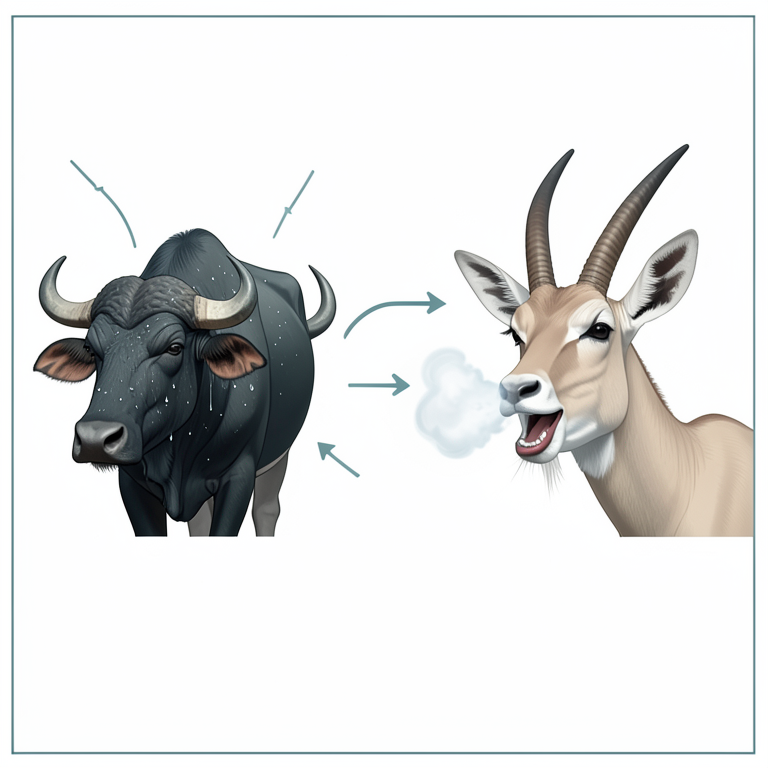
Comparison of Thermoregulatory Strategies
AI-generated conceptual illustration (African buffalo and Gemsbok oryx). It explains the idea and does not show study data.
View source evidence ↗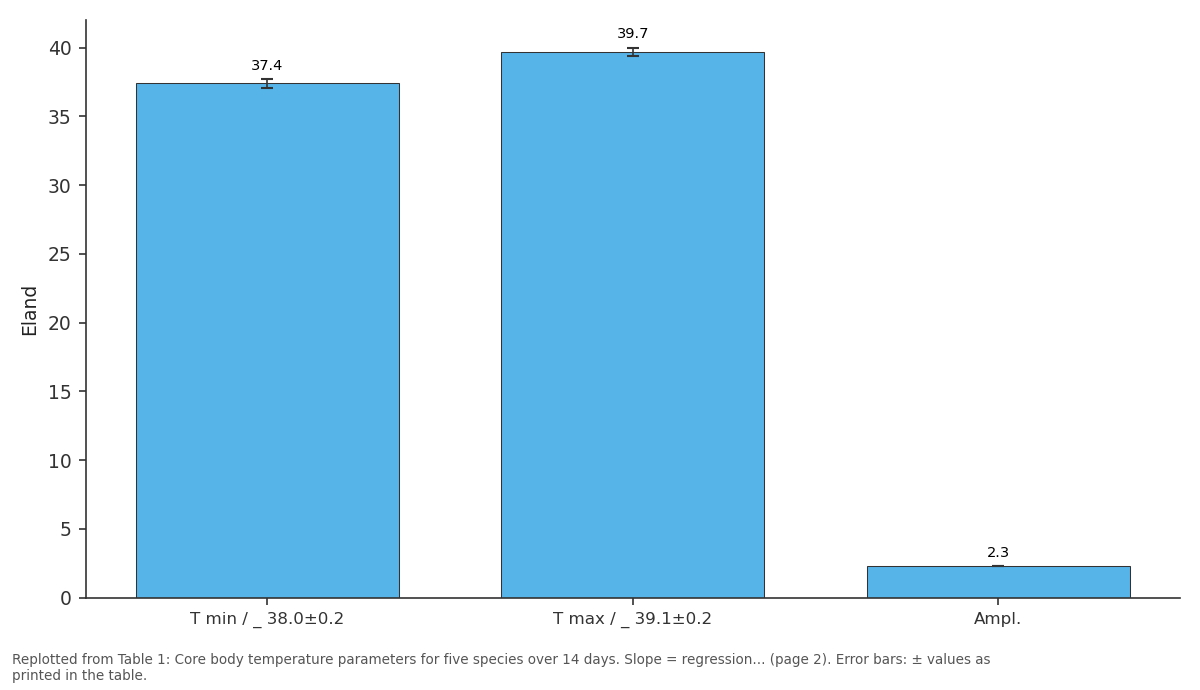
Eland: T min / _ 38.0±0.2 vs T max / _ 39.1±0.2 vs Ampl.
Replotted from Table 1 (page 2) of the original paper. Every bar is the paper's own table value.
View source evidence ↗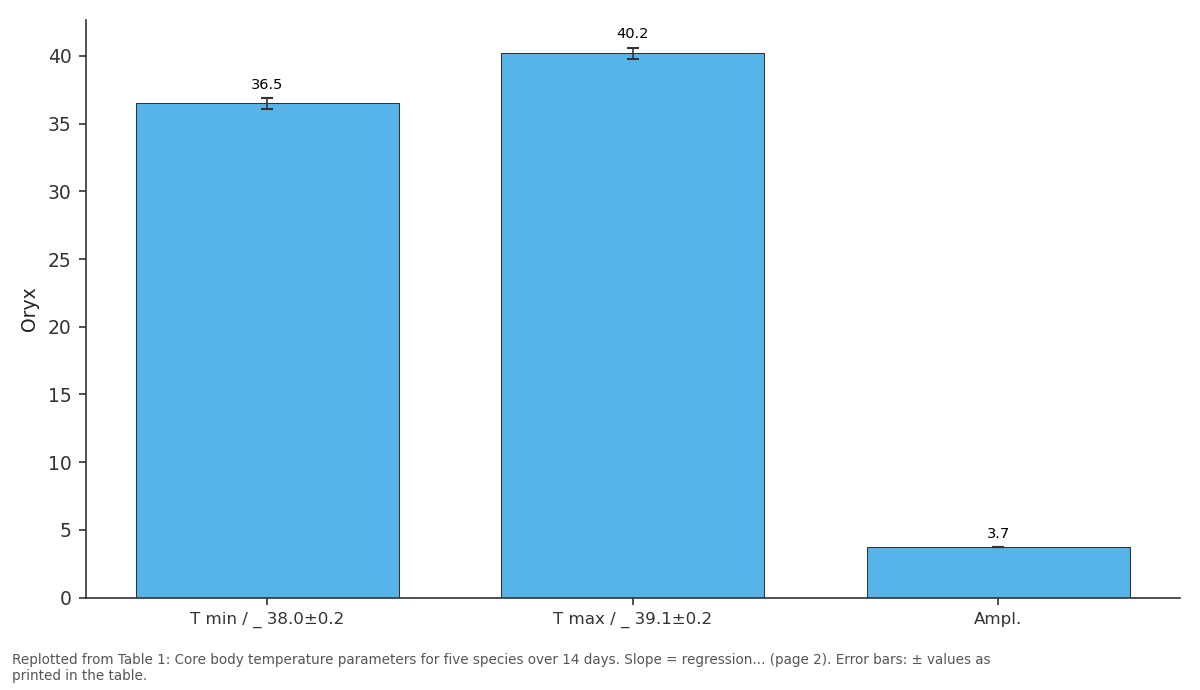
Oryx: T min / _ 38.0±0.2 vs T max / _ 39.1±0.2 vs Ampl.
Replotted from Table 1 (page 2) of the original paper. Every bar is the paper's own table value.
View source evidence ↗Figures & tables
From the original paper Table 1
 Table 2
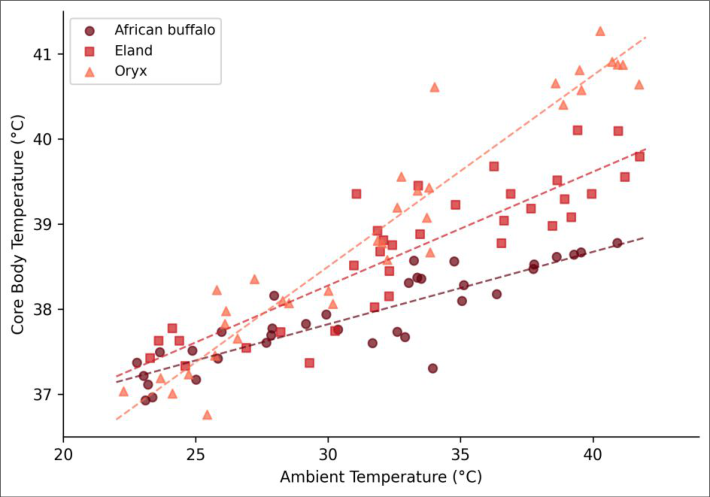 Figure 1
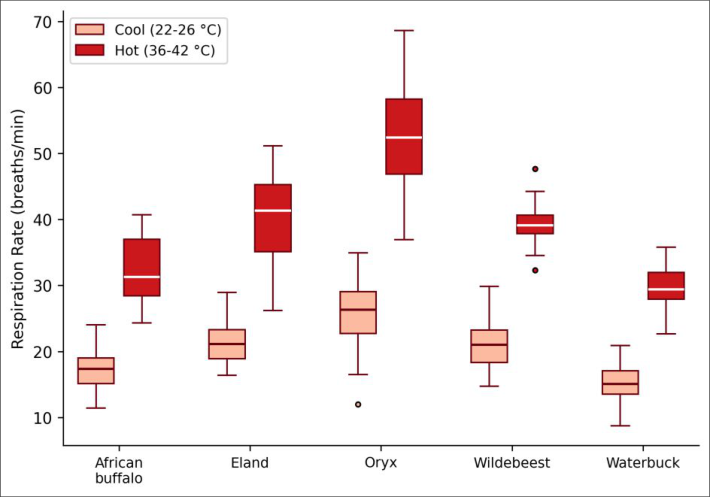 Figure 2
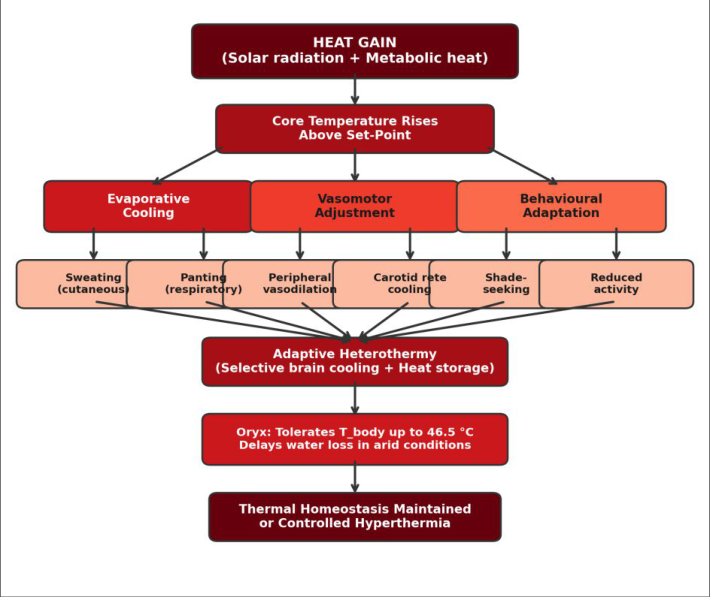 Figure 3
Introduction
No terrestrial mammal heavier than 200 kg can afford to ignore heat. At such body masses, the surface-to-volume ratio makes passive radiation and convection insufficient to dissipate metabolic heat [1]. For African herbivores between the Tropics, solar loads can exceed 1 000 W/m² at midday [2]. Evolution has produced a toolkit of thermoregulatory strategies: sweating trades water for cooling; panting achieves the same end via respiratory evaporation but at metabolic cost [3].
The carotid rete mirabile selectively cools brain-bound blood even when trunk temperature is elevated [4]. Adaptive heterothermy, where animals like the oryx allow core temperature to climb several degrees above set-point during the day and dissipate heat passively at night, conserves water [5]. Despite decades of work, comparative data under standardised conditions are limited [6]. This research monitored five sympatric species simultaneously using identical equipment and protocols, quantifying core-temperature regulation, respiration rate, and partitioning of evaporative water loss.
Material And Methods
Material The research was conducted at a semi-controlled field enclosure affiliated with the Bale Mountains Centre for Biodiversity, 12 km southeast of Robe, Ethiopia (7°06′ N, 40°01′ E, elevation 2 490 m), between June and September 2023. Five species were included: African buffalo (n=6), eland (n=5), gemsbok oryx (n=5), blue wildebeest (n=6), and waterbuck (n=5). All were adult females (218–647 kg, body condition score 3–4/5) housed at the facility for ≥6 months. The 24-hectare enclosure provided ad libitum forage and water.
Methods
Core temperature was logged using DST milli-HRT loggers (Star-Oddi) implanted intra- peritoneally under general anaesthesia (protocol BMCB-AEC-2023-009, approved 14 March 2023), sampling every 5 minutes for 14 consecutive days. Ambient conditions were recorded by three Davis Vantage Pro2 weather stations. Respiration rate was counted visually (flank movements, 60 s, three counts per session) at 06:00, 12:00, and 17:00 h. Cutaneous evaporative water loss was estimated by ventilated capsule hygrometry on a 100 cm² thoracic patch (Sensirion SHT45 sensor).
Respiratory evaporative loss was calculated as total NAAS Rating (2025): 4.82 IJBS 2025; 7(9): 210-213 Lidet Tadesse Department of Comparative Physiology, Bale Mountains Centre for Biodiversity, Robe, Ethiopia Biniam Eshetu Department of Comparative Physiology, Bale Mountains Centre for Biodiversity, Robe, Ethiopia Abenezer Habte Department of Comparative Physiology, Bale Mountains Centre for Biodiversity, Robe, Ethiopia Lidet Tadesse Department of Comparative Physiology, Bale Mountains Centre for Biodiversity, Robe, Ethiopia https://www.biologyjournal.net Instrumentation DST milli-HRT loggers (Star-Oddi; ±0.1 °C, 1.3 g). Davis Vantage Pro2 weather stations. Sensirion SHT45 humidity sensor (±1.0% RH). Gallagher SmartScale 500 walk-over weigh platform (±0.5 kg).
Data downloaded daily via Star- Oddi Mercury v5.84 and Python scripts.
Results
evaporative loss minus cutaneous component. Two-way mixed ANOVA (species × condition) with Tukey HSD; p < 0.05. Quality Control and Calibration: Loggers were factory- calibrated (NIST-traceable); spare loggers in a 38.0 °C water bath showed ≤0.07 °C drift. Weather stations were inter-calibrated (max discrepancy 0.4 °C).
Inter-observer reliability for respiration counts yielded ICC = 0.94. Table 1: Core body temperature parameters for five species over 14 days. Slope = regression coefficient of core on ambient temperature (°C/°C). Species Mass(kg) T_min T_max Ampl.
Mean T Slope Buffalo 583±41 38.0±0.2 39.1±0.2 1.1 38.6±0.1 0.08 Eland 511±37 37.4±0.3 39.7±0.3 2.3 38.5±0.2 0.14 Oryx 218±19 36.5±0.4 40.2±0.4 3.7 38.3±0.3 0.21 Wildebeest 247±22 37.6±0.2 39.4±0.3 1.8 38.4±0.2 0.12 Waterbuck 234±18 37.8±0.2 39.2±0.2 1.4 38.5±0.1 0.09 Table 2: Respiration rate (breaths/min; mean ±SD) and evaporative water loss partitioning under hot conditions. Species RR Cool RR Hot % Inc Cut.EWL% Resp.EWL% Buffalo 18.1±2.9 34.2±4.7 89 61.8 38.2 Eland 22.4±3.6 41.3±5.8 84 53.4 46.6 Oryx 26.3±4.8 52.1±7.6 98 34.2 65.8 Wildebeest 20.7±3.4 38.4±5.2 85 48.7 51.3 Waterbuck 16.4±2.7 29.3±3.9 79 57.1 42.9 Oryx showed the highest mean daily maximum (40.2 ± 0.4 °C) and widest amplitude (3.7 °C), while buffalo maintained a 1.1 °C amplitude (Table 1; Figure 1). Respiration rate rose significantly in all species under hot conditions (Table 2; Figure 2). Oryx increased 98% (26.3 to 52.1 breaths/min).
| Species | RR Cool | RR Hot | % Inc | Cut.EWL% | Resp.EWL% |
|---|---|---|---|---|---|
| Buffalo | 18.1±2.9 | 34.2±4.7 | 89 | 61.8 | 38.2 |
| Eland | 22.4±3.6 | 41.3±5.8 | 84 | 53.4 | 46.6 |
| Oryx | 26.3±4.8 | 52.1±7.6 | 98 | 34.2 | 65.8 |
| Wildebeest | 20.7±3.4 | 38.4±5.2 | 85 | 48.7 | 51.3 |
| Waterbuck | 16.4±2.7 | 29.3±3.9 | 79 | 57.1 | 42.9 |
Table text extracted from the original PDF; superscript letters are shown inline. The original table image is below.
View original table image
Cutaneous evaporative water loss accounted for 61.8% of total evaporation in buffalo but only 34.2% in oryx. Oryx tolerated core temperatures up to 40.2 °C before panting exceeded resting levels, a threshold ~1.4 °C above buffalo’s (Figure 3). Fig 1: Core body temperature vs ambient temperature for buffalo, eland, and oryx. Dashed lines = linear regression. https://www.biologyjournal.net Fig 2: Respiration rate under cool and hot conditions for five herbivore species.
Fig 3: Heat dissipation mechanisms in large African herbivores, from evaporative and vasomotor pathways to adaptive heterothermy.
Discussion
The 3.7 °C daily amplitude in oryx matches values from free-ranging Kalahari gemsbok (3.4–6.8 °C) reported by Fuller and colleagues [7]. Our narrower range likely reflects ad libitum water access, yet oryx retained the heterothermic pattern, suggesting it is partly obligate [8]. Buffalo’s tight regulation (1.1 °C) aligns with their semi-aquatic tendencies—wallowing provides conductive cooling unavailable to most bovids [9]. The high cutaneous fraction (61.8%) is consistent with a denser sweat gland coat [10].
Eland occupied the middle ground, reflecting ecological flexibility across mesic and semi-arid rangelands [11, 12]. A limitation is that all animals had continuous water access, which doesn’t reflect wild arid conditions where dehydration amplifies heterothermy [13].
Conclusion
Thermoregulatory strategy varied from strict homeothermy (buffalo) to pronounced adaptive heterothermy (oryx). Core- temperature amplitude, respiration rate, and evaporative partitioning all differed significantly among species. Oryx tolerated core temperatures exceeding 40 °C before activating high-cost respiratory cooling—a water- conservation advantage under arid conditions. Species depending on strict homeothermy and high sweat rates, like buffalo, face disproportionate climate-change risks as surface water becomes scarcer. https://www.biologyjournal.net
Acknowledgements
Funding Sources Supported by the Bale Mountains Centre for Biodiversity internal operating budget. Institutional Support The authors thank the Department of Comparative Physiology for field enclosure access and veterinary support. Contributions Not Qualifying for Authorship Mr. Dawit Bekele assisted with animal handling; Ms.
Tigist Gebremedhin maintained weather stations.
References
14 in the original paper- Porter WP, Kearney M. Size, shape, and the thermal niche of endotherms. Proceedings of the National Academy of Sciences. 2009;106(Suppl 2):19666- 19672.
- Hetem RS, Fuller A, Maloney SK, Mitchell D. Responses of large mammals to climate change. Temperature. 2014;1(2):115-127.
- Taylor CR. The vascularity and possible thermoregulatory function of the horns in goats. Physiological Zoology. 1966;39(2):127-139.
- Mitchell D, Maloney SK, Jessen C, Laburn HP, Kamerman PR, Mitchell G, Fuller A. Adaptive heterothermy and selective brain cooling in arid-zone mammals. Comparative Biochemistry and Physiology Part B. 2002;131(4):571-585.
- Fuller A, Hetem RS, Maloney SK, Mitchell D. Adaptation to heat and water shortage in large, arid- zone mammals. Physiology. 2014;29(3):159-167.
- Jessen C. Selective brain cooling in mammals and birds. Japanese Journal of Physiology. 2001;51(3):291- 301.
- Fuller A, Maloney SK, Mitchell D, Mitchell G. The eland and the oryx revisited: body and brain temperatures of free-living animals. International Congress Series. 2004;1275:275-282.
- Hetem RS, Strauss WM, Fick LG, Maloney SK, Meyer LC, Shobrak M, Fuller A, Mitchell D. Activity re- assignment and microclimate selection of free-living Arabian oryx. Zoology. 2012;115(6):411-416.
- Mloszewski MJ. The behaviour and ecology of the African buffalo. Cambridge University Press. 1983;1:1- 256.
- Robertshaw D. Mechanisms for the control of respiratory evaporative heat loss in panting animals. Journal of Applied Physiology. 2006;101(2):664-668.
- Underwood R. Vigilance behaviour in grazing African antelopes. Behaviour. 1982;79(2-4):81-107.
- Berry HH, Siegfried WR, Crowe TM. Activity patterns in a population of free-ranging wildebeest at Etosha National Park. Zeitschrift fur Tierpsychologie. 1982;59(3):229-246.
- Fuller A, Mitchell D, Maloney SK, Hetem RS. Towards a mechanistic understanding of the responses of large terrestrial mammals to heat and aridity. Climate Change Responses. 2016;3:10.
- Maloney SK, Fuller A, Mitchell D, Gordon C, Overton JM. Translating animal model research: does it matter that our rodents are cold? Physiology. 2014;29(6):413- 420.