
Research article · 2025 · Full text
International Journal of Biology SciencesMALDI-TOF mass spectrometry for rapid identification of clinical bacterial isolates in diagnostic labs
Volume 7(3) · Pages 95–97 · DOI: 10.33545/26649926.2025.v7.i3b.719 ↗
Research areasBacterial Identification and Susceptibility TestingMass Spectrometry Techniques and ApplicationsInfections and bacterial resistance
Abstract
Author-writtenSpeed matters in clinical microbiology—every hour of delay in pathogen identification can affect antibiotic selection. This research compared the diagnostic accuracy and turnaround time of MALDI-TOF MS against conventional biochemical identification for 412 bacterial isolates at the Konkan Institute of Biological Research, Goa, India, between January and August 2023. MALDI-TOF MS achieved species-level concordance with 16S rRNA sequencing in 94.7% of cases at a log(score) ≥2.0, compared with 89.1% for conventional panels. Median turnaround was 21 minutes for MALDI-TOF versus 18-24 hours for biochemical identification. The technique performed best with Enterobacteriaceae (97.8%) and showed reduced accuracy for viridans group streptococci (81.4%). These findings confirm MALDI-TOF MS as a dependable rapid identification platform for mid-sized diagnostic laboratories.
Summary
Source-checkedPlain-language reading of the full paper, prepared with AI and checked against the text. Each point links to the authors' own words.
Why it matters
- Rapid pathogen identification is critical in clinical microbiology because delays can negatively impact the selection of antibiotics. View evidence ↗
- Traditional identification methods, which use Gram staining and biochemical panels, are slow, often taking 18 to 48 hours after colonies have grown. View evidence ↗
- While MALDI-TOF adoption is increasing in Indian tertiary hospitals, smaller labs are uncertain about how the technology performs with non-curated collections. View evidence ↗
The question
- The study aimed to compare the turnaround time and diagnostic accuracy of MALDI-TOF MS against conventional biochemical identification using 412 bacterial isolates. View evidence ↗
What they did
- The study analyzed 412 unique bacterial isolates collected from clinical specimens in Goa, India, from January to August 2023. View evidence ↗
- The researchers used a Bruker MALDI Biotyper system with a 60 Hz smartbeam laser to acquire spectra between 2,000 and 20,000 Da. View evidence ↗
What they found
- MALDI-TOF MS showed higher species-level accuracy (94.7%) compared to conventional biochemical panels (89.1%) when compared to the 16S rRNA reference. View evidence ↗
- The median turnaround time for MALDI-TOF was 21 minutes, significantly faster than the 22.1 hours required for biochemical panels. View evidence ↗
- The highest accuracy was observed for Enterobacteriaceae (97.8%), while accuracy was lower for viridans group streptococci (81.4%). View evidence ↗
- MALDI-TOF was more cost-effective per test, costing INR 42 for consumables compared to INR 85 for API strips. View evidence ↗
What it means
- The authors conclude that MALDI-TOF MS should be adopted as the primary identification platform for mid-sized diagnostic laboratories in India. View evidence ↗
- The study was limited by its single-center design and the exclusion of mycobacteria and anaerobes. View evidence ↗
Visual summary
1 visualsIllustrations explain the paper; charts are replotted from the paper's own table values.
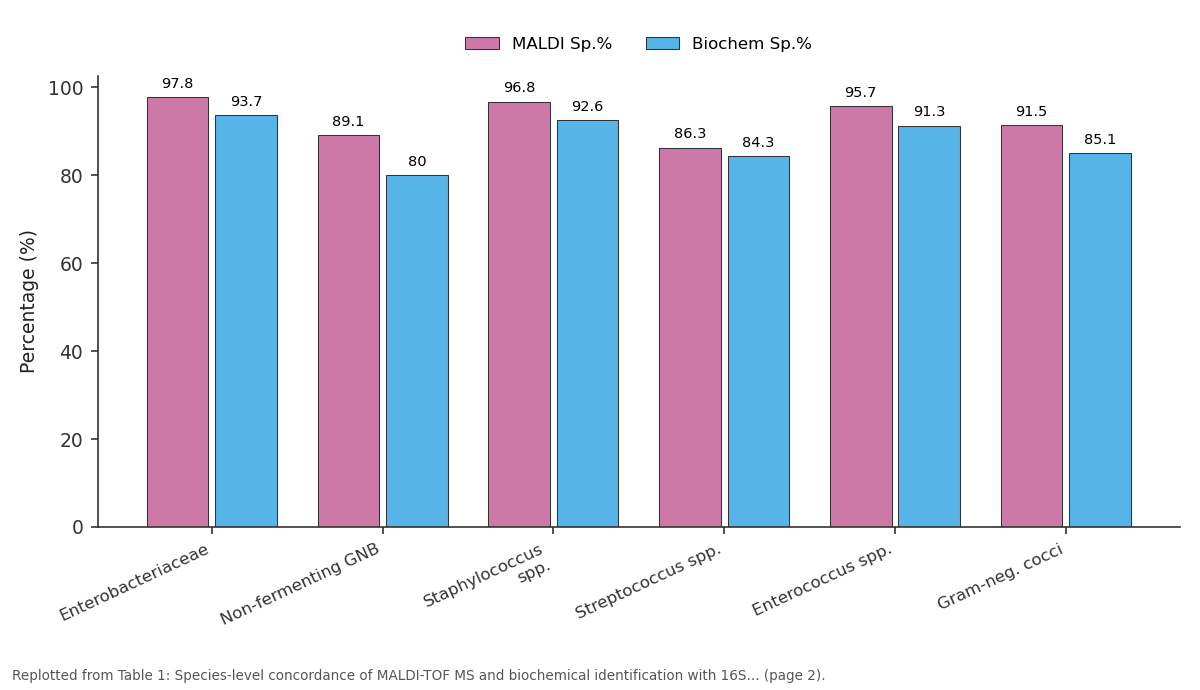
MALDI Sp.% and Biochem Sp.%: Enterobacteriaceae vs Non-fermenting GNB vs Staphylococcus spp. vs Streptococcus spp. vs Enterococcus spp.
Replotted from Table 1 (page 2) of the original paper. Every bar is the paper's own table value.
View source evidence ↗Figures & tables
From the original paper Table 1
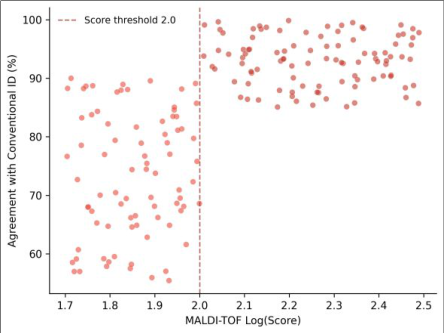 Figure 1
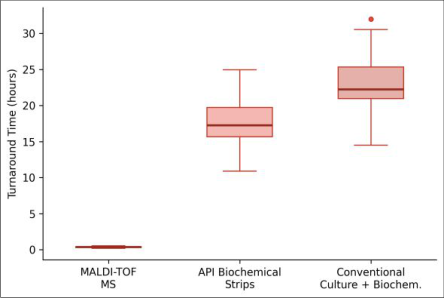 Figure 2
Introduction
Correct bacterial identification within the first few hours of culture positivity can reshape antibiotic therapy. Conventional identification—Gram staining followed by biochemical panels—typically takes 18 to 48 hours after colony growth [1]. MALDI-TOF MS entered clinical laboratories around 2010 and has since become the preferred first-line tool in many settings [2]. The technique ionises ribosomal proteins from a colony smear, generates a mass spectrum, and matches it against a reference library in under 20 minutes.
Large European evaluations have reported species-level rates above 90% [3]. Data from South Asia are still limited, particularly from laboratories handling a tropical pathogen mix [4]. In India, MALDI-TOF adoption has accelerated in tertiary hospitals, yet smaller laboratories remain uncertain about performance outside curated reference collections [5]. This research evaluated accuracy and speed of a Bruker Biotyper system against conventional identification in Goa, India, with 16S rRNA sequencing as reference standard [6].
Instrumentation Identification used a Bruker MALDI Biotyper (Bruker Daltonics, Bremen, Germany) with a smartbeam laser at 60 Hz, acquiring spectra in the 2,000-20,000 Da range. Daily calibration used the Bruker Bacterial Test Standard. Conventional identification employed API 20E and API 20NE strips (bioMérieux). For the 16S rRNA reference, PCR products were sequenced on an Applied Biosystems 3500 Genetic Analyzer using BigDye Terminator v3.1 chemistry.
Material And Methods
Materials A total of 412 non-duplicate isolates were collected from clinical specimens at the Konkan Institute of Biological Research, Goa, India, between January and August 2023. Specimens included blood cultures (n = 127), urine (n = 114), wound swabs (n = 89), respiratory NAAS Rating: 4.82 IJBS 2025; 7(3): 95-97 Abhilash Kamath Department of Microbiology, Konkan Institute of Biological Research, Goa, India Upasana Venkatraman Department of Microbiology, Konkan Institute of Biological Research, Goa, India Abhilash Kamath Department of Microbiology, Konkan Institute of Biological Research, Goa, India https://www.biologyjournal.net identity = species match and ≥97% = genus match [9]. Chi- square tests compared concordance rates (p < 0.05). Quality Control Daily calibration of the Biotyper used the Bruker Bacterial Test Standard.
Reference strains E. coli ATCC 25922, S. aureus ATCC 25923, and P. aeruginosa ATCC 27853 were run weekly. API strips were tested with control organisms per new lot. Sequencing quality was monitored by Phred scores (threshold ≥30).
Results
secretions (n = 52), and sterile body fluids (n = 30). Isolates were subcultured onto Columbia blood agar and MacConkey agar (Oxoid) at 35 °C for 18-24 hours and stored in BHI broth with 20% glycerol at −70 °C.
Methods
For MALDI-TOF, a single colony was smeared onto a steel target plate, overlaid with 1 µL alpha-cyano-4- hydroxycinnamic acid matrix, and air-dried. Scores ≥2.0 indicated reliable species identification; 1.7-1.99 genus- level [7]. Each isolate was tested in duplicate. Biochemical identification followed standard algorithms [8].
Partial 16S rRNA sequencing (~800 bp) served as reference, with ≥99% Table 1: Species-level concordance of MALDI-TOF MS and biochemical identification with 16S rRNA sequencing Bacterial Group n MALDI Sp.% MALDI Gen.% Biochem Sp.% p-value Enterobacteriaceae 142 97.8 100.0 93.7 0.048 Non-fermenting GNB 55 89.1 96.4 80.0 0.031 Staphylococcus spp. 94 96.8 100.0 92.6 0.107 Streptococcus spp. 51 86.3 98.0 84.3 0.512 Enterococcus spp. 23 95.7 100.0 91.3 0.426 Gram-neg. cocci 47 91.5 97.9 85.1 0.089 Overall 412 94.7 98.3 89.1 <0.001 GNB = Gram-negative bacilli. MALDI-TOF achieved overall 94.7% species-level concordance, significantly higher than 89.1% for biochemical methods (p < 0.001). The widest gap appeared among non-fermenting GNB (9.1 percentage points). Median turnaround was 21 minutes (IQR 16-28) for MALDI-TOF versus 22.1 hours (IQR 18.3-25.7) for biochemical panels.
| Bacterial Group | n | MALDI Sp.% | MALDI Gen.% | Biochem Sp.% | p-value |
|---|---|---|---|---|---|
| Enterobacteriaceae | 142 | 97.8 | 100.0 | 93.7 | 0.048 |
| Non-fermenting GNB | 55 | 89.1 | 96.4 | 80.0 | 0.031 |
| Staphylococcus spp. | 94 | 96.8 | 100.0 | 92.6 | 0.107 |
| Streptococcus spp. | 51 | 86.3 | 98.0 | 84.3 | 0.512 |
| Enterococcus spp. | 23 | 95.7 | 100.0 | 91.3 | 0.426 |
| Gram-neg. cocci | 47 | 91.5 | 97.9 | 85.1 | 0.089 |
| Overall | 412 | 94.7 | 98.3 | 89.1 | <0.001 |
Table text extracted from the original PDF; superscript letters are shown inline. The original table image is below.
View original table image
Per-test consumable cost was INR 42 for MALDI-TOF versus INR 85 for API strips. Fig 1: Scatter plot of MALDI-TOF log(score) versus percentage agreement with 16S rRNA identification for 412 isolates
Discussion
The 94.7% concordance matches large European validation findings and confirms that the Bruker Biotyper database performs well on a tropical Indian collection [10]. Enterobacteriaceae performance was strongest (97.8%). Non-fermenting GNB showed a lower but acceptable 89.1%, likely because the reference library still lacks some tropical environmental species [11]. The turnaround reduction is the most clinically impactful finding—delivering a species name within 21 minutes enables same-shift antibiotic adjustment [12].
Limitations include exclusion of anaerobes and mycobacteria and the single-centre design [13].
Conclusion
MALDI-TOF MS delivered species-level identification concordant with 16S rRNA sequencing in nearly 95% of 412 clinical isolates, outperforming conventional biochemical identification. Turnaround dropped from a full day to under half an hour. These results support adoption as the primary identification platform in mid-sized Indian diagnostic laboratories. Regional referral models could extend benefits to smaller facilities, and ongoing database curation for tropical species would further boost accuracy [14].
Figures and tables from the paper
References
13 in the original paper- Patel R. MALDI-TOF MS for the diagnosis of infectious diseases. Clinical Chemistry. 2015;61(1):100-111.
- Croxatto A, Prod'hom G, Greub G. Applications of MALDI-TOF mass spectrometry in clinical diagnostic microbiology. FEMS Microbiology Reviews. 2012;36(2):380-407.
- Bizzini A, Greub G. Matrix-assisted laser desorption ionization time-of-flight mass spectrometry, a revolution in clinical microbial identification. Clinical Microbiology and Infection. 2010;16(11):1614-1619.
- Singhal N, Kumar M, Kanaujia PK, Virdi JS. MALDI- TOF mass spectrometry: an emerging technology for Fig 2: Box-and-whisker comparison of turnaround time across three identification methods https://www.biologyjournal.net microbial identification. Frontiers in Microbiology. 2015;6:791.
- Seng P, Drancourt M, Gouriet F, La Scola B, Fournier PE, Rolain JM, et al. Ongoing revolution in bacteriology: routine identification by MALDI-TOF MS. Clinical Infectious Diseases. 2009;49(4):543-551. 6. van Veen SQ, Claas EC, Kuijper EJ. High-throughput identification of bacteria and yeast by MALDI-TOF MS in conventional laboratories. Journal of Clinical Microbiology. 2010;48(3):900-907.
- Schubert S, Kostrzewa M. MALDI-TOF MS in the microbiology laboratory: current trends. Current Issues in Molecular Biology. 2017;23:17-32.
- Winn WC, Allen SD, Janda WM, Koneman EW, Procop GW, Schreckenberger PC, et al. Koneman's Color Atlas and Textbook of Diagnostic Microbiology. 6th ed. Philadelphia: Lippincott Williams and Wilkins; 2006.
- Janda JM, Abbott SL. 16S rRNA gene sequencing for bacterial identification in the diagnostic laboratory. Journal of Clinical Microbiology. 2007;45(9):2761- 2764.
- Lau AF, Drake SK, Cain SE, Dekker JP, Frank KM. Performance of the Bruker Biotyper and VITEK MS systems for identification of bacterial isolates. Journal of Clinical Microbiology. 2020;58(6):e00300-20.
- Sauget M, Valot B, Bertrand X, Hocquet D. Can MALDI-TOF mass spectrometry reasonably type bacteria? Trends in Microbiology. 2017;25(6):447-455.
- Tan KE, Ellis BC, Lee R, Stamper PD, Zhang SX, Carroll KC. Prospective evaluation of a MALDI-TOF MS system in a hospital microbiology laboratory. Journal of Clinical Microbiology. 2012;50(8):2524- 2531.
- Tran A, Alby K, Kerber A, Jones M, Gilligan PH. Cost savings by implementation of MALDI-TOF MS identification. Journal of Clinical Microbiology. 2015;53(8):2473-2479.
- Clark AE, Kaleta EJ, Arora A, Wolk DM. MALDI- TOF MS: a fundamental shift in clinical microbiology practice. Clinical Microbiology Reviews. 2013;26(3):547-603.