
Research article · 2025 · Full text
International Journal of Biology SciencesHepatitis E virus seroprevalence and risk factors in pig farm workers and veterinarians
Volume 7(11) · Pages 50–52 · DOI: 10.33545/26649926.2025.v7.i11a.666 ↗
Research areasHepatitis Viruses Studies and EpidemiologyAnimal Disease Management and EpidemiologyHepatitis B Virus Studies
Abstract
Author-writtenRoughly 20 million hepatitis E virus (HEV) infections occur worldwide each year, yet occupational risk among animal handlers in Southeast Asia remains poorly quantified. This cross-sectional research assessed HEV seroprevalence and risk factors among pig farm workers and veterinarians in Perak, Malaysia. A total of 320 participants—196 farm workers and 124 veterinarians—were recruited from June 2023 to August 2024. Serum samples were tested for anti-HEV IgG using ELISA, with positive samples confirmed by immunoblot assay. Overall seroprevalence was 29.7%, with farm workers showing higher seropositivity (34.7%) than veterinarians (21.8%). Multivariate logistic regression identified direct pig contact (OR = 3.42), absence of glove use (OR = 2.87), and manure handling (OR = 2.51) as the strongest predictors. These results point to substantial subclinical HEV exposure in pig-associated occupations and argue for targeted hygiene interventions.
Summary
Source-checkedPlain-language reading of the full paper, prepared with AI and checked against the text. Each point links to the authors' own words.
Why it matters
- Hepatitis E virus (HEV) is a global health concern, with approximately 20 million infections occurring annually. View evidence ↗
- HEV genotypes 3 and 4 are zoonotic, meaning they are transmitted between domestic pigs and humans. View evidence ↗
- Perak, Malaysia, has one of the largest swine populations in the country, but there is limited data on HEV exposure among people working in this sector. View evidence ↗
The question
- The study aimed to measure the prevalence of anti-HEV IgG antibodies and identify risk factors among veterinarians and pig farm workers in Perak. View evidence ↗
What they did
- The study recruited 320 participants (196 farm workers and 124 veterinarians) between June 2023 and August 2024. View evidence ↗
- Researchers used ELISA to test serum samples for anti-HEV IgG, and confirmed positive results using an immunoblot assay. View evidence ↗
- Demographics, hygiene practices, and occupational history were collected via a structured questionnaire. View evidence ↗
- The analysis involved chi-square tests for univariate analysis and multivariate logistic regression for variables with p < 0.20. View evidence ↗
What they found
- The overall seroprevalence of anti-HEV IgG among the participants was 29.7% (95 out of 320). View evidence ↗
- Farm workers had a significantly higher seroprevalence rate (34.7%) compared to veterinarians (21.8%). View evidence ↗
- Direct contact with pigs was the strongest predictor of seropositivity, with an adjusted odds ratio (aOR) of 3.42. View evidence ↗
- Consumption of raw pork was significantly associated with seropositivity, with an adjusted odds ratio of 1.93. View evidence ↗
- Most infections in the study group were subclinical, as seropositive participants did not report symptomatic hepatitis. View evidence ↗
What it means
- The authors note that a randomized trial is necessary to confirm the causal relationship between the lack of glove use and HEV risk. View evidence ↗
Visual summary
2 visualsIllustrations explain the paper; charts are replotted from the paper's own table values.
Risk Factors for HEV Exposure
AI-generated conceptual illustration (pig farm workers and domestic pigs). It explains the idea and does not show study data.
View source evidence ↗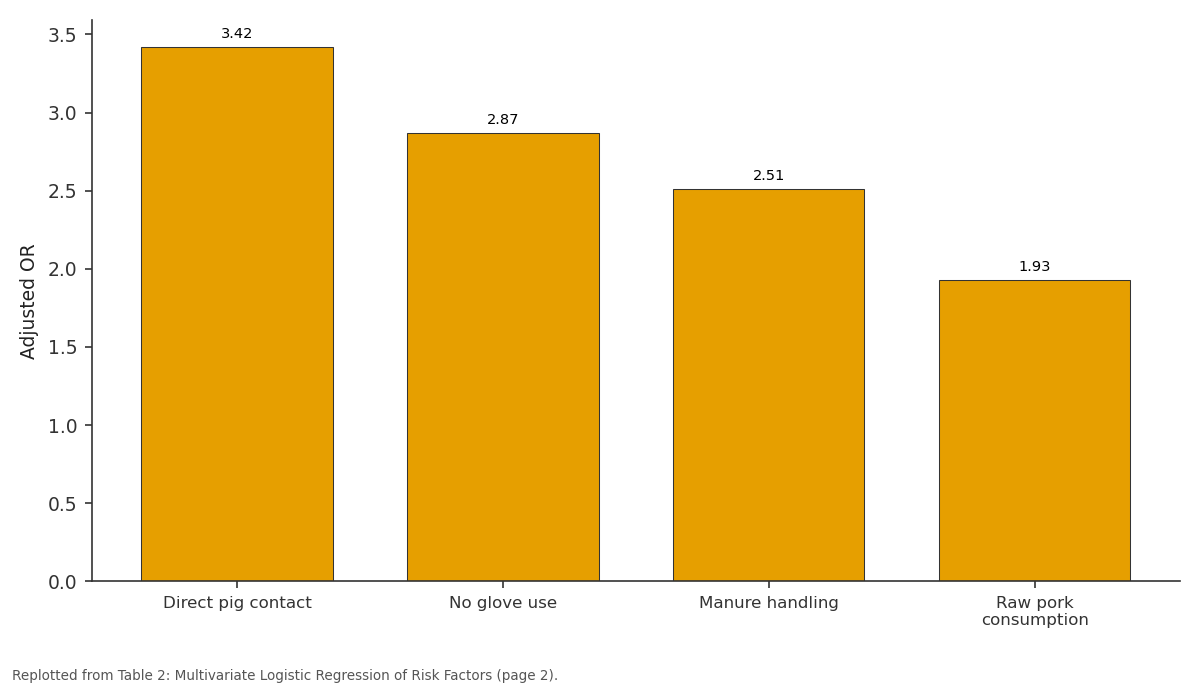
Adjusted OR: Direct pig contact vs No glove use vs Manure handling vs Raw pork consumption
Replotted from Table 2 (page 2) of the original paper. Every bar is the paper's own table value.
View source evidence ↗Figures & tables
From the original paper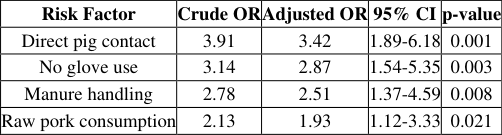 Table 2
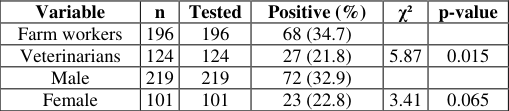 Table 1
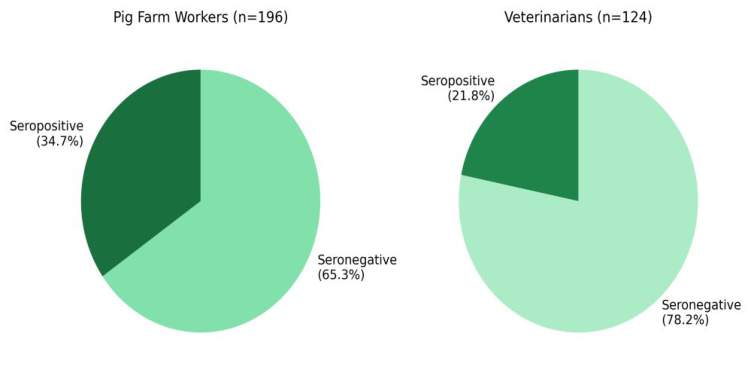 Figure 1
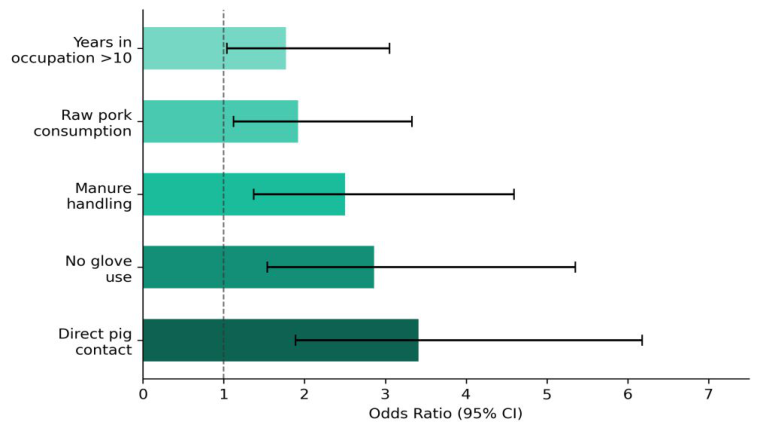 Figure 2
Introduction
An estimated 3.3 million symptomatic hepatitis E cases arise each year, causing approximately 44,000 deaths globally [1]. While waterborne transmission of genotypes 1 and 2 dominates in low-income settings, genotypes 3 and 4 are primarily zoonotic and circulate between domestic pigs and humans [2]. Malaysia's pig farming sector is concentrated in a few states, with Perak housing one of the largest swine populations, yet only a handful of investigations have measured HEV exposure in Malaysian occupational cohorts [3]. Pigs serve as the main reservoir for HEV genotype 3, with viral RNA detected in liver, feces, and blood of healthy swine [4].
Serological surveys in Europe have reported higher anti-HEV prevalence in swine workers compared to the general population [5, 6]. This research aimed to determine anti-HEV IgG seroprevalence among pig farm workers and veterinarians in Perak and to identify associated risk factors.
Materials And Methods
Materials This cross-sectional research was conducted at the Department of Clinical Virology, Perak College of Biological Sciences, Ipoh, Perak, Malaysia, from June 2023 to August 2024. The Institutional Ethics Committee approved the protocol (PCBS-IEC/2023-042, May 15, 2023). A total of 320 participants were enrolled: 196 pig farm workers from 28 farms and 124 veterinarians from 15 clinics across Kinta, Batang Padang, and Manjung districts. Venous blood (8 mL) was collected, centrifuged at 3,000 rpm, and serum stored at-20 °C.
A structured questionnaire captured demographics, occupational history, and hygiene practices.
Methods
Anti-HEV IgG was detected using the Wantai HEV-IgG ELISA kit (Wantai Biological Pharmacy, Beijing, China) with sensitivity of 97.8% and specificity of 99.6% [7]. Positive samples and 10% of negatives underwent confirmatory immunoblot assay (Mikrogen GmbH, Germany) [8]. Univariate analysis used chi-square tests; variables with p < 0.20 entered multivariate logistic regression. Odds ratios with 95% confidence intervals were calculated.
Analysis was performed in SPSS version 28.0 [9]. NAAS Rating (2025): 4.82 IJBS 2025; 7(11): 50-52 Sakinah Tahir Department of Clinical Virology, Perak College of Biological Sciences, Ipoh, Perak, Malaysia Syamsul Ghazali Department of Clinical Virology, Perak College of Biological Sciences, Ipoh, Perak, Malaysia Taslim Rashdi Department of Clinical Virology, Perak College of Biological Sciences, Ipoh, Perak, Malaysia Sakinah Tahir Department of Clinical Virology, Perak College of Biological Sciences, Ipoh, Perak, Malaysia https://www.biologyjournal.net Table 2: Multivariate Logistic Regression of Risk Factors
| Risk Factor | Crude OR | Adjusted OR | 95% CI | p-value |
|---|---|---|---|---|
| Direct pig contact | 3.91 | 3.42 | 1.89-6.18 | 0.001 |
| No glove use | 3.14 | 2.87 | 1.54-5.35 | 0.003 |
| Manure handling | 2.78 | 2.51 | 1.37-4.59 | 0.008 |
| Raw pork consumption | 2.13 | 1.93 | 1.12-3.33 | 0.021 |
Table text extracted from the original PDF; superscript letters are shown inline. The original table image is below.
View original table image
Results
Table 1: Anti-HEV IgG Seroprevalence by Occupational Group Risk Factor Crude ORAdjusted OR 95% CI p-value Direct pig contact 3.91 3.42 1.89-6.18 0.001 No glove use 3.14 2.87 1.54-5.35 0.003 Manure handling 2.78 2.51 1.37-4.59 0.008 Raw pork consumption 2.13 1.93 1.12-3.33 0.021 Direct pig contact carried the highest adjusted odds of seropositivity (aOR = 3.42), followed by absence of glove use and manure handling. Variable n Tested Positive (%) χ² p-value Farm workers 196 196 68 (34.7) Veterinarians 124 124 27 (21.8) 5.87 0.015 Male 219 219 72 (32.9) Female 101 101 23 (22.8) 3.41 0.065 Overall seroprevalence was 29.7% (95/320). Farm workers had significantly higher rates than veterinarians (34.7% vs. 21.8%, p = 0.015). Fig 1: Anti-HEV IgG seroprevalence in pig farm workers (34.7%) and veterinarians (21.8%).
| Variable | n | Tested | Positive (%) | χ² | p-value |
|---|---|---|---|---|---|
| Farm workers | 196 | 196 | 68 (34.7) | ||
| Veterinarians | 124 | 124 | 27 (21.8) | 5.87 | 0.015 |
| Male | 219 | 219 | 72 (32.9) | ||
| Female | 101 | 101 | 23 (22.8) | 3.41 | 0.065 |
Table text extracted from the original PDF; superscript letters are shown inline. The original table image is below.
View original table image
Fig 2: Adjusted odds ratios and 95% confidence intervals for risk factors associated with HEV seropositivity.
Discussion
The overall 29.7% seroprevalence exceeds the estimated 5- 10% for the general Malaysian population [3]. This gap is consistent with European occupational surveys documenting two-to four-fold higher prevalence among swine-exposed workers [5, 6]. Direct pig contact emerged as the strongest risk factor, aligning with the understanding that HEV genotype 3 sheds abundantly in pig feces [4]. The protective effect implied by elevated risk among non-glove users supports PPE interventions, though a randomized trial would be needed to confirm causality [10].
The absence of symptomatic hepatitis among seropositive participants suggests most infections were subclinical, typical for immunocompetent adults with genotype 3 [11]. Nevertheless, subclinical infections can progress to chronic hepatitis in immunocompromised individuals [12].
Conclusion
This research found 29.7% HEV seroprevalence among pig farm workers and veterinarians in Perak, Malaysia. Farm workers showed greater seropositivity than veterinarians, consistent with more intensive animal contact. Direct pig contact, absence of glove use, and manure handling were independently associated with seropositivity. These findings support targeted occupational health interventions including mandatory PPE, hygiene training, and educational https://www.biologyjournal.net campaigns discouraging raw pork consumption among at- risk workers.
Acknowledgements
Funding Sources This research was supported by internal departmental funds from the Perak College of Biological Sciences. Institutional Support The authors thank the Perak College of Biological Sciences for laboratory access and farm owners who facilitated recruitment. Contributions Not Qualifying for Authorship Phlebotomy staff and research assistants who administered questionnaires are gratefully acknowledged.
References
12 in the original paper- World Health Organization. Hepatitis E fact sheet. WHO. 2023. Accessed January 10, 2024.
- Kamar N, Izopet J, Pavio N, Aggarwal R, Labrique A, Wedemeyer H, et al. Hepatitis E virus infection. Nature Reviews Disease Primers. 2017;3:17086.
- Saat Z, Salmah IS, Suri AS, Amal NM, Wahab MA. Seroprevalence of hepatitis E virus infection in Malaysia. Malaysian Journal of Pathology. 2011;33(1):49-53.
- Meng XJ, Purcell RH, Halbur PG, Lehman JR, Webb DM, Tsareva TS, et al. A novel virus in swine closely related to human hepatitis E virus. Proceedings of the National Academy of Sciences. 1997;94(18):9860- 9865.
- Krumbholz A, Mohn U, Lange J, Motz M, Wenzel JJ, Jilg W, et al. Prevalence of hepatitis E virus antibodies in humans with occupational exposure to pigs. Medical Microbiology and Immunology. 2012;201(2):239-244.
- Galiana C, Fernandez-Barredo S, Garcia A, Gomez MT, Perez-Gracia MT. Occupational exposure to hepatitis E virus in swine workers. American Journal of Tropical Medicine and Hygiene. 2008;78(6):1012- 1015.
- Pas SD, Streefkerk RH, Pronk M, de Man RA, Beersma MF, Osterhaus AD, et al. Diagnostic performance of selected commercial HEV ELISAs. Journal of Clinical Virology. 2013;58(4):629-634.
- Avellon A, Morago L, Garcia-Galera del Carmen M, Munoz M, Echevarria JM. Comparative sensitivity of commercial tests for hepatitis E genotype 3 antibody detection. Journal of Medical Virology. 2015;87(11):1934-1939.
- IBM Corp. IBM SPSS Statistics for Windows, Version 28.0. IBM Corp. 2021. Armonk, NY.
- Teixeira J, Mesquita JR, Pereira SS, Oliveira RM, Abreu-Silva J, Rodrigues A, et al. Prevalence of hepatitis E virus antibodies in workers exposed to swine in Portugal. Medical Microbiology and Immunology. 2017;206(1):77-81.
- Dalton HR, Bendall R, Ijaz S, Banks M. Hepatitis E: an emerging infection in developed countries. Lancet Infectious Diseases. 2008;8(11):698-709.
- Kamar N, Selves J, Mansuy JM, Ouezzani L, Peron JM, Guitard J, et al. Hepatitis E virus and chronic hepatitis in organ-transplant recipients. New England Journal of Medicine. 2008;358(8):811-817.