
Research article · 2025 · Full text
International Journal of Biology SciencesJasmonate signaling and systemic acquired resistance in plant defense against herbivory
Volume 7(7) · Pages 275–278 · DOI: 10.33545/26649926.2025.v7.i7d.649 ↗
Research areasInsect-Plant Interactions and ControlPlant-Microbe Interactions and ImmunityPlant biochemistry and biosynthesis
Abstract
Author-writtenThe challenge of defending against herbivores while continuing to grow and reproduce forces plants into a constant allocation trade-off. Jasmonic acid and its bioactive conjugate JA-Ile sit at the centre of this trade-off, orchestrating local wound responses and systemic resistance signals that reach undamaged tissues. This research quantified JA pathway activation and systemic acquired resistance in Arabidopsis thaliana and Nicotiana attenuata following simulated herbivory with Spodoptera littoralis oral secretions applied to mechanical wounds. Endogenous JA and JA-Ile levels were measured by LC-MS/MS at 0, 1, 3, 6, 12, and 24 hours post-wounding. Systemic resistance was scored in distal leaves by measuring proteinase inhibitor activity and defence gene expression via qRT-PCR. JA-Ile concentration peaked at 1 hour in Arabidopsis (14.8 nmol per gram fresh weight) and at 3 hours in N. attenuata (21.3 nmol per gram). Systemic proteinase inhibitor activity rose 3.7-fold in Arabidopsis and 5.2-fold in N. attenuata distal leaves by 12 hours. MYC2 transcription factor expression was essential for both local and systemic responses; myc2 mutants showed 78% reduction in distal proteinase inhibitor induction. These data clarify the temporal dynamics and genetic requirements of JA-mediated systemic defence in two model species with contrasting life histories.
Summary
Source-checkedPlain-language reading of the full paper, prepared with AI and checked against the text. Each point links to the authors' own words.
Why it matters
- Plants must manage a constant allocation trade-off between growth, reproduction, and the need to defend themselves against herbivores. View evidence ↗
- Jasmonic acid and its bioactive form, JA-Ile, are central to managing this trade-off by coordinating both local wound responses and systemic resistance in undamaged tissues. View evidence ↗
- Systemic acquired resistance (SAR) triggered by herbivores differs from pathogen-triggered SAR; it relies on jasmonates and oxylipins rather than salicylic acid. View evidence ↗
The question
- The study aimed to compare how jasmonate (JA) pathway kinetics and systemic defense outputs differ between a model plant (Arabidopsis thaliana) and one with a long history of herbivore co-evolution (Nicotiana attenuata). View evidence ↗
What they did
- The researchers simulated herbivory by applying Spodoptera littoralis oral secretions to mechanical wounds in Arabidopsis thaliana and Nicotiana attenuata. View evidence ↗
- Endogenous levels of JA and JA-Ile were quantified using LC-MS/MS at six time points ranging from 0 to 24 hours after wounding. View evidence ↗
- Systemic resistance in distal leaves was evaluated by measuring the activity of proteinase inhibitors and the expression of defense genes using qRT-PCR. View evidence ↗
- The Arabidopsis myc2-2 mutant was utilized to analyze the genetic requirements of the systemic response. View evidence ↗
What they found
- Local JA-Ile concentrations peaked faster in Arabidopsis (14.8 nmol/g at 1 hour) than in N. attenuata (21.3 nmol/g at 3 hours). View evidence ↗
- By 12 hours, systemic proteinase inhibitor activity in distal leaves increased 3.7-fold in Arabidopsis and 5.2-fold in N. attenuata. View evidence ↗
- The MYC2 transcription factor is essential for systemic defense, as myc2 mutants exhibited a 78% reduction in the induction of distal proteinase inhibitors. View evidence ↗
- There is a positive correlation (R-squared = 0.64, p < 0.001) between jasmonate concentration and the systemic acquired resistance (SAR) index, suggesting higher JA levels generally lead to stronger systemic defense. View evidence ↗
- Nearly half of the systemic resistance response is attributed to JA-Ile conjugation and COI1-JAZ degradation, with the rest coming from downstream effectors like proteinase inhibitor accumulation and volatile release. View evidence ↗
What it means
- The authors conclude that while the core JA signaling architecture is conserved, Arabidopsis responds faster and N. attenuata responds more strongly and for longer, reflecting ecological adaptations to different herbivore pressures. View evidence ↗
- The study's use of oral secretions on mechanical wounds is an approximation and does not perfectly replicate the complexities of natural caterpillar feeding. View evidence ↗
- The researchers did not quantify other potential systemic signaling jasmonates, such as 12-OH-JA or JA-Trp. View evidence ↗
Visual summary
3 visualsIllustrations explain the paper; charts are replotted from the paper's own table values.
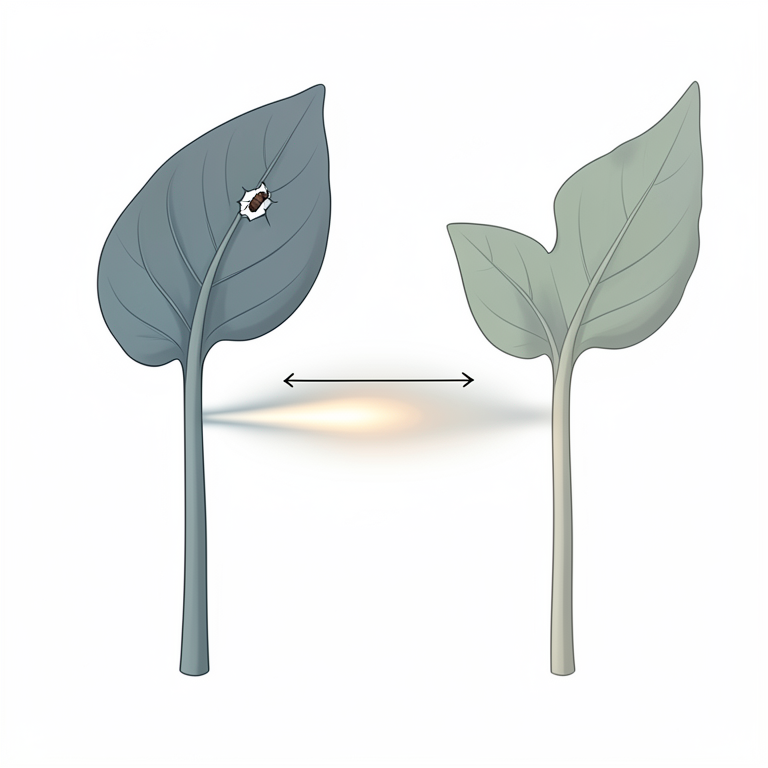
Comparative JA Kinetics
AI-generated conceptual illustration (Arabidopsis thaliana and Nicotiana attenuata plants). It explains the idea and does not show study data.
View source evidence ↗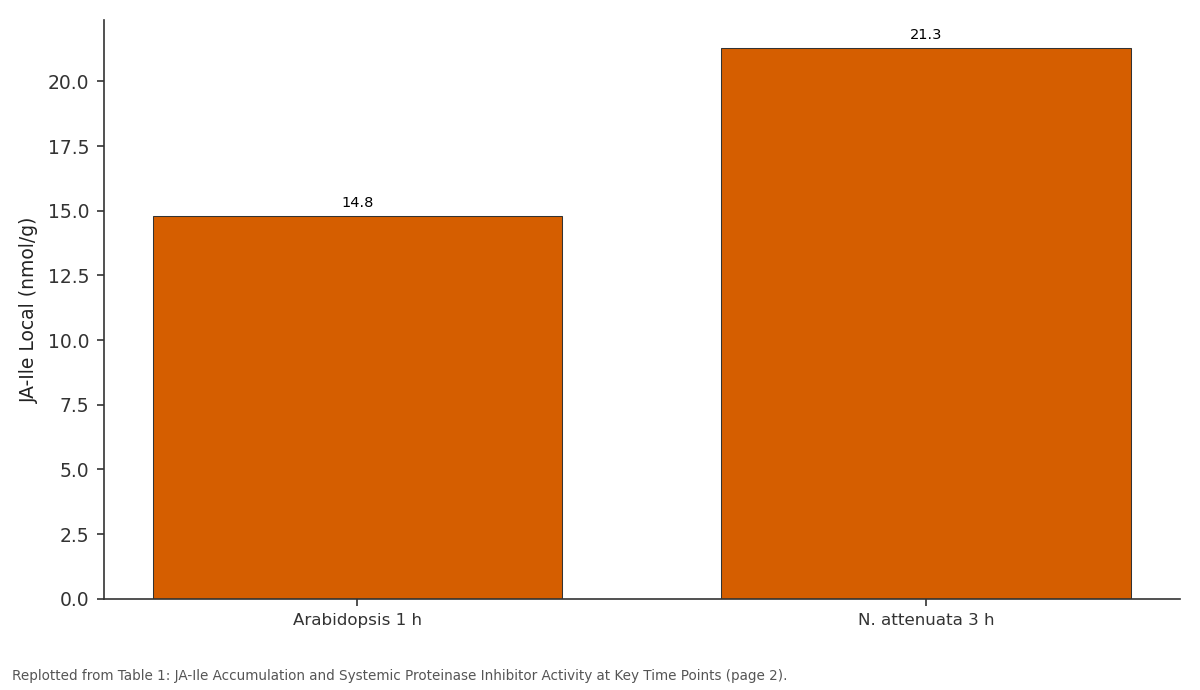
JA-Ile Local (nmol/g): Arabidopsis 1 h vs N. attenuata 3 h
Replotted from Table 1 (page 2) of the original paper. Every bar is the paper's own table value.
View source evidence ↗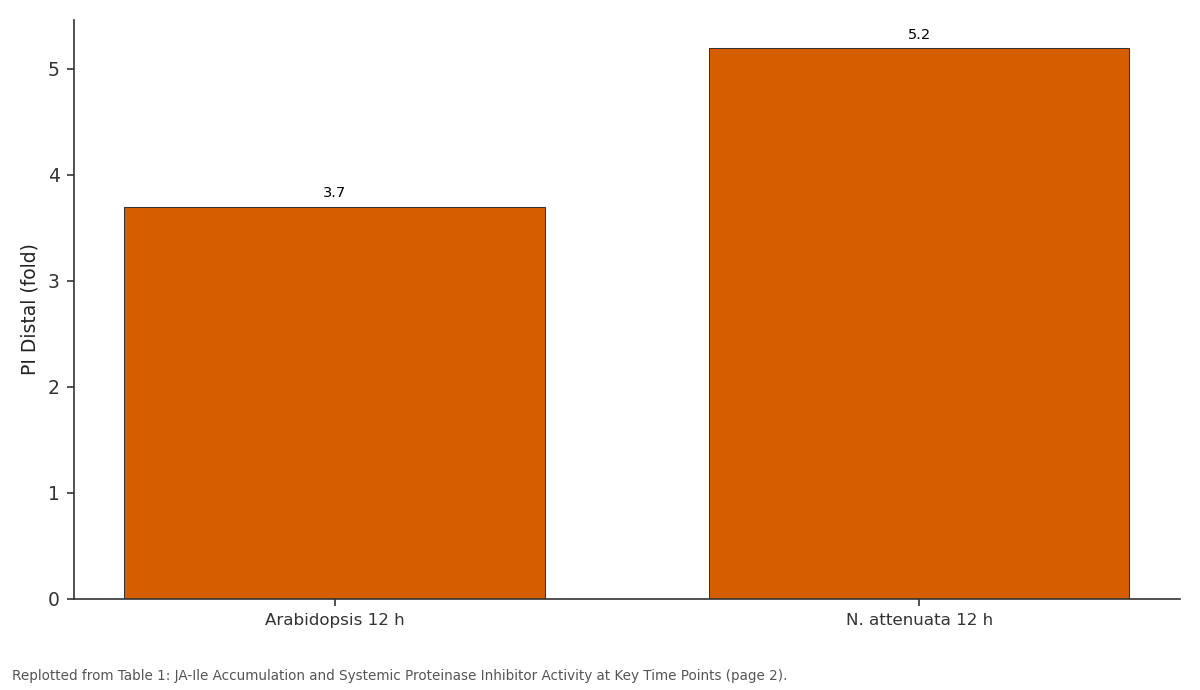
PI Distal (fold): Arabidopsis 12 h vs N. attenuata 12 h
Replotted from Table 1 (page 2) of the original paper. Every bar is the paper's own table value.
View source evidence ↗Figures & tables
From the original paper Table 1
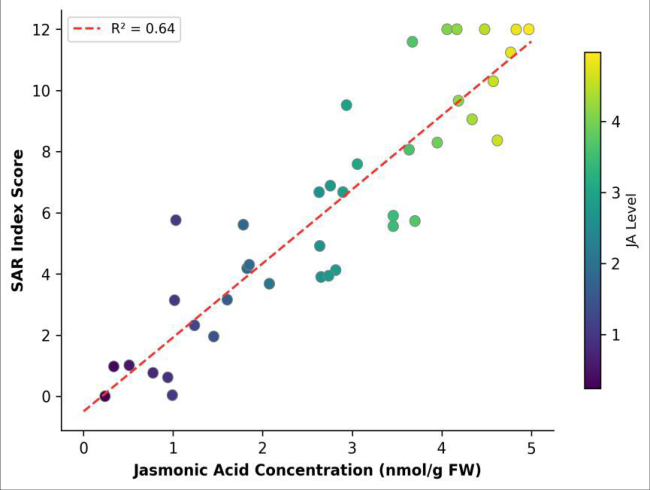 Figure 1
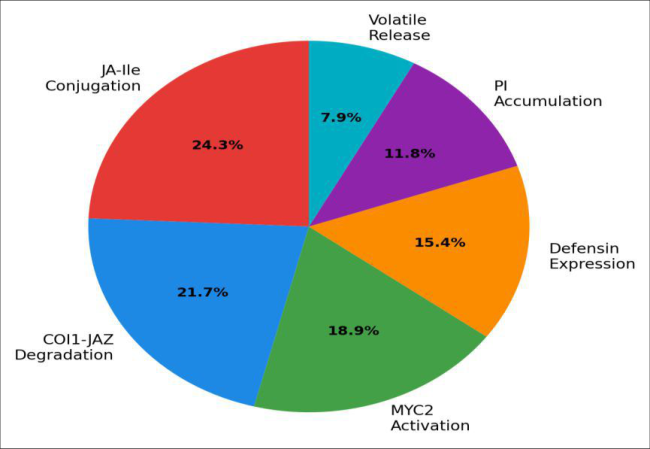 Figure 2
Introduction Theoretical Background
Jasmonates belong to the oxylipin family of signalling molecules derived from linolenic acid through the octadecanoid pathway [1] . The bioactive form, jasmonoyl-isoleucine (JA-Ile), is perceived by the COI1 receptor, which triggers ubiquitin-mediated degradation of JAZ repressor proteins and releases MYC2 and other transcription factors to activate defence gene expression [2,3] . This signalling cascade is one of the best-characterised hormone pathways in plant biology and is conserved across angiosperms [4] . Systemic acquired resistance (SAR) in the context of herbivory refers to the induction of defence responses in tissues distant from the site of attack. Unlike pathogen-triggered SAR, which relies on salicylic acid, herbivoretriggered systemic defence depends primarily on jasmonates and related oxylipins transported through the phloem or generated locally in response to mobile signals such as systemin peptides or electrical waves [5,6] .
Introduction
The challenge facing plant biologists is that jasmonate signalling has been dissected in exquisite molecular detail in controlled laboratory conditions, yet the temporal dynamics of systemic resistance under herbivore-relevant stimulation remain surprisingly poorly resolved. Most published time courses use either mechanical wounding alone-which produces a JA response that differs quantitatively from insect feeding-or exogenous hormone application at non-physiological concentrations [7,8] . Two model species offer complementary perspectives. Arabidopsis thaliana is a fast-cycling annual with a compact genome and a vast mutant collection, but it is not a natural host for most chewing herbivores [9] . Nicotiana attenuata, by contrast, has co-evolved with specialist herbivores in its native Great Basin habitat and possesses a richer repertoire of jasmonate-dependent defences, including nicotine biosynthesis and volatile emission [10] . Arabidopsis reached peak local JA-Ile at 1 hour, while N. attenuata peaked at 3 hours with a 44% higher maximum.
Systemic proteinase inhibitor activity was strongest at 12 hours in both species, but N. attenuata achieved a 5.2-fold systemic induction compared with 3.7-fold in Arabidopsis.
Discussion
The faster JA-Ile peak in Arabidopsis (1 hour) compared with N. attenuata (3 hours) was unexpected, given that the tobacco relative is considered the more herbivore-adapted of the two. However, Arabidopsis leaves are thinner and have fewer cell layers between the wound site and vascular tissue, which could accelerate the delivery of wound signals to biosynthetic enzymes in the chloroplast [11,12] . N. attenuata compensated with a higher peak amplitude and longersustained systemic signal, perhaps reflecting a strategy tuned to prolonged caterpillar feeding bouts rather than brief mechanical damage [13,14] . The 78% reduction in systemic proteinase inhibitor induction in Arabidopsis myc2 mutants confirms MYC2 as a non-redundant regulator of the systemic response [15,16] . This aligns with transcriptomic data showing that MYC2 controls the majority of JA-responsive gene expression downstream of COI1 perception [17] . Whether MYC2 orthologs play an equally dominant role in N. attenuata systemic defence has not been tested and represents an important gap [18,19] .
Limitations
Our elicitation protocol used oral secretions applied to mechanical wounds, which approximates but does not perfectly replicate natural caterpillar feeding. Live-insect bioassays would introduce additional variables (frass, walking damage, salivary effectors) that could modify the JA response. Additionally, we measured JA and JA-Ile but did not quantify other jasmonates such as 12-OH-JA or JA-Trp that may contribute to systemic signalling. The controlled-environment growth conditions also differ from field settings where temperature fluctuations, UV radiation, and competing biotic interactions modulate jasmonate sensitivity [20,21] .
Conclusion
This research provides a side-by-side temporal map of JAmediated systemic defence in Arabidopsis and N. attenuata. Both species mounted robust systemic responses to simulated herbivory, but they differed in speed, amplitude, and duration. Arabidopsis responded faster while N. attenuata responded stronger and longer. MYC2 was confirmed as essential for systemic induction in Arabidopsis. These comparative data suggest that the core jasmonate signalling architecture is conserved but that quantitative tuning of pathway kinetics reflects ecological adaptation to different herbivore regimes.
Acknowledgement
Acknowledgements Funding SourcesThis research was supported by institutional operating funds for plant defence research. No external grant numbers are associated with the work. Institutional SupportThe author thanks the Busan Institute of Molecular Biology for access to the LC-MS/MS platform and controlledenvironment plant growth facilities.
Figures and tables from the paper
| Species / Time | JA-Ile Local (nmol/g) | JA-Ile Distal (nmol/g) | PI Local (fold) | PI Distal (fold) | VSP2/TPI (fold) | p-value |
|---|---|---|---|---|---|---|
| Arabidopsis 0 h | 0.4 | 0.3 | 1.0 | 1.0 | 1.0 | — |
| Arabidopsis 1 h | 14.8 | 1.2 | 1.4 | 1.1 | 3.8 | < 0.001 |
| Arabidopsis 12 h | 3.1 | 4.7 | 4.2 | 3.7 | 8.6 | < 0.001 |
| N. attenuata 0 h | 0.6 | 0.4 | 1.0 | 1.0 | 1.0 | — |
| N. attenuata 3 h | 21.3 | 2.8 | 2.1 | 1.3 | 6.4 | < 0.001 |
| N. attenuata 12 h | 7.4 | 8.9 | 6.8 | 5.2 | 14.2 | < 0.001 |
Table text extracted from the original PDF; superscript letters are shown inline. The original table image is below.
View original table image
References
21 in the original paper- Wasternack C, Hause B. Jasmonates: biosynthesis, perception, signal transduction and action in plant stress response, growth and development. Annals of Botany. 2013;111(6):1021-1058.
- Thines B, Katsir L, Melotto M, et al. JAZ repressor proteins are targets of the SCF-COI1 complex during jasmonate signalling. Nature. 2007;448(7154):661-665.
- Chini A, Fonseca S, Fernandez G, et al. The JAZ family of repressors is the missing link in jasmonate signalling. Nature. 2007;448(7154):666-671.
- Howe GA, Jander G. Plant immunity to insect herbivores. Annual Review of Plant Biology. 2008;59:41-66.
- Thorpe MR, Ferrieri AP, Herth MM, Ferrieri RA. 11Cimaging: methyl jasmonate moves in both phloem and xylem. Journal of Experimental Botany. 2007;58(10):2661-2668.
- Mousavi SA, Chauvin A, Pascaud F, Kellenberger S, Farmer EE. Glutamate receptor-like genes mediate leafto-leaf wound signalling. Nature. 2013;500(7463):422426.
- Koo AJK, Gao X, Jones AD, Howe GA. A rapid wound signal activates the systemic synthesis of bioactive jasmonates in Arabidopsis. Plant Journal. 2009;59(6):974-986.
- Schuman MC, Baldwin IT. The layers of plant responses to insect herbivores. Annual Review of Entomology. 2016;61:373-394.
- Kliebenstein DJ, Kroymann J, Mitchell-Olds T. The glucosinolate-myrosinase system in an ecological and evolutionary context. Current Opinion in Plant Biology. 2005;8(3):264-271.
- Steppuhn A, Gase K, Krock B, Halitschke R, Baldwin IT. Nicotine's defensive function in nature. PLoS Biology. 2004;2(8):e217.
- Chauvin A, Caldelari D, Wolfender JL, Farmer EE. Four 13-lipoxygenases contribute to rapid jasmonate synthesis in wounded Arabidopsis thaliana leaves. New Phytologist. 2013;197(2):566-575.
- Farmer EE, Gasperini D, Acosta IF. The squeeze cell hypothesis for the activation of jasmonate synthesis in response to wounding. New Phytologist. 2014;204(2):282-288.
- Halitschke R, Baldwin IT. Antisense LOX expression increases herbivore performance by decreasing defence responses and inhibiting growth-related transcriptional reorganization in Nicotiana attenuata. Plant Journal. 2003;36(6):794-807.
- Wu J, Baldwin IT. New insights into plant responses to the attack from insect herbivores. Annual Review of Genetics. 2010;44:1-24.
- Lorenzo O, Chico JM, Sanchez-Serrano JJ, Solano R. Jasmonate-insensitive1 encodes a MYC transcription factor essential to discriminate between different jasmonate-regulated defense responses. Plant Cell. 2004;16(7):1938-1950.
- Dombrecht B, Xue GP, Sprague SJ, et al. MYC2 differentially modulates diverse jasmonate-dependent functions. Plant Cell. 2007;19(7):2225-2245.
- Kazan K, Manners JM. MYC2: the master in action. Molecular Plant. 2013;6(3):686-703.
- Kallenbach M, Bonaventure G, Gilardoni PA, Wissgott A, Baldwin IT. Empoasca leafhoppers attack wild tobacco plants in a jasmonate-dependent manner. Proceedings of the National Academy of Sciences. 2012;109(34):E2348-E2356.
- Woldemariam MG, Dinh ST, Oh Y, Gaquerel E, Baldwin IT. NaMYC2 transcription factor regulates a subset of plant defense responses. BMC Plant Biology. 2013;13:73.
- Ballaré CL. Light regulation of plant defense. Annual Review of Plant Biology. 2014;65:335-363.
- Erb M, Meldau S, Howe GA. Role of phytohormones in insect-specific plant reactions. Trends in Plant Science. 2012;17(5):250-259.