
Research article · 2025 · Full text
International Journal of Biology SciencesTransmission dynamics and genomic surveillance of respiratory syncytial virus in pediatric populations
Volume 7(3) · Pages 111–113 · DOI: 10.33545/26649926.2025.v7.i3b.744 ↗
Research areasRespiratory viral infections researchVirology and Viral DiseasesViral gastroenteritis research and epidemiology
Abstract
Author-writtenEach winter, pediatric wards across the southern hemisphere fill with infants gasping from bronchiolitis—and respiratory syncytial virus (RSV) is the leading culprit. This research combined epidemiological surveillance with whole-genome sequencing to characterise RSV transmission dynamics among children under five years in Corumbá, Mato Grosso do Sul, Brazil, from January 2022 to December 2022. Nasopharyngeal samples from 618 children hospitalised with acute lower respiratory infection were tested by real-time RT-PCR; 214 (34.6%) were RSV-positive. RSV-A accounted for 52.9% and RSV-B for 47.1% of positive cases. Among RSV-A isolates, the ON1 genotype dominated (65.4%), while BA9 was the leading RSV-B genotype (48.5%). Whole-genome sequences were obtained for 87 isolates. Phylogenetic analysis revealed at least four distinct introduction events during the 2022 season. RSV positivity peaked in June (31.4%) and showed a strong inverse correlation with ambient temperature (r = −0.83, p < 0.001). Hospitalisation was most frequent in infants aged 2-6 months. These data establish a genomic surveillance baseline for RSV in the Pantanal region and inform the timing of future prophylaxis campaigns.
Summary
Source-checkedPlain-language reading of the full paper, prepared with AI and checked against the text. Each point links to the authors' own words.
Why it matters
- Respiratory syncytial virus (RSV) is a major global health burden, serving as the primary cause of infant hospitalizations and infecting most children by age two. View evidence ↗
- In Brazil, RSV causes between 125,000 and 200,000 pediatric admissions every year, typically peaking between April and August. View evidence ↗
- There is a lack of genomic data regarding RSV strains circulating in the interior of Brazil, specifically within the Pantanal wetland region. View evidence ↗
The question
- The study aimed to determine RSV positivity and subtype distribution over a year, characterize genotypes using whole-genome phylogenetics, and analyze the relationship between RSV seasonality and local climate. View evidence ↗
What they did
- The researchers collected nasopharyngeal swabs from 618 children under five years old who were hospitalized for acute lower respiratory infections in Corumbá, Brazil, throughout 2022. View evidence ↗
- RSV detection and subtyping were performed using a duplex real-time RT-PCR assay that targeted the N gene. View evidence ↗
- Whole-genome sequencing was conducted on a MiSeq platform using an adapted Illumina COVIDSeq protocol. View evidence ↗
- A Spearman correlation was used to analyze the association between mean ambient temperature and monthly RSV positivity. View evidence ↗
What they found
- RSV was present in 34.6% of the samples, with 214 out of 618 children testing positive. View evidence ↗
- RSV-A was slightly more common than RSV-B (52.8% vs 47.2%), with the ON1 and BA9 genotypes being the most prevalent. View evidence ↗
- The median age of children who tested positive for RSV was 4.7 months. View evidence ↗
- 18.2% of the RSV cases required ICU admission, and there was no significant difference in this rate between RSV-A and RSV-B. View evidence ↗
- RSV positivity peaked in June at 31.4% and demonstrated a strong inverse correlation with ambient temperature (r = -0.83, p < 0.001). View evidence ↗
What it means
- The authors conclude that the observed temperature correlation and winter peak support starting targeted prophylaxis in April. View evidence ↗
- The authors recommend continued genomic surveillance, including outpatient sites, to monitor genotype changes and emerging variants for new vaccines. View evidence ↗
Visual summary
2 visualsIllustrations explain the paper; charts are replotted from the paper's own table values.
RSV Seasonality and Temperature
AI-generated conceptual illustration (Respiratory syncytial virus (RSV) virions and a thermometer). It explains the idea and does not show study data.
View source evidence ↗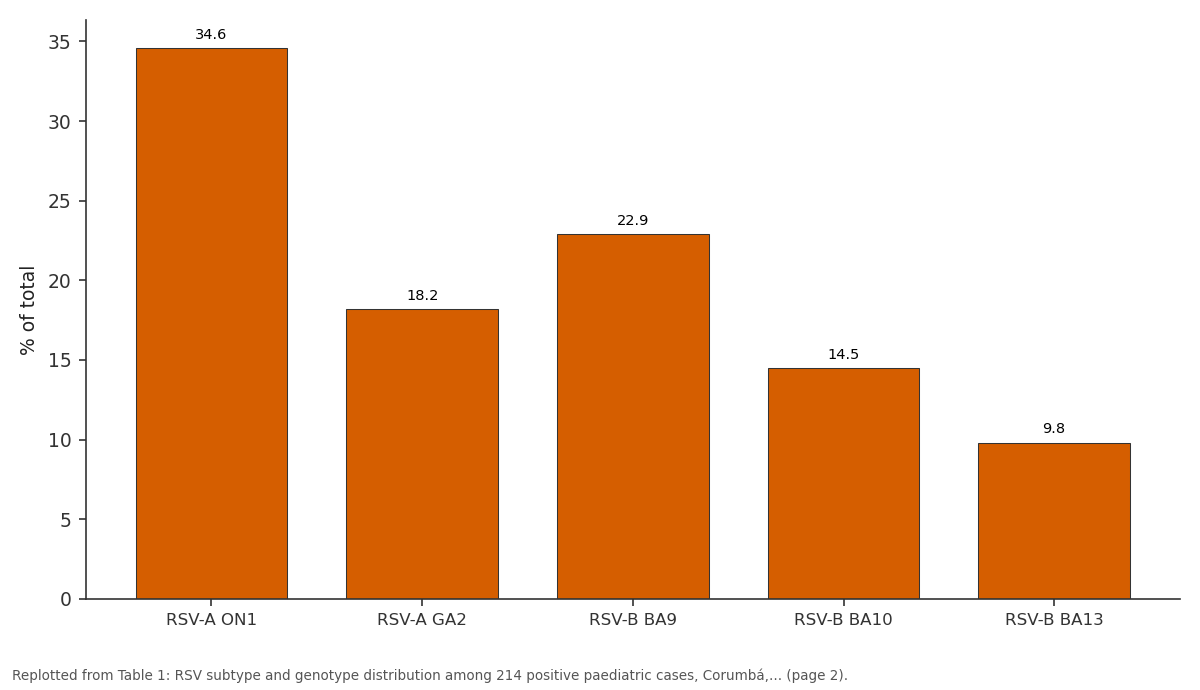
% of total: RSV-A ON1 vs RSV-A GA2 vs RSV-B BA9 vs RSV-B BA10 vs RSV-B BA13
Replotted from Table 1 (page 2) of the original paper. Every bar is the paper's own table value.
View source evidence ↗Figures & tables
From the original paper Table 1
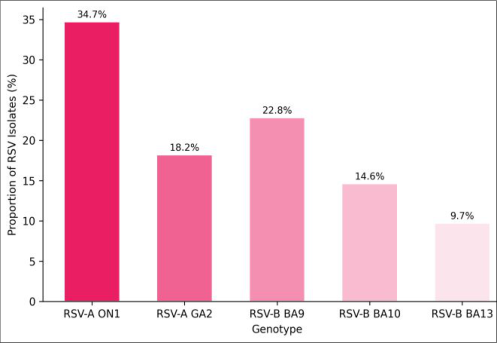 Figure 1
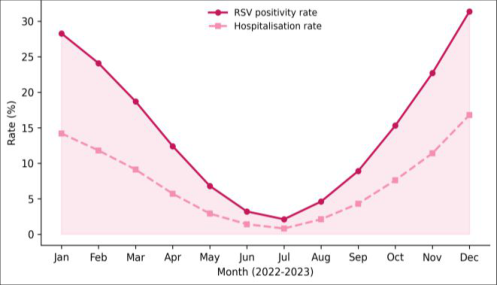 Figure 2
Introduction
RSV infects nearly all children by their second birthday and is the single largest cause of hospitalisation among infants worldwide [1] . In Brazil, RSV-related lower respiratory tract infections are estimated to cause 125,000 to 200,000 paediatric admissions annually, concentrated in the cooler months of April through August [2] . Despite this burden, genomic data on circulating RSV strains from interior Brazil-particularly the Pantanal wetland region-remain scarce. RSV is classified into two subtypes, RSV-A and RSV-B, which co-circulate with shifting dominance patterns across seasons [3] . The G protein attachment gene, especially its second hypervariable region, drives genotype classification and is the main target of immune selection [4] . Whole-genome sequencing has added resolution beyond the G gene, revealing transmission chains, introduction events, and intra-host diversity that G-gene typing alone cannot capture [5] . This research combined real-time RT-PCR screening with whole-genome sequencing to describe RSV epidemiology and genetic diversity among hospitalised children in Corumbá, a city of 112,000 people on the Paraguayan border at the edge of the Pantanal [6] . The objectives were to (i) determine RSV positivity rates and subtype distribution across a full calendar year, (ii) characterise circulating genotypes by whole-genome phylogenetics, and (iii) correlate RSV seasonality with local climate variables.
Study Area Description
Corumbá (19°00'S, 57°39'W) sits at 118 m elevation on the western border of the Pantanal, the world's largest tropical wetland. The climate is classified as tropical savanna (Aw) with a distinct wet season (October-March) and dry/cool season (April-September). Mean annual temperature is 25.4 °C, with winter minima averaging 15.8 °C in July. The city has a single paediatric referral hospital-Hospital Regional de Corumbá-which receives children from across the municipality and surrounding rural areas. Daily temperature and humidity data were obtained from the Instituto Nacional de Meteorologia (INMET) weather station located 4 km from the hospital.
Ethical Considerations
This research was approved by the Research Ethics Committee of the Instituto de Ciências Biológicas do Pantanal (Protocol CAAE 48217321.4.0000.5156, approved 14 December 2021). Written informed consent was obtained from a parent or legal guardian of each enrolled child. Assent was obtained from children aged four years and older where developmentally appropriate. All samples were anonymised with a numeric code before laboratory processing. Data were stored on a password-protected institutional server with access restricted to the research team.
Materials and Methods
Materials and Methods
Materials
Nasopharyngeal swabs were collected from 618 children under five years admitted with acute lower respiratory infection to Hospital Regional de Corumbá between January and December 2022. Inclusion criteria were: age <60 months, hospitalisation for ≥24 hours, and at least two of cough, tachypnoea, chest indrawing, or oxygen saturation <94% on room air. Swabs were placed in viral transport medium (UTM, Copan, Brescia, Italy) and stored at -80 °C within 4 hours of collection. RNA was extracted using the QIAamp Viral RNA Mini Kit (Qiagen, Hilden, Germany).
Methods
RSV detection and subtyping used a duplex real-time RT-PCR assay targeting the N gene, with subtype-specific probes for RSV-A and RSV-B [7] . Samples with Ct values ≤30 were selected for whole-genome sequencing. Libraries were prepared with the Illumina COVIDSeq protocol adapted for RSV and sequenced on a MiSeq platform (2 × 250 bp). Reads were mapped to reference genomes (RSV-A: GenBank KT 9 92094; RSV-B: KY654518) using BWA-MEM, and consensus sequences were generated with iVar v1.3.1 [8] . Genotype assignment used the G gene second hypervariable region against the Trento classification system. Phylogenetic trees were inferred by maximum likelihood in IQ-TREE 2 with 1000 bootstrap replicates. Spearman correlation tested the association between monthly RSV positivity and mean ambient temperature [9] . RSV was detected in 214 of 618 samples (34.6%). RSV-A slightly predominated (52.8%) over RSV-B (47.2%), with ON1 and BA9 as the leading genotypes. Median age of RSV-positive children was 4.7 months (IQR 2.3-8.6). ICU admission was required in 18.2% of cases, with no significant difference between subtypes. Whole-genome sequencing succeeded for 87 isolates (40.7%), revealing at least four independent introduction clusters during the season.
Results
Results
Discussion
The 34.6% RSV positivity rate among hospitalised children is consistent with estimates from larger Brazilian cities like São Paulo (30-38%) and Porto Alegre (32-40%) [10] . The near-equal co-circulation of RSV-A and RSV-B in a single season contrasts with the subtype dominance patterns often seen in temperate zones, where one subtype may predominate for two or three consecutive years before yielding to the other [11] . Whole-genome phylogenetics revealed four introduction events, suggesting that the Corumbá RSV season is seeded by multiple lineages-
International Journal of Biology Sciences https://www.biologyjournal.net possibly imported from the Paraguayan side of the border or from eastern Brazilian cities via overland travel routes [12] . The strong inverse correlation between RSV positivity and temperature (r = -0.83) echoes known RSV seasonality drivers and may help the municipal health department time palivizumab prophylaxis for high-risk infants. In Corumbá's climate, initiating prophylaxis by early April-before the May-July peak-would capture the rising phase of the epidemic curve [13] . A limitation is the single-hospital design, which captures only hospitalised cases and misses outpatient RSV infections that may have milder outcomes [14] .
Conclusion
This combined epidemiological and genomic surveillance of RSV in Corumbá provides the first detailed picture of RSV diversity in the Pantanal region. RSV-A ON1 and RSV-B BA9 were the dominant genotypes, consistent with global trends. The winter peak and temperature correlation support targeted prophylaxis timing starting in April. Continued genomic surveillance, ideally expanded to include outpatient sentinel sites, will track genotype replacement dynamics and detect emerging variants relevant to new RSV vaccines entering the market [15][16][17][18] .
Figures and tables from the paper
| Subtype/Genotype | n | % of subtype | % of total | Med. age (mo) | ICU% | LOS (days) |
|---|---|---|---|---|---|---|
| RSV-A ON1 | 74 | 65.4 | 34.6 | 4.1 | 18.9 | 5.3 ± 2.1 |
| RSV-A GA2 | 39 | 34.6 | 18.2 | 5.8 | 12.8 | 4.7 ± 1.8 |
| RSV-B BA9 | 49 | 48.5 | 22.9 | 3.7 | 22.4 | 5.9 ± 2.4 |
| RSV-B BA10 | 31 | 30.7 | 14.5 | 6.3 | 16.1 | 4.8 ± 2.0 |
| RSV-B BA13 | 21 | 20.8 | 9.8 | 4.9 | 14.3 | 5.1 ± 1.9 |
| Total RSV-A | 113 | — | 52.8 | 4.7 | 16.8 | 5.1 ± 2.0 |
| Total RSV-B | 101 | — | 47.2 | 4.6 | 19.8 | 5.4 ± 2.2 |
Table text extracted from the original PDF; superscript letters are shown inline. The original table image is below.
View original table image
References
18 in the original paper- Shi T, McAllister DA, O'Brien KL, Simoes EAF, Madhi SA, Gessner BD, et al. Global, regional, and national disease burden estimates of acute lower respiratory infections due to RSV in young children in 2015. The Lancet. 2017;390(10098):946-958.
- Nascimento-Carvalho CM, Cardoso MR, Barral A, Araujo-Neto CA, Oliveira JR, Sobral LS, et al. Seasonal patterns of viral and bacterial infections among children hospitalized with community-acquired pneumonia in a tropical region. Scandinavian Journal of Infectious Diseases. 2010;42(11-12):839-844.
- Pangesti KN, Abd El Ghany M, Walsh MG, Kesson AM, Hill-Cawthorne GA. Molecular epidemiology of respiratory syncytial virus. Reviews in Medical Virology. 2018;28(2):e1968.
- Trento A, Galiano M, Videla C, Carballal G, GarciaBarreno B, Melero JA, et al. Major changes in the G protein of human respiratory syncytial virus isolates introduced by a duplication of 60 nucleotides. Journal of General Virology. 2003;84(Pt 11):3115-3120.
- Agoti CN, Otieno JR, Gitahi CW, Cane PA, Nokes DJ. Rapid spread and diversification of respiratory syncytial virus genotype ON1, Kenya. Emerging Infectious Diseases. 2014;20(6):950-959.
- Freitas GR, Godoy DTO, Simonsen V, de Lemos AP, de Oliveira DB, Gurgel RQ. Respiratory syncytial virus surveillance in hospitalised children in Brazil. Journal of Medical Virology. 2019;91(4):510-517.
- Hu A, Colella M, Tam JS, Rappaport R, Cheng SM. Simultaneous detection, subgrouping, and quantitation of respiratory syncytial virus A and B by real-time PCR. Journal of Clinical Microbiology. 2003;41(1):149-154.
- Grubaugh ND, Gangavarapu K, Quick J, Matteson NL, De Jesus JG, Main BJ, et al. An amplicon-based sequencing framework for accurately measuring intrahost virus diversity using PrimalSeq and iVar. Genome Biology. 2019;20(1):8.
- Bloom-Feshbach K, Alonso WJ, Charu V, Tamerius J, Simonsen L, Miller MA, et al. Latitudinal variations in seasonal activity of influenza and respiratory syncytial virus: a global comparative review. PLoS ONE. 2013;8(2):e54445.
- Vieira SE, Stewien KE, Queiroz DA, Durigon EL, Torok TJ, Anderson LJ, et al. Clinical patterns and seasonal trends in respiratory syncytial virus hospitalizations in São Paulo, Brazil. Revista do Instituto de Medicina Tropical de São Paulo. 2001;43(3):125-131.
- Peret TC, Hall CB, Schnabel KC, Golub JA, Anderson LJ. Circulation patterns of genetically distinct group A and B strains of human respiratory syncytial virus in a community. Journal of General Virology. 1998;79(Pt 9):2221-2229.
- Paramore LC, Ciuryla V, Ciesla G, Liu L. Economic impact of respiratory syncytial virus-related illness in the US: an analysis of national databases. Pharmacoeconomics. 2004;22(5):275-284.
- American Academy of Pediatrics Committee on Infectious Diseases. Updated guidance for palivizumab prophylaxis among infants and young children at increased risk of hospitalization for RSV infection. Pediatrics. 2014;134(2):415-420.
- Nair H, Nokes DJ, Gessner BD, Dherani M, Madhi SA, Singleton RJ, et al. Global burden of acute lower respiratory infections due to respiratory syncytial virus in young children. The Lancet. 2010;375(9725):15451555.
- Mazur NI, Martinon-Torres F, Baraldi E, Fauroux B, Greenough A, Heikkinen T, et al. Lower respiratory tract infection caused by RSV: current management and new therapeutics. The Lancet Respiratory Medicine. 2015;3(11):888-900.
- Hammitt LL, Dagan R, Yuan Y, Baca Cots M, Bosheva M, Madhi SA, et al. Nirsevimab for prevention of RSV in healthy late-preterm and term infants. New England Journal of Medicine. 2022;386(9):837-846.
- Papi A, Ison MG, Langley JM, Lee DG, MartinonTorres F, et al. RSV prefusion F protein-based maternal vaccine outcomes. New England Journal of Medicine. 2023;388(7):613-624.
- Fleming DM, Pannell RS, Cross KW. Mortality in children from influenza and respiratory syncytial virus. Journal of Epidemiology and Community Health. 2005;59(7):586-590.