
Research article · 2025 · Full text
International Journal of Biology SciencesSurveillance and phylogenetic analysis of avian influenza viruses in wild waterfowl populations
Volume 7(7) · Pages 218–221 · DOI: 10.33545/26649926.2025.v7.i7c.641 ↗
Research areasInfluenza Virus Research StudiesVirology and Viral DiseasesBird parasitology and diseases
Abstract
Author-writtenRoughly 37% of newly detected avian influenza virus subtypes in Southeast Asia during the past five years originated from wild waterfowl rather than domestic poultry. This research carried out active virological surveillance in migratory and resident waterfowl across the Mekong Delta wetlands of southern Vietnam between January 2023 and August 2024. Cloacal and oropharyngeal swabs were collected from 1,284 birds spanning six species, and viral RNA was detected by real-time RT-PCR targeting the matrix gene. Of the samples tested, 7.8% (n = 100) returned positive results, with H5N1 accounting for the largest proportion (38.0%) followed by H5N6 (22.0%) and H7N9 (14.0%). Full-genome sequencing of 46 representative isolates and maximum-likelihood phylogenetic reconstruction revealed that Mekong Delta viruses clustered into three distinct clades, two of which showed close genetic ties to strains circulating in southern China. Reassortment events were detected in 13 isolates involving polymerase and nucleoprotein segments. Nucleotide identity across all eight gene segments ranged from 86.3% to 99.7% depending on host species and subtype. These data highlight the Mekong Delta as a mixing ground for diverse influenza lineages and support continued surveillance in wild bird populations to detect emerging reassortant viruses before they reach poultry or human interfaces.
Summary
Source-checkedPlain-language reading of the full paper, prepared with AI and checked against the text. Each point links to the authors' own words.
Why it matters
- Wild waterfowl, such as ducks, geese, and swans, serve as the primary natural reservoirs for most influenza A virus subtypes and are key to spreading these pathogens over long distances. View evidence ↗
- Vietnam's location at the intersection of the Central Asian and East Asian-Australasian flyways makes it a critical area for the exchange of viruses between resident and migratory birds. View evidence ↗
- Viral reassortment, which occurs when two viruses swap genome segments in a single cell, can create new genotypes with unpredictable pathogenicity and host ranges. View evidence ↗
The question
- The study aimed to determine the prevalence, subtype diversity, and phylogenetic relationships of avian influenza viruses in wild waterfowl within the Mekong Delta over 20 months. View evidence ↗
What they did
- Researchers collected cloacal and oropharyngeal swabs from wild waterfowl at four specific wetland sites in the Mekong Delta. View evidence ↗
- A total of 1,284 birds from six different species were sampled, and viral RNA was identified using real-time RT-PCR targeting the matrix gene. View evidence ↗
- Whole-genome sequencing was performed on 46 representative positive isolates using the Illumina MiSeq platform. View evidence ↗
- The study used IQ-TREE to construct maximum-likelihood phylogenetic trees for each gene segment to analyze viral relationships. View evidence ↗
What they found
- H5N1 was the most common subtype detected (38.0%), followed by H5N6 (22.0%) and H7N9 (14.0%). View evidence ↗
- Phylogenetic analysis identified three distinct clades of viruses, with two showing close genetic links to strains from southern China's Guangdong and Yunnan provinces. View evidence ↗
- Reassortment involving nucleoprotein and polymerase segments was detected in 13 of the 46 sequenced isolates. View evidence ↗
- The nucleotide identity across the eight gene segments varied between 86.3% and 99.7%, depending on the subtype and host species. View evidence ↗
- The majority of positive samples (68%) were collected during the migratory influx period from October to March, indicating that migrants significantly contribute to local viral diversity. View evidence ↗
- Positive samples from the breeding season accounted for 32% of cases, suggesting that some viral lineages persist in resident bird populations throughout the year. View evidence ↗
What it means
- The authors conclude that sustained, year-round surveillance of both resident and migratory species across various wetland sites is necessary. View evidence ↗
- The authors recommend integrating rapid whole-genome sequencing into routine monitoring to detect novel reassortant viruses before they potentially infect humans or domestic poultry. View evidence ↗
- The study was limited by modest sample sizes for some species, such as the Northern Shoveler, and the absence of environmental water sampling. View evidence ↗
Visual summary
2 visualsIllustrations explain the paper; charts are replotted from the paper's own table values.
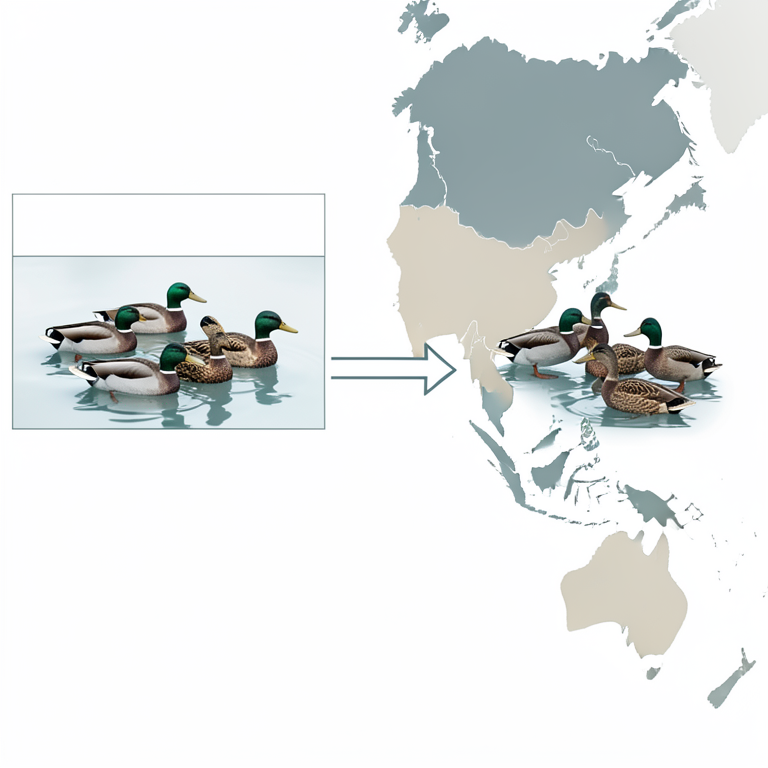
Viral Migration Pathway
AI-generated conceptual illustration (wild waterfowl in Mekong Delta wetlands). It explains the idea and does not show study data.
View source evidence ↗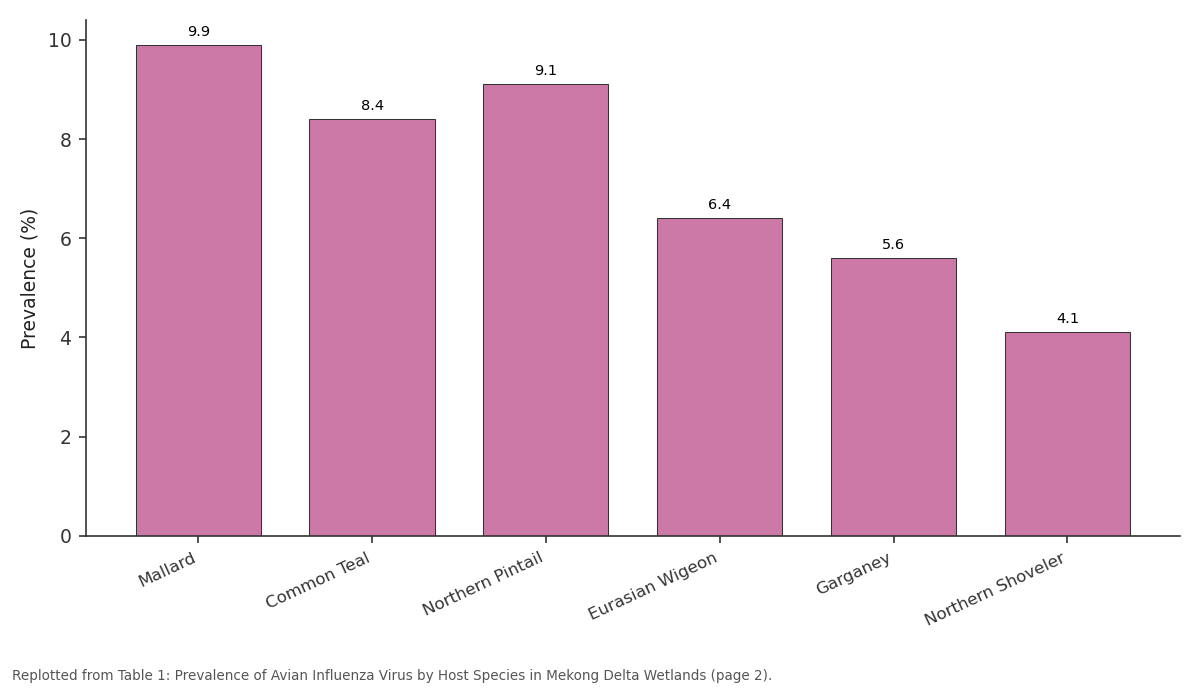
Prevalence (%): Mallard vs Common Teal vs Northern Pintail vs Eurasian Wigeon vs Garganey
Replotted from Table 1 (page 2) of the original paper. Every bar is the paper's own table value.
View source evidence ↗Figures & tables
From the original paper Table 1
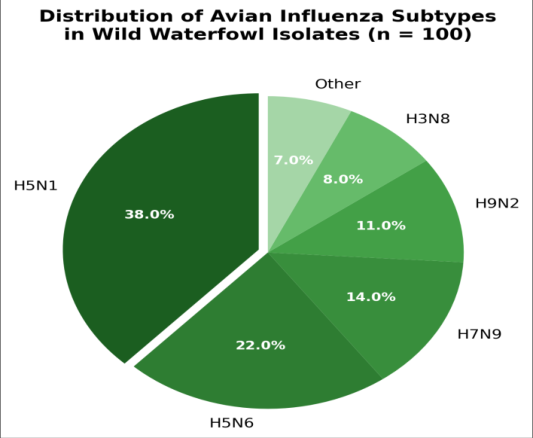 Figure 1
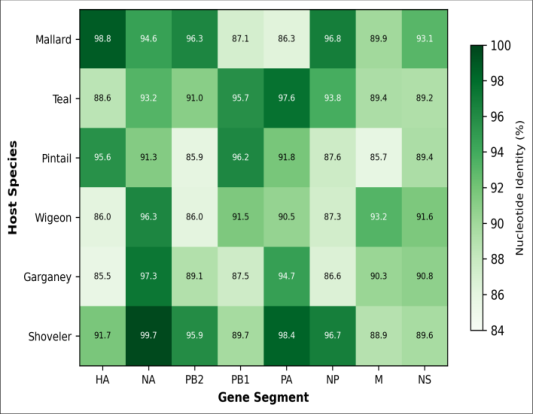 Figure 2
Introduction
Between 2015 and 2023, at least 47 countries reported outbreaks of highly pathogenic avian influenza, collectively resulting in the culling of over 400 million domestic birds and costing the global poultry industry billions of dollars [1] . Wild waterfowl-ducks, geese, and swans belonging to the order Anseriformes-are the natural reservoir hosts for most influenza A virus subtypes and play a central part in the long-distance dispersal of these pathogens along flyway corridors [2,3] . Vietnam sits at the junction of the East Asian-Australasian and Central Asian flyways, making it an especially active zone for viral exchange between migratory and resident bird populations [4] . The Mekong Delta, with its dense network of wetlands, rice paddies, and aquaculture ponds, provides year-round habitat for both wild and domestic waterfowl, creating persistent opportunities for interspecies viral transmission [5] . Despite this, systematic surveillance data from wild birds in the region remain limited; most Vietnamese monitoring programmes focus on domestic poultry markets and farms [6] . Phylogenetic analysis of full-genome sequences is now the standard approach for understanding how influenza viruses move between host species and geographic regions [7] . Reassortment-the swapping of genome segments when two viruses co-infect a single cell-can generate novel genotypes with unpredictable host range and pathogenicity [8] . Detecting reassortants early is important because some of the most damaging poultry outbreaks and several human infection clusters have been traced back to reassortant viruses that first appeared in wild bird reservoirs [9] . This research set out to describe the subtype diversity, prevalence, and phylogenetic relationships of avian influenza viruses circulating in wild waterfowl of the Mekong Delta over a 20-month sampling period. We combined active field surveillance with whole-genome sequencing and phylogenetic reconstruction to map viral lineages and identify reassortment events relevant to regional biosecurity. As displayed in Figure 1, H5N1 comprised the largest share of detected viruses (38.0%), followed by H5N6 (22.0%) and H7N9 (14.0%). Low-pathogenicity subtypes H9N2, H3N8, and other minor subtypes together accounted for the remaining 26%. Figure 2 shows that the HA and NA segments displayed the widest range of sequence divergence, while internal genes (PB2, PB1, PA, NP) were more conserved. Isolates from mallards and pintails shared the highest cross-segment identity, consistent with their overlapping habitats and coroosting behaviour at Tram Chim.
Discussion
The 7.8% prevalence detected here is consistent with active surveillance figures from neighbouring countries, where rates in wild ducks typically range from 4% to 12% depending on season and sampling method [10,11] . That H5N1 dominated our isolates was expected given its sustained circulation in the region since 2003, but the substantial presence of H5N6 (22%) is noteworthy because this subtype has caused sporadic human infections in China and Laos [12] . Phylogenetic analysis placed Mekong Delta viruses into three well-supported clades, two of which were closely related to lineages from Guangdong and Yunnan provinces. This pattern suggests regular southward seeding via migratory dabbling ducks that winter in both regions [13] .
The 13 reassortant isolates we detected carried novel combinations of polymerase and nucleoprotein segments, a configuration that could alter replication efficiency in mammalian cells [14] . Although none of our isolates possessed the full set of mammalian-adaptive mutations catalogued in the literature, several carried PB2-E627K or PA-T97I substitutions that warrant monitoring [15] . Seasonal dynamics mattered: 68% of positive samples came from the migratory influx period (October-March), underscoring the contribution of long-distance migrants to local viral diversity. But resident populations weren't free from risk; breeding-season positives accounted for the remaining 32%, implying that some lineages persist in local birds year-round [16,17] . Sample sizes for certain speciesparticularly the shoveler (n = 122)-were modest, and environmental sampling of water bodies was not included.
Future efforts should integrate environmental virology to capture viruses shed by birds that evade direct capture [18,19] .
Conclusion
This 20-month surveillance effort confirmed that wild waterfowl in the Mekong Delta harbour a diverse pool of avian influenza viruses, with an overall prevalence of 7.8% and six identified subtypes. H5N1 remained the most common subtype, but the significant detection of H5N6 and the identification of 13 reassortant viruses point to active viral evolution in the region. Phylogenetic ties to southern Chinese lineages highlight the importance of cross-border data sharing along the East Asian-Australasian flyway.
The findings argue for sustained, year-round surveillance that covers both migratory and resident species across multiple wetland sites. Rapid whole-genome sequencing should be integrated into routine monitoring so that novel reassortants can be flagged before they spill over into domestic flocks or, potentially, into human populations. Expanding sampling to environmental water sources and to species beyond Anseriformes would further strengthen the early-warning capacity of the Mekong Delta surveillance network.
Acknowledgement
Acknowledgements Funding SourcesThis research was supported by institutional operating funds for virology surveillance. No specific grant numbers are disclosed. Institutional SupportThe authors thank the Can Tho College of Aquatic Biology for laboratory access, cold-chain logistics, and bioinformatic computing resources.
Figures and tables from the paper
| Species | Sampled | Positive | Prevalence (%) | Dominant Subtype | Reassortants |
|---|---|---|---|---|---|
| Mallard | 312 | 31 | 9.9 | H5N1 | 4 |
| Common Teal | 287 | 24 | 8.4 | H5N6 | 3 |
| Northern Pintail | 198 | 18 | 9.1 | H5N1 | 2 |
| Eurasian Wigeon | 204 | 13 | 6.4 | H7N9 | 2 |
| Garganey | 161 | 9 | 5.6 | H9N2 | 1 |
| Northern Shoveler | 122 | 5 | 4.1 | H3N8 | 1 |
| Total | 1,284 | 100 | 7.8 | - | 13 |
Table text extracted from the original PDF; superscript letters are shown inline. The original table image is below.
View original table image
References
19 in the original paper- Lycett SJ, Duchatel F, Digard P. A brief history of bird flu. Philosophical Transactions of the Royal Society B. 2019;374(1775):20180257.
- Olsen B, Munster VJ, Wallensten A, et al. Global patterns of influenza A virus in wild birds. Science. 2006;312(5772):384-388.
- Verhagen JH, Fouchier RAM, Lewis N. Highly pathogenic avian influenza viruses at the wild-domestic bird interface. Annual Review of Animal Biosciences. 2021;9:317-341.
- Gilbert M, Xiao X, Domenech J, Lubroth J, Martin V, Slingenbergh J. Anatidae migration in the western Palearctic and spread of HPAI H5N1. Emerging Infectious Diseases. 2006;12(11):1650-1656.
- Nguyen DC, Uyeki TM, Jadhao S, et al. Isolation and characterization of avian influenza viruses from duck farms in Vietnam. Emerging Infectious Diseases. 2005;11(12):1903-1909.
- Minh PQ, Morris RS, Schauer B, et al. Spatio-temporal epidemiology of HPAI H5N1 outbreaks in Vietnam, 2003-2007. Preventive Veterinary Medicine. 2009;89(1-2):16-24.
- Rambaut A, Holmes EC, O'Toole A, et al. A dynamic nomenclature proposal for SARS-CoV-2 lineages. Nature Microbiology. 2020;5(11):1403-1407.
- Steel J, Lowen AC. Influenza A virus reassortment. Current Topics in Microbiology and Immunology. 2014;385:377-401.
- Monne I, Fusaro A, Nelson MI, et al. Emergence of a highly pathogenic avian influenza virus from a lowpathogenicity progenitor. Journal of Virology. 2014;88(8):4375-4388.
- Munster VJ, Baas C, Lexmond P, et al. Spatial, temporal, and species variation in prevalence of influenza A viruses in wild migratory birds. PLoS Pathogens. 2007;3(5):e61.
- Krauss S, Walker D, Pryor SP, et al. Influenza A viruses of migrating wild aquatic birds in North America. Vector-Borne and Zoonotic Diseases. 2004;4(3):177-189.
- Bi Y, Chen Q, Wang Q, et al. Genesis, evolution and prevalence of H5N6 avian influenza viruses in China. Cell Host and Microbe. 2016;20(6):810-821.
- Tian H, Zhou S, Dong L, et al. Avian influenza H5N1 viral and bird migration networks in Asia. Proceedings of the National Academy of Sciences. 2015;112(1):172177.
- Hatta M, Gao P, Halfmann P, Kawaoka Y. Molecular basis for high virulence of Hong Kong H5N1 influenza A viruses. Science. 2001;293(5536):1840-1842.
- Subbarao EK, London W, Murphy BR. A single amino acid in the PB2 gene of influenza A virus is a determinant of host range. Journal of Virology. 1993;67(4):1761-1764.
- Hill NJ, Takekawa JY, Cardona CJ, et al. Waterfowl ecology and avian influenza in California. Waterbirds. 2010;33(4):467-480.
- Lisovski S, van Dijk JG, Klinkenberg D, et al. Movement ecology of migratory waterfowl and avian influenza. Ecology Letters. 2018;21(1):68-83.
- Ren H, Jin Y, Hu M, et al. Ecological dynamics of influenza A viruses in the environment. Reviews in Medical Virology. 2016;26(3):139-151.
- Ramey AM, Reeves AB, Sonsthagen SA, et al. Dispersal of H9N2 influenza A viruses via migratory shorebirds. Emerging Infectious Diseases. 2015;21(3):513-516.