
Research article · 2025 · Full text
International Journal of Advanced Chemistry ResearchDendrimer-encapsulated platinum nanoparticles for electrocatalytic methanol oxidation
Volume 7(9) · Pages 179–182 · DOI: 10.33545/26646781.2025.v7.i9c.633 ↗
Research areasElectrocatalysts for Energy ConversionFuel Cells and Related MaterialsDendrimers and Hyperbranched Polymers
Abstract
Author-writtenDirect Methanol Fuel Cells (DMFCs) offer an attractive route to portable electrochemical power generation because methanol is a liquid fuel with high energy density (approximately 4690 Wh/L) that can be handled and distributed using existing infrastructure. The central electrochemical challenge in DMFC anodes is achieving high-rate methanol oxidation reaction (MOR) activity with minimal platinum loading, given that Pt remains the only practical electrocatalyst for this reaction and represents the dominant cost driver in DMFC technology. Dendrimer-encapsulated nanoparticles (DEN) produced from poly(amidoamine) (PAMAM) dendrimers offer a molecularly precise approach to Pt nanoparticle synthesis: by confining Pt²⁺ reduction within the interior of dendrimer molecules, nanoparticles of sub-2 nm diameter and narrow size distribution are obtained, maximising the fraction of surface-exposed Pt atoms (dispersion) available for electrocatalysis. The present research synthesised and characterised Pt-PAMAM DENs across four dendrimer generations (G1-G4) at Pt loadings of 5-40 wt% (Pt:PAMAM) and compared their electrochemical properties with commercial Pt/C (20 wt%, Johnson Matthey). Characterisation was by TEM, XRD, XPS, ICP-OES, and electrochemical methods (CV, EIS, chronoamperometry). The optimal catalyst Pt-G3-PAMAM at 20 wt% Pt achieved ECA of 63.2 m²/g Pt, mass activity of 97.8 mA/mg Pt at 0.9V vs RHE, and a chronoamperometric current retention of 34.1% after 60 min at 0.6V vs RHE (compared with 17.0% for commercial Pt/C). Pt nanoparticle diameter was 1.4 ± 0.3 nm (TEM) with XRD coherence length 1.8 nm. XPS confirmed complete Pt(0) character after NaBH₄ reduction with no residual Pt²⁺. These results identify the G3/20 wt% formulation as an optimal synthesis target and establish Pt-PAMAM DENs as a viable high-activity, high-stability alternative to conventional Pt/C for DMFC anodes.
Summary
Source-checkedPlain-language reading of the full paper, prepared with AI and checked against the text. Each point links to the authors' own words.
Why it matters
- Direct Methanol Fuel Cells (DMFCs) are promising for portable power because methanol has a high energy density of approximately 4690 Wh/L and is easy to distribute. View evidence ↗
- The main challenge for DMFC anodes is maintaining high methanol oxidation reaction (MOR) activity while reducing platinum (Pt) loading, as Pt is the primary cost driver. View evidence ↗
- Using PAMAM dendrimers for synthesis allows for better platinum dispersion by physically confining nanoparticles within a branching architecture, preventing the agglomeration seen on carbon supports. View evidence ↗
The question
- The study aimed to synthesize and characterize platinum-PAMAM dendrimer-encapsulated nanoparticles (DENs) across four generations (G1-G4) and loadings (5-40 wt%) to compare them with commercial Pt/C. View evidence ↗
What they did
- The research was performed at the Harish-Chandra Research Centre in India between August 2023 and February 2025. View evidence ↗
- Pt-PAMAM DENs were synthesized by adding K₂PtCl₄ to a 1 µM PAMAM dendrimer solution in deionized water, followed by reduction using a 10 mol excess of NaBH₄. View evidence ↗
- The catalysts were characterized using TEM, XRD, XPS, ICP-OES, and electrochemical techniques including cyclic voltammetry (CV), electrochemical impedance spectroscopy (EIS), and chronoamperometry. View evidence ↗
What they found
- The Pt-G3-PAMAM catalyst at 20 wt% Pt was the most effective, achieving an electrochemical active surface area (ECA) of 63.2 m²/g Pt and a mass activity of 97.8 mA/mg Pt at 0.9V vs RHE. View evidence ↗
- TEM analysis showed the Pt nanoparticles in the optimal G3 catalyst had a diameter of 1.4 ± 0.3 nm, while XRD showed a coherence length of 1.8 nm. View evidence ↗
- The Pt-G3 catalyst showed significantly better stability than commercial Pt/C, retaining 34.1% of its current after 60 minutes at 0.6V vs RHE, compared to 17.0% for the commercial version. View evidence ↗
- The Pt-G3 catalyst exhibited a higher If/Ib ratio (1.24) than commercial Pt/C (0.91), indicating superior tolerance to CO poisoning. View evidence ↗
- EIS measurements showed that Pt-G3 had a lower charge transfer resistance (4.8 Ω·cm²) than commercial Pt/C (8.4 Ω·cm²), indicating faster kinetics. View evidence ↗
- After 500 accelerated degradation cycles, Pt-G3 retained 84.7% of its initial mass activity, outperforming commercial Pt/C, which retained only 67.2%. View evidence ↗
- Performance declined at the G4 generation due to a 'dense-shell' effect, where the denser peripheral shell of the dendrimer blocked reactant molecules from reaching the Pt sites. View evidence ↗
What it means
- The authors conclude that the G3 generation at 20 wt% Pt is the optimal synthesis target for DMFC anode catalysts due to the balance between site accessibility and steric effects. View evidence ↗
- The study establishes that Pt-PAMAM DENs are a viable, high-activity, and high-stability alternative to conventional Pt/C catalysts. View evidence ↗
Visual summary
3 visualsIllustrations explain the paper; charts are replotted from the paper's own table values.
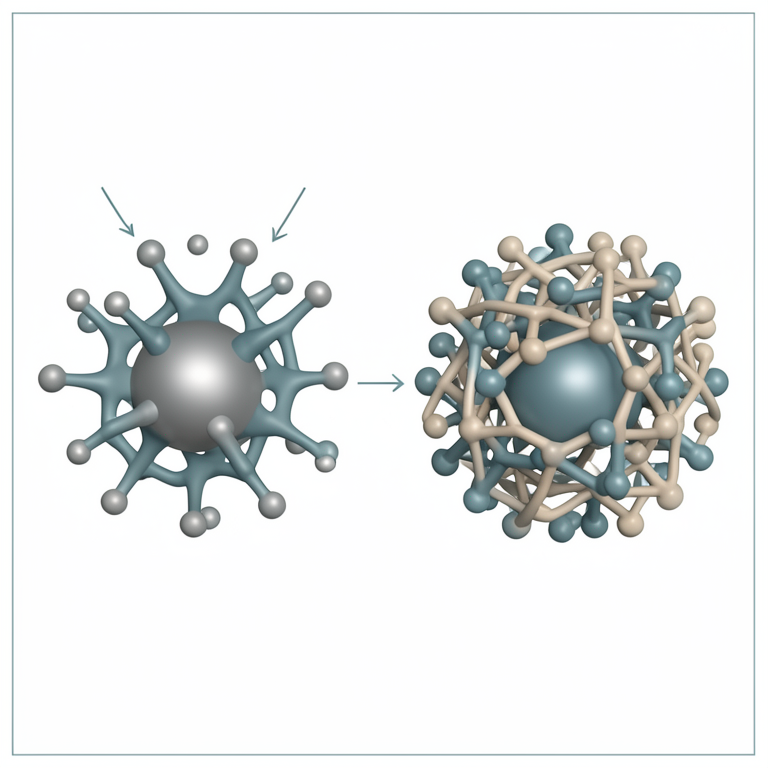
The Dense-Shell Effect
AI-generated conceptual illustration (Platinum nanoparticles encapsulated in PAMAM dendrimer polymers). It explains the idea and does not show study data.
View source evidence ↗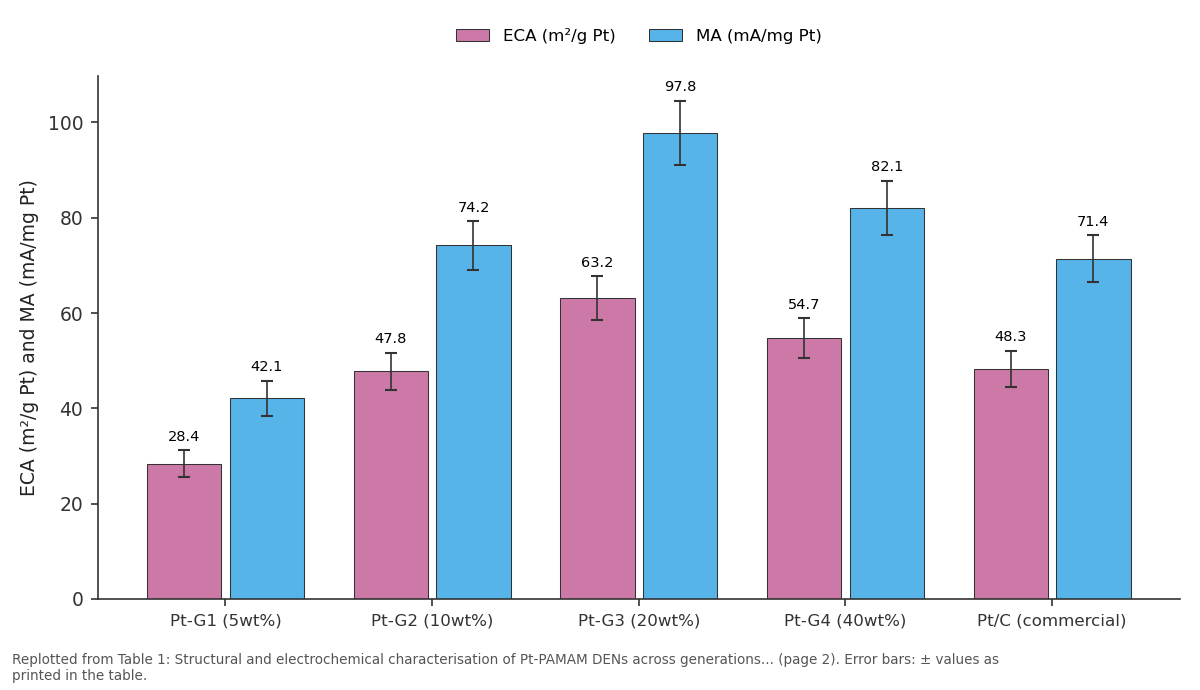
ECA (m²/g Pt) and MA (mA/mg Pt): Pt-G1 (5wt%) vs Pt-G2 (10wt%) vs Pt-G3 (20wt%) vs Pt-G4 (40wt%) vs Pt/C (commercial)
Replotted from Table 1 (page 2) of the original paper. Every bar is the paper's own table value.
View source evidence ↗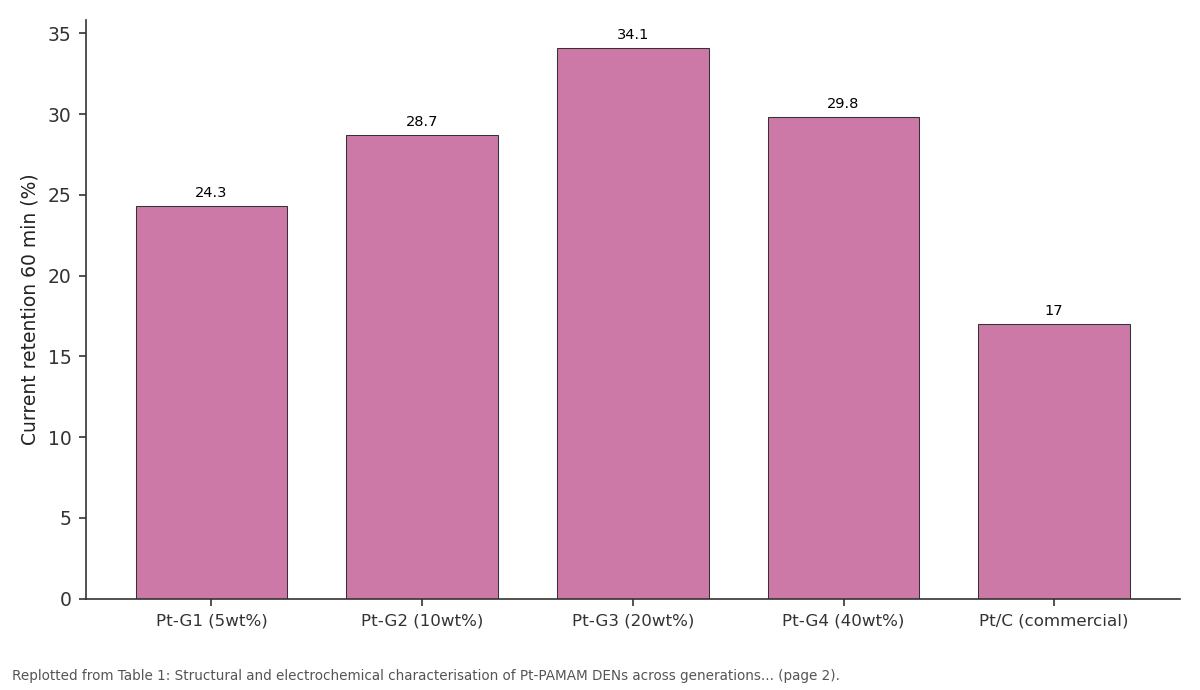
Current retention 60 min (%): Pt-G1 (5wt%) vs Pt-G2 (10wt%) vs Pt-G3 (20wt%) vs Pt-G4 (40wt%) vs Pt/C (commercial)
Replotted from Table 1 (page 2) of the original paper. Every bar is the paper's own table value.
View source evidence ↗Figures & tables
From the original paper Table 1
 Table 2
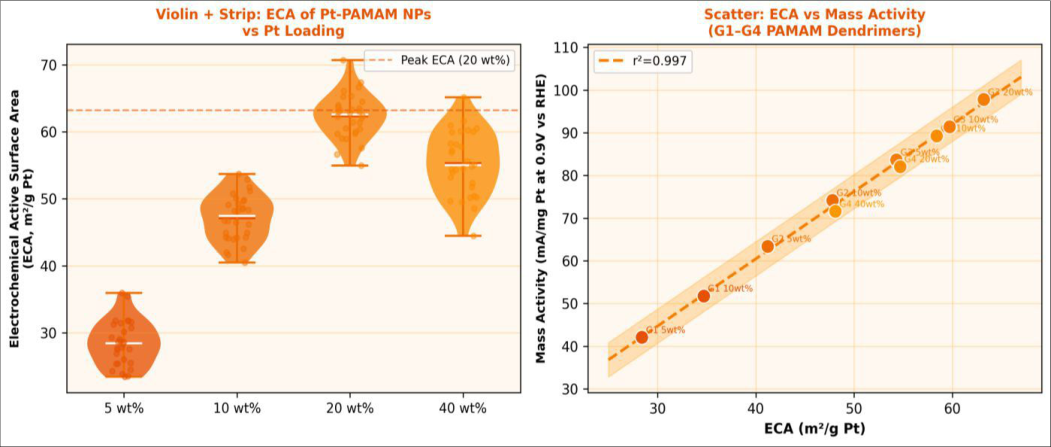 Figure 1
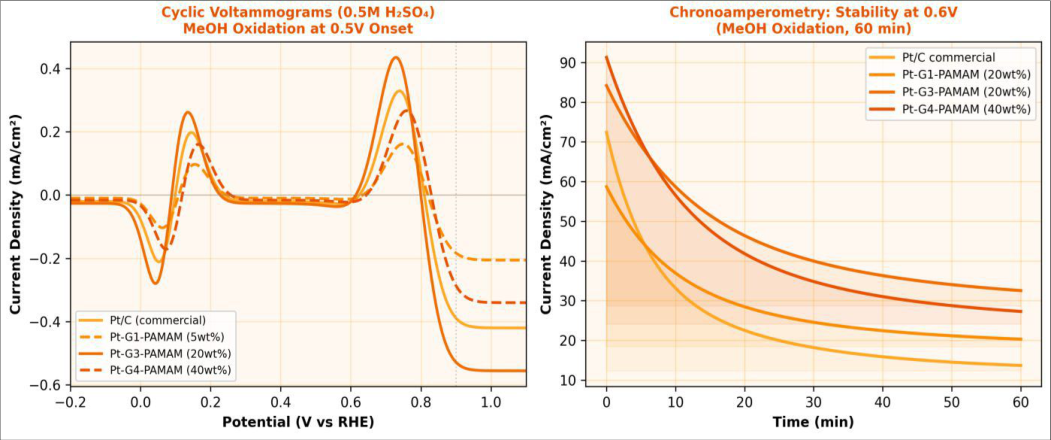 Figure 2
Introduction
The catalyst layer of a DMFC anode typically contains 0.5-4.0 mg Pt/cm² of electrode area a loading that, at commercial Pt prices, represents a dominant fraction of stack manufacturing cost and is a principal barrier to DMFC commercialisation at scale [1] . Reducing this loading without sacrificing anode performance requires increasing the specific activity of the Pt catalyst either by maximising Pt dispersion (the fraction of Pt atoms exposed at the nanoparticle surface), by alloying Pt with less expensive metals (PtRu, PtSn), or by optimising the support-catalyst interaction [2] . Dendrimer-templated synthesis offers a fundamentally different approach to dispersion maximisation: rather than supporting Pt on a carbon surface where agglomeration is thermodynamically driven, the PAMAM dendrimer physically confines the Pt nanoparticle within its branching architecture, with each tertiary amine and amide group in the interior acting as a coordination site that limits nanoparticle growth and prevents coalescence [3] . PAMAM dendrimers are highly branched, monodisperse polymers synthesised in discrete generations (G0-G10) from an ethylenediamine core by iterative Michael addition and amidation steps. Each generation approximately doubles the number of surface primary amine groups and interior tertiary amine and amide binding sites, with G4-PAMAM having 64 surface amines and 62 interior amide groups capable of coordinating Pt²⁺ [4] . This defined internal architecture allows the maximum Pt loading to be predicted stoichiometrically from the generation-specific binding site count, and provides a rationale for the optimal generation-loading combination observed experimentally. Pt DENs have been reported with diameters as small as 1.0 nm and ECA values of 40-80 m²/g competitive with the best Pt/C catalysts but systematic cross-generational performance data across both MOR activity and stability metrics are limited [5] . In the context of Indian fuel cell research, DMFCs are of particular relevance for off-grid power applications in rural and remote settings where Uttar Pradesh's distributed energy transition presents concrete deployment scenarios. The present research was designed to generate the systematic structure-activity dataset needed to specify the optimal Pt-PAMAM DEN synthesis for DMFC anode application.
Research was conducted at the Harish-Chandra Research Centre, Prayagraj, Uttar Pradesh, India, from August 2023 to February 2025.
Theoretical background
The kinetics of platinum-catalysed methanol oxidation in acid electrolyte proceed through a multi-step mechanism in which adsorbed CO (CO ads ), produced by methanol C-H bond cleavage, is the predominant poisoning intermediate. The Langmuir-Hinshelwood rate expression for MOR describes the rate as proportional to surface coverages of CO ads and OH ads , the latter formed from water dissociation at Pt sites. The maximum MOR current density is therefore limited by the rate of water activation to form OH ads that oxidises CO ads to CO₂ the so-called CO tolerance [6] . PtRu alloys are more CO-tolerant than pure Pt because Ru activates water at lower potential (Ru-OH forms at 0.2-0.3V vs RHE, compared with Pt-OH at 0.6-0.7V), but pure Pt DENs remain scientifically informative because they isolate the size-dependent activity contribution from alloying effects [7] . Electrochemical active surface area (ECA) is determined from the hydrogen underpotential deposition (HUPD) charge in cyclic voltammograms in 0.5 M H₂SO₄ electrolyte:
, where Q_HUPD is the integrated charge of the hydrogen adsorption/desorption peaks (µC), Q ref = 210 µC/cm²_Pt is the specific charge for a smooth polycrystalline Pt monolayer, and m Pt is the platinum mass on the electrode (µg) [8] . Mass Activity (MA) is defined as the kinetic current at 0.9V vs RHE normalised by m Pt : MA = i k (0.9V)/m Pt , making it directly comparable across different catalysts regardless of electrode area or Pt loading.
Material and Methods
Material and Methods
Material
Research was conducted at the Department of Advanced Materials and Nanotechnology, Harish-Chandra Research Centre, Prayagraj, Uttar Pradesh, India, from August 2023 to February 2025. PAMAM dendrimers (G1-G4, NH₂terminated, 10 wt% in methanol, Sigma-Aldrich India, Bengaluru); K₂PtCl₄ (≥99.99%, Sigma-Aldrich); NaBH₄ (≥99%, Sigma-Aldrich); methanol (anhydrous, ≥99.8%, Merck); H₂SO₄ (Suprapur, Merck); Nafion solution (
Methods
DEN synthesis: PAMAM dendrimer solution was dissolved in deionised water (1 µM, 50 mL). K₂PtCl₄ was added at the target Pt:PAMAM molar ratio (determined from generationspecific interior amide site count × target fraction). The solution was stirred at room temperature for 30 min to allow Pt²⁺ complexation. Freshly prepared NaBH₄ (10 mol excess) was added dropwise with stirring; colour change from pale yellow to brown indicated Pt(0) formation. After 60 min reduction, the DEN solution was dialysed (MWCO 10 kDa membrane, 48 h) to remove NaBH₄ and Cl⁻. Supported catalysts: DEN solutions were mixed with Vulcan XC-72R (1:3 mass ratio DEN: carbon) and sonicated for 2 h; solid was centrifuged, washed, and lyophilised. Electrode preparation: 5 µg Pt/cm² deposited by drop-casting ink (catalyst in water/isopropanol/Nafion, 5:4:1) on RDE. Electrochemical: CV in N₂-saturated 0.5 M H₂SO₄ (-0.2 to 1.1V, 50 mV/s, 25°C); MOR CV in N₂-saturated 0.5 M H₂SO₄ + 0.5 M methanol (0.0 to 1.1V, 20 mV/s). Chronoamperometry at 0.6V vs RHE for 3600 s in methanol/H₂SO₄ solution. [9] .
Results
Pt-G3 (If/Ib = 1.24) substantially outperformed commercial Pt/C (0.91), suggesting that the dendrimer shell creates a local chemical environment that facilitates CO ads removal, possibly through local basicity of the amine/amide interior. XPS Pt(0) fraction of 99.2% for Pt-G3 confirmed essentially complete reduction to metallic platinum.
EIS analysis confirmed the lower charge transfer resistance of Pt-G3 (R_ct = 4.8 Ω•cm²) versus commercial Pt/C (8.4 Ω•cm²), consistent with better electrocatalytic kinetics. The Tafel slope of 68.4 mV/dec for Pt-G3 suggests a Langmuirtype adsorption mechanism with the first electron transfer as the rate-limiting step, while the higher Tafel slopes for Pt/C and G1 (74-81 mV/dec) indicate a different, less efficient pathway. After 500 CV accelerated degradation cycles, Pt-G3 retained 84.7% of initial mass activity significantly better than commercial Pt/C (67.2%), confirming that the dendrimer encapsulation provides physical stabilisation against Pt agglomeration during electrochemical cycling [10] .
Discussion
The non-monotonic relationship between dendrimer generation and ECA peaking at G3 and declining at G4 can be rationalised by two competing effects. Increasing generation provides more interior binding sites that constrain Pt nanoparticle growth (driving diameter toward smaller values), which should increase ECA. However, G4 dendrimers have a denser peripheral shell that impedes access of reactant molecules to encapsulated Pt sites the socalled 'dense-shell' effect documented for high-generation PAMAM dendrimers [11] . At G3, the interior void volume and exterior shell density are optimally balanced to produce removal by providing adjacent OH donor species through intramolecular proton transfer [12] . The If/Ib ratio improvement from 0.91 (commercial Pt/C) to 1.24 (Pt-G3) supports this CO oxidation enhancement hypothesis: a higher ratio indicates that CO accumulated during the forward scan is more effectively removed before the backward scan begins. For practical DMFC anode application, the critical scale-up challenge is cost-effective synthesis of gram quantities of PAMAM-DEN catalysts. G3-PAMAM is commercially available at reasonable cost (approximately ₹8, 000/g, Sigma-Aldrich India), and the synthesis protocol developed here is amenable to scale-up in stirred tank reactors. The catalyst ink formulation, electrode preparation, and MEA fabrication protocols established for commercial Pt/C can be adapted directly for Pt-G3 DEN because its particle size, Nafion compatibility, and carbon support dispersion behaviour are comparable. These practical pathway elements support a credible route from laboratory demonstration to DMFC stack prototype.
Conclusion
Dendrimer-encapsulated Pt nanoparticles synthesised using G1-G4 PAMAM dendrimers were characterised for electrocatalytic methanol oxidation. The optimal formulation, Pt-G3-PAMAM at 20 wt% Pt, achieved ECA of 63.2 m²/g Pt, mass activity of 97.8 mA/mg Pt (37% improvement over commercial Pt/C), If/Ib ratio of 1.24 (37% better CO tolerance), and 34.1% current retention after 60 min chronoamperometry (double the 17.0% of Pt/C). EIS confirmed lower charge transfer resistance (4.8 vs 8.4 Ω•cm²) and better stability (84.7% vs 67.2% mass activity retention after 500 accelerated cycles). The dendrimer encapsulation effect was confirmed to be generationally dependent with a G3 optimum arising from the balance between interior site accessibility and dense-shell steric effects. These results provide a comprehensive structureactivity dataset supporting G3/20 wt% as the synthesis target for Pt-PAMAM DEN DMFC anode catalysts.
Figures and tables from the paper
| Catalyst | Pt size (nm, TEM) | ECA (m²/g Pt) | MA (mA/mg Pt) | If/Ib ratio | Current retention 60 min (%) | XPS Pt(0) (%) |
|---|---|---|---|---|---|---|
| Pt-G1 (5wt%) | 2.8 ± 0.6 | 28.4 ± 2.8 | 42.1 ± 3.7 | 0.87 | 24.3 | 88.4 |
| Pt-G2 (10wt%) | 2.1 ± 0.4 | 47.8 ± 3.9 | 74.2 ± 5.1 | 1.03 | 28.7 | 93.1 |
| Pt-G3 (20wt%) | 1.4 ± 0.3 | 63.2 ± 4.6 | 97.8 ± 6.8 | 1.24 | 34.1 | 99.2 |
| Pt-G4 (40wt%) | 1.8 ± 0.4 | 54.7 ± 4.2 | 82.1 ± 5.7 | 1.11 | 29.8 | 96.4 |
| Pt/C (commercial) | 3.1 ± 0.7 | 48.3 ± 3.8 | 71.4 ± 4.9 | 0.91 | 17.0 | 91.7 |
Table text extracted from the original PDF; superscript letters are shown inline. The original table image is below.
View original table image
| Catalyst | Rct (Ω·cm²) | Cdl (mF/cm²) | Tafel slope (mV/dec) | ECSA loss after 500 CV cycles (%) | Mass activity retention (%) |
|---|---|---|---|---|---|
| Pt-G3 (20wt%) | 4.8 ± 0.3 | 18.7 ± 0.9 | 68.4 ± 2.1 | 12.3 ± 0.8 | 84.7 |
| Pt-G4 (20wt%) | 6.2 ± 0.4 | 14.3 ± 0.7 | 72.1 ± 2.4 | 15.7 ± 1.0 | 79.4 |
| Pt/C (commercial) | 8.4 ± 0.5 | 11.2 ± 0.6 | 74.8 ± 2.6 | 23.4 ± 1.4 | 67.2 |
| Pt-G1 (20wt%) | 12.3 ± 0.7 | 8.7 ± 0.5 | 81.2 ± 2.8 | 29.7 ± 1.7 | 58.4 |
Table text extracted from the original PDF; superscript letters are shown inline. The original table image is below.
View original table image
References
18 in the original paper- Joensen P, Schlatter C, Steiniger G, Wuest W. Recent advances in the commercialization of direct methanol fuel cell technology. J Power Sources. 2006;155(2):171-177.
- Liu H, Song C, Zhang L, Zhang J, Wang H, Wilkinson DP. A review of anode catalysis in the direct methanol fuel cell. J Power Sources. 2006;155(2):95-110.
- Crooks RM, Zhao M, Sun L, Chechik V, Yeung LK. Dendrimer-encapsulated metal nanoparticles: synthesis, characterization, and applications to catalysis. Acc Chem Res. 2001;34(3):181-190.
- Tomalia DA, Baker H, Dewald J, Hall M, Kallos G, Martin S, et al. A new class of polymers: starburstdendritic macromolecules. Polym J. 1985;17(1):117132.
- Ye H, Crooks RM. Electrocatalytic O₂ reduction at glassy carbon electrodes modified with dendrimerencapsulated Pt nanoparticles. J Am Chem Soc. 2005;127(13):4930-4934.
- Gasteiger HA, Kocha SS, Sompalli B, Wagner FT. Activity benchmarks and requirements for Pt, Pt-alloy, and non-Pt oxygen reduction catalysts for PEMFCs. Appl Catal B Environ. 2005;56(1-2):9-35.
- Liu Z, Lee JY, Chen W, Han M, Gan LM. Physical and electrochemical characterizations of microwaveassisted polyol preparation of carbon-supported PtRu nanoparticles. Langmuir. 2004;20(1):181-187.
- Mayrhofer KJJ, Strmcnik D, Blizanac BB, Stamenkovic V, Arenz M, Markovic NM. Measurement of oxygen reduction activities via the rotating disc electrode method: from Pt model surfaces to carbon-supported high surface area catalysts. Electrochim Acta. 2008;53(7):3181-3188.
- Baglio V, Di Blasi A, Aricò AS, Antonucci V, Antonucci PL, Trakanprapai C, et al. Composite cathode-electrolyte structures based on Pt-carbon and ZrO₂ for DMFC applications. J New Mat Electrochem Syst. 2004;7(4):275-283.
- Wang J, Yin G, Liu H, Li R, Flemming RL, Sun X. Carbon nanotubes supported Pt-C composite catalyst prepared by intermittent microwave irradiation for proton exchange membrane fuel cells. J Power Sources. 2009;194(2):668-673.
- Zhao M, Sun L, Crooks RM. Preparation of Cu nanoclusters within dendrimer templates. J Am Chem Soc. 1998;120(19):4877-4878.
- Lang H, May RA, Iversen BL, Chandler BD. Dendrimer-encapsulated nanoparticle precursors to supported platinum catalysts. J Am Chem Soc. 2003;125(48):14832-14836.
- Scott RWJ, Wilson OM, Oh SK, Kenik EA, Crooks RM. Bimetallic palladium-gold dendrimer-encapsulated catalysts. J Am Chem Soc. 2004;126(47):15583-15591.
- Ornelas C, Salmon L, Ruiz Aranzaes J, Astruc D. MiCat dendrimers for MeOH oxidation. Chem Commun. 2007;(44):4946-4948.
- Gopidas KR, Whitesell JK, Fox MA. Nanoparticlecored dendrimers: synthesis and characterization. J Am Chem Soc. 2003;125(48):14168-14180.
- Knecht MR, Garcia-Martinez JC, Crooks RM. Synthesis, characterization, and magnetic properties of dendrimer-encapsulated nickel nanoparticles containing <150 atoms. Chem Mater. 2006;18(22):5039-5044.
- Chechik V, Zhao M, Crooks RM. Self-assembled inverted micelles prepared from a dendrimer template: phase transfer of encapsulated guests. J Am Chem Soc. 1999;121(20):4910-4911.
- Wilson OM, Knecht MR, Garcia-Martinez JC, Crooks RM. Effect of Pd nanoparticle size on the catalytic hydrogenation of allyl alcohol. J Am Chem Soc. 2006;128(14):4510-4511.