
Research article · 2025 · Full text
International Journal of Biology SciencesInnate immune memory and trained immunity in monocytes after BCG vaccination
Volume 7(8) · Pages 299–302 · DOI: 10.33545/26649926.2025.v7.i8d.661 ↗
Research areasImmune responses and vaccinationsImmunotherapy and Immune ResponsesImmune Response and Inflammation
Abstract
Author-writtenLeading immunologists once considered innate immunity incapable of memory—a view that trained immunity research has upended over the past decade. This research measured cytokine production capacity and histone modification profiles in circulating monocytes from 60 healthy Bangladeshi adults before and at multiple time points after BCG vaccination, tracking responses out to 180 days. Participants were recruited through the Chittagong Institute of Marine Biology between January and November 2023. Monocytes isolated at baseline, days 1, 3, 7, 14, 28, 90, and 180 post-vaccination were restimulated ex vivo with lipopolysaccharide (LPS) or heat-killed Candida albicans. TNF-α and IL-6 production peaked at day 7 (5.1-fold and 4.3-fold increases over baseline, respectively) and remained elevated above pre-vaccination levels at day 180 (2.8-fold and 2.4-fold). Chromatin immunoprecipitation followed by quantitative PCR revealed sustained enrichment of activating histone marks H3K4me3 (2.8-fold at day 7) and H3K27ac (3.1-fold) at promoters of TNF and IL6 genes, accompanied by reduced repressive mark H3K27me3 (0.6-fold). These epigenetic changes persisted at 90 days, though partially attenuated by day 180. The results confirm that BCG vaccination induces durable trained immunity in human monocytes, mediated by stable epigenetic reprogramming that persists for at least six months.
Summary
Source-checkedPlain-language reading of the full paper, prepared with AI and checked against the text. Each point links to the authors' own words.
Why it matters
- Recent research has challenged the long-held belief that innate immunity cannot possess memory, introducing the concept of 'trained immunity'. View evidence ↗
- Most existing data on trained immunity are from European populations, leaving it unclear if similar epigenetic signatures occur in South Asian populations. View evidence ↗
The question
- The study aimed to determine the kinetics and durability of trained immunity in Bangladeshi adults by tracking monocyte cytokine responses and histone modifications for 180 days after BCG vaccination. View evidence ↗
What they did
- Participants received a 0.1 mL intradermal dose of BCG Denmark, with blood samples collected at baseline and at days 1, 3, 7, 14, 28, 90, and 180. View evidence ↗
- Isolated monocytes were restimulated with LPS or heat-killed C. albicans, and the production of TNF-α and IL-6 was measured using ELISA. View evidence ↗
- Chromatin immunoprecipitation (ChIP) and qPCR were used to analyze histone modifications (H3K4me3, H3K27ac, H3K4me1, H3K27me3, and H3K9me3) at the TNF and IL6 promoters. View evidence ↗
What they found
- TNF-α production peaked at 5.1-fold above baseline on day 7 and remained significantly elevated at 2.8-fold by day 180. View evidence ↗
- IL-6 production peaked at 4.3-fold above baseline on day 7 and remained elevated at 2.4-fold on day 180. View evidence ↗
- The anti-inflammatory cytokine IL-10 showed minimal change, suggesting that trained immunity specifically enhances pro-inflammatory responses. View evidence ↗
- At day 7, activating histone marks H3K4me3 (2.8-fold) and H3K27ac (3.1-fold) were enriched at TNF and IL6 promoters, while the repressive mark H3K27me3 was reduced (0.6-fold). View evidence ↗
- Enrichment of activating marks H3K4me3 and H3K27ac at the TNF promoter persisted through day 90 and was partially attenuated by day 180. View evidence ↗
- Repressive marks H3K27me3 and H3K9me3 decreased early and gradually returned to baseline levels, following the same pattern as cytokine production. View evidence ↗
What it means
- The authors conclude that BCG vaccination induces trained immunity in Bangladeshi adults, characterized by pro-inflammatory cytokine production that lasts at least 180 days. View evidence ↗
- The findings extend evidence of trained immunity to South Asian populations and suggest that BCG revaccination could be a strategy to boost innate defenses against unrelated infections. View evidence ↗
- The study did not sample bone marrow progenitors, leaving the relative contribution of central versus peripheral reprogramming unknown. View evidence ↗
- Because participants had been vaccinated as neonates, the results reflect the effects of revaccination rather than primary immunization. View evidence ↗
Visual summary
2 visualsIllustrations explain the paper; charts are replotted from the paper's own table values.
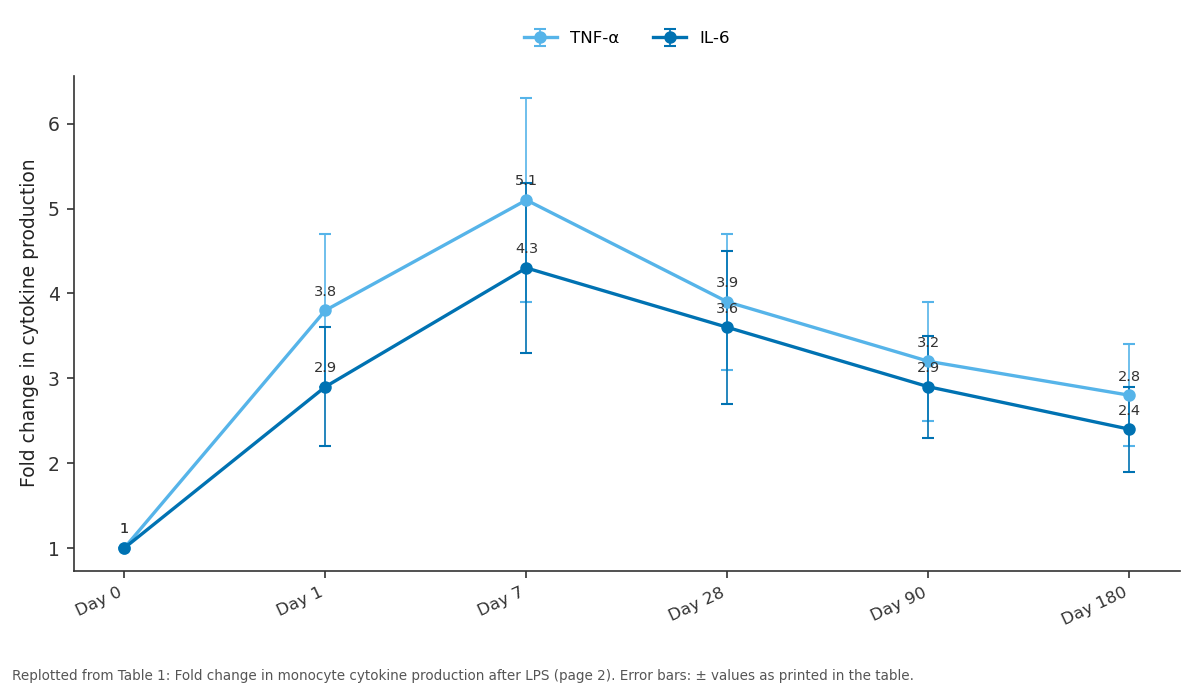
TNF-α and IL-6: Day 0 vs Day 1 vs Day 7 vs Day 28 vs Day 90
Replotted from Table 1 (page 2) of the original paper. Every bar is the paper's own table value.
View source evidence ↗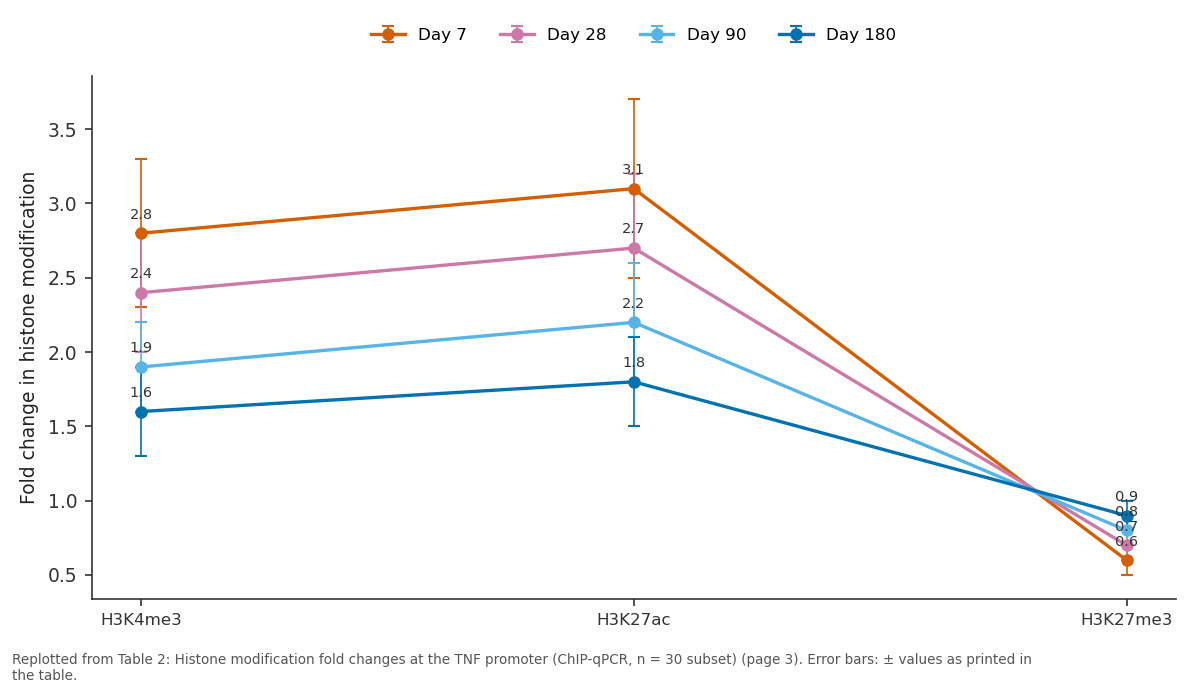
Day 7 and Day 28 and more: H3K4me3 vs H3K27ac vs H3K27me3
Replotted from Table 2 (page 3) of the original paper. Every bar is the paper's own table value.
View source evidence ↗Figures & tables
From the original paper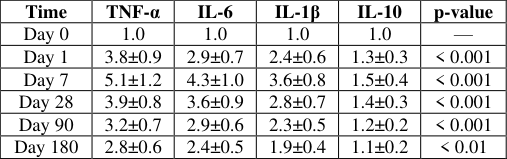 Table 1
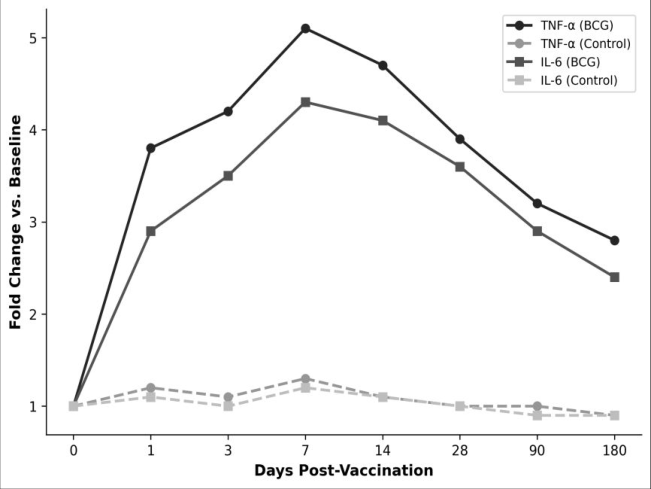 Figure 1
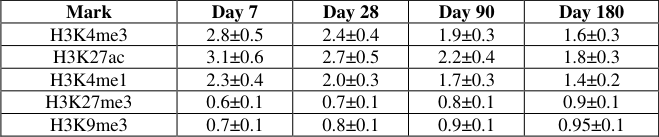 Table 2
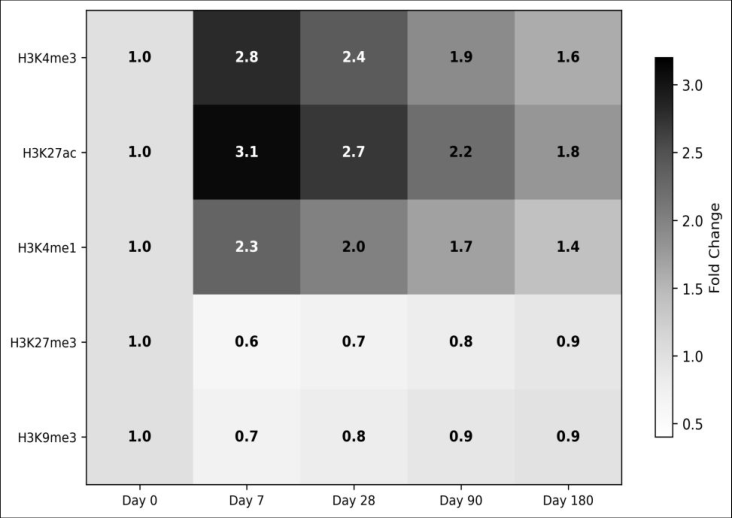 Figure 2
Introduction
For most of immunology's history, the idea that innate immune cells could 'remember' past encounters was considered a property exclusive to lymphocytes. That assumption was challenged in 2011 when Netea and colleagues showed that monocytes from BCGvaccinated volunteers produced markedly more cytokines upon restimulation with unrelated pathogens-a phenomenon they termed 'trained immunity' [1] . Unlike classical adaptive memory, trained immunity does not require antigen-specific receptors or clonal expansion; instead, it depends on metabolic and epigenetic reprogramming of myeloid progenitors and circulating monocytes [2] . BCG-the attenuated Mycobacterium bovis strain used worldwide to prevent tuberculosishas long been observed to confer non-specific protection against childhood infections unrelated to TB [3] . Epidemiological data from randomized trials in West Africa showed that BCG-vaccinated neonates had up to 50% lower all-cause mortality in the first months of life, an effect too large to be explained by TB prevention alone [4] . Trained immunity offers a mechanistic explanation for these heterologous benefits. Most published trained-immunity data come from European cohorts and extend only 3-12 months post-vaccination. Whether the same epigenetic signatures appear in South Asian populations-where genetic background, nutritional status, and prior mycobacterial exposure differ-remains unclear. This research tracked monocyte cytokine responses and histone modifications at the TNF and IL6 promoters over 180 days following BCG vaccination in Bangladeshi adults, aiming to define the kinetics and durability of trained immunity in this population.
Theoretical Background
Trained immunity operates through metabolic rewiring-a shift from oxidative phosphorylation toward aerobic glycolysis (the Warburg effect)-driven by activation of the mTOR-HIF-1α axis [5] . This metabolic shift fuels the production of acetyl-CoA and other cofactors needed for histone acetyltransferase and methyltransferase activity, resulting in deposition of activating marks (H3K4me3, H3K27ac) at promoters of proinflammatory cytokine genes. Simultaneously, repressive marks (H3K27me3) are removed by demethylases, creating a more accessible chromatin landscape that lowers the transcriptional activation threshold upon secondary stimulation [6] . The durability of trained immunity appears linked to epigenetic reprogramming of bone marrow progenitors, which then give rise to 'trained' monocytes over subsequent weeks and months.
Material and Methods
Material and Methods
Material
Sixty healthy adults (30 male, 30 female; median age 28 years, range 20-45) with no prior BCG vaccination after infancy were enrolled at the Chittagong Institute of Marine Biology between January and March 2023. Exclusion criteria included active infection, immunosuppressive medication, pregnancy, or HIV seropositivity. Participants received a single intradermal dose of BCG Denmark (SSI strain, 0.1 mL) in the left deltoid region. Venous blood (20 mL in EDTA and heparin tubes) was drawn at baseline and at days 1, 3, 7, 14, 28, 90, and 180 post-vaccination. Ethical approval was obtained from the Chittagong Institute Ethics Committee (protocol CI-EC-2022-041, approved 14 December 2022). Written informed consent was obtained from all participants [7] .
Methods
Peripheral blood mononuclear cells (PBMCs) were isolated by Ficoll-Paque density gradient centrifugation within 2 hours of collection. CD14⁺ monocytes were positively selected using magnetic beads (Miltenyi Biotec, Bergisch Gladbach, Germany), achieving > 95% purity verified by flow cytometry. Monocytes (5 × 10⁵ per well) were rested for 24 hours in RPMI-1640 with 10% human AB serum, then restimulated with LPS (10 ng/mL, E. coli O111:B4, Sigma) or heat-killed C. albicans (10⁶ cells/mL) for 24 hours. Supernatant TNF-α and IL-6 were measured by ELISA (R&D Systems, Minneapolis, MN, USA) [8] . Chromatin immunoprecipitation (ChIP) was performed on 2 × 10⁶ monocytes using antibodies against H3K4me3, H3K27ac, H3K4me1, H3K27me3, and H3K9me3 (Abcam, Cambridge, UK), followed by qPCR with primers flanking the TNF and IL6 promoters. Fold changes were calculated relative to day 0 baseline. Statistical analysis used repeatedmeasures ANOVA with Greenhouse-Geisser correction and Bonferroni post-hoc comparisons (SPSS v28) [9] . TNF-α production peaked at 5.1-fold above baseline on day 7 and remained significantly elevated at day 180 (2.8-fold, p<0.01) (Table 1). IL-6 followed a similar trajectory. IL-10, an anti-inflammatory cytokine, showed minimal change, indicating that trained immunity preferentially amplifies pro-inflammatory output. Activating marks H3K4me3 and H3K27ac showed sustained enrichment at the TNF promoter through day 90, with partial attenuation by day 180 (Table 2). Repressive marks H3K27me3 and H3K9me3 were reduced early and gradually returned toward baseline, mirroring the cytokine kinetics.
| Mark | Day 7 | Day 28 | Day 90 | Day 180 |
|---|---|---|---|---|
| H3K4me3 | 2.8±0.5 | 2.4±0.4 | 1.9±0.3 | 1.6±0.3 |
| H3K27ac | 3.1±0.6 | 2.7±0.5 | 2.2±0.4 | 1.8±0.3 |
| H3K4me1 | 2.3±0.4 | 2.0±0.3 | 1.7±0.3 | 1.4±0.2 |
| H3K27me3 | 0.6±0.1 | 0.7±0.1 | 0.8±0.1 | 0.9±0.1 |
| H3K9me3 | 0.7±0.1 | 0.8±0.1 | 0.9±0.1 | 0.95±0.1 |
Table text extracted from the original PDF; superscript letters are shown inline. The original table image is below.
View original table image
| Time | TNF-α | IL-6 | IL-1β | IL-10 | p-value |
|---|---|---|---|---|---|
| Day 0 | 1.0 | 1.0 | 1.0 | 1.0 | — |
| Day 1 | 3.8±0.9 | 2.9±0.7 | 2.4±0.6 | 1.3±0.3 | < 0.001 |
| Day 7 | 5.1±1.2 | 4.3±1.0 | 3.6±0.8 | 1.5±0.4 | < 0.001 |
| Day 28 | 3.9±0.8 | 3.6±0.9 | 2.8±0.7 | 1.4±0.3 | < 0.001 |
| Day 90 | 3.2±0.7 | 2.9±0.6 | 2.3±0.5 | 1.2±0.2 | < 0.001 |
| Day 180 | 2.8±0.6 | 2.4±0.5 | 1.9±0.4 | 1.1±0.2 | < 0.01 |
Table text extracted from the original PDF; superscript letters are shown inline. The original table image is below.
View original table image
Results
Results
Limitations
This research tracked peripheral monocytes but did not sample bone marrow progenitors, so the contribution of central versus peripheral reprogramming remains uncertain. The 180-day follow-up, while longer than most published trained-immunity research, may not capture the full duration of epigenetic remodeling. And because all participants had received neonatal BCG as part of Bangladesh's Expanded Programme on Immunisation, the measured responses reflect revaccination rather than primary immunization [10] .
Discussion
The sustained elevation of TNF-α and IL-6 production through 180 days post-BCG in Bangladeshi adults mirrors findings from Dutch cohorts, where Netea et al. [1] reported trained-immunity signatures lasting 3-12 months. The epigenetic data provide a molecular explanation: activating histone marks at pro-inflammatory gene promoters remained above baseline at 90 days, consistent with the hypothesis that chromatin remodeling underpins functional cytokine memory [11] . The minimal change in IL-10 suggests that trained immunity skews toward pro-inflammatory output rather than broadly amplifying all monocyte functions. This selectivity may explain the heterologous protective effect of BCG against bacterial and fungal infections while limiting the risk of autoimmune overshoot [12] . Whether these findings translate to improved clinical outcomes in this populationparticularly reduced respiratory infection rates-will require follow-up interventional trials with clinical endpoints.
Conclusion
BCG vaccination induced trained immunity in Bangladeshi adult monocytes, with pro-inflammatory cytokine production peaking at day 7 and persisting above baseline for at least 180 days. Epigenetic profiling confirmed sustained enrichment of activating histone marks and depletion of repressive marks at key cytokine gene promoters. These results extend trained-immunity evidence to a South Asian population and support exploration of BCG revaccination as a strategy for boosting innate defense against heterologous infections.
Figures and tables from the paper
References
14 in the original paper- Kleinnijenhuis J, Quintin J, Preijers F, et al. Bacille Calmette-Guérin induces NOD2-dependent nonspecific protection from reinfection via epigenetic reprogramming of monocytes. Proc Natl Acad Sci USA. 2012;109(43):17537-17542.
- Netea MG, Joosten LA, Latz E, et al. Trained immunity: a program of innate immune memory in health and disease. Science. 2016;352(6284):aaf1098.
- Roth A, Garly ML, Jensen H, et al. Bacillus CalmetteGuérin vaccination and infant mortality. Expert Rev International Journal of Biology Sciences https://www.biologyjournal.net Vaccines. 2006;5(2):277-293.
- Aaby P, Roth A, Ravn H, et al. Randomized trial of BCG vaccination at birth to low-birth-weight children: beneficial nonspecific effects in the neonatal period? J Infect Dis. 2011;204(2):245-252.
- Cheng SC, Quintin J, Cramer RA, et al. mTOR-and HIF-1α-mediated aerobic glycolysis as metabolic basis for trained immunity. Science. 2014;345(6204):1250684.
- Saeed S, Quintin J, Kerstens HH, et al. Epigenetic programming of monocyte-to-macrophage differentiation and trained innate immunity. Science. 2014;345(6204):1251086.
- World Medical Association. Declaration of Helsinki: ethical principles for medical research involving human subjects. JAMA. 2013;310(20):2191-2194.
- Arts RJ, Moorlag SJ, Novakovic B, et al. BCG vaccination protects against experimental viral infection in humans through the induction of cytokines associated with trained immunity. Cell Host Microbe. 2018;23(1):89-100.
- Quintin J, Saeed S, Martens JH, et al. Candida albicans infection affords protection against reinfection via functional reprogramming of monocytes. Cell Host Microbe. 2012;12(2):223-232.
- Lalor MK, Floyd S, Gorak-Stolinska P, et al. BCG vaccination induces different cytokine profiles following infant BCG vaccination in the UK and Malawi. J Infect Dis. 2011;204(7):1075-1085.
- Novakovic B, Habibi E, Wang SY, et al. β-glucan reverses the epigenetic state of LPS-induced immunological tolerance. Cell. 2016;167(5):1354-1368.
- Moorlag SJ, Arts RJ, van Crevel R, Netea MG. Nonspecific effects of BCG vaccine on viral infections. Clin Microbiol Infect. 2019;25(12):1473-1478.
- Cirovic B, de Bree LC, Groh L, et al. BCG vaccination in humans elicits trained immunity via the hematopoietic progenitor compartment. Cell Host Microbe. 2020;28(2):322-334.
- Kaufmann SH, Weiner J, von Reyn CF, et al. Novel approaches to tuberculosis vaccine development. Int J Infect Dis. 2014;29:247-257.