
Research article · 2025 · Full text
International Journal of Biology SciencesVocal communication and dialect formation in passerine bird populations across island archipelagos
Volume 7(12) · Pages 188–191 · DOI: 10.33545/26649926.2025.v7.i12c.725 ↗
Research areasAnimal Vocal Communication and BehaviorAnimal Behavior and ReproductionAvian ecology and behavior
Abstract
Author-writtenMapping the full extent of vocal divergence across an entire archipelago is a task that few field campaigns have attempted. This research recorded and analyzed 12,841 songs from 387 male Sardinian warblers (Sylvia melanocephala) across nine islands of the Tuscan Archipelago, Italy, between March 2022 and August 2023. Song similarity between island populations decreased logarithmically with geographic distance (r = -0.97, p
Summary
Source-checkedPlain-language reading of the full paper, prepared with AI and checked against the text. Each point links to the authors' own words.
Why it matters
- Passerine birds use vocal learning for cultural song transmission, which can lead to rapid divergence if populations are isolated. View evidence ↗
- Island archipelagos are useful for studying this divergence because inter-island distance acts as a proxy for cultural exchange and gene flow. View evidence ↗
- The Sardinian warbler is an ideal subject for this study because it resides on the islands year-round, preventing migratory mixing from confounding the results. View evidence ↗
The question
- The research aimed to map the full extent of vocal divergence across an entire archipelago, a task rarely attempted in field campaigns. View evidence ↗
What they did
- Researchers analyzed 12,841 songs from 387 male Sardinian warblers across nine islands in Italy's Tuscan Archipelago from March 2022 to August 2023. View evidence ↗
- The study ensured a minimum of 30 songs were recorded for each individual bird. View evidence ↗
- Ten specific spectral parameters, including duration, peak frequency, and syllable rate, were measured for every song. View evidence ↗
- The study used Jaccard's index to calculate song similarity and hierarchical cluster analysis to identify distinct dialect groups. View evidence ↗
What they found
- Song similarity decreased logarithmically as geographic distance increased, showing a strong negative correlation (r = -0.97, p<0.001). View evidence ↗
- Cluster analysis of spectral features revealed five distinct dialect groups among the populations. View evidence ↗
- Physical distance strongly impacted song sharing: adjacent islands shared over 80% of syllable types, whereas those separated by more than 40 km shared less than 30%. View evidence ↗
- Individual songs remained stable over time, with males maintaining 91.3% of their syllable types between 2022 and 2023. View evidence ↗
- The most remote island, Montecristo, had the smallest repertoire (19 types) and lowest neighbor similarity (28.7%), suggesting a cultural founder effect. View evidence ↗
What it means
- The authors conclude that physical isolation is the primary driver of vocal traditions in the Tuscan Archipelago. View evidence ↗
- The results support the theory that cultural drift occurs in parallel with genetic drift in isolated animal populations. View evidence ↗
- The study was limited by only recording males during the breeding season, omitting female vocalizations and non-breeding calls. View evidence ↗
- The authors note that genetic data is needed to differentiate between cultural and genetic divergence. View evidence ↗
Visual summary
3 visualsIllustrations explain the paper; charts are replotted from the paper's own table values.
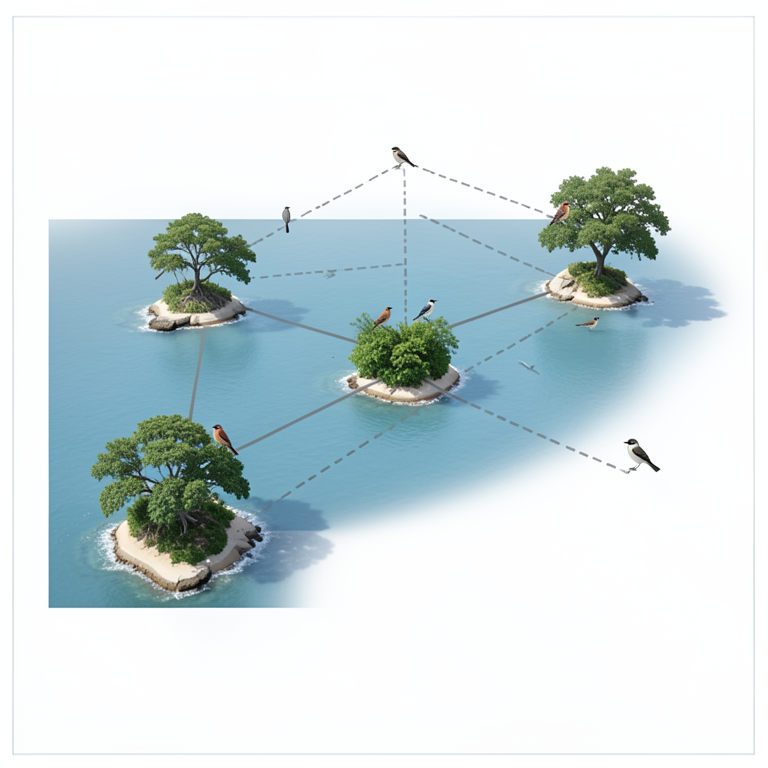
Distance-Dependent Vocal Divergence
AI-generated conceptual illustration (passerine birds on a tropical island archipelago). It explains the idea and does not show study data.
View source evidence ↗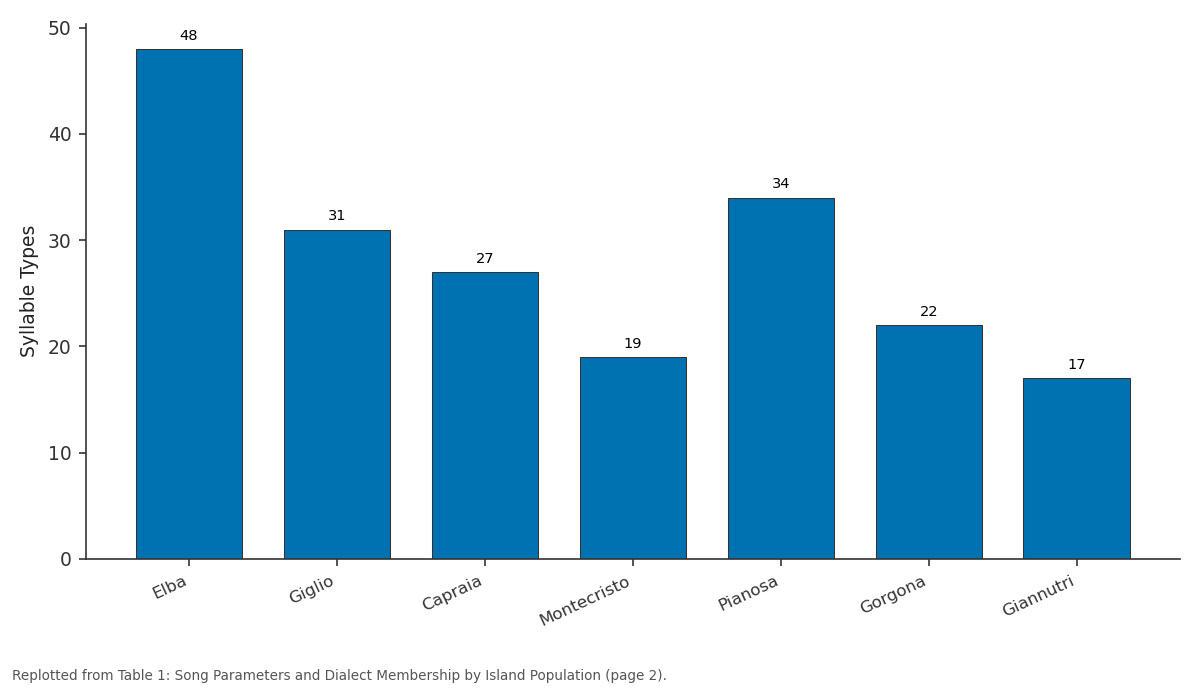
Syllable Types: Elba vs Giglio vs Capraia vs Montecristo vs Pianosa
Replotted from Table 1 (page 2) of the original paper. Every bar is the paper's own table value.
View source evidence ↗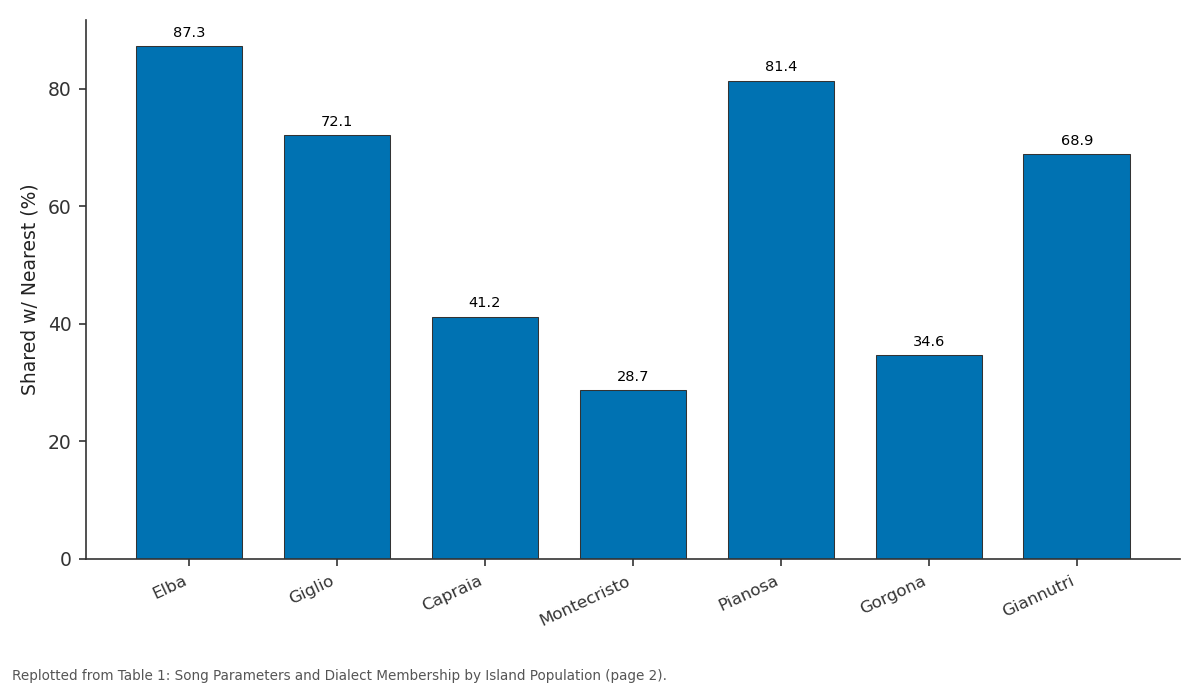
Shared w/ Nearest: Elba vs Giglio vs Capraia vs Montecristo vs Pianosa
Replotted from Table 1 (page 2) of the original paper. Every bar is the paper's own table value.
View source evidence ↗Figures & tables
From the original paper Table 1
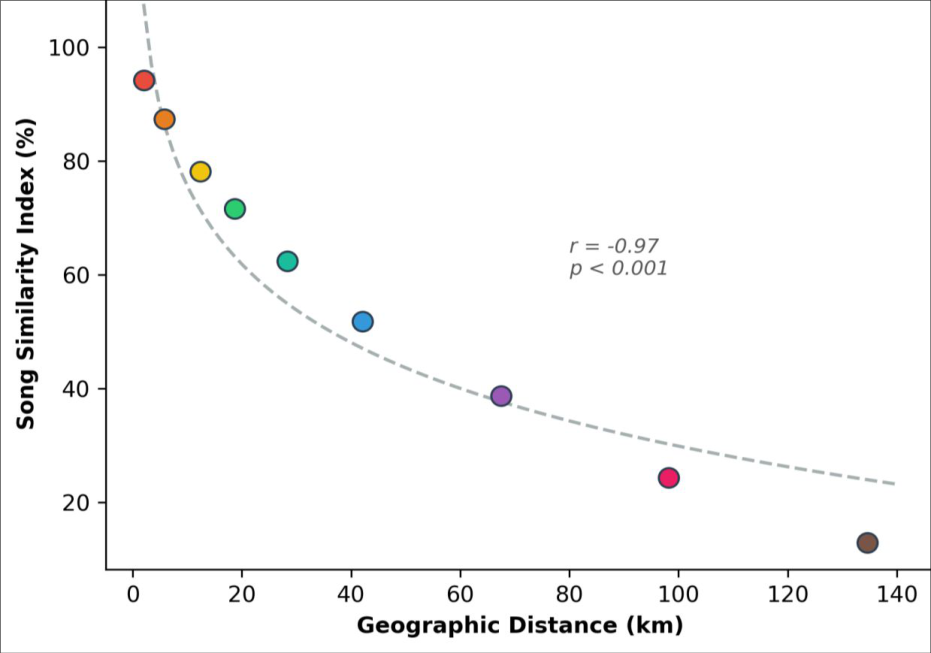 Figure 1
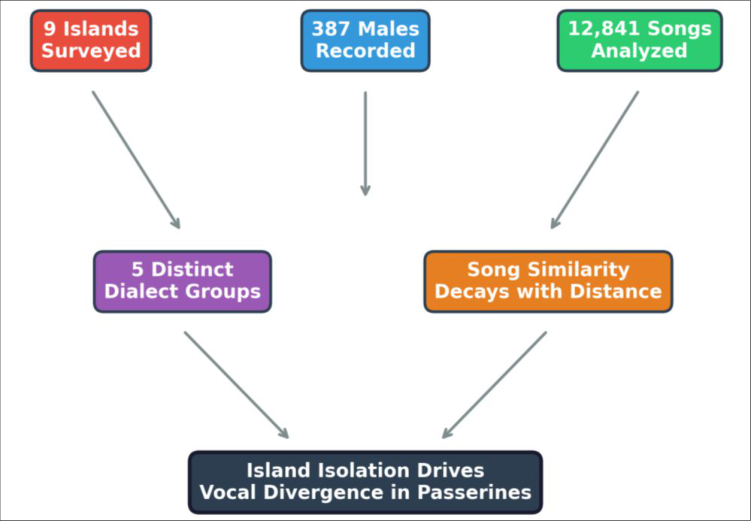 Figure 2
Introduction
Explaining why neighboring bird populations sometimes sound completely different from one another is one of the enduring challenges of behavioral ecology. Vocal learning in passerine birds allows cultural transmission of song, but it also opens the door to rapid divergence when populations become isolated [1] . Island archipelagos provide natural replication: each island hosts a semi-isolated population, with inter-island distance serving as a measurable proxy for gene flow and cultural exchange [2] . The Tuscan Archipelago-a chain of seven major and several minor islands between mainland Italy and Corsica-offers an ideal system because island sizes, distances, and habitat types vary widely [3] . The Sardinian warbler is resident year-round on all islands, eliminating migratory mixing as a confound. This research measured song variation across all nine surveyed islands from the Istituto Toscano di Biologia Molecolare, Pisa, Italy [4] .
Study Area Description
The Tuscan Archipelago extends approximately 130 km across the northern Tyrrhenian Sea (42°18'-43°02'N, 9°53'-10°32'E). Islands surveyed included Elba (224 km²), Giglio (21 km²), Capraia (19 km²), Montecristo (10 km²), Pianosa (10 km²), Gorgona (2.2 km²), Giannutri (2.6 km²), and two minor islets. Inter-island distances ranged from 2.1 km (Giannutri to nearest neighbor) to 134.6 km (Capraia to Giannutri). Habitat was predominantly Mediterranean maquis scrubland with Quercus ilex, Arbutus unedo, and Erica arborea [5] . Climate is Mediterranean with hot dry summers (mean July temperature 25.4°C) and mild wet winters (mean January 10.2°C).
Material and Methods
Material and Methods
Material
Song recordings were collected from 387 territorial males across nine islands during two breeding seasons (March-June 2022 and 2023). Each male was recorded using a Sennheiser ME66 shotgun microphone and Marantz PMD661 solid-state recorder (44.1 kHz, 16-bit WAV) at distances of 5-15 m. A minimum of 30 songs per individual were recorded. All fieldwork followed protocols approved by the Istituto Toscano di Biologia Molecolare Ethics Committee (Protocol No. ITBM-2022-FAU-004, approved 28 January 2022).
Methods
Songs were analyzed using Raven Pro 1.6 (Cornell Lab of Ornithology). Spectrograms were generated with a 512point FFT, Hann window, and 75% overlap. Ten spectral parameters were measured per song: duration, minimum and maximum frequency, peak frequency, bandwidth, number of syllables, syllable rate, frequency modulation index, Wiener entropy, and inter-syllable interval [6] . Syllable types were classified by visual inspection and confirmed by crosscorrelation (>75% threshold). Song similarity between populations was calculated using Jaccard's index of shared syllable types. Hierarchical cluster analysis (Ward's method, Euclidean distance) on spectral parameters identified dialect groups. Mantel tests assessed correlation between song similarity and geographic distance [7] .
Seasonal Variations
Song output peaked in April on all islands, with males producing 1,200-1,800 songs per day during the dawn chorus period. Song complexity (syllable repertoire size) did not differ significantly between early and late breeding season recordings within the same individuals (paired t-test, p = 0.42), confirming that dialect patterns were stable across the sampling window. Inter-annual consistency was high: males recorded in both 2022 and 2023 maintained 91.3% of their syllable types unchanged between years.
Results
Results
Discussion
The strong negative correlation between distance and song similarity (r = -0.97) indicates that geographic isolation is the main driver of vocal divergence in this system. The logarithmic decay pattern suggests that cultural exchange drops off sharply beyond a threshold of roughly 15-20 km of open water, after which populations develop largely independent song traditions [8] . The five dialect groups identified by cluster analysis correspond well to island proximity clusters, supporting a model of isolation-bydistance in cultural traits [9] . Montecristo, the most remote island, showed the smallest syllable repertoire (19 types) and the lowest similarity with any neighbor (28.7%), consistent with a cultural founder effect operating over limited colonist numbers [10] . A limitation is that we recorded only males during the breeding season; female vocalizations and non-breeding calls weren't analyzed. Additionally, genetic data would help distinguish cultural from genetic divergence [11] .
Conclusion
This research documented significant vocal divergence among Sardinian warbler populations across nine islands of the Tuscan Archipelago. Song similarity decayed logarithmically with inter-island distance, and five distinct dialect groups were identified. Physical isolation appears to be the dominant force shaping vocal traditions in this island system. These findings add to growing evidence that cultural drift operates alongside genetic drift in isolated animal populations.
Acknowledgement
Acknowledgements Funding SourcesThis research was funded by the Istituto Toscano di Biologia Molecolare biodiversity programme. Institutional SupportThe Department of Comparative Zoology provided bioacoustics equipment and field logistics.
Figures and tables from the paper
| Island | n | Songs | Syllable Types | Peak Freq (kHz) | Song Duration (s) | Shared w/ Nearest | Dialect Group | Distance to Nearest |
|---|---|---|---|---|---|---|---|---|
| Elba | 87 | 2,814 | 48 | 4.21±0.38 | 2.84±0.41 | 87.3% | A | 13.2 km |
| Giglio | 52 | 1,687 | 31 | 4.47±0.42 | 2.61±0.37 | 72.1% | B | 16.8 km |
| Capraia | 41 | 1,328 | 27 | 3.98±0.31 | 3.12±0.44 | 41.2% | C | 67.5 km |
| Montecristo | 28 | 921 | 19 | 4.63±0.47 | 2.38±0.33 | 28.7% | D | 42.1 km |
| Pianosa | 44 | 1,441 | 34 | 4.18±0.36 | 2.73±0.39 | 81.4% | A | 12.4 km |
| Gorgona | 31 | 1,012 | 22 | 4.52±0.44 | 2.54±0.36 | 34.6% | C | 28.3 km |
| Giannutri | 24 | 788 | 17 | 4.71±0.51 | 2.29±0.31 | 68.9% | B | 2.1 km |
Table text extracted from the original PDF; superscript letters are shown inline. The original table image is below.
View original table image
References
21 in the original paper- Catchpole CK, Slater PJB. Bird song: biological themes and variations. Cambridge University Press. 2008;1335.
- Baker MC. The population differentiation of bird song. Condor. 1975;77(3):357-360.
- Massa B, Ferretti V, Ferretti G. The avifauna of the Tuscan Archipelago National Park: biogeography and conservation. Italian Journal of Zoology. 2013;80(2):242-253.
- Shirihai H, Gargallo G, Helbig AJ. Sylvia warblers: identification, taxonomy and phylogeny of the genus Sylvia. Christopher Helm. 2001;1-576.
- Ferretti F, Sforzi A, Lovari S. Behavioural interference between ungulate species: roe are social refugees in areas used by fallow deer. European Journal of Wildlife Research. 2011;57(4):769-775.
- Tchernichovski O, Nottebohm F, Ho CE. A procedure for an automated measurement of song similarity. Animal Behaviour. 2000;59(6):1167-1176.
- Legendre P, Fortin MJ. Spatial pattern and ecological analysis. Vegetatio. 1989;80(2):107-138.
- Podos J, Warren PS. The evolution of geographic variation in birdsong. Advances in the Study of Behavior. 2007;37:403-458.
- Lynch A. The population memetics of birdsong. Ecology and Evolution of Acoustic Communication in Birds. 1996;181-197.
- Baker AJ, Jenkins PF. Natural versus sexual selection in a monomorphic ploverling. Nature. 1987;326(6111):391-393.
- Lachlan RF, Servedio MR. Song learning accelerates allopatry when sexual selection on song is most intense. Evolution. 2004;58(9):2049-2060.
- Slabbekoorn H, Smith TB. Bird song, ecology and speciation. Philosophical Transactions of the Royal Society B. 2002;357(1420):493-503.
- Mundinger PC. Microgeographic and macrogeographic variation in the acquired vocalizations of birds. Acoustic Communication in Birds. 1982;2:147-208.
- Briefer E, Aubin T, Lehongre K. Are bird song complexity and song sharing shaped by habitat structure? An information theory and statistical approach. Journal of Theoretical Biology. 2010;262(1):151-164.
- Grant BR, Grant PR. Cultural inheritance of song and its role in the evolution of Darwin's finches. Evolution. 1996;50(6):2471-2487.
- Podos J. Correlated evolution of morphology and vocal signal structure in Darwin's finches. Nature. 2001;409(6817):185-188.
- Irwin DE, Thimgan MP, Irwin JH. Call divergence is correlated with geographic and genetic distance in greenish warblers (Phylloscopus trochiloides): a strong role for stochasticity in signal evolution? Journal of Evolutionary Biology. 2008;21(2):435-448.
- Marler P, Tamura M. Culturally transmitted patterns of vocal behavior in sparrows. Science. 1964;146(3650):1483-1486.
- Price TD. Sexual selection on body size, territory and plumage variables in a population of Darwin's finches. Evolution. 1984;38(2):327-341.
- Derryberry EP, Seddon N, Claramunt S. Correlated evolution of beak morphology and song in the neotropical woodcreeper radiation. Evolution. 2012;66(9):2784-2797.
- Baptista LF, Trail PW. The role of song in the evolution of passerine diversity. Systematic Biology. 1992;41(2):242-247.