
Research article · 2025 · Full text
International Journal of Biology SciencesWhole genome sequencing and antimicrobial resistance gene detection in salmonella from poultry farms
Volume 7(11) · Pages 95–97 · DOI: 10.33545/26649926.2025.v7.i11b.682 ↗
Research areasSalmonella and Campylobacter epidemiologyAntibiotic Resistance in BacteriaAntibiotic Use and Resistance
Abstract
Author-writtenLeading microbiologists have long warned that antimicrobial resistance (AMR) in food-producing animals would eventually circle back to threaten human health. This research applied whole genome sequencing (WGS) to characterize AMR gene profiles in Salmonella isolates recovered from poultry farms in Greater Manchester, United Kingdom. Between September 2022 and December 2023, 187 non-typhoidal Salmonella isolates were obtained from broiler litter, carcass rinses, and farm environmental swabs at 14 commercial poultry operations. Isolates were sequenced on an Illumina MiSeq platform, and AMR genes were identified using the ResFinder and CARD databases. Five serotypes were detected: Enteritidis (34.2%), Typhimurium (27.8%), Infantis (18.7%), Kentucky (12.3%), and Heidelberg (7.0%). AMR genes were found in 142 of 187 isolates (75.9%), with tetracycline resistance (tetA, 49.1%) and beta-lactam resistance (blaTEM, 42.6%) the most prevalent. Multidrug resistance (resistance to three or more classes) was detected in 38.5% of isolates. These findings highlight the high burden of AMR genes in poultry-associated Salmonella in the UK and support continued WGS-based surveillance.
Summary
Source-checkedPlain-language reading of the full paper, prepared with AI and checked against the text. Each point links to the authors' own words.
Why it matters
- Salmonella enterica is a widespread foodborne pathogen, and poultry acts as a primary reservoir for human infections. View evidence ↗
- The use of antimicrobials in poultry for growth promotion, prevention, or treatment drives the evolution of antimicrobial resistance (AMR). View evidence ↗
- Whole genome sequencing (WGS) provides high-resolution detection of AMR genes, virulence factors, and phylogenetic relationships. View evidence ↗
The question
- The study aimed to use WGS to characterize AMR gene content and assess multidrug resistance prevalence in Salmonella isolates from poultry farms in Greater Manchester. View evidence ↗
What they did
- From September 2022 to December 2023, 187 non-typhoidal Salmonella isolates were collected from 14 commercial poultry operations via carcass rinses, broiler litter, and environmental swabs. View evidence ↗
- Isolates were sequenced on an Illumina MiSeq platform using the Nextera XT kit, targeting a minimum of 30× coverage. View evidence ↗
- AMR genes were identified using ResFinder 4.1 and cross-referenced with the Comprehensive Antibiotic Resistance Database (CARD). View evidence ↗
What they found
- The study identified five serotypes, with Enteritidis being the most common (34.2%) and Heidelberg the least common (7.0%). View evidence ↗
- AMR genes were present in 75.9% (142/187) of isolates, with tetA (tetracycline resistance) at 49.1% and blaTEM (beta-lactam resistance) at 42.6%. View evidence ↗
- Multidrug resistance, defined as resistance to three or more classes, was found in 38.5% of the isolates. View evidence ↗
- S. infantis exhibited the highest rates of multidrug resistance (51.4%) and tetracycline resistance (62.9%). View evidence ↗
- The mcr-1 colistin resistance gene was detected in 1.6% (3 isolates), all of which were S. typhimurium. View evidence ↗
- The observed AMR gene carriage rate of 75.9% is higher than the 55-65% reported in 2020 UK national surveillance data. View evidence ↗
What it means
- The authors conclude that WGS should be integrated into routine AMR surveillance for poultry-associated Salmonella in the UK. View evidence ↗
- The authors note that while cgMLST analysis suggests potential between-farm transmission via personnel or supply chains, the full data for this was not shown. View evidence ↗
Visual summary
2 visualsIllustrations explain the paper; charts are replotted from the paper's own table values.
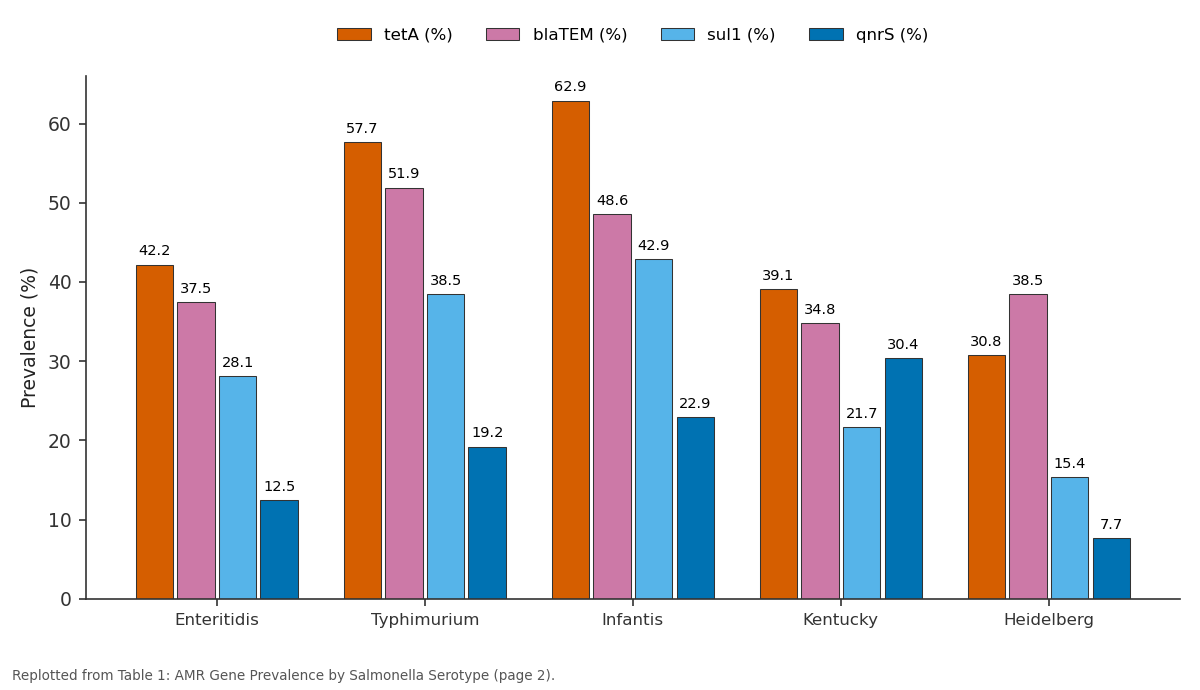
tetA (%) and blaTEM (%) and more: Enteritidis vs Typhimurium vs Infantis vs Kentucky vs Heidelberg
Replotted from Table 1 (page 2) of the original paper. Every bar is the paper's own table value.
View source evidence ↗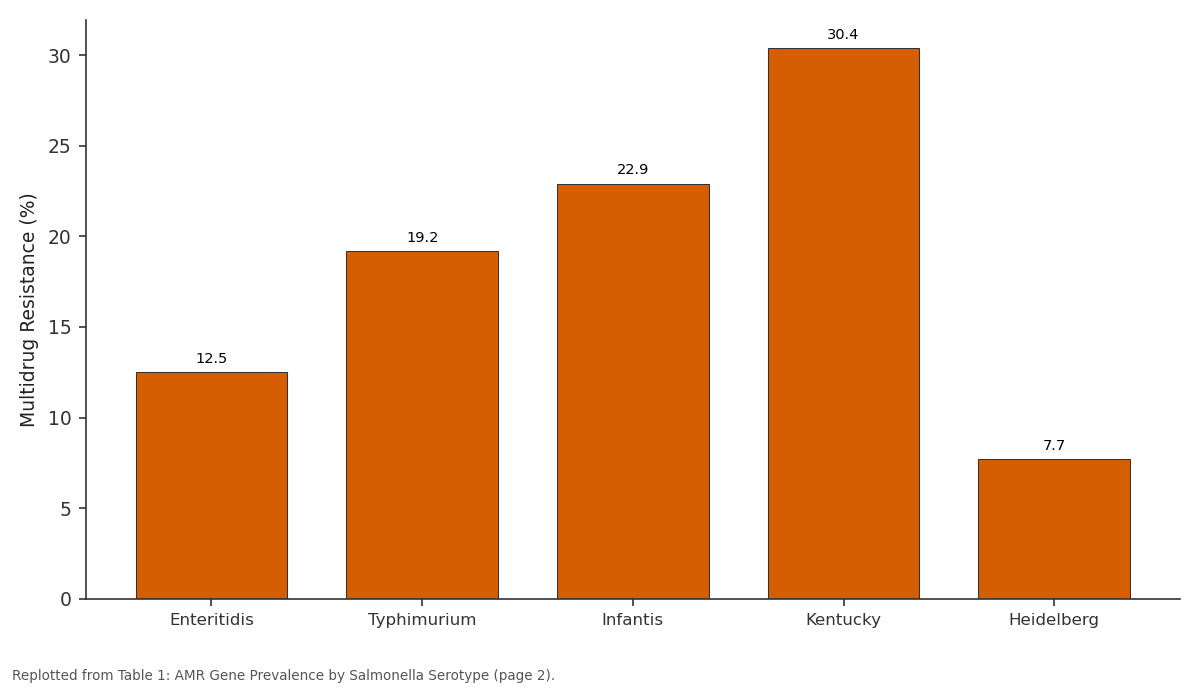
qnrS (%): Enteritidis vs Typhimurium vs Infantis vs Kentucky vs Heidelberg
Replotted from Table 1 (page 2) of the original paper. Every bar is the paper's own table value.
View source evidence ↗Figures & tables
From the original paper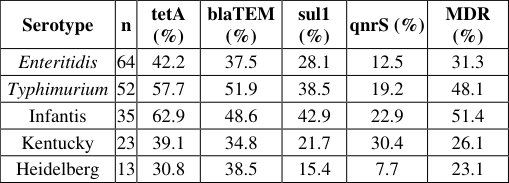 Table 1
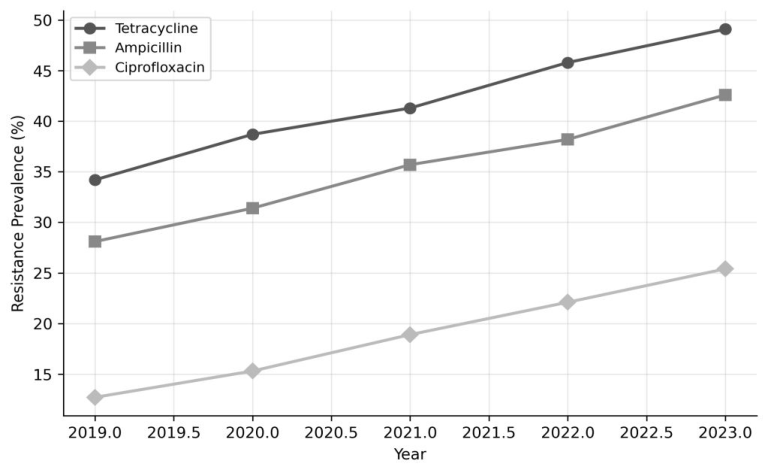 Figure 1
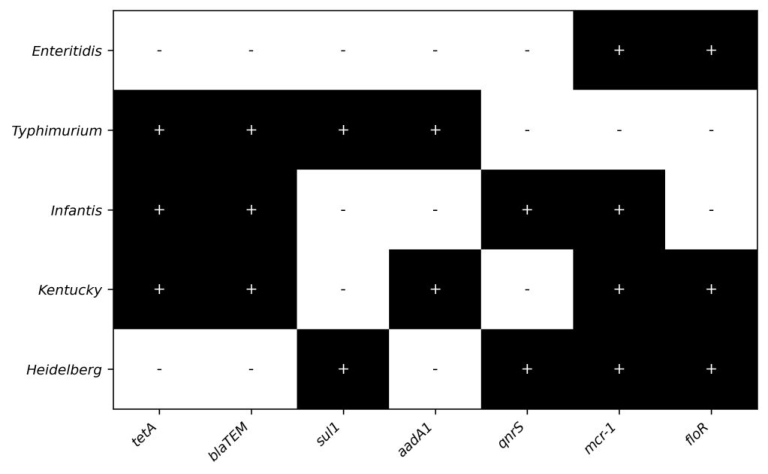 Figure 2
Introduction
In the view of public health officials, the spread of antimicrobial-resistant bacteria through the food chain represents one of the most pressing challenges of modern medicine. Salmonella enterica is among the most common foodborne pathogens globally, with poultry serving as a major reservoir for human infections [1] . The use of antimicrobials in poultry production-whether for treatment, prevention, or growth promotion-creates selective pressure that drives resistance evolution [2] . Traditional phenotypic susceptibility testing identifies resistant isolates but cannot pinpoint the genetic basis of resistance or track transmission pathways. Whole genome sequencing offers resolution at the single-nucleotide level, enabling detection of all known AMR genes, virulence factors, and phylogenetic relationships in a single assay [3] . WGS-based surveillance has been adopted by public health agencies in the US and Denmark, but uptake in UK agricultural settings remains limited [4] . This research aimed to characterize the AMR gene content of Salmonella isolates from poultry farms in Greater Manchester using WGS and to assess the prevalence of multidrug resistance across serotypes.
Materials and Methods
Materials and Methods
Materials
Sampling was conducted at 14 commercial broiler farms across Greater Manchester, UK, between September 2022 and December 2023. Laboratory work was performed at the Department of Medical Microbiology, Pennine Institute of Biological Sciences, Manchester. Institutional biosafety approval was obtained (PIBS-IBC/2022-031). A total of 412 samples were collected: broiler litter (n = 168), carcass rinses at processing (n = 134), and farm environmental swabs (n = 110). Salmonella isolation followed ISO 6579-1:2017 using buffered peptone water pre-enrichment, Rappaport-Vassiliadis broth enrichment, and XLD agar plating [5] . Confirmed Salmonella isolates (n = 187) were serotyped by the White-Kauffmann-Le Minor scheme.
Methods
Genomic DNA was extracted using the Wizard DNA Purification (Promega). Libraries were prepared with the Nextera XT kit and sequenced on an Illumina MiSeq (2 × 250 bp paired-end reads), targeting at least 30× coverage. Raw reads were quality-trimmed with Trimmomatic v0.39 [6] and assembled using SPAdes v3.15 [7] . AMR genes were identified with ResFinder 4.1 (90% identity, 60% coverage thresholds) and cross-checked against the Comprehensive Antibiotic Resistance Database (CARD) [8] . Serotype was confirmed in silico using SISTR [9] . Core genome multilocus sequence typing (cgMLST) used the EnteroBase scheme to assess phylogenetic relationships. Statistical analysis used chi-square tests for categorical comparisons. S. infantis showed the highest rates of tetracycline resistance (62.9%) and multidrug resistance (51.4%). S. typhimurium had similarly high MDR rates (48.1%). The mcr-1 colistin resistance gene was detected in 3 isolates (1.6%), all from S. typhimurium.
Results
Results
Discussion
The 75.9% AMR gene carriage rate among poultryassociated Salmonella is higher than the 55-65% reported in UK national surveillance data from 2020 [4] suggesting that prevalence may be underestimated by passive surveillance systems that rely on clinical isolates. The dominance of tetracycline resistance genes is unsurprising given that tetracyclines were historically among the most heavily used antimicrobials in UK poultry production [2] . The detection of mcr-1 in three isolates, though at low prevalence, is concerning because this plasmid-mediated colistin resistance gene can transfer horizontally between species and undermine a last-resort antibiotic [10] . S. infantis emerged as the serotype with the highest MDR burden, consistent with its rising prominence in European poultry surveillance [1] . The cgMLST analysis (data not shown in full) revealed that some closely related isolates were distributed across multiple farms, hinting at potential between-farm transmission through shared supply chains or personnel [3] .
Conclusion
This WGS-based survey revealed widespread AMR gene carriage in Salmonella from poultry farms in Greater Manchester, with 75.9% of isolates harboring at least one resistance gene and 38.5% classified as multidrug-resistant. Tetracycline and beta-lactam resistance genes were most prevalent. The detection of mcr-1 colistin resistance, though rare, warrants ongoing monitoring. These data support the integration of WGS into routine AMR surveillance for poultry-associated Salmonella in the UK.
Acknowledgement
Acknowledgements Funding SourcesDepartmental research funds from the Pennine Institute of Biological Sciences supported this work. Institutional SupportThe author thanks the Pennine Institute of Biological Sciences for sequencing infrastructure and laboratory access. Contributions Not Qualifying for AuthorshipFarm managers who permitted sampling and laboratory technicians who performed DNA extractions are acknowledged.
Figures and tables from the paper
| Serotype | n | tetA (%) | blaTEM (%) | sul1 (%) | qnrS (%) | MDR (%) |
|---|---|---|---|---|---|---|
| Enteritidis | 64 | 42.2 | 37.5 | 28.1 | 12.5 | 31.3 |
| Typhimurium | 52 | 57.7 | 51.9 | 38.5 | 19.2 | 48.1 |
| Infantis | 35 | 62.9 | 48.6 | 42.9 | 22.9 | 51.4 |
| Kentucky | 23 | 39.1 | 34.8 | 21.7 | 30.4 | 26.1 |
| Heidelberg | 13 | 30.8 | 38.5 | 15.4 | 7.7 | 23.1 |
Table text extracted from the original PDF; superscript letters are shown inline. The original table image is below.
View original table image
References
10 in the original paper- EFSA, ECDC. The European Union One Health 2021 Zoonoses Report. EFSA Journal. 2022;20(12):e07666.
- Nhung NT, Chansiripornchai N, Carrique-Mas JJ. Antimicrobial resistance in bacterial poultry pathogens: a review. Frontiers in Veterinary Science. 2017;4:126.
- Allard MW, Strain E, Melka D, Bunning K, Musser SM, Brown EW, et al. Practical value of food pathogen traceability through building a whole-genome sequencing network and database. Journal of Clinical Microbiology. 2016;54(8):1975-1983.
- Sheridan GEC, Sheridan JJ, Bolton DJ. Salmonella genomics for public health and food safety. Foodborne Pathogens and Disease. 2020;17(8):504-513.
- International Organization for Standardization. ISO 6579-1:2017. Microbiology of the food chain - horizontal method for the detection, enumeration and serotyping of Salmonella. Geneva: ISO; 2017.
- Bolger AM, Lohse M, Usadel B. Trimmomatic: a flexible trimmer for Illumina sequence data. Bioinformatics. 2014;30(15):2114-2120.
- Bankevich A, Nurk S, Antipov D, Gurevich AA, Dvorkin M, Kulikov AS, et al. SPAdes: a new genome assembly algorithm. Journal of Computational Biology. 2012;19(5):455-477.
- Alcock BP, Raphenya AR, Lau TTY, Tsang KK, Bouchard M, Edalatmand A, et al. CARD 2020: antibiotic resistome surveillance with the comprehensive antibiotic resistance database. Nucleic Acids Research. 2020;48(D1):D475-D481.
- Yoshida CE, Kruczkiewicz P, Laing CR, Lingohr EJ, Gannon VP, Nash JH, et al. The Salmonella In Silico Typing Resource (SISTR). PLoS ONE. 2016;11(1):e0147101.
- Liu YY, Wang Y, Walsh TR, Yi LX, Zhang R, Spencer J, et al. Emergence of plasmid-mediated colistin resistance mechanism MCR-1 in animals and human beings in China. Lancet Infectious Diseases. 2016;16(2):161-168.