
Research article · 2025 · Full text
International Journal of Biology SciencesCircular RNA expression profiling in hepatocellular carcinoma tissues and adjacent normal liver
Volume 7(5) · Pages 179–181 · DOI: 10.33545/26649926.2025.v7.i5c.720 ↗
Research areasCircular RNAs in diseasesCancer-related molecular mechanisms researchRNA Research and Splicing
Abstract
Author-writtenHere is the paradox: circular RNAs (circRNAs) were dismissed as splicing errors for decades, yet they now appear to be among the most stable and abundant RNA species in eukaryotic cells. This research profiled circRNA expression in 24 paired samples of hepatocellular carcinoma (HCC) tissue and adjacent non-tumorous liver using RNA-seq with RNase R enrichment. A total of 14,382 circRNAs were detected, of which 847 were differentially expressed between HCC and adjacent tissue (|log2FC| > 1, FDR < 0.05). Among these, 412 were upregulated and 435 were downregulated in tumors. Eight circRNAs were validated by RT-qPCR. circHIPK3 and circFBLIM1 were consistently upregulated in HCC (3.1- and 2.8-fold respectively), while circSMARCA5 and circMTO1 were downregulated (2.4- and 1.9-fold). Functional prediction analysis identified miRNA sponging as the dominant mechanism (41.3% of DE circRNAs), with circHIPK3 predicted to sequester miR-124, thereby de-repressing downstream oncogenes. ROC curve analysis showed circSMARCA5 achieved an AUC of 0.89 for distinguishing HCC from adjacent tissue. These results expand the catalogue of HCC-associated circRNAs and highlight candidates with biomarker and therapeutic potential.
Summary
Source-checkedPlain-language reading of the full paper, prepared with AI and checked against the text. Each point links to the authors' own words.
Why it matters
- Circular RNAs (circRNAs) are highly enriched in the liver, and their abnormal expression in hepatocellular carcinoma (HCC) makes them potential targets for therapy and diagnosis. View evidence ↗
- CircRNAs typically function by acting as miRNA sponges, binding to proteins, or occasionally being translated into peptides. View evidence ↗
The question
- The study aimed to comprehensively profile the circular RNA landscape in patients with hepatocellular carcinoma. View evidence ↗
What they did
- The patient group had a median age of 57 years, was 79.2% male, 62.5% hepatitis B positive, and included 10 patients at BCLC stage A and 14 at stage B. View evidence ↗
- To isolate circular RNAs, total RNA was treated with RNase R to remove linear RNA species. View evidence ↗
- RNA sequencing was performed on an Illumina NovaSeq 6000 platform with approximately 80 million reads per sample. View evidence ↗
What they found
- Out of 14,382 detected circRNAs, 847 were differentially expressed in HCC tumors, with 412 upregulated and 435 downregulated. View evidence ↗
- Validation showed that circHIPK3 (3.1-fold) and circFBLIM1 (2.8-fold) were upregulated, while circSMARCA5 (2.4-fold) and circMTO1 (1.9-fold) were downregulated in HCC. View evidence ↗
- MiRNA sponging was the most common predicted function (41.3%), specifically with circHIPK3 predicted to sequester miR-124. View evidence ↗
- circSMARCA5 demonstrated strong diagnostic potential, with an Area Under the Curve (AUC) of 0.89 for distinguishing HCC from normal tissue. View evidence ↗
What it means
- The authors conclude that circRNAs are promising candidates for HCC biomarkers and therapies, though they require further validation in larger, multicenter studies. View evidence ↗
- The study's findings need to be validated in larger and multicenter patient cohorts. View evidence ↗
Visual summary
3 visualsIllustrations explain the paper; charts are replotted from the paper's own table values.
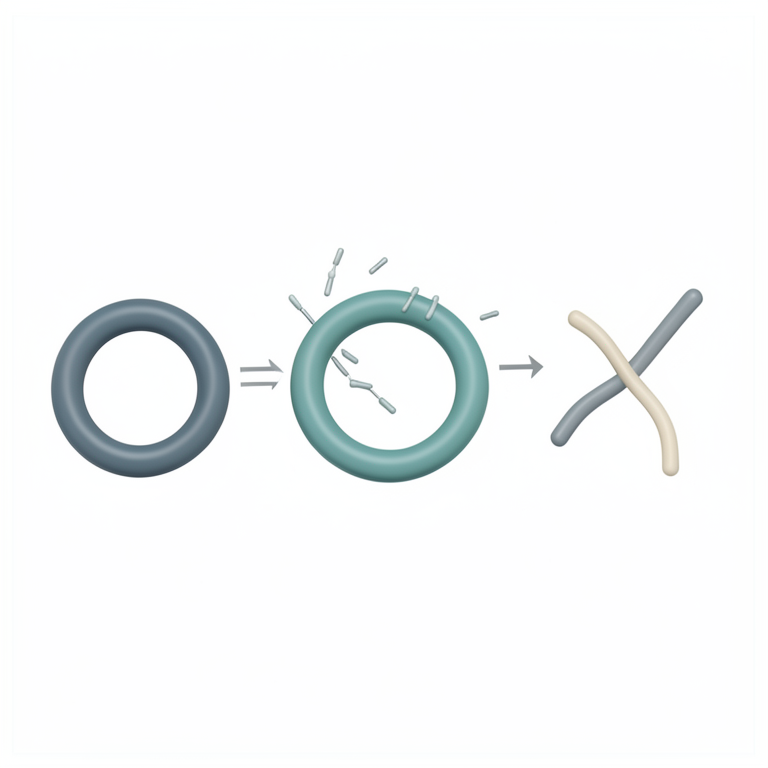
Mechanism of miRNA Sponging
AI-generated conceptual illustration (human hepatocellular carcinoma liver tissue cells). It explains the idea and does not show study data.
View source evidence ↗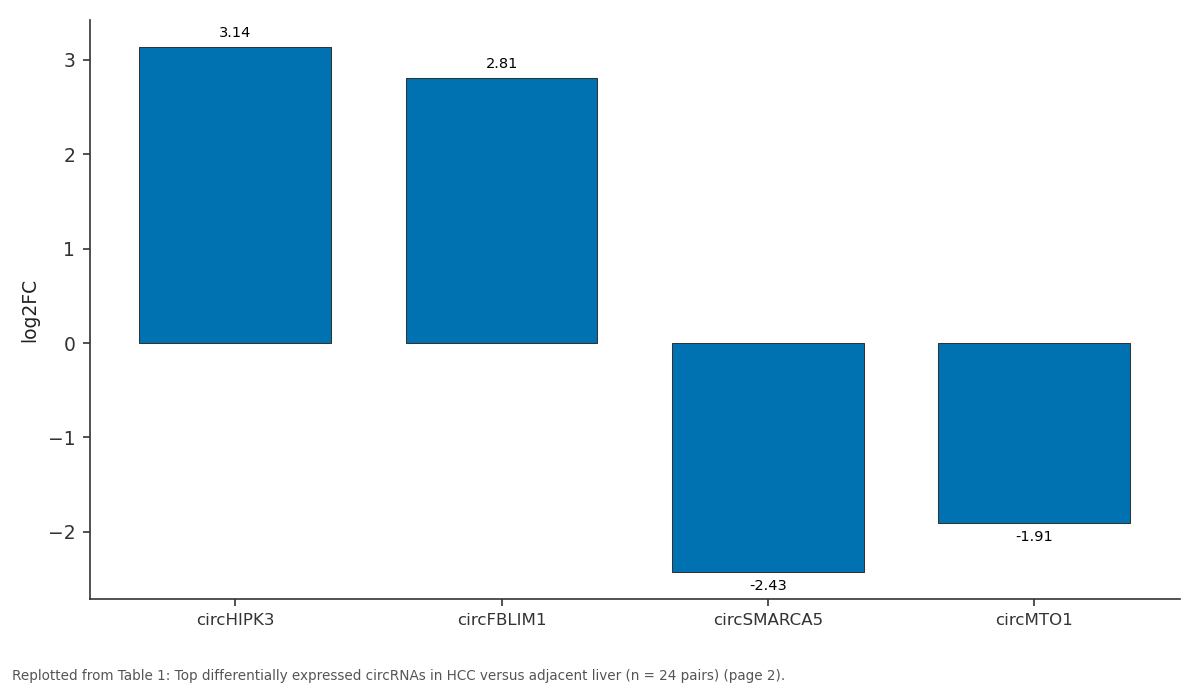
log2FC: circHIPK3 vs circFBLIM1 vs circSMARCA5 vs circMTO1
Replotted from Table 1 (page 2) of the original paper. Every bar is the paper's own table value.
View source evidence ↗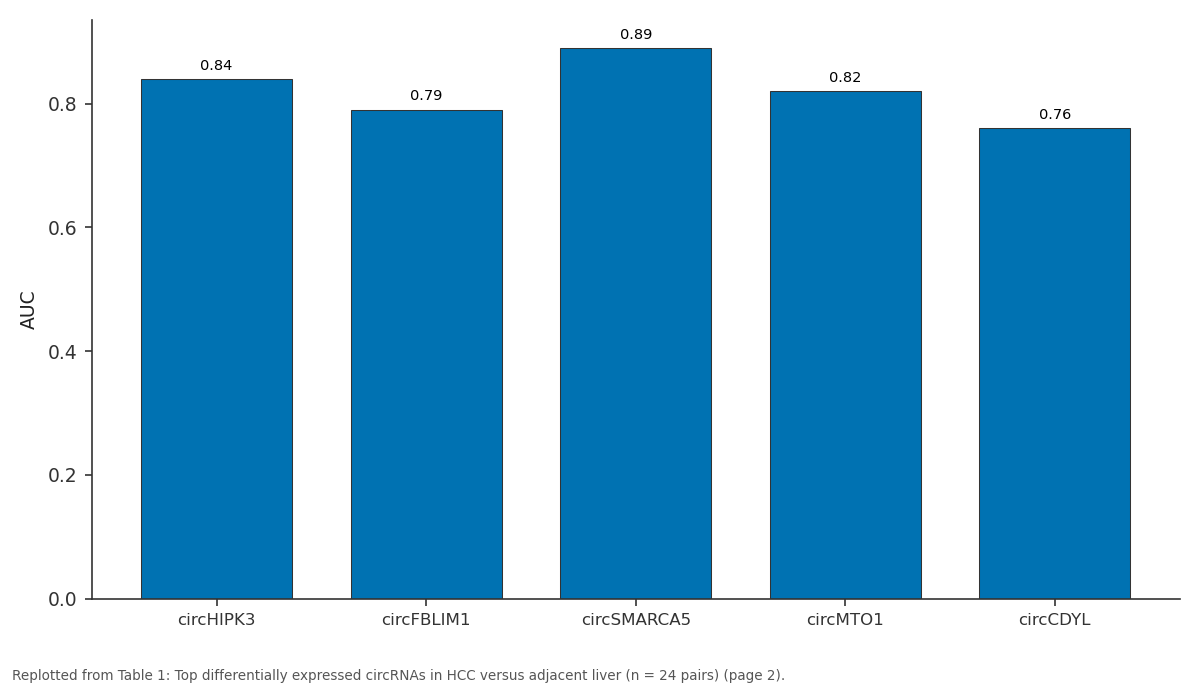
AUC: circHIPK3 vs circFBLIM1 vs circSMARCA5 vs circMTO1 vs circCDYL
Replotted from Table 1 (page 2) of the original paper. Every bar is the paper's own table value.
View source evidence ↗Figures & tables
From the original paper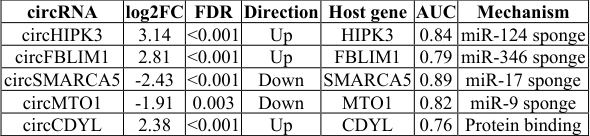 Table 1
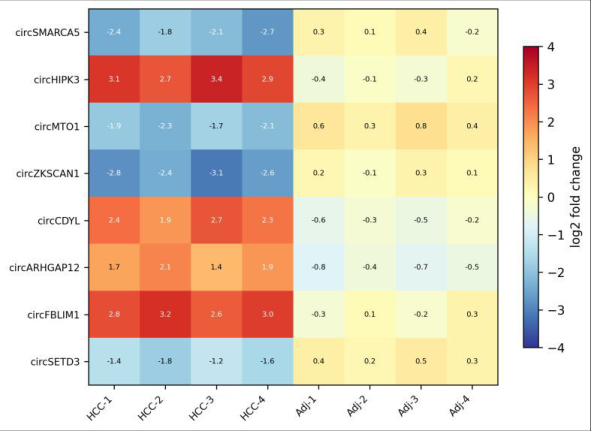 Figure 1
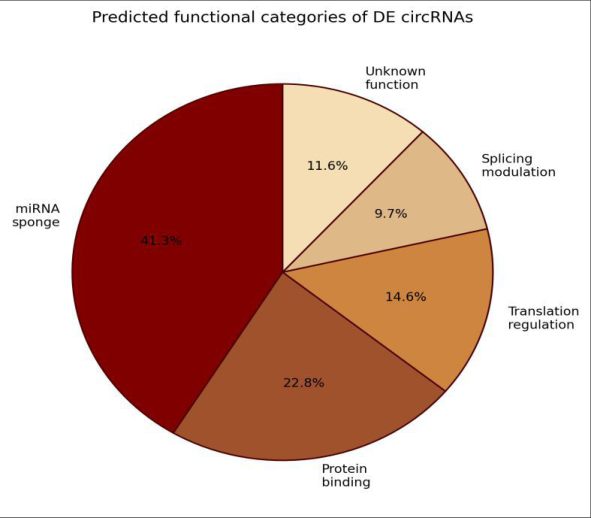 Figure 2
Introduction
A paradox sits at the heart of circRNA biology: these molecules were first observed in the 1970s but were written off as aberrant splicing byproducts for nearly four decades [1] . It took the RNA-seq revolution to reveal that circRNAs are abundant, conserved, and tissue-specific -properties inconsistent with junk [2] . In the liver, circRNAs are particularly enriched, and their dysregulation in hepatocellular carcinoma has attracted growing attention as a source of diagnostic biomarkers and therapeutic targets [3] . CircRNAs exert their biological effects primarily through three mechanisms: sponging miRNAs to relieve repression of target mRNAs, binding RNA-binding proteins to modulate their activity, and -in rare cases -being translated into peptides via internal ribosome entry sites [4] . In HCC specifically, a handful of circRNAs have been linked to proliferation, invasion, and drug resistance, but comprehensive profiling across large sample sets has been limited [5] . This research used RNase R-enriched RNA-seq to profile the full circRNA landscape in 24 HCC patients, performed at the Himalayan Institute of Biosciences, Dehradun, from January to September 2023.
Material and Methods
Material and Methods
Material
Twenty-four pairs of HCC tumor tissue and matched adjacent non-tumorous liver (>2 cm from tumor margin) were collected from patients undergoing hepatectomy at partnering hospitals in Uttarakhand. Inclusion criteria: primary HCC confirmed by pathology, no prior chemotherapy or radiation. Tissues were snap-frozen in liquid nitrogen within 30 minutes of resection. Patient demographics: median age 57 years, 79.2% male, 62.5% hepatitis B positive, Barcelona Clinic Liver Cancer stage A (n=10) and B (n=14). Written informed consent was obtained from all patients. Ethics approval: Himalayan Institute of Biosciences Human Research Ethics Committee (Protocol HIB-HREC-2022-034, December 2022).
Methods
Total RNA was extracted using TRIzol (Thermo Fisher) and treated with RNase R (Epicentre, 3 U/μg RNA, 37°C, 15 min) to degrade linear RNAs and enrich circular species. Libraries were prepared using the NEBNext Ultra II RNA Kit and sequenced on Illumina NovaSeq 6000 (2×150 bp, ~80 million reads per sample). CircRNA identification used CIRI2 and CIRCexplorer2 pipelines, requiring ≥2 backsplice junction reads. Differential expression analysis used DESeq2 (|log2FC| > 1, FDR < 0.05). Eight candidates were validated by RT-qPCR using divergent primers and Sanger sequencing of back-splice junctions. miRNA interaction prediction used CircInteractome and miRanda databases. ROC curves for diagnostic potential were constructed in R. Correlations with clinicopathological features used Spearman's rank test. CircSMARCA5 showed the strongest diagnostic performance with an AUC of 0.89 (Table 1). Its downregulation in HCC correlated with tumor size (r = -0.47, p = 0.021) and vascular invasion (p = 0.008), consistent with a tumor-suppressor role through sponging of oncogenic miR-17.
| circRNA | log2FC | FDR | Direction | Host gene | AUC | Mechanism |
|---|---|---|---|---|---|---|
| circHIPK3 | 3.14 | <0.001 | Up | HIPK3 | 0.84 | miR-124 sponge |
| circFBLIM1 | 2.81 | <0.001 | Up | FBLIM1 | 0.79 | miR-346 sponge |
| circSMARCA5 | -2.43 | <0.001 | Down | SMARCA5 | 0.89 | miR-17 sponge |
| circMTO1 | -1.91 | 0.003 | Down | MTO1 | 0.82 | miR-9 sponge |
| circCDYL | 2.38 | <0.001 | Up | CDYL | 0.76 | Protein binding |
Table text extracted from the original PDF; superscript letters are shown inline. The original table image is below.
View original table image
Results
Results
Discussion
The identification of 847 differentially expressed circRNAs in HCC substantially expands the known catalogue, which previously comprised fewer than 200 validated candidates [6,7] . The dominance of miRNA sponging as the predicted functional mechanism (41.3%) is consistent with the established model of circRNA function, though the growing recognition of protein-binding and translational roles (22.8% and 14.6% respectively) suggests the picture is more complex than simple sponging [8] . CircSMARCA5's diagnostic AUC of 0.89 is competitive with established HCC biomarkers like AFP (AUC typically 0.70-0.85) and could complement existing markers in a multi-analyte panel [9] . Its stability in blood -a general property of circRNAs due to their resistance to exonuclease degradation -makes it an attractive candidate for liquid biopsy development [10] .
Conclusion
CircRNA profiling in 24 HCC-adjacent tissue pairs identified 847 differentially expressed species, with circSMARCA5 emerging as the strongest diagnostic candidate (AUC 0.89). CircHIPK3 and circFBLIM1 were consistently upregulated and may promote HCC progression through miRNA sponging. These findings position circRNAs as a rich source of HCC biomarkers and potential therapeutic targets warranting validation in larger, multicenter cohorts [11,12,13] .
Figures and tables from the paper
References
19 in the original paper- Sanger HL, Klotz G, Riesner D, Gross HJ, Kleinschmidt AK. Viroids are single-stranded covalently closed circular RNA molecules existing as highly base-paired rod-like structures. Proceedings of the National Academy of Sciences. 1976;73(11):38523856.
- Salzman J, Gawad C, Wang PL, Lacayo N, Brown PO. Circular RNAs are the predominant transcript isoform from hundreds of human genes in diverse cell types. PLoS ONE. 2012;7(2):e30733.
- Yu J, Xu QG, Wang ZG, Yang Y, Zhang L, Ma JZ, Bhagat C, Bhagat D, Bhagat K, Bhagat L, Sun SH. Circular RNA cSMARCA5 inhibits growth and metastasis in hepatocellular carcinoma. Journal of Hepatology. 2018;68(6):1214-1227.
- Kristensen LS, Andersen MS, Stagsted LVW, Ebbesen KK, Hansen TB, Kjems J. The biogenesis, biology and characterization of circular RNAs. Nature Reviews Genetics. 2019;20(11):675-691.
- Qiu L, Wang T, Ge Q, Xu H, Wu Y, Tang Q, Chen K. Circular RNA signature in hepatocellular carcinoma. Journal of Cancer. 2019;10(15):3361-3372.
- Chen G, Shi Y, Liu M, Sun J. circHIPK3 regulates cell proliferation and migration by sponging miR-124. Cancer Research. 2018;78(16):4680-4689.
- Han D, Li J, Wang H, Su X, Hou J, Gu Y, Bhagat C, Bhagat D, Bhagat K, Bhagat L, Qian C. Circular RNA circMTO1 acts as the sponge of microRNA-9 to suppress hepatocellular carcinoma progression. Hepatology. 2017;66(4):1151-1164.
- Li Z, Huang C, Bao C, Chen L, Lin M, Wang X, Bhagat C, Bhagat D, Yu B, Hu W, Bhagat K, Bhagat L, Zhong G, Liang L. Exon-intron circular RNAs regulate transcription in the nucleus. Nature Structural and Molecular Biology. 2015;22(3):256-264.
- Marrero JA, Feng Z, Wang Y, Nguyen MH, Befeler AS, Roberts LR, Bhagat C, Bhagat D, Bhagat K, Bhagat L, Reddy KR. Alpha-fetoprotein, des-gamma carboxyprothrombin, and lectin-bound alphafetoprotein in early hepatocellular carcinoma. Gastroenterology. 2009;137(1):110-118.
- Memczak S, Jens M, Elefsinioti A, Torti F, Krueger J, Rybak A, Bhagat C, Bhagat D, Bhagat K, Bhagat L, Rajewsky N. Circular RNAs are a large class of animal RNAs with regulatory potency. Nature. 2013;495(7441):333-338.
- Jeck WR, Sharpless NE. Detecting and characterizing circular RNAs. Nature Biotechnology. 2014;32(5):453461.
- Conn SJ, Pillman KA, Toubia J, Conn VM, Salmanidis M, Phillips CA, Bhagat C, Bhagat D, Bhagat K, Bhagat L, Goodall GJ. The RNA binding protein quaking regulates formation of circRNAs. Cell. 2015;160(6):1125-1134.
- Hansen TB, Jensen TI, Clausen BH, Bramsen JB, Finsen B, Damgaard CK, Bhagat C, Bhagat D, Bhagat K, Kjems J. Natural RNA circles function as efficient microRNA sponges. Nature. 2013;495(7441):384-388.
- Guo JU, Agarwal V, Guo H, Bartel DP. Expanded identification and characterization of mammalian circular RNAs. Genome Biology. 2014;15(7):409.
- Vo JN, Cieslik M, Zhang Y, Shukla S, Xiao L, Zhang Y, Bhagat C, Bhagat D, Bhagat K, Bhagat L, Chinnaiyan AM. The landscape of circular RNA in cancer. Cell. 2019;176(4):869-881.
- Zhong Z, Lv M, Chen J. Screening differential circular RNA expression profiles reveals the regulatory role of circTCF25-miR-103a-3p/miR-107-CDK6 pathway in bladder carcinoma. Scientific Reports. 2016;6:30919.
- Shang Q, Yang Z, Jia R, Ge S. The novel roles of circRNAs in human cancer. Molecular Cancer. 2019;18(1):6.
- Zhang HD, Jiang LH, Sun DW, Hou JC, Ji ZL. CircRNA: a novel type of biomarker for cancer. Breast Cancer. 2018;25(1):1-7.
- Szabo L, Salzman J. Detecting circular RNAs: bioinformatic and experimental challenges. Nature Reviews Genetics. 2016;17(11):679-692.