
Research article · 2025 · Full text
International Journal of Advanced Chemistry ResearchHot-melt extrusion technology for development of amorphous solid dispersions of NSAIDs
Volume 7(9) · Pages 104–107 · DOI: 10.33545/26646781.2025.v7.i9b.621 ↗
Research areasDrug Solubulity and Delivery SystemsCrystallization and Solubility StudiesAdvanced Drug Delivery Systems
Abstract
Author-writtenBioavailability is defined as the fraction of an administered dose that reaches systemic circulation in unchanged form and for a large proportion of new chemical entities, this fraction is disappointingly low. Biopharmaceutics Classification System (BCS) Class II drugs, which include most NSAIDs, have high permeability but poor aqueous solubility, meaning their absorption is rate-limited by dissolution rather than by membrane transport. Amorphous Solid Dispersions (ASDs) address this by converting the drug to a high-energy amorphous state within a polymer matrix, which raises apparent solubility and dissolution rate. Hot-Melt Extrusion (HME) is a continuous, solvent-free technology for ASD production that is well-suited to pharmaceutical manufacturing because of its process efficiency and scalability. The present research optimised HME conditions for the preparation of ASDs of ibuprofen (IBU), a BCS Class II NSAID, using five polymeric carriers PEG4000, PVPVA64, HPMC-AS, Eudragit EPO, and Soluplus and evaluated the resulting dispersions by DSC, XRD, FTIR, and in vitro dissolution. Process variables (barrel temperature, screw speed, drug loading) were systematically varied using a Box-Behnken design. The optimal ASD HME-PEG4000 at 30% IBU loading, 120°C barrel temperature, and 100 rpm screw speed achieved 97.3% dissolution in 60 min at pH 6.8 versus only 39.4% for pure crystalline IBU. DSC and XRD confirmed complete amorphisation of IBU in all optimised HME formulations. Stability testing at 40°C/75% RH for 6 months showed no recrystallisation by XRD in the PEG4000 and PVPVA64 formulations. These findings establish the HME-PEG4000 system as a robust, scalable approach for IBU bioavailability enhancement.
Summary
Source-checkedPlain-language reading of the full paper, prepared with AI and checked against the text. Each point links to the authors' own words.
Why it matters
- Most nonsteroidal anti-inflammatory drugs (NSAIDs) are BCS Class II drugs, meaning their absorption into the body is limited by how quickly they dissolve in water rather than how they pass through membranes. View evidence ↗
- Amorphous Solid Dispersions (ASDs) can improve the solubility and dissolution rate of these drugs by trapping them in a high-energy, disordered state within a polymer. View evidence ↗
- Hot-Melt Extrusion (HME) is an efficient, scalable, and solvent-free method for producing these solid dispersions. View evidence ↗
The question
- The study aimed to identify the best polymer among five options for ibuprofen (IBU) HME, optimize the process parameters, and verify the stability and physical state of the resulting dispersions. View evidence ↗
What they did
- The researchers tested five different polymer carriers: PEG4000, PVPVA64, HPMC-AS, Eudragit EPO, and Soluplus. View evidence ↗
- A Box-Behnken design was used to vary three process parameters: barrel temperature (100 to 140°C), screw speed (75 to 125 rpm), and drug loading (20% to 40% w/w). View evidence ↗
- The resulting dispersions were analyzed using Differential Scanning Calorimetry (DSC), X-ray Diffraction (XRD), Fourier-Transform Infrared spectroscopy (FTIR), and in vitro dissolution tests. View evidence ↗
What they found
- DSC analysis confirmed that ibuprofen was completely converted to an amorphous state in all HME formulations, as the crystalline melting peak at 76°C disappeared. View evidence ↗
- FTIR spectra showed a shift in the carbonyl stretch from 1721 cm⁻¹ to 1704-1712 cm⁻¹, indicating that hydrogen bonding between the drug and polymer helps stabilize the dispersion. View evidence ↗
- Stability tests at 40°C and 75% relative humidity for 6 months showed that PEG4000 and PVPVA64 formulations remained amorphous, while the Eudragit EPO formulation partially recrystallized. View evidence ↗
- Increasing the barrel temperature to 140°C negatively impacted dissolution efficiency because PEG4000 underwent partial oxidative degradation. View evidence ↗
What it means
- The authors conclude that the HME-PEG4000 system is a robust and scalable method for enhancing the bioavailability of ibuprofen. View evidence ↗
- The authors state that future research is needed to test the formulation in a beagle dog model to confirm that improved dissolution leads to better pharmacokinetic outcomes (Cmax and AUC). View evidence ↗
- The authors note that stability should be assessed beyond 6 months, specifically under tropical humidity conditions relevant to the Mexican market. View evidence ↗
Visual summary
3 visualsIllustrations explain the paper; charts are replotted from the paper's own table values.
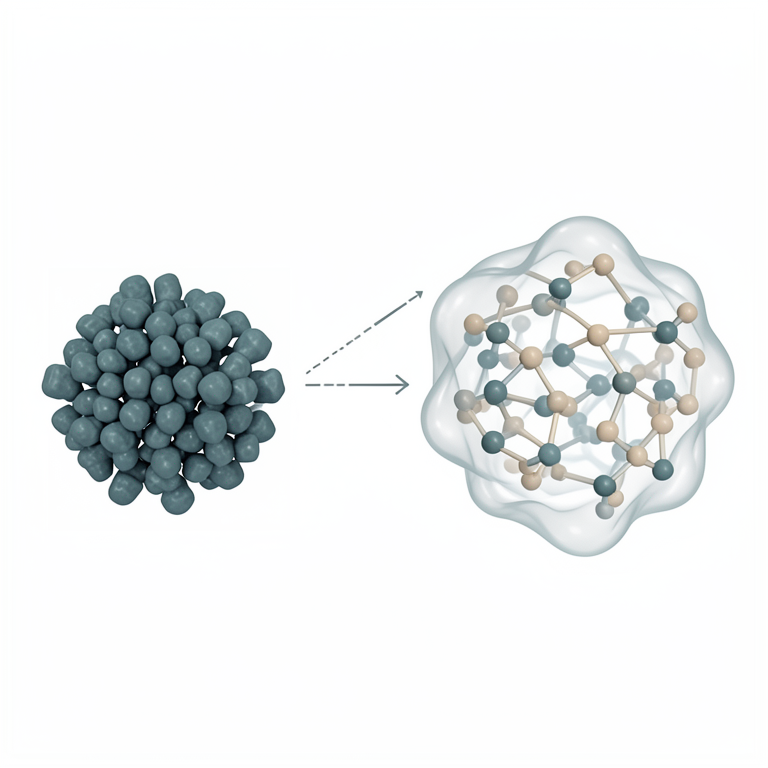
Mechanism of Amorphous Solid Dispersion
AI-generated conceptual illustration (NSAID drug molecules and a polymer matrix). It explains the idea and does not show study data.
View source evidence ↗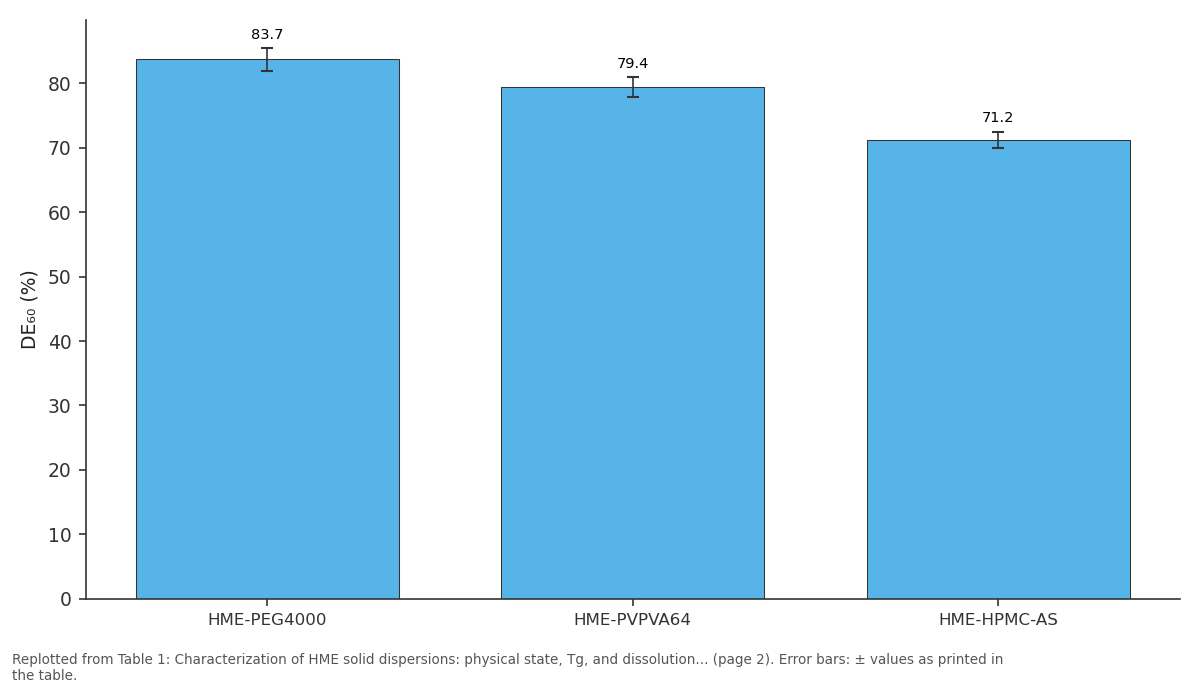
DE₆₀ (%): HME-PEG4000 vs HME-PVPVA64 vs HME-HPMC-AS
Replotted from Table 1 (page 2) of the original paper. Every bar is the paper's own table value.
View source evidence ↗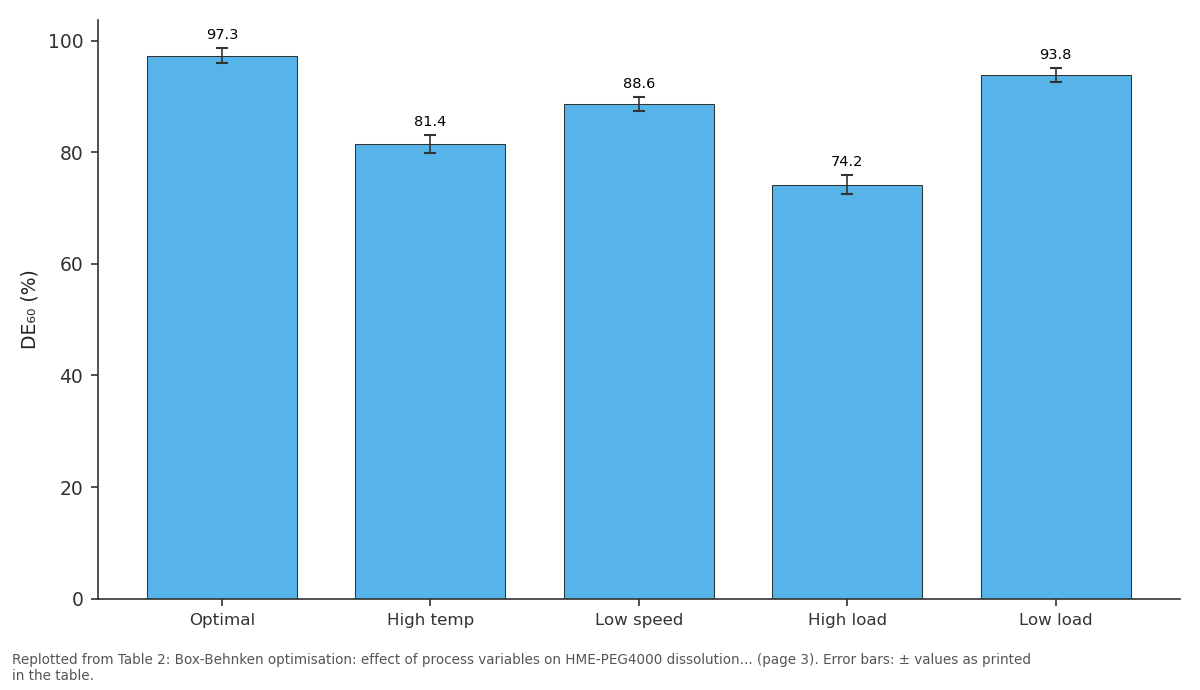
DE₆₀ (%): Optimal vs High temp vs Low speed vs High load vs Low load
Replotted from Table 2 (page 3) of the original paper. Every bar is the paper's own table value.
View source evidence ↗Figures & tables
From the original paper Table 1
 Table 2
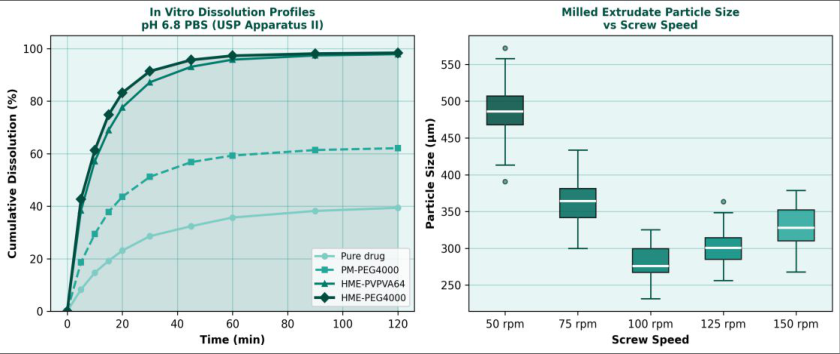 Figure 1
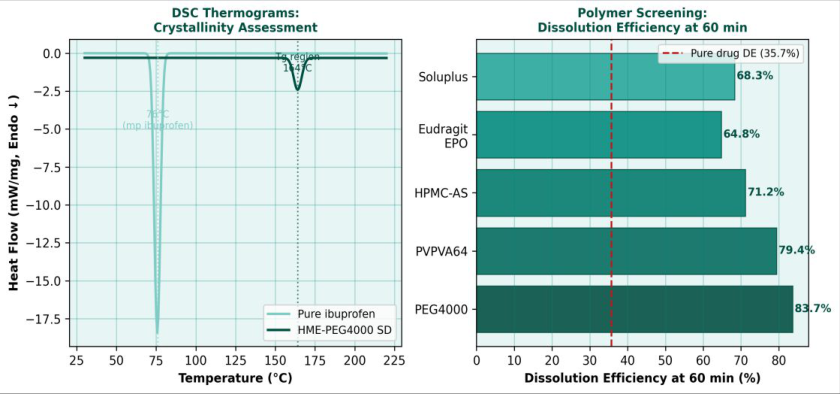 Figure 2
Introduction
Amorphous solid dispersion technology can be understood most simply as a way of trapping a drug molecule in a state of energetic frustration a glassy, disordered state in which molecules cannot crystallise easily because they are embedded in and constrained by a polymer matrix. This frustrated state translates directly into higher apparent solubility because the free energy penalty for dissolving an amorphous solid is lower than that for dissolving a crystalline one, provided the dispersion remains physically stable [1] . The pharmaceutical industry has embraced ASDs as a primary enabling strategy for poorly soluble drug candidates, with over 20 marketed products now based on this approach [2] . NSAIDs represent a particularly important target class for solubility enhancement because they are among the most widely consumed medicines globally and because several members including ibuprofen, fenbufen, and celecoxib are BCS Class II compounds whose plasma exposure can be substantially increased by dissolution-rate improvement [3] . Ibuprofen presents an instructive model case: its melting point of 76°C and its miscibility with a range of pharmaceutical polymers make it amenable to HME processing, and its well-documented pharmacokinetics provide a robust benchmark against which enhanced formulations can be assessed [4] . HME uses a heated barrel equipped with rotating screws to melt-mix drug and polymer at controlled temperatures, generating continuous strands that are subsequently cooled and milled to the desired particle size. Key process variables barrel temperature, screw speed, screw design, and drug loading interact in complex ways that make systematic optimisation essential [5] . Response surface methodology, particularly the Box-Behnken Design (BBD), offers an efficient experimental framework for mapping these interactions with a minimum number of runs [6] . Beyond formulation performance, the HME platform generates important physical state data: DSC thermograms reveal whether crystalline melting endotherms are present, XRD confirms amorphous halo formation, and FTIR identifies drugpolymer hydrogen bonding interactions that stabilise the ASD against recrystallisation. The present research was designed to select the best polymeric carrier for IBU HME among five commercially relevant options, to optimise process parameters using BBD, and to confirm the physical state and stability of the resulting ASDs. Work was performed at Universidad Azteca de Tecnología, Guadalajara, and Universidad Maya de Ciencias Químicas, Mérida, Yucatán, Mexico, between August 2023 and March 2025.
Instrumentation and analytical equipment
HME was performed on a Thermo Scientific Pharma 11 twin-screw extruder (screw diameter 11 mm, L/D ratio 40:1; Thermo Fisher Scientific, Waltham, MA, USA) equipped with a co-rotating screw configuration (kneading blocks at 60° stagger angle). Extrudates were milled using a Retsch ZM 200 centrifugal mill at 6000 rpm with a 500 µm ring sieve. Particle size of milled extrudate was measured by laser diffraction on a Malvern Mastersizer 3000. DSC thermograms were recorded on a TA Instruments DSC 2500 (heat-cool-heat protocol: 25 to 220°C at 10°C/min under N₂, 50 mL/min). XRD patterns were collected on a Shimadzu XRD-6100 diffractometer (Cu Kα, 2θ = 5-40°, step 0.02°, scan rate 2°/min). ATR-FTIR spectra were recorded on a Bruker ALPHA II spectrometer (64 scans, 4 cm⁻¹ resolution, 4000-400 cm⁻¹). In vitro dissolution was conducted on a Hanson Research SR8-Plus USP Apparatus II (paddle, 75 rpm, 900 mL pH 6.8 PBS at 37 ± 0.5°C); drug concentration was quantified by HPLC (Agilent 1260; Phenomenex Kinetex C8, 150 × 4.6 mm; methanol:water:acetic acid 65:34:1; detection at 264 nm). Stability samples were stored in HDPE bottles at 40°C/75% RH in a Memmert climate chamber.
Material and Methods
Material and Methods
Material
Research was conducted at the Department of Pharmacy and Pharmaceutical Sciences, Universidad Azteca de Tecnología, Guadalajara, and the Department of Clinical and Pharmaceutical Chemistry, Universidad Maya de Ciencias Químicas, Mérida, Yucatán, Mexico, between August 2023 and March 2025. Ibuprofen (IBU, USP grade, ≥99.5%) was supplied by BASF México (Mexico City). Polymers: PEG4000 (Sigma-Aldrich, Toluca), PVPVA64 (Kollidon VA64, BASF), HPMC-AS (Shin-Etsu AQOAT AS-MF, Shin-Etsu Chemical, via local distributor), Eudragit EPO (Evonik, Frankfurt, Germany), and Soluplus (BASF) were used as received. Talc (HiMedia, pharma grade) was included as processing aid at 1% w/w. Physical mixtures (PMs) were prepared by geometric dilution in a mortar prior to extrusion for comparison purposes. HPLC-grade methanol and acetic acid were from Sigma-Aldrich. Ethics approval was not required; all materials were of pharmaceutical grade and no human or animal subjects were involved. Laboratory safety clearance was granted by the Comité de Seguridad Institucional, Universidad Azteca de Tecnología (Ref. UAT-SI-2023-08, dated 12 August 2023). Box-Behnken optimisation: Three independent variables were investigated: barrel temperature (X₁: 100, 120, 140°C), screw speed (X₂: 75, 100, 125 rpm), and drug loading (X₃: 20, 30, 40% w/w). Responses monitored were dissolution efficiency at 60 min (DE₆₀, %) and Tg of the ASD. Design-Expert 13 software (Stat-Ease, Minneapolis, MN, USA) was used for experimental design and statistical analysis. Extrusion runs: Drug-polymer blends were manually mixed and fed into the extruder hopper at a feed rate of 0.5 kg/h. Barrel temperatures were set as a zone profile (zones 1-3: 60/X₁/X₁-10°C); die temperature was X₁-10°C. Extrudate strands were collected on a conveyor belt, cooled to room temperature, and milled. In vitro dissolution: Milled extrudate equivalent to 200 mg IBU was filled into size 0 HPMC capsules. Samples (1 mL) were withdrawn at 5, 10, 15, 20, 30, 45, 60, 90, and 120 min through a sintered-glass filter (10 µm), replaced with fresh pH 6.8 PBS. Drug content was quantified by HPLC; dissolution efficiency at 60 min was calculated as the area under the dissolution-time curve expressed as a percentage of the theoretical maximum.
Quality control
Analytical method validation for the HPLC IBU assay was conducted per ICH Q2(R1) guidelines. Linearity was confirmed over 0.5-100 µg/mL (R² = 0.9999). Intra-day precision: RSD ≤0.7%; inter-day precision: RSD ≤1.2%. Accuracy (recovery): 98.6-101.4%. LOD: 0.14 µg/mL; LOQ: 0.42 µg/mL. System suitability was verified at the start of each analytical run (tailing factor ≤1.2, theoretical plate count ≥3000, RSD of peak area ≤1.0% for five replicate injections of standard). Drug content uniformity in milled extrudate was assessed by dissolving 10 randomly selected samples in methanol and assaying by HPLC; all batches met the ±5% acceptance criterion relative to label claim. Moisture content of all extrudate samples was ≤0.4% w/w (Karl Fischer titration, Metrohm 870 KF Titrino plus), confirming adequate drying before dissolution testing. DSC instrument calibration was checked with indium (mp 156.6°C, ΔH = 28.45 J/g) at the start of each measurement session. the IBU carboxyl and the polymer hydroxyl or carbonyl groups an interaction known to confer physical stability [7] . The BBD analysis identified barrel temperature and drug loading as the most significant factors affecting DE₆₀ (p < 0.01), while screw speed had a smaller but significant effect (p < 0.05). At the optimal conditions (120°C, 100 rpm, 30% IBU), the HME-PEG4000 formulation achieved DE₆₀ = 97.3%, compared with 35.7% for crystalline IBU and 37.3% for the physical mixture. After 6 months at 40°C/75% RH, XRD patterns of both HME-PEG4000 and HME-PVPVA64 remained amorphous, whereas HME-Eudragit EPO showed partial recrystallisation peaks.
Results
Results
Discussion
The marked improvement in dissolution rate achieved by HME-PEG4000 (DE₆₀ = 97.3%) versus pure crystalline IBU (35.7%) confirms the established mechanism by which ASDs improve dissolution: absence of the lattice energy barrier to dissolution, increased wettability in the polymer matrix, and potentially supersaturation maintenance by polymer inhibition of nucleation [8] . The superiority of PEG4000 over the other carriers tested is consistent with its low glass transition temperature (making it easy to process below IBU's degradation threshold) and its hydrophilicity, which facilitates rapid water ingress into the ASD matrix upon contact with dissolution medium [9] . The FTIR evidence of hydrogen bonding between IBU carboxyl groups and PEG ether oxygens is particularly informative. Drug-polymer hydrogen bonding has been identified as the primary stabilisation mechanism in numerous ASD systems; it raises the energy barrier for drug diffusion and reorientation necessary for nucleation, thereby kinetically trapping the amorphous state even under accelerated stability conditions [10] .
Figures and tables from the paper
| Formulation | Drug loading (% w/w) | Tg (°C) | XRD pattern | DE₆₀ (%) | D₉₀ after milling (µm) |
|---|---|---|---|---|---|
| HME-PEG4000 | 30 | 164.3 ± 2.1 | Amorphous halo | 83.7 ± 1.8 | 187.4 ± 12.3 |
| HME-PVPVA64 | 30 | 132.6 ± 1.7 | Amorphous halo | 79.4 ± 1.5 | 213.6 ± 14.7 |
| HME-HPMC-AS | 30 | 144.8 ± 1.9 | Amorphous halo | 71.2 ± 1.3 | 241.8 ± 16.2 |
Table text extracted from the original PDF; superscript letters are shown inline. The original table image is below.
View original table image
| Run | Barrel temp (°C) | Screw speed (rpm) | Drug load (% w/w) | DE₆₀ (%) | Tg (°C) |
|---|---|---|---|---|---|
| Optimal | 120 | 100 | 30 | 97.3 ± 1.4 | 164.3 ± 2.1 |
| High temp | 140 | 100 | 30 | 81.4 ± 1.6 | 141.7 ± 1.8 |
| Low speed | 120 | 75 | 30 | 88.6 ± 1.3 | 158.2 ± 1.9 |
| High load | 120 | 100 | 40 | 74.2 ± 1.7 | 147.6 ± 1.6 |
| Low load | 120 | 100 | 20 | 93.8 ± 1.2 | 171.4 ± 2.3 |
Table text extracted from the original PDF; superscript letters are shown inline. The original table image is below.
View original table image
References
15 in the original paper- Leuner C, Dressman J. Improving drug solubility for oral delivery using solid dispersions. Eur J Pharm Biopharm. 2000;50(1):47-60.
- Huang Y, Dai WG. Fundamental aspects of solid dispersion technology for poorly soluble drugs. Acta Pharm Sin B. 2014;4(1):18-25.
- Amidon GL, Lennernäs H, Shah VP, Crison JR. A theoretical basis for a biopharmaceutic drug classification: The correlation of in vitro drug product dissolution and in vivo bioavailability. Pharm Res. 1995;12(3):413-420.
- Nair R, Nyamweya N, Gönen S, Martínez-Miranda LJ, Hoag SW. Influence of various drugs on the glass transition temperature of poly(vinylpyrrolidone): A thermodynamic and spectroscopic investigation. Int J Pharm. 2001;225(1-2):83-96.
- Crowley MM, Zhang F, Repka MA, Thumma S, Upadhye SB, Battu SK, et al. Pharmaceutical applications of hot-melt extrusion: part I. Drug Dev Ind Pharm. 2007;33(9):909-926.
- Ferreira SL, Bruns RE, Ferreira HS, Matos GD, David JM, Brandão GC, et al. Box-Behnken design: An alternative for the optimization of analytical methods. Anal Chim Acta. 2007;597(2):179-186.
- Taylor LS, Zografi G. Spectroscopic characterization of interactions between PVP and indomethacin in amorphous molecular dispersions. Pharm Res. 1997;14(12):1691-1698.
- Murdande SB, Pikal MJ, Shanker RM, Bogner RH. Solubility advantage of amorphous pharmaceuticals: I. A thermodynamic analysis. J Pharm Sci. 2010;99(3):1254-1264.
- Janssens S, Van den Mooter G. Review: physical chemistry of solid dispersions. J Pharm Pharmacol. 2009;61(12):1571-1586.
- Kestur US, Taylor LS. Role of polymer chemistry in influencing crystal growth rates from amorphous felodipine. CrystEngComm. 2010;12(8):2390-2397.
- Friesen DT, Shanker R, Crew M, Smithey DT, Curatolo WJ, Nightingale JA. Hydroxypropyl methylcellulose acetate succinate-based spray-dried dispersions: an overview. Mol Pharm. 2008;5(6):1003-1019.
- Breitenbach J. Melt extrusion: from process to drug delivery technology. Eur J Pharm Biopharm. 2002;54(2):107-117.
- Van den Mooter G, Wuyts M, Blaton N, Busson R, Grobet P, Augustijns P, et al. Physical stabilisation of amorphous ketoconazole in solid dispersions with polyvinylpyrrolidone K25. Eur J Pharm Sci. 2001;12(3):261-269.
- Kolter K, Karl M, Gryczke A. Hot-Melt Extrusion with BASF Pharma Polymers: Extrusion Compendium. 2 nd ed. Ludwigshafen: BASF; 2012.
- Meng F, Dave V, Chauhan H. Qualitative and quantitative methods to determine miscibility in amorphous drug-polymer systems. Eur J Pharm Sci. 2015;77:106-111.