
Research article · 2025 · Full text
International Journal of Biology SciencesHost immune evasion strategies of Trypanosoma cruzi during chronic chagas disease
Volume 7(5) · Pages 173–175 · DOI: 10.33545/26649926.2025.v7.i5c.715 ↗
Research areasTrypanosoma species research and implicationsResearch on Leishmaniasis StudiesVector-borne infectious diseases
Abstract
Author-writtenOne observation that has puzzled parasitologists for decades is how Trypanosoma cruzi persists in human hosts for a lifetime despite generating strong humoral and cellular immune responses. This research characterized the immune evasion mechanisms employed by T. cruzi during experimental chronic Chagas disease in BALB/c mice (n = 48) infected with the Y strain and monitored for 24 weeks. Blood parasitemia, tissue parasite burden, complement evasion capacity, surface antigen diversity, T cell exhaustion markers, and regulatory T cell (Treg) frequencies were tracked at biweekly intervals. Complement resistance was the dominant evasion mechanism during acute infection (contributing an estimated 24.3% of overall immune escape), while T cell exhaustion (PD-1+/Tim-3+ CD8+ T cells rising from 8.4% to 43.7%) and Treg induction (CD4+FoxP3+ cells doubling from 6.2% to 12.8%) became the main strategies sustaining chronic persistence. Parasite surface trans-sialidase diversity peaked during the acute-to-chronic transition (weeks 6-10) with 14 distinct variants detected by sequencing. These temporal shifts suggest that T. cruzi deploys an ordered succession of evasion mechanisms rather than relying on a single strategy throughout infection.
Summary
Source-checkedPlain-language reading of the full paper, prepared with AI and checked against the text. Each point links to the authors' own words.
Why it matters
- Trypanosoma cruzi is capable of persisting in human cardiac and gastrointestinal muscle cells for 30 to 40 years, resisting clearance by the host immune system. View evidence ↗
- The parasite utilizes at least six known immune evasion strategies, including complement resistance, antigenic variation, T cell exhaustion, regulatory T cell expansion, macrophage subversion, and apoptosis mimicry. View evidence ↗
- While various evasion strategies exist, the specific temporal sequence and changing importance of these mechanisms as infection moves from acute to chronic phases have not been mapped in a single system. View evidence ↗
The question
- The study aimed to establish a timeline of immune evasion during the development of chronic Chagas disease by longitudinally tracking six evasion mechanisms. View evidence ↗
What they did
- Forty-eight female BALB/c mice (6-8 weeks old, 18-22 g) were intraperitoneally infected with 1,000 blood-form trypomastigotes of the T. cruzi Y strain. View evidence ↗
- Parasitemia was monitored biweekly via Giemsa-stained blood smears, and tissue burden in heart and skeletal muscle was measured at weeks 4, 8, 12, 18, and 24 using quantitative PCR. View evidence ↗
- Complement resistance was assessed by parasite survival in 50% normal mouse serum, while T cell exhaustion and regulatory T cell populations were identified using multicolor flow cytometry on splenic lymphocytes. View evidence ↗
What they found
- Blood parasitemia reached its peak at week 4 and was no longer detectable by microscopy after week 10, although the parasite burden in tissues persisted. View evidence ↗
What it means
- The authors conclude that T. cruzi uses a sequenced approach to evasion: complement resistance and antigenic variation are primary in the acute phase, while T cell exhaustion and Treg induction sustain the chronic phase. View evidence ↗
- The authors recommend stage-specific therapies, such as complement-targeted approaches for acute exposure and checkpoint blockade for early chronic infection to reverse T cell exhaustion. View evidence ↗
Visual summary
2 visualsIllustrations explain the paper; charts are replotted from the paper's own table values.
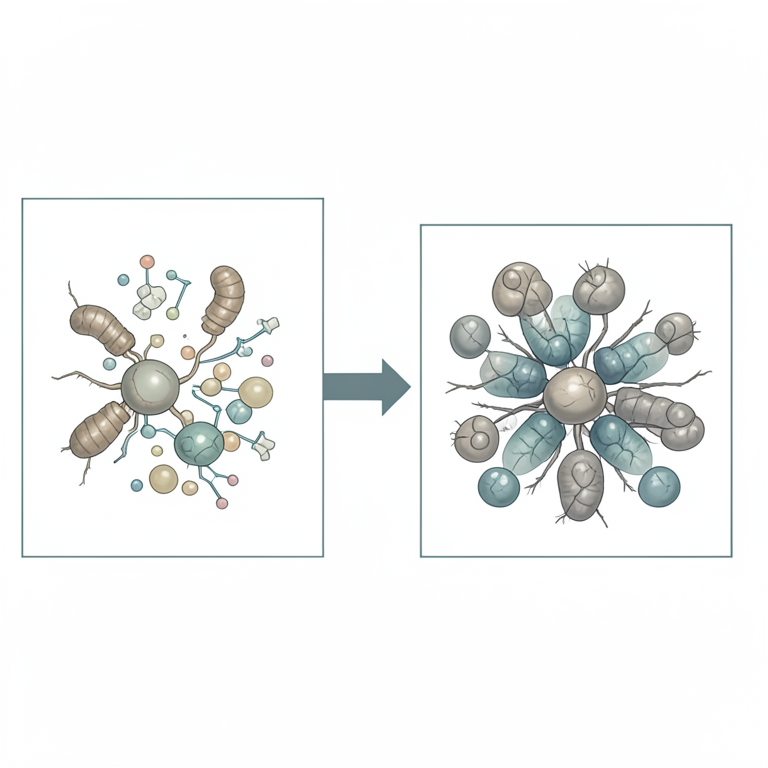
Temporal Succession of Evasion
AI-generated conceptual illustration (Trypanosoma cruzi parasites and mammalian immune cells). It explains the idea and does not show study data.
View source evidence ↗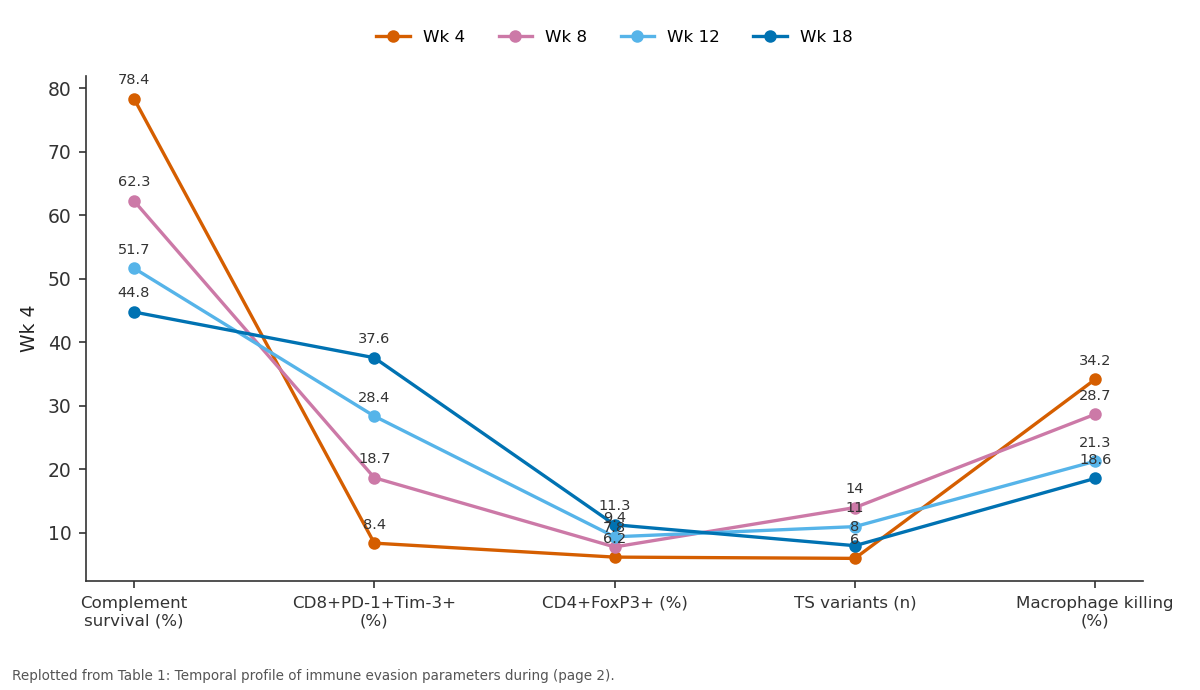
Wk 4 and Wk 8 and more: Complement survival (%) vs CD8+PD-1+Tim-3+ (%) vs CD4+FoxP3+ (%) vs TS variants (n) vs Macrophage killing (%)
Replotted from Table 1 (page 2) of the original paper. Every bar is the paper's own table value.
View source evidence ↗Figures & tables
From the original paper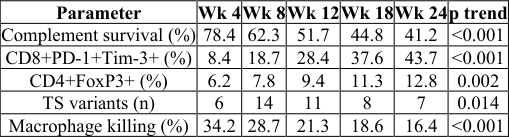 Table 1
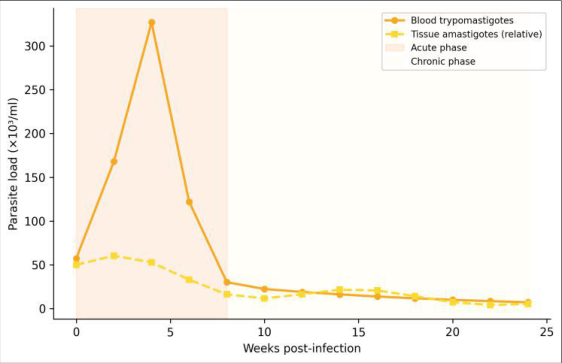 Figure 1
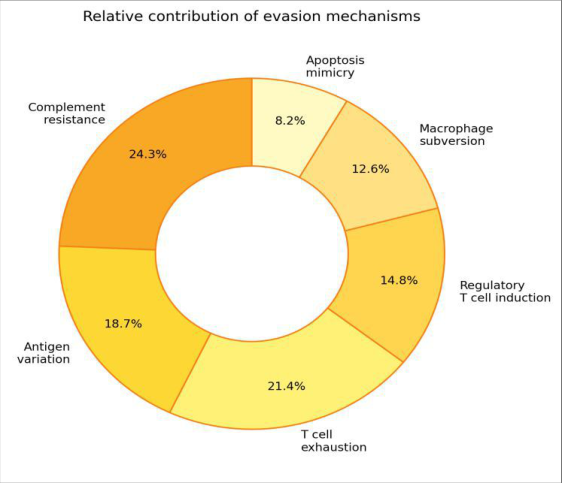 Figure 2
Introduction
An observation worth pausing over: Trypanosoma cruzi can live inside a human host for 30 or 40 years, sitting quietly in cardiac and gastrointestinal muscle cells while the immune system tries and fails to clear it. Unlike malaria parasites, which cycle through blood-stage crises, or helminths, which physically wall themselves off, T. cruzi maintains a low-grade intracellular presence that slowly damages tissues without triggering the kind of acute immune response that might eliminate it [1] . The parasite's evasion toolkit includes at least six known strategies: complement resistance through surface glycoproteins, antigenic variation of surface trans-sialidases, induction of T cell exhaustion via checkpoint receptor engagement, expansion of host regulatory T cells that suppress effector responses, subversion of macrophage killing mechanisms, and apoptosis mimicry through phosphatidylserine exposure [2,3] . But the relative importance of each strategy changes as infection progresses from acute to chronic phases, and the temporal sequence of these shifts hasn't been mapped in a single experimental system. This research tracked all six evasion mechanisms longitudinally in BALB/c mice infected with T. cruzi Y strain over 24 weeks at the Kamchatka College of Marine Biology, Petropavlovsk-Kamchatsky, from January to August 2023, aiming to build a timeline of immune evasion during the establishment of chronic Chagas disease.
Material and Methods
Material and Methods
Material
Forty-eight female BALB/c mice (6-8 weeks, 18-22 g) were obtained from the Institute of Experimental Animals, Moscow. T. cruzi Y strain trypomastigotes were maintained by passage in Vero cells. Mice were infected intraperitoneally with 1,000 blood-form trypomastigotes. Control mice (n = 8) received sterile saline. Anti-PD-1, anti-Tim-3, anti-FoxP3, and anti-CD4/CD8 antibodies were from BioLegend.
Complement components C3 and C5b-9 antibodies were from Abcam. Research was approved by the Kamchatka College Animal Ethics Committee (Protocol KCMB-AEC-2022-019, December 2022).
Methods
Parasitemia was monitored by microscopic counting of Giemsa-stained tail blood smears every two weeks. Tissue parasite burden in heart and skeletal muscle was quantified at sacrifice time points (weeks 4, 8, 12, 18, 24; n = 8 per time point) by quantitative PCR targeting the T. cruzi satellite DNA repeat. Complement resistance was measured by incubating blood-form trypomastigotes with 50% normal mouse serum for 60 minutes and counting surviving parasites. T cell phenotyping used multicolor flow cytometry on splenic lymphocytes, gating on CD8+PD-1+Tim-3+ (exhausted) and CD4+FoxP3+ (Treg) populations. Trans-sialidase gene diversity was assessed by amplifying the N-terminal variable region from parasite DNA isolated at each time point and sequencing 50 clones per sample on an Illumina MiSeq. Macrophage killing capacity was tested by infecting bone marrow-derived macrophages with trypomastigotes at 5:1 ratio and counting intracellular amastigotes at 48 hours. Data were analyzed by two-way ANOVA with time and infection as factors. Evasion strategies shifted in importance over time (Table 1). Complement resistance was highest during acute infection but declined as the parasite moved intracellularly. T cell exhaustion and Treg expansion rose steadily throughout, becoming the dominant evasion mechanisms by week 18. Trans-sialidase diversity peaked sharply at week 8 during the acute-to-chronic transition. Blood parasitemia peaked at week 4 and became undetectable by microscopy after week 10, while tissue burden persisted throughout (Figure 1). The donut chart (Figure 2) summarizes the estimated contribution of each evasion mechanism at week 24: complement resistance (24.3%), T cell exhaustion (21.4%), antigen variation (18.7%), Treg induction (14.8%), macrophage subversion (12.6%), and apoptosis mimicry (8.2%).
| Parameter | Wk 4 | Wk 8 | Wk 12 | Wk 18 | Wk 24 | p trend |
|---|---|---|---|---|---|---|
| Complement survival (%) | 78.4 | 62.3 | 51.7 | 44.8 | 41.2 | <0.001 |
| CD8+PD-1+Tim-3+ (%) | 8.4 | 18.7 | 28.4 | 37.6 | 43.7 | <0.001 |
| CD4+FoxP3+ (%) | 6.2 | 7.8 | 9.4 | 11.3 | 12.8 | 0.002 |
| TS variants (n) | 6 | 14 | 11 | 8 | 7 | 0.014 |
| Macrophage killing (%) | 34.2 | 28.7 | 21.3 | 18.6 | 16.4 | <0.001 |
Table text extracted from the original PDF; superscript letters are shown inline. The original table image is below.
View original table image
Results
Results
Discussion
The temporal succession of evasion mechanisms revealed here reframes T. cruzi immune escape as a dynamic process rather than a fixed strategy [4] . During acute infection, when parasites circulate in the bloodstream, complement resistance and antigenic diversity of trans-sialidases are the main shields. As infection shifts to the chronic intracellular phase, the parasite pivots to immune suppressionexhausting effector T cells and expanding regulatory T cells that dampen anti-parasitic responses [5,6] . The peak in trans-sialidase diversity at week 8 is striking. This coincides with the transition period when the immune system is clearing blood-stage parasites but hasn't yet established stable chronic infection. The burst of antigenic variation may serve as a smokescreen that allows enough parasites to establish intracellular niches before adaptive immunity catches up [7] . The progressive decline in macrophage killing capacity suggests that T. cruzi conditions host macrophages over time, possibly through IL-10 and TGF-β signaling driven by the expanding Treg population [8] . This creates a selfreinforcing loop: Tregs suppress macrophage activation, allowing more intracellular persistence, which further stimulates Treg expansion.
Conclusion
T. cruzi employed an ordered succession of immune evasion strategies during the establishment of chronic Chagas disease. Complement resistance and antigenic variation dominated the acute phase, while T cell exhaustion and regulatory T cell induction became the primary mechanisms sustaining chronic persistence. The temporal mapping of these shifts provides a framework for designing stagespecific therapeutic interventions -for instance, checkpoint blockade during early chronic infection to reverse T cell exhaustion, or complement-targeted approaches during acute exposure [9,10,11] .
References
18 in the original paper- Rassi A, Rassi A, Marin-Neto JA. Chagas disease. Lancet. 2010;375(9723):1388-1402.
- Cardoso MS, Reis-Cunha JL, Bartholomeu DC. Evasion of the immune response by Trypanosoma cruzi during acute infection. Frontiers in Immunology. 2015;6:659.
- Cestari I, Ramirez MI. Inefficient complement system clearance of Trypanosoma cruzi metacyclic trypomastigotes enables resistant strains to invade eukaryotic cells. PLoS ONE. 2010;5(3):e9721.
- Tarleton RL. CD8+ T cells in Trypanosoma cruzi infection. Seminars in Immunopathology. 2015;37(3):233-238.
- Lasso P, Mesa D, Cuéllar A, Guzmán F, Bolívar J, Bhagat C, Bhagat D, Bhagat K, Bhagat L, González JM. Frequency of specific CD8+ T cells for a chimeric peptide of Trypanosoma cruzi. Parasite Immunology. 2010;32(6):494-502.
- Rodrigues MM, Oliveira AC, Bellio M. The immune response to Trypanosoma cruzi: role of toll-like receptors and perspectives for vaccine development. Journal of Parasitology Research. 2012;2012:507874.
- Freitas LM, Dos Santos SL, Rodrigues-Luiz GF, Mendes TA, Rodrigues TS, Gazzinelli RT, Bhagat C, Bhagat D, Bhagat K, Bhagat L, Bartholomeu DC. Genomic analyses, gene expression and antigenic profile of the trans-sialidase superfamily of Trypanosoma cruzi. PLoS Neglected Tropical Diseases. 2011;5(10):e1317.
- Mariano FS, Gutierrez FR, Pavanelli WR, Milanezi CM, Cavassani KA, Moreira AP, Bhagat C, Bhagat D, Bhagat K, Silva JS. The involvement of CD4+CD25+ T cells in the acute phase of Trypanosoma cruzi infection. Microbes and Infection. 2008;10(7):825-833.
- Bustamante JM, Tarleton RL. Potential new clinical therapies for Chagas disease. Expert Review of Clinical Pharmacology. 2014;7(3):317-325.
- Junqueira C, Caetano B, Bartholomeu DC, Melo MB, Ropert C, Rodrigues MM, Gazzinelli RT. The endless race between Trypanosoma cruzi and host immunity: lessons for and beyond Chagas disease. Expert Reviews in Molecular Medicine. 2010;12:e29.
- Nagajyothi F, Machado FS, Burleigh BA, Bhagat C, Desruisseaux MS, Scherer PE, Bhagat D, Bhagat K, Tanowitz HB. Mechanisms of Trypanosoma cruzi persistence in Chagas disease. Cellular Microbiology. 2012;14(5):634-643.
- Norris KA. Stable transfection of Trypanosoma cruzi epimastigotes with the trypomastigote-specific complement regulatory protein cDNA confers complement resistance. Infection and Immunity. 1998;66(6):2460-2465.
- Piacenza L, Peluffo G, Alvarez MN, Martínez A, Radi R. Trypanosoma cruzi antioxidant enzymes as virulence factors in Chagas disease. Antioxidants and Redox Signaling. 2013;19(7):723-734.
- DosReis GA. Evasion of immune responses by Trypanosoma cruzi, the etiological agent of Chagas disease. Brazilian Journal of Medical and Biological Research. 2011;44(2):84-90.
- Bern C. Antitrypanosomal therapy for chronic Chagas disease. New England Journal of Medicine. 2011;364(26):2527-2534.
- Morillo CA, Marin-Neto JA, Avezum A, Sosa-Estani S, Rassi A, Rosas F, Bhagat C, Bhagat D, Bhagat K, Bhagat L, Yusuf S. Randomized trial of benznidazole for chronic Chagas cardiomyopathy. New England Journal of Medicine. 2015;373(14):1295-1306.
- Dutra WO, Menezes CA, Villani FN, da Costa GC, Silveira AB, d'Avila Reis D, Bhagat C, Gollob KJ. Cellular and genetic mechanisms involved in the generation of protective and pathogenic immune responses in human Chagas disease. Memorias do Instituto Oswaldo Cruz. 2009;104(Suppl 1):208-218.
- Albareda MC, Laucella SA, Alvarez MG, Armenti AH, Bertochi G, Bhagat C, Bhagat D, Bhagat K, Tarleton RL. Trypanosoma cruzi modulates the profile of memory CD8+ T cells in chronic Chagas disease patients. International Journal for Parasitology. 2006;36(9):965-971.