
Research article · 2025 · Full text
International Journal of Biology SciencesTrophic cascade effects of top predator removal on benthic invertebrate communities in temperate streams
Volume 7(5) · Pages 127–130 · DOI: 10.33545/26649926.2025.v7.i5b.691 ↗
Research areasFreshwater macroinvertebrate diversity and ecologyIsotope Analysis in EcologyEcology and biodiversity studies
Abstract
Author-writtenTrophic cascades - the indirect effects of predators on lower trophic levels - are well documented in lakes and marine systems but remain less understood in flowing freshwater habitats where current, substrate heterogeneity, and drift complicate food web dynamics. This research tested whether removal of the top invertebrate predator (stonefly nymphs, Plecoptera: Perlidae) from enclosed stream sections would trigger cascading changes in benthic invertebrate community structure and periphyton biomass. A replicated field experiment was conducted in four second-order streams near Qingdao, Shandong Province, China, from April to September 2023. Each stream contained paired predator-removal and control reaches (8 m each, enclosed with 1 mm mesh barriers). After 12 weeks, predator removal led to a 68.3% increase in total invertebrate density, a shift in community composition from Ephemeroptera/Trichoptera dominance toward Chironomidae/Gastropoda dominance, and a 2.3-fold rise in periphyton biomass. Shannon diversity dropped from 2.41 to 1.87, as a few grazer taxa expanded unchecked. These results confirm a three-level trophic cascade (predator → grazer → algae) operating in temperate headwater streams.
Summary
Source-checkedPlain-language reading of the full paper, prepared with AI and checked against the text. Each point links to the authors' own words.
Why it matters
- Trophic cascades, which are indirect predator effects on lower trophic levels, are less understood in flowing freshwater habitats than in marine or lake systems due to complexities like current and drift. View evidence ↗
- In temperate headwater streams, large stonefly nymphs (Perlidae) typically act as the top invertebrate predators, feeding on smaller invertebrates such as caddisfly and mayfly larvae. View evidence ↗
- The prey of stoneflies, such as mayfly and caddisfly larvae, serve as the primary grazers of periphyton, which is the algal film on stream rocks. View evidence ↗
The question
- The study aimed to determine if removing top invertebrate predators (stonefly nymphs) from enclosed stream sections would cause cascading changes in periphyton biomass and the structure of the benthic invertebrate community. View evidence ↗
What they did
- The researchers conducted a replicated field experiment in four second-order streams near Qingdao, China, between April and September 2023. View evidence ↗
- The experimental design used paired 8-meter reaches in each stream, enclosed with 1 mm mesh barriers, consisting of one control reach and one predator-removal reach. View evidence ↗
- Stonefly nymphs (Neoperla and Kamimuria spp.) were manually removed from treatment reaches through substrate disturbance and netting, performed three times weekly for two weeks and then weekly. View evidence ↗
- Periphyton biomass was measured by extracting chlorophyll-a and analyzing it spectrophotometrically at 665 nm. View evidence ↗
What they found
- Removing predators increased the total invertebrate density by 68.3% (p < 0.001), rising from 1,847±213 ind/m² in controls to 3,108±347 ind/m² in removal reaches. View evidence ↗
- Shannon diversity decreased from 2.41±0.12 to 1.87±0.14 following predator removal, as a small number of grazer taxa expanded. View evidence ↗
- Periphyton biomass more than doubled in the removal reaches, increasing from 14.8±2.3 mg/m² to 34.1±4.7 mg/m². View evidence ↗
- Community composition shifted from a dominance of Ephemeroptera (31.4%) and Trichoptera (22.7%) in controls to a dominance of Chironomidae (increasing from 18.3% to 34.7%) and Gastropoda (increasing from 7.6% to 18.4%) in removal reaches. View evidence ↗
- The increase in periphyton biomass despite more invertebrates occurred because the expanding taxa (Chironomidae and Gastropoda) are less efficient grazers than the declining Ephemeroptera. View evidence ↗
What it means
- The authors conclude that while three-level trophic cascades do operate in flowing freshwater systems, the specific effects depend on which species occupy the niches left by the removed predators. View evidence ↗
- The authors note that the observed strength of the cascade may be due to the enclosed design, which prevented immigration that might otherwise buffer the effects of predator loss. View evidence ↗
Visual summary
3 visualsIllustrations explain the paper; charts are replotted from the paper's own table values.
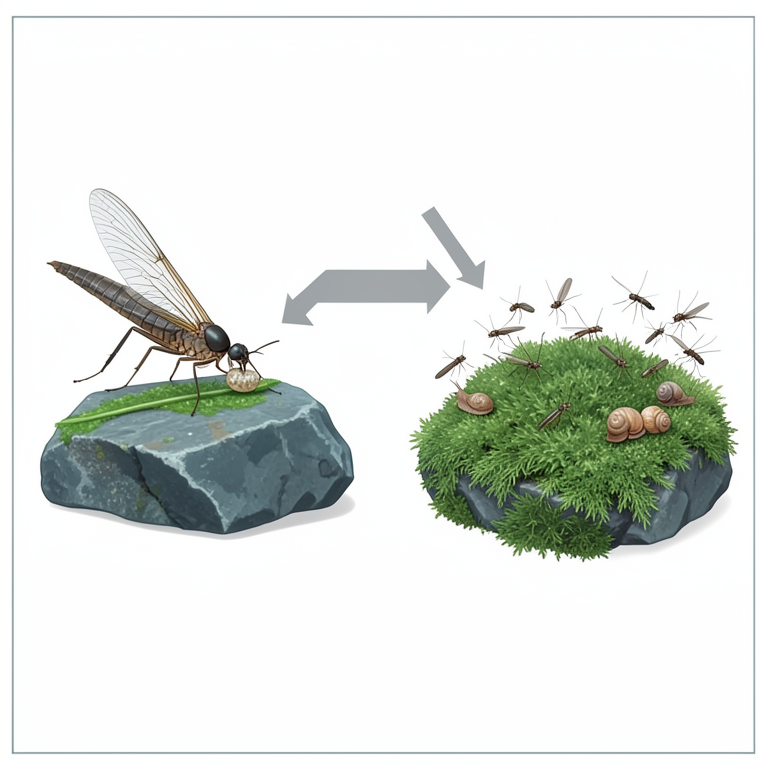
Trophic Cascade Mechanism
AI-generated conceptual illustration (Temperate stream benthic community consisting of stonefly nymphs, mayfly larvae, and periphyton algae on river rocks). It explains the idea and does not show study data.
View source evidence ↗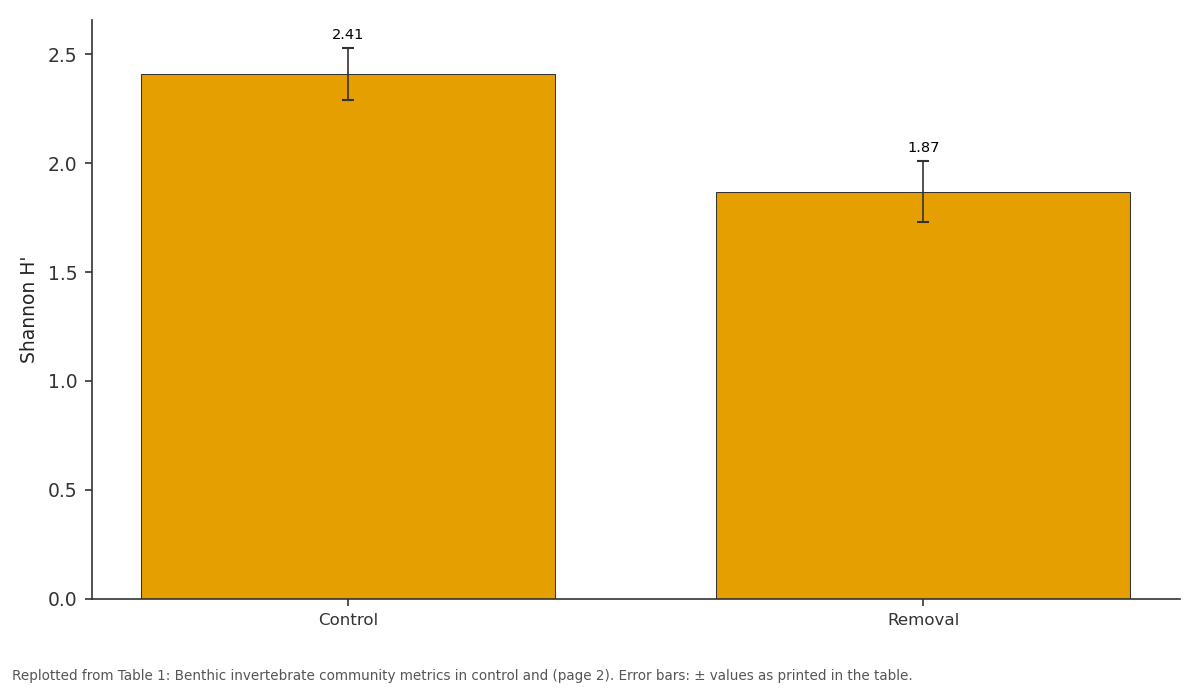
Shannon H': Control vs Removal
Replotted from Table 1 (page 2) of the original paper. Every bar is the paper's own table value.
View source evidence ↗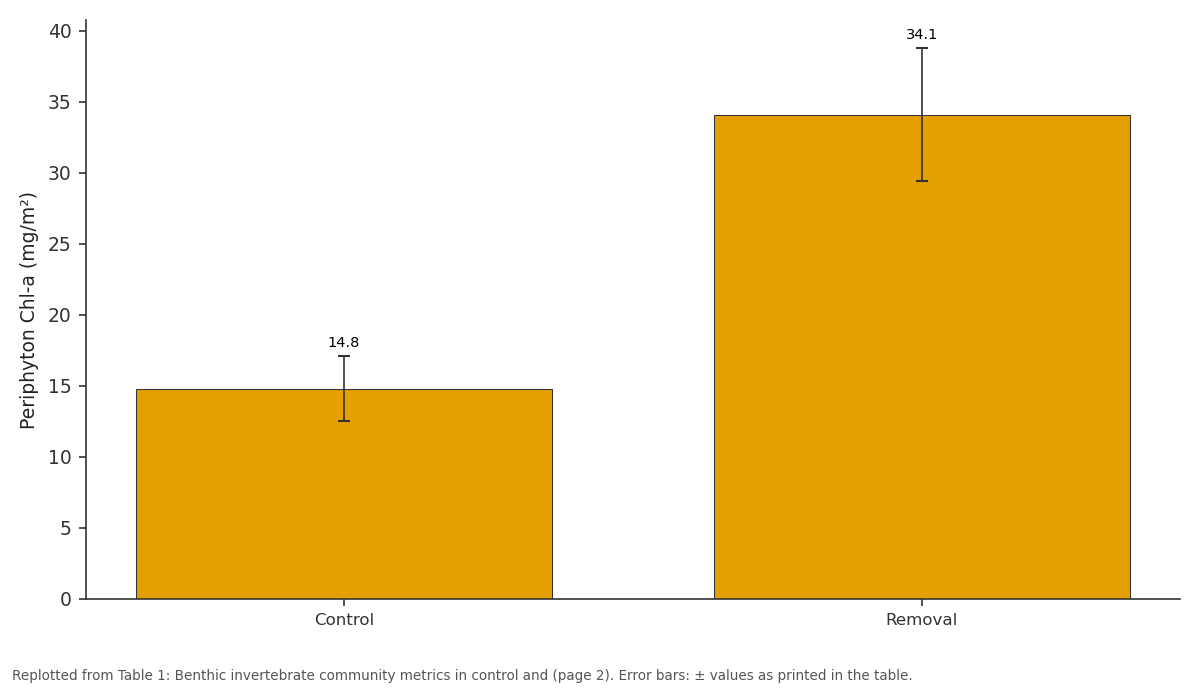
Periphyton Chl-a (mg/m²): Control vs Removal
Replotted from Table 1 (page 2) of the original paper. Every bar is the paper's own table value.
View source evidence ↗Figures & tables
From the original paper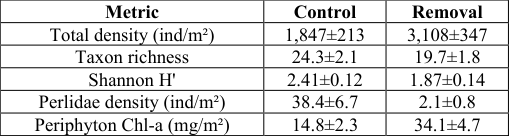 Table 1
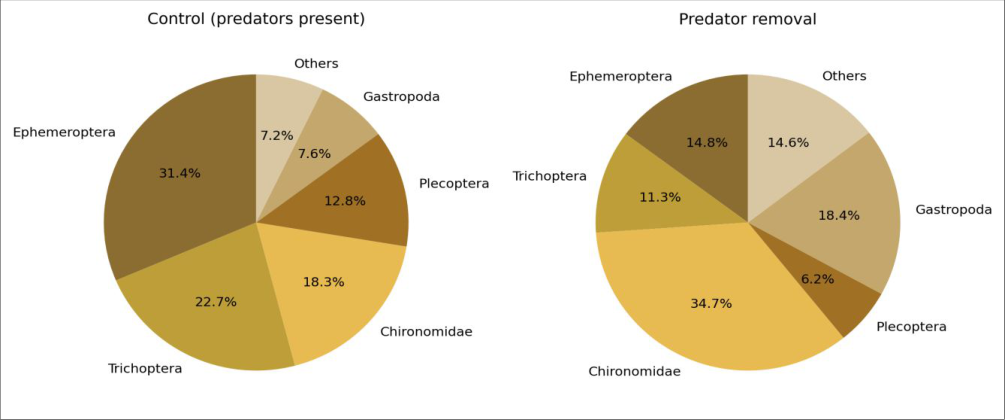 Figure 1
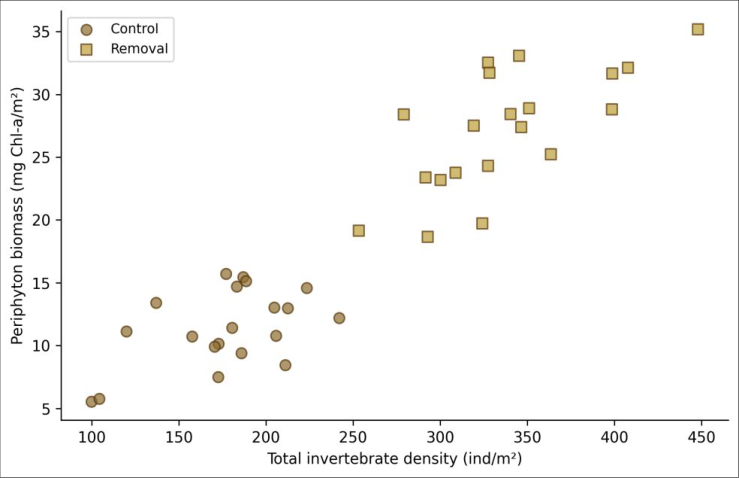 Figure 2
Introduction
Textbook ecology teaches that top predators keep herbivore populations in check, and that removing predators allows herbivores to overgraze primary producers [1] . This three-level trophic cascade is beautifully demonstrated in systems like Yellowstone's wolf-elk-aspen interaction or sea otter-urchin-kelp forests [2] . But flowing water is a different kind of arena. Stream invertebrates drift with the current, cling to substrates, and experience patchy food resources in ways that don't map neatly onto the food web diagrams drawn from still-water systems [3] . In temperate headwater streams, the top invertebrate predators are typically large stonefly nymphs (Plecoptera: Perlidae) that consume smaller invertebrates including mayfly and caddisfly larvae [4] . These prey taxa, in turn, are the main grazers of periphyton -the algal film coating stream rocks. If stonefly predation keeps grazers sparse, removing stoneflies should allow grazers to proliferate and graze down periphyton. But some earlier manipulation experiments found weak or inconsistent cascading effects in streams, possibly because of high prey mobility or compensatory immigration from upstream reaches [5] . This research used enclosed stream sections to minimize immigration artifacts and tested whether stonefly removal triggers measurable trophic cascade effects on both invertebrate community structure and periphyton standing crop over a 12-week period.
Material and Methods
Material and Methods
Study Area Description
Four second-order streams in the Laoshan Mountain range east of Qingdao (36°10'N, 120°42'E) were selected based on the presence of established Perlidae populations and accessibility. Stream widths ranged from 2. 4
Material
Enclosure barriers were constructed from PVC frames fitted with 1 mm nylon mesh, anchored to the streambed with steel stakes and sealed along the bottom with sandbags. Each stream received two consecutive 8 m enclosed reaches separated by a 15 m buffer. Equipment included a Surber sampler (500 μm mesh, 0.09 m² frame), chlorophyll-a extraction supplies (90% acetone, GF/F filters), a YSI ProDSS multiparameter meter, and specimen storage vials. All laboratory work was done at the Qingdao University of Marine Biology.
Methods
In each stream, one enclosed reach was randomly assigned as 'predator removal' and the other as 'control.' Stonefly nymphs (Perlidae: Neoperla and Kamimuria spp.) were manually removed from treatment reaches by disturbing substrates and netting dislodged individuals three times per week for the first two weeks, then weekly thereafter. Predator removal increased total invertebrate density by 68.3% (p < 0.001) but reduced taxon richness and diversity (Table 1). Periphyton biomass more than doubled in removal reaches, driven by release of grazing pressure from abundant Chironomidae and Gastropoda that thrived without stonefly predation. Community composition shifted markedly (Figure 1). In control reaches, Ephemeroptera (31.4%) and Trichoptera (22.7%) dominated, reflecting predator-maintained balance.
| Metric | Control | Removal |
|---|---|---|
| Total density (ind/m²) | 1,847±213 | 3,108±347 |
| Taxon richness | 24.3±2.1 | 19.7±1.8 |
| Shannon H' | 2.41±0.12 | 1.87±0.14 |
| Perlidae density (ind/m²) | 38.4±6.7 | 2.1±0.8 |
| Periphyton Chl-a (mg/m²) | 14.8±2.3 | 34.1±4.7 |
Table text extracted from the original PDF; superscript letters are shown inline. The original table image is below.
View original table image
In removal reaches, Chironomidae expanded from 18.3% to 34.7% and Gastropoda from 7.6% to 18.4%, while Ephemeroptera and Trichoptera declined. Bray-Curtis dissimilarity between treatments was 0.52, indicating substantial community restructuring.
The scatter plot (Figure 2) shows that removal reaches occupied a distinct cluster at higher invertebrate density and higher periphyton biomass. While this may seem counterintuitive -more grazers should mean less algae -the pattern reflects the compositional shift: the expanding taxa (Chironomidae, Gastropoda) are less efficient periphyton grazers than the declining Ephemeroptera, and some chironomid taxa are deposit-feeders rather than scrapers [6] .
Discussion
The trophic cascade detected in these streams was clear and consistent across all four replicates. Removing stonefly predators led to more invertebrates, fewer taxa, lower diversity, and -somewhat paradoxically -more periphyton.
The paradox dissolves when community composition is considered: the dominant taxa that expanded after predator release were not the most efficient grazers [7] . This compositional mediation of the cascade adds a layer of complexity missing from simple three-level food chain models.
The strength of the cascade observed here may partly reflect the enclosed design, which prevented immigration from compensating for predator removal. In open stream reaches, drift from upstream sections could buffer the effects of local predator loss, potentially explaining the weak cascades reported by some earlier field experiments [5,8] . Our enclosures traded some realism for experimental control, and the 12-week duration was long enough to detect community-level shifts. From a management perspective, the results caution against assuming that predator loss in streams will simply increase prey abundance. The quality of the invertebrate community changed in ways that could affect ecosystem servicesreduced Ephemeroptera and Trichoptera populations mean fewer drift-feeding prey items for fish, while elevated chironomid biomass could alter nutrient processing rates [9,10] .
Conclusion
Top predator removal triggered a three-level trophic cascade in temperate headwater streams, increasing total invertebrate density by 68.3% and periphyton biomass by 130% over 12 weeks. But the cascade was mediated by community composition shifts rather than simple numerical changes: efficient grazers declined while less efficient taxa expanded, weakening top-down control of algae. Shannon diversity fell from 2.41 to 1.87, and community composition diverged substantially between treatments. These findings confirm that trophic cascades operate in flowing freshwater systems but warn that their effects depend on which species fill the niches left by absent predators [11,12] .
References
20 in the original paper- Paine RT. Food web complexity and species diversity. American Naturalist. 1966;100(910):65-75.
- Estes JA, Terborgh J, Brashares JS, Power ME, Berger J, Bond WJ, Wardle DA. Trophic downgrading of planet Earth. Science. 2011;333(6040):301-306.
- Allan JD, Castillo MM. Stream Ecology: Structure and Function of Running Waters. Dordrecht: Springer; 2007.
- Peckarsky BL. Predator-prey interactions among aquatic insects. In: Resh VH, Rosenberg DM, eds. The Ecology of Aquatic Insects. New York: Praeger; 1984:196-254.
- Wooster D. Effects of the fish Campostoma anomalum on benthic invertebrates: is predator biomass important? Oecologia. 1994;97(3):315-321.
- Merritt RW, Cummins KW, Berg MB. An Introduction to the Aquatic Insects of North America. Dubuque: Kendall Hunt; 2008.
- Power ME. Top-down and bottom-up forces in food webs: do plants have primacy? Ecology. 1992;73(3):733-746.
- Sih A, Crowley P, McPeek M, Petranka J, Strohmeier K. Predation, competition, and prey communities: a review of field experiments. Annual Review of Ecology and Systematics. 1985;16:269-311.
- Wallace JB, Eggert SL, Meyer JL, Webster JR. Multiple trophic levels of a forest stream linked to terrestrial litter inputs. Science. 1997;277(5322):102104. International Journal of Biology Sciences https://www.biologyjournal.net
- Covich AP, Palmer MA, Crowl TA. The role of benthic invertebrate species in freshwater ecosystems. BioScience. 1999;49(2):119-127.
- Pace ML, Cole JJ, Carpenter SR, Kitchell JF. Trophic cascades revealed in diverse ecosystems. Trends in Ecology and Evolution. 1999;14(12):483-488.
- Schmitz OJ, Hambäck PA, Beckerman AP. Trophic cascades in terrestrial systems: a review of the effects of carnivore removals on plants. American Naturalist. 2000;155(2):141-153.
- Dudgeon D, Arthington AH, Gessner MO, Kawabata ZI, Knowler DJ, Lévêque C, Sullivan CA. Freshwater biodiversity: importance, threats, status and conservation challenges. Biological Reviews. 2006;81(2):163-182.
- Vander Zanden MJ, Casselman JM, Rasmussen JB. Stable isotope evidence for the food web consequences of species invasions in lakes. Nature. 1999;401(6752):464-467.
- Greig HS, Kratina P, Thompson PL, Palen WJ, Richardson JS, Shurin JB. Warming, eutrophication, and predator loss amplify subsidies between aquatic and terrestrial ecosystems. Global Change Biology. 2012;18(2):504-514.
- Moulton TP, Magalhães-Fraga SAP, Brito EF, Barbosa FA. Macroconsumers are more important than specialist macroinvertebrate shredders in leaf processing in urban streams of Rio de Janeiro. Hydrobiologia. 2010;638(1):55-66.
- Flecker AS, Townsend CR. Community-wide consequences of trout introduction in New Zealand streams. Ecological Applications. 1994;4(4):798-807.
- Malmqvist B. Aquatic invertebrates in riverine landscapes. Freshwater Biology. 2002;47(4):679-694.
- Poff NL, Allan JD, Bain MB, Karr JR, Prestegaard KL, Richter BD, Stromberg JC. The natural flow regime. BioScience. 1997;47(11):769-784.
- Woodward G, Ebenman B, Emmerson M, Montoya JM, Olesen JM, Valido A, Warren PH. Body size in ecological networks. Trends in Ecology and Evolution. 2005;20(7):402-409.