
Research article · 2026 · Full text
International Journal of Horticulture and Food ScienceEffect of different picking on growth character of okra (Abelmoschus esculentus (L.) Monech” Cv Phule Utkarsha
Volume 8(4) · Pages 32–34 · DOI: 10.33545/26631067.2026.v8.i4a.507 ↗
Research areasAgricultural Practices and Plant GeneticsPlant Growth and Agriculture TechniquesFlowering Plant Growth and Cultivation
Abstract
Author-writtenA field experiment titled “Effect of different picking on growth character of okra (Abelmoschus esculentus (L.) Moench) variety Phule Utkarsha” was conducted at the research farm of the Horticulture Section, College of Agriculture, Kolhapur, during the summer season of 2013.The treatment consisted of five levels of pickings as no picking, one picking, two picking, three picking and four picking. Significantly higher plant height 168.20 cm, number of internodes, and number of green fruits per plant were recorded under four green fruit pickings. The highest number of branches was observed in the no-picking treatment (P0) with 2.75 and maximum fruits length were observed in the no green fruit picking treatment (P0) at 20.00 cm, The maximum fruit diameter, fruit length, fruit weight were observed when no green fruit picking.
Summary
Source-checkedPlain-language reading of the full paper, prepared with AI and checked against the text. Each point links to the authors' own words.
Why it matters
- Okra, also known as lady's finger, is a significant summer vegetable crop in the Malvaceae family. View evidence ↗
- Okra is economically important in India, particularly in Maharashtra, where it is grown year-round for domestic use and export to Middle Eastern markets. View evidence ↗
- The stage at which fruits are picked can affect seed quality because the nutrient supply from the plant varies. View evidence ↗
The question
- The study aimed to evaluate how different frequencies of fruit picking affect the growth characteristics of the okra variety 'Phule Utkarsha'. View evidence ↗
What they did
- The field experiment took place at the College of Agriculture's research farm in Kolhapur during the 2012–13 period. View evidence ↗
- The researchers tested five treatment levels: no picking (P0), one picking (P1), two pickings (P2), three pickings (P3), and four pickings (P4). View evidence ↗
- Land preparation included the application of 20 t/ha of farmyard manure and a fertilizer dose of 100:50:50 kg NPK per hectare. View evidence ↗
- Growth parameters measured at harvest included plant height, number of branches, internodal length, and the number of internodes per plant. View evidence ↗
What they found
- Plant height increased with more frequent picking, with the tallest plants in the four-picking group (168.20 cm) and the shortest in the no-picking group (156.42 cm). View evidence ↗
- The number of branches decreased as picking frequency increased, ranging from a high of 2.75 branches per plant (no picking) to a low of 1.75 (four pickings). View evidence ↗
- The maximum number of internodes per plant was found in the two-picking treatment (23.08), which was statistically similar to the three-picking treatment (22.83). View evidence ↗
- The frequency of fruit picking had no significant effect on the number of days until the first flowering occurred. View evidence ↗
- Fruit diameter was largest with one picking (1.92 cm) and smallest with four pickings (1.79 cm). View evidence ↗
- Fruit length was greatest when no picking occurred (20.00 cm) and shortest after four pickings (18.42 cm). View evidence ↗
What it means
- The authors conclude that moderate picking (one to two times) improves fruit quality, whereas excessive picking negatively affects yield and vegetative growth. View evidence ↗
- The authors attribute the progressive decrease in fruit size and weight during repeated harvests to plant aging and limited nutrient availability. View evidence ↗
Visual summary
3 visualsIllustrations explain the paper; charts are replotted from the paper's own table values.
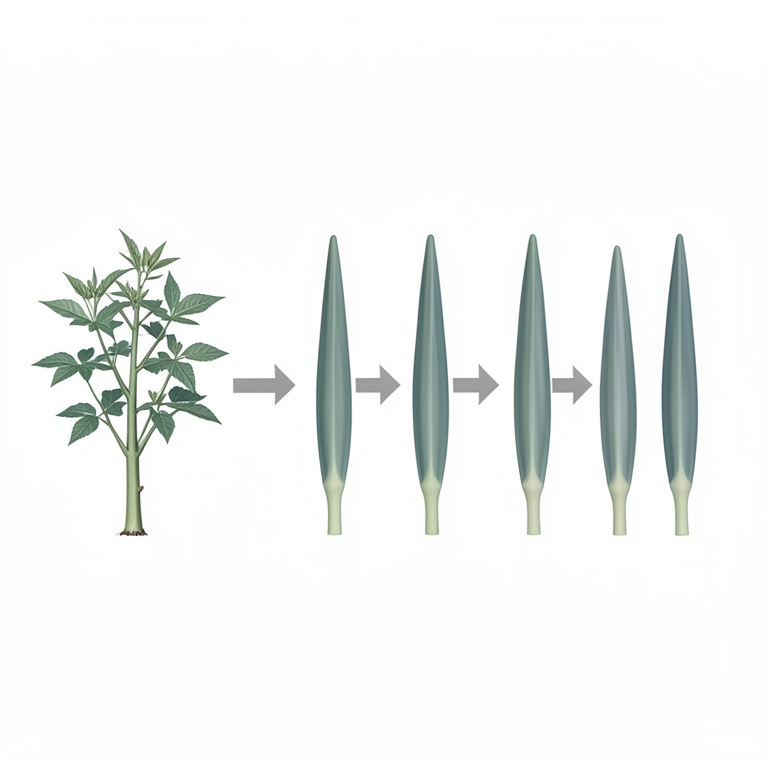
Effect of Picking Frequency on Okra Growth
AI-generated conceptual illustration (okra plants (Abelmoschus esculentus)). It explains the idea and does not show study data.
View source evidence ↗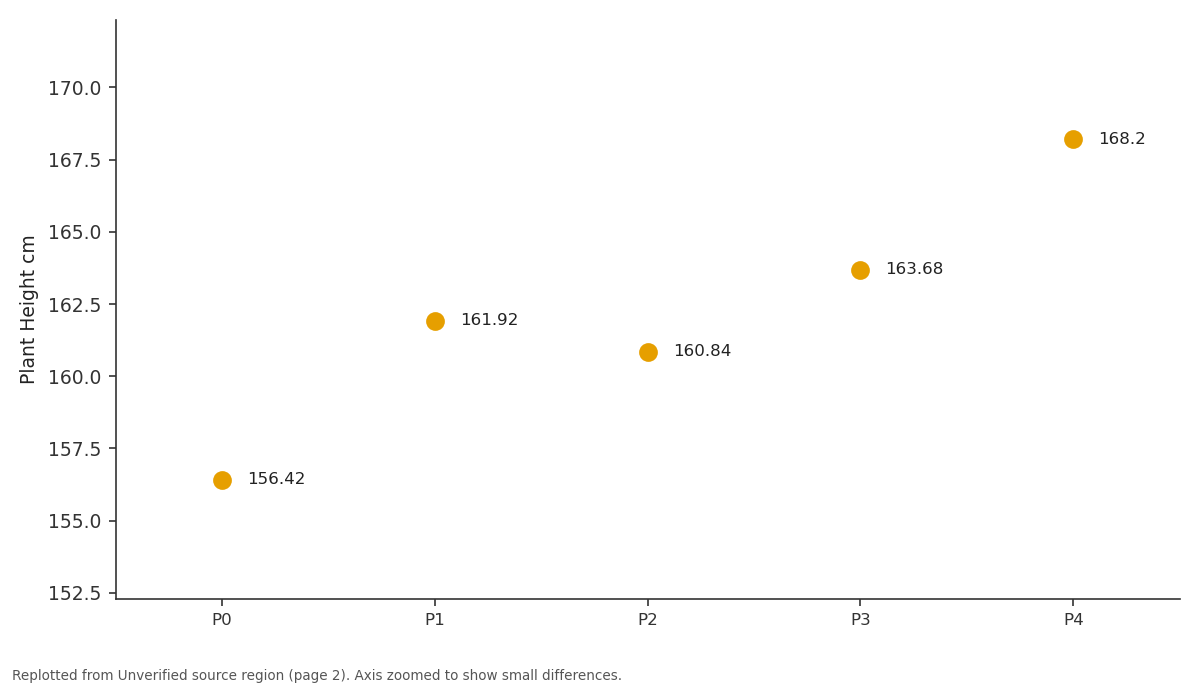
Plant Height cm: P0 vs P1 vs P2 vs P3 vs P4
Replotted from a table (page 2) of the original paper. Every bar is the paper's own table value.
View source evidence ↗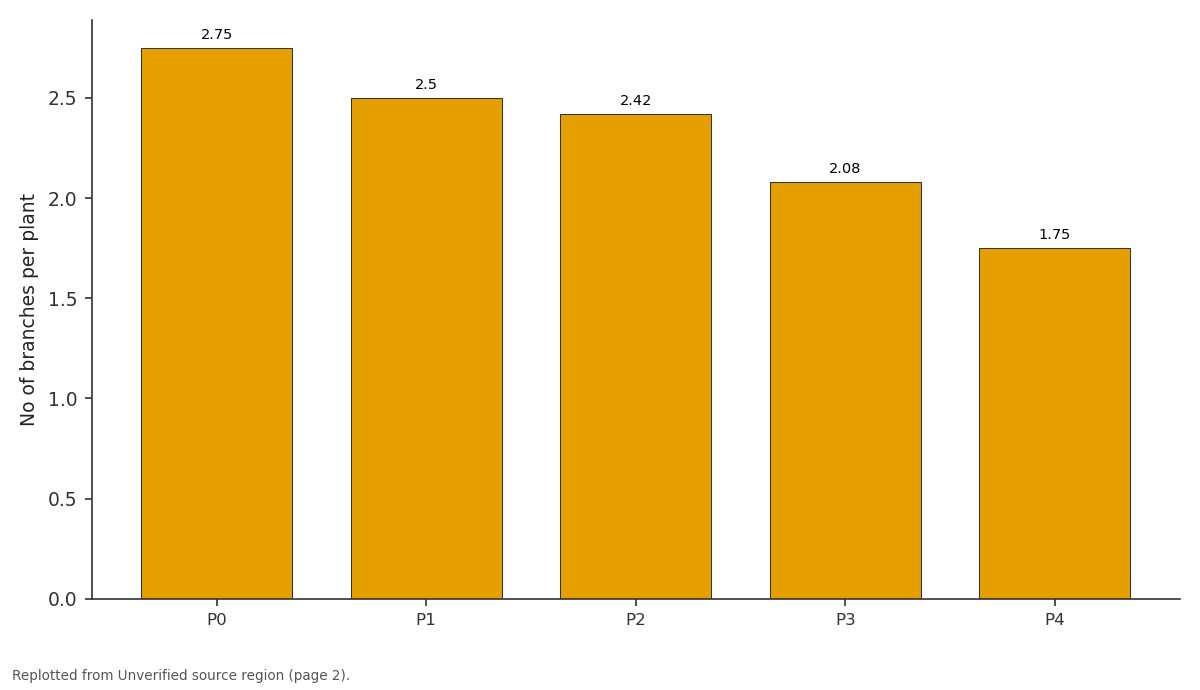
No of branches per plant: P0 vs P1 vs P2 vs P3 vs P4
Replotted from a table (page 2) of the original paper. Every bar is the paper's own table value.
View source evidence ↗Introduction
Okra (Abelmoschus esculentus (L.) Moench), commonly known as lady's finger, is an important summer vegetable crop belonging to the family Malvaceae. It is believed to have originated in tropical and subtropical regions such as Africa, South America, the West Indies, and India. In India, it is widely cultivated across several states including Uttar Pradesh, Assam, Bihar, Maharashtra, and others. The crop covers about 5.30 lakh hectares in India with a production of 63.50 lakh MT, while in Maharashtra it occupies around 22,000 hectares with a production of 3.28 lakh MT (Anon, 2013). Major producing districts in Maharashtra include Nashik, Pune, Solapur, Jalgaon, and Sangli. Okra is valued for its adaptability, nutritional richness, and economic returns. It is a good source of vitamins A, B, and C, along with protein, calcium, potassium, and other minerals. It also possesses medicinal properties and is considered beneficial for certain health conditions. Immature okra pods are commonly consumed as a boiled vegetable, while dried pods are used as a soup thickener (Owonubi and Yayock, 1981). Okra seeds are rich in protein and vegetable oil, containing mainly monounsaturated fatty acids and palmitic acid. Roasted seeds are sometimes used as a coffee substitute. In certain regions, crushed plants soaked in water produce a solution used as a clarifying agent in jaggery preparation. The mature fruits and stems, rich in crude fibre, are also utilized in the paper industry. In Maharashtra, okra is cultivated almost throughout the year for both domestic consumption and export, particularly to Middle Eastern countries. Among exported vegetables from India, okra holds a significant position. Owing to its economic importance and export potential, there is a need to standardize cultural practices to enhance its productivity. In okra, prolonged flowering and fruit maturity require harvesting at different stages. Seed quality may vary depending on the picking stage due to differences in nutrient supply from the plant. For seed production, fruits from various pickings are often harvested, and the extracted seeds are bulked and processed without assessing quality differences among pickings. This is particularly important when producing high-value seed. Although traditionally considered a summer crop, okra is now cultivated year-round due to Its wide adaptability, high yield potential, and better economic returns. Consequently, there is a continuous and growing demand for okra seeds, especially of the variety Phule Utkarsha, which has gained wide acceptance in the market.
Material and Methods
The experiment was was conducted at the Research Farm of the Horticulture Section, College of Agriculture, Kolhapur, during 2012-13 title "Effect of different picking on growth character of okra (Abelmoschus esculentus (L.) Moench) variety 'Phule Utkarsha'". Five green fruit picking sequences, namely zero, one, two, three, and four pickings, were included (P0: No picking, P1: One picking, P2: Two picking, P3: Three picking and four picking) the experimental site was well leveled with uniform soil fertility. The soil was medium black, having good texture and proper drainage. The land was prepared by ploughing, harrowing, and clod crushing to obtain a fine tilth. Farmyard manure at 20 t/ha was incorporated during land preparation. Ridges and furrows were formed according to the recommended spacing for sowing. A fertilizer dose of 100:50:50 kg NPK per hectare was applied. Half of the nitrogen along with the full dose of phosphorus and potash was applied as a basal dose before sowing, while the remaining nitrogen was applied in two equal splits as top dressing
Result
Data on growth parameters such as plant height (cm), number of branches, intermodal length (cm), and number of internodes per plant were recorded at the time of harvesting and are presented below.
Plant Height
Plant height was significantly influenced by different fruit picking treatments. The tallest plants were observed under four green fruit pickings (P 4) with an average height of 168.20 cm, which was statistically similar to three pickings (P0) at 163.68 cm. The shortest plants were recorded in the no-picking treatment (P0), 156.42 cm.
Number of Branches per plant
The data revealed that the number of branches per plant was significantly affected by the number of green fruit pickings. The highest number of branches was observed in the nopicking treatment (P0) with 2.75 branches per plant, which was statistically similar to one picking (P1) at 2.50 and two pickings (P2) at 2.42. The lowest number of branches per plant was recorded under four pickings (P4), with 1.75 branches
Number of internodes per plant
The data indicated that the number of internodes per plant was significantly influenced by the number of green fruit pickings. The highest number of internodes was recorded in the two-picking treatment (P2) with 23.08 internodes per plant, which was statistically similar to three pickings (P3) at 22.83 and significantly higher than the other treatments
Days to first flowering
The number of fruit pickings did not significantly affect the days to first flowering. The shortest time to first flowering was observed in plants with three green fruit pickings (P3) at 40.58 days, followed closely by one green fruit picking (P1) at 40.67 days. The longest duration to first flowering occurred in plants with no green fruit picking (P0), which took 41.58 days.
Fruit of diameter cm
The number of fruit pickings had a significant effect on green fruit diameter. The largest diameter was observed in the one green fruit picking treatment (P1) at 1.92 cm, which was significantly higher than all other treatments. In contrast, the smallest diameter was recorded in the four green fruit pickings treatment (P4) at 1.79 cm.
Fruit length
The number of green fruit pickings had a significant effect on fruit length. The longest fruits were observed in the no green fruit picking treatment (P0) at 20.00 cm, which was significantly higher than all other treatments. In contrast, the shortest fruits length were recorded in the four green fruit pickings treatment (P4) at 18.42 cm.
Discussion
Plant height increased with the frequency of green fruit pickings, being lower when fruits were left for seed or picked only once or twice, and higher with three or four pickings, consistent with Tyagi and Khandelwal (1985) [12] ,
Velumani and Ramaswamy (1980), and Ashtaputre (1987) [1] . The maximum number of branches was observed in the control (P0, 2.75), while picking reduced branch development, as also reported by Ubale et al.
(2013) [13] . Internodal length was shortest in three pickings (P3, 6.98 cm) and the number of internodes highest in two pickings (P2, 23.08), likely due to reduced cortical cell size, consistent with Ubale et al.
(2013) [13] . Days to first flowering were not significantly affected by pickings, in line with Birbal et al.
(1995), Moniruzzaman et al.
(2007), Moniruzzaman and Quamruzzaman (2009) [5] , and Ubale et al. (2013). The maximum green fruit diameter and length were recorded (1.98 cm) and (12.94 cm) respectively in one picking of green fruit against four green fruit pickings. It is observed that as number of pickings advanced these fruit characters were decreased successively and it was lowest at four green fruit pickings. This might be due to less nutrient available for the new fruits produced after picking previous one and ageing of plant. Similar results were reported by Ashtaputre (1987) [1] , Bhat and Singh (1997) [3] , Moniruzzaaman and Quamruzzaman (2009), Ubale et al. (2013) in okra.
Conclusion
Frequent green fruit pickings markedly affected okra growth and fruit development. Plant height increased with more pickings, but branch number and internodal length declined. Fruit size and weight decreased progressively with repeated harvests, likely due to limited nutrient availability and plant aging. Overall, moderate pickings (one to two times) enhanced fruit quality, while excessive pickings adversely impacted both vegetative growth and yield.
References
12 in the original paper- Rahuri, Maharashtra: Mahatma Phule Krishi Vidyapeeth; 1987.
- Rahuri, MS: Mahatma Phule Krishi Vidyapeeth; 2001.
- Bhat KL, Singh AK. Effect of different levels of phosphorus, gibberellic acid and picking on seed production of okra (Abelmoschus esculentus (L.) Moench). Veg Sci. 1997;24(1):4-6.
- Maurya RP, Jamar A. Impact of plant spacing and picking interval on the growth, fruit quality and yield of okra (Abelmoschus esculentus (L.) Moench). Am J Agric For. 2013;1(4):48-54.
- Moniruzzamazn M, Quamruzzaman AKM. Effect of nitrogen levels and picking of green fruits on the fruit and seed production of okra (Abelmoschus esculentus (L) Moench). J Agric Rural Dev. 2009;7(1-2):99-106.
- Nikumbh MP. Effect of Ethrel and fruit pickings on seed yield and seed quality of cucumber (Cucumis sativus L.) var Himangi [master's thesis]. Rahuri, MS: Mahatma Phule Krishi Vidyapeeth; 2001.
- Patil RS, Chaitanya HS, Nagesh L. Effect of plant growth regulators and fruit picking on seed yield and seed quality attributes of okra in coastal Karnataka. Environ Ecol. 2013;32(1A):215-9.
- Pushpakumari R, Saraswathy P. Influence of green fruit picking and nutrient sources on fruit production of okra (Abelmoschus esculentus (L.) Moench). J Trop Agric. 1998. [13] ; 36:50-2.
- Saha PK, Aditya DK, Sharfuddin AFM. Effects of plant spacing and picking interval on the growth and yield of okra Cv. Pusa sawani. Bangladesh Hortic. 1989;17:104.
- Sajjan AS, Shekhargouda, Badanur VP. Influence of apical pinching and fruit picking on growth and seed yield in okra. Karnataka J Agric Sci. 2002;15(2):33772.
- Tyagi SVS, Khandelwal RC. Seed yield of okra (Abelmoschus esculentus (L.) Moench) as affected by urea sprays and green pod pickings. Seed Farm. 1985 [12] ;10(1):53-5.
- Rahuri, Maharashtra: Mahatma Phule Krishi Vidyapeeth; 2013.