
Research article · 2025 · Full text
International Journal of Biology SciencesAlternative oxidase pathway and its role in plant stress tolerance mechanisms
Volume 7(5) · Pages 192–194 · DOI: 10.33545/26649926.2025.v7.i5c.728 ↗
Research areasPlant Stress Responses and ToleranceMitochondrial Function and PathologyPhotosynthetic Processes and Mechanisms
Abstract
Author-writtenWhile animal biologists view mitochondria as ATP factories, plant physiologists know them as something more flexible - organelles with a backup respiratory system called the alternative oxidase (AOX) pathway that bypasses the energy-conserving cytochrome chain. This research compared AOX activity, gene expression, reactive oxygen species (ROS) levels, and stress survival in wild-type (WT) and AOX-knockout (KO) Arabidopsis thaliana lines exposed to five abiotic stressors: drought, cold (4°C), salt (150 mM NaCl), heavy metal (50 μM CdCl₂), and UV-B radiation (3.2 kJ/m²/day). Experiments ran from April to October 2023 at the Hue Institute of Tropical Biology. WT plants upregulated AOX activity 2.1- to 4.1-fold across all stressors, with the strongest induction under cold stress. KO plants accumulated 2-3 times more mitochondrial ROS, showed 34-58% greater membrane lipid peroxidation, and had 40-65% lower survival rates under drought and cold stress compared with WT. Exogenous application of the ROS scavenger ascorbate partially rescued KO plant survival but didn't fully restore WT performance. These results confirm AOX as a stress safety valve that prevents mitochondrial ROS overproduction when the main electron transport chain is backed up.
Summary
Source-checkedPlain-language reading of the full paper, prepared with AI and checked against the text. Each point links to the authors' own words.
Why it matters
- Plant mitochondria possess a flexible backup respiratory system known as the alternative oxidase (AOX) pathway, which bypasses the standard energy-conserving cytochrome chain. View evidence ↗
- The AOX pathway functions by accepting electrons from ubiquinol to reduce oxygen to water, skipping the proton pumping associated with complexes III and IV. View evidence ↗
- During abiotic stresses like drought, cold, or salt, the electron transport chain can become over-reduced, leading to the production of reactive oxygen species (ROS); AOX acts as a relief valve to maintain electron flow. View evidence ↗
The question
- The study aimed to determine if the loss of AOX compromises the ability of Arabidopsis thaliana to tolerate five different types of abiotic stress. View evidence ↗
What they did
- The experiments were conducted at the Hue Institute of Tropical Biology between April and October 2023. View evidence ↗
- AOX activity was measured via cyanide-resistant oxygen consumption, while ROS was quantified using DCFH-DA fluorescence and MDA assays for lipid peroxidation. View evidence ↗
- To test for rescue, 5 mM sodium ascorbate was sprayed daily on KO plants during drought stress. View evidence ↗
What they found
- Wild-type plants increased AOX activity by 2.1 to 4.1 times across all stressors, with the highest induction occurring under cold stress. View evidence ↗
- AOX-knockout plants exhibited 2-3 times more mitochondrial ROS and a 34-58% increase in membrane lipid peroxidation compared to wild-type plants. View evidence ↗
- Under drought and cold stress, KO plants had survival rates 40-65% lower than those of WT plants. View evidence ↗
- The difference in survival between WT and KO plants was most significant under heavy metal stress (45.8 percentage points) and least significant under UV-B (33.3 percentage points). View evidence ↗
- Applying exogenous ascorbate partially improved KO plant survival under drought from 33.3% to 54.2%, indicating that ROS is a primary driver of the KO phenotype. View evidence ↗
What it means
- The authors conclude that AOX is an essential mitochondrial safety valve for Arabidopsis across various abiotic stresses. View evidence ↗
- The authors suggest that enhancing AOX expression through crop engineering could improve the stress resilience of agricultural species. View evidence ↗
Visual summary
1 visualsIllustrations explain the paper; charts are replotted from the paper's own table values.
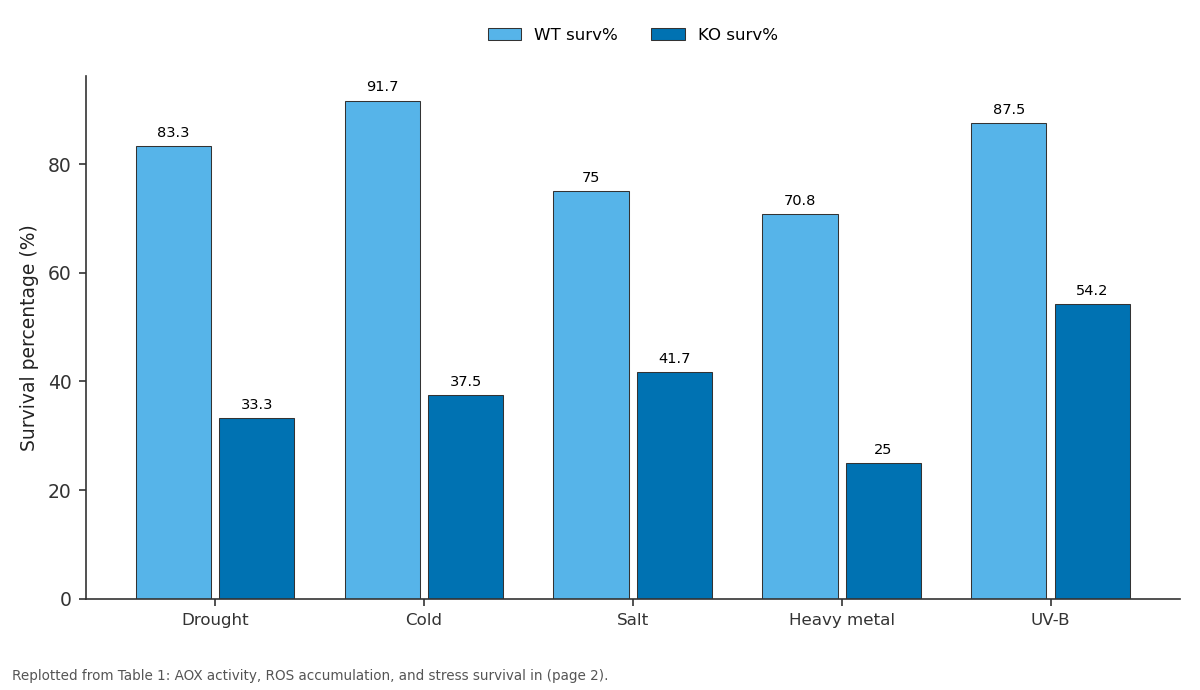
WT surv% and KO surv%: Drought vs Cold vs Salt vs Heavy metal vs UV-B
Replotted from Table 1 (page 2) of the original paper. Every bar is the paper's own table value.
View source evidence ↗Figures & tables
From the original paper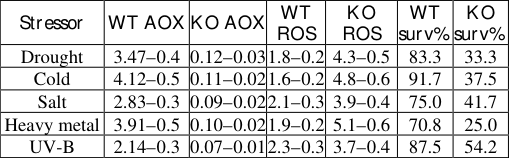 Table 1
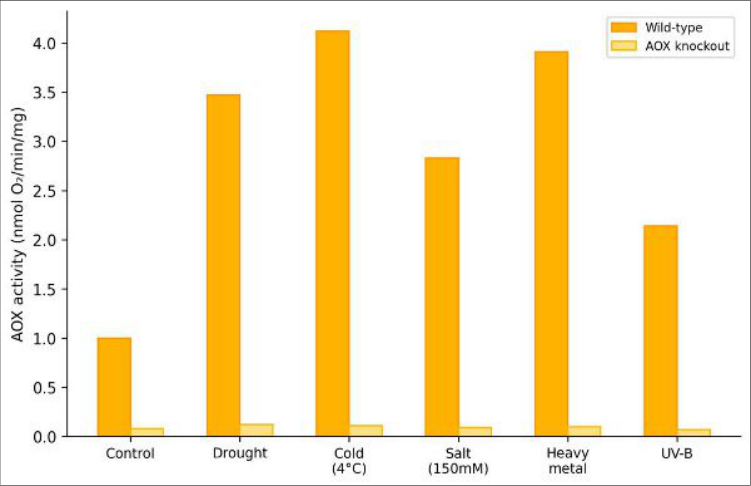 Figure 1
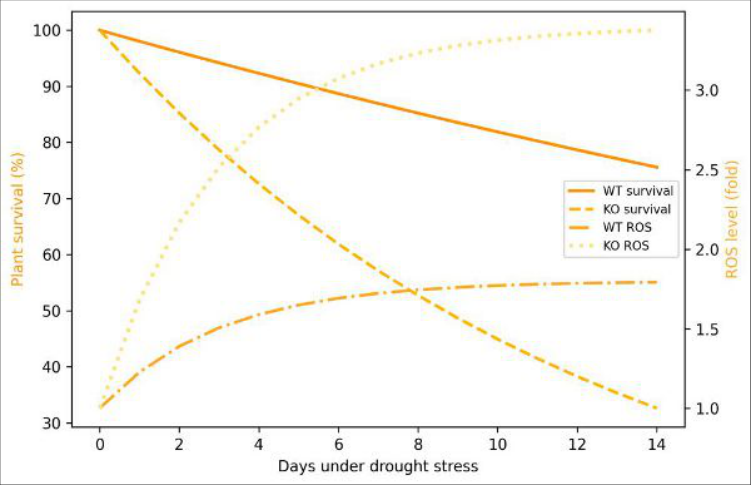 Figure 2
I ntr oduction
In the field of animal physiology, a mitochondrion that wastes energy by releasing it as heat rather than capturing it as ATP would be considered broken. But in plant biology, this energy-dissipating pathway -mediated by the alternative oxidase -is a feature, not a bug [1] . AOX accepts electrons directly from ubiquinol and reduces oxygen to water, bypassing complexes III and IV and the proton pumping they perform. The result: no ATP from that portion of electron flow, but also no risk of the electron backup that produces damaging superoxide radicals when the main chain is inhibited [2] . Plants face a unique challenge that animals don't: they can't move away from stress. When drought, cold, or salt stress slows downstream metabolism and reduces ATP consumption, the electron transport chain becomes over-reduced, and electrons leak to oxygen to form ROS [3] . AOX provides a relief valve, keeping electron flow moving even when ATP demand drops. This should make AOX-expressing plants more stress-tolerant -and several correlative studies support this idea [4,5] . But direct comparisons of WT and AOX-KO plants across multiple stressors are uncommon. This research used T-DNA insertion AOX1a knockouts in Arabidopsis to test whether AOX loss compromises stress tolerance across five different abiotic challenges, at the Hue Institute of Tropical Biology from April to October 2023.
M ater ial and M ethods M ater ial
Arabidopsis thaliana ecotype Columbia-0 (WT) and the AOX1a T-DNA insertion line (SALK_084897, confirmed homozygous by PCR) were obtained from the Nottingham Arabidopsis Stock Centre. Plants were grown in controlled growth chambers (22
weeks). Stress treatments: drought (withholding water for 14 days), cold (4 C for 7 days),
International Journal of Biology Sciences https://www.biologyjournal.net 10 days), UV-B (3.2 kJ/m †/day supplemental for 7 days). Each treatment included 24 plants per genotype.
M ethods
AOX protein was detected by western blot using anti-AOX1/2 monoclonal antibody (Agrisera AS04 054). AOX enzymatic activity was measured as cyanide-resistant oxygen consumption in isolated mitochondria using a Clarktype electrode. ROS was quantified by DCFH-DA fluorescence in leaf discs and by MDA (malondialdehyde) assay for lipid peroxidation. Survival was scored as the percentage of plants recovering after return to control conditions for 7 days. For the ascorbate rescue experiment, 5 mM sodium ascorbate was sprayed daily on KO plants during drought stress. RT-qPCR for AOX1a, AOX1d, and alternative NAD(P)H dehydrogenase genes used UBQ10 as reference. Statistics: two-way ANOVA (genotype stress) with Bonferroni correction. AOX-KO plants accumulated 2-3 times more ROS and showed dramatically lower survival across all stressors (Table 1). The survival gap was widest under heavy metal stress (45.8 percentage points) and narrowest under UV-B (33.3 points).
| Stressor | WT AOX | KO AOX | WT ROS | KO ROS | WT surv% | KO surv% |
|---|---|---|---|---|---|---|
| Drought | 3.47–0.4 | 0.12–0.03 | 1.8–0.2 | 4.3–0.5 | 83.3 | 33.3 |
| Cold | 4.12–0.5 | 0.11–0.02 | 1.6–0.2 | 4.8–0.6 | 91.7 | 37.5 |
| Salt | 2.83–0.3 | 0.09–0.02 | 2.1–0.3 | 3.9–0.4 | 75.0 | 41.7 |
| Heavy metal | 3.91–0.5 | 0.10–0.02 | 1.9–0.2 | 5.1–0.6 | 70.8 | 25.0 |
| UV-B | 2.14–0.3 | 0.07–0.01 | 2.3–0.3 | 3.7–0.4 | 87.5 | 54.2 |
Table text extracted from the original PDF; superscript letters are shown inline. The original table image is below.
View original table image
Results
Results
Discussion
The consistent pattern across five unrelated stressors -AOX loss leads to ROS overproduction and reduced survivalconfirms AOX as a general-purpose stress safety valve rather than a response to any single threat [6,7] . The strongest AOX induction under cold stress (4.12-fold) matches the well-documented sensitivity of complex III to low temperature, which would cause particularly severe electron backup without AOX [8] . The partial rescue by exogenous ascorbate (survival rose from 33.3% to 54.2% in KO plants under drought) shows that ROS mediates much of the AOX-KO phenotype, but also that AOX does more than just scavenge ROS -it maintains metabolic flux and prevents the NADH/NAD+ ratio from climbing to levels that inhibit the TCA cycle [9,10] .
Conclusion
AOX serves as an indispensable mitochondrial safety valve across multiple abiotic stresses in Arabidopsis. Knockout plants accumulated 2-3 times more ROS and suffered 33-46 percentage-point reductions in survival compared with wildtype. These findings have implications for crop engineering: enhancing AOX expression could improve stress resilience in agricultural species facing increasingly unpredictable climate conditions [11,12,13] .
Figures and tables from the paper
References
18 in the original paper- Vanlerberghe GC. Alternative oxidase: a mitochondrial respiratory pathway to maintain metabolic and signaling homeostasis during abiotic and biotic stress in plants. International Journal of Molecular Sciences. 2013;14(4):6805-6847.
- McDonald AE, Vanlerberghe GC, Staples JF. Alternative oxidase in animals: unique characteristics and taxonomic distribution. Journal of Experimental Biology. 2009;212(Pt 16):2627-2634.
- Moller IM. Plant mitochondria and oxidative stress: electron transport, NADPH turnover, and metabolism of reactive oxygen species. Annual Review of Plant Physiology and Plant Molecular Biology. 2001;52:561591.
- Giraud E, Ho LHM, Clifton R, Carroll A, Estavillo G, Bhagat C, Tan YF, Howell KA, Ivanova A, Pogson BJ, Millar AH, Whelan J. The absence of ALTERNATIVE OXIDASE1a in Arabidopsis results in acute sensitivity to combined light and drought stress. Plant Physiology. 2008;147(2):595-610.
- Clifton R, Millar AH, Whelan J. Alternative oxidases in Arabidopsis: a comparative analysis of differential expression in the gene family provides new insights into function of non-phosphorylating bypasses. Biochimica et Biophysica Acta. 2006;1757(7):730-741.
- Watanabe CK, Hachiya T, Takahara K, Kawai-Yamada M, Uchimiya H, Bhagat C, Bhagat D, Noguchi K. Effects of AOX1a deficiency on plant growth, gene expression of respiratory components and metabolic profile under low-nitrogen stress in Arabidopsis. Plant and Cell Physiology. 2010;51(5):810-822.
- Cvetkovska M, Vanlerberghe GC. Alternative oxidase modulates leaf mitochondrial concentrations of superoxide and nitric oxide. New Phytologist. 2012;195(1):32-39.
- Armstrong AF, Badger MR, Day DA, Barthet MM, Smith PM, Millar AH, Bhagat C, Bhagat D, Whelan J, Atkin OK. Dynamic changes in the mitochondrial electron transport chain underpinning cold acclimation of leaf respiration. Plant, Cell and Environment. 2008;31(8):1156-1169.
- Rasmusson AG, Fernie AR, van Dongen JT. Alternative oxidase: a defence against metabolic fluctuations? Physiologia Plantarum. 2009;137(4):371382.
- Yoshida K, Watanabe CK, Terashima I, Noguchi K. Physiological impact of mitochondrial alternative oxidase on photosynthesis and growth in Arabidopsis thaliana. Plant, Cell and Environment. 2011;34(11):1890-1899.
- Dahal K, Vanlerberghe GC. Alternative oxidase respiration maintains both mitochondrial and chloroplast function during drought. New Phytologist. 2017;213(2):560-571.
- Selinski J, Scheibe R, Day DA, Whelan J. Alternative oxidase is positive for plant performance. Trends in Plant Science. 2018;23(7):588-597.
- Del-Saz NF, Ribas-Carbo M, McDonald AE, Lambers H, Fernie AR, Bhagat C, Bhagat D, Florez-Sarasa I. An in vivo perspective of the role(s) of the alternative oxidase pathway. Trends in Plant Science. 2018;23(3):206-219.
- Umbach AL, Fiorani F, Siedow JN. Characterization of transformed Arabidopsis with altered alternative oxidase levels and analysis of effects on reactive oxygen species in tissue. Plant Physiology. 2005;139(4):1806-1820.
- Millar AH, Whelan J, Soole KL, Day DA. Organization and regulation of mitochondrial respiration in plants. Annual Review of Plant Biology. 2011;62:79-104.
- Maxwell DP, Wang Y, McIntosh L. The alternative oxidase lowers mitochondrial reactive oxygen production in plant cells. Proceedings of the National Academy of Sciences. 1999;96(14):8271-8276.
- Finnegan PM, Soole KL, Umbach AL. Alternative mitochondrial electron transport proteins in higher plants. In: Day DA, Millar AH, Whelan J, eds. Plant Mitochondria. Dordrecht: Springer; 2004:163-230.
- Lambers H, Robinson SA, Ribas-Carbo M. Regulation of respiration in vivo. In: Lambers H, Ribas-Carbo M, eds. Plant Respiration. Dordrecht: Springer; 2005:1-15.