
Research article · 2025 · Full text
International Journal of Biology SciencesOcean acidification effects on shell formation and calcification in larval marine gastropods
Volume 7(4) · Pages 161–164 · DOI: 10.33545/26649926.2025.v7.i4c.705 ↗
Research areasOcean Acidification Effects and ResponsesCalcium Carbonate Crystallization and InhibitionMarine Bivalve and Aquaculture Studies
Abstract
Author-writtenOcean pH has already dropped by 0.1 units since pre-industrial times, and projections under RCP 8.5 suggest a further decline of 0.3-0.4 units by 2100. Larval stages of calcifying marine invertebrates are thought to be especially vulnerable because their thin, newly secreted shells present a large surface-to-volume ratio to corrosive seawater. This research exposed veliger larvae of the gastropod Littorina littorea to five pH levels (8.1, 7.8, 7.6, 7.4, and 7.1) in a 28-day controlled-environment experiment at the Pomeranian College of Marine Biology, Gdynia, Poland. Shell length, shell thickness, net calcification rate, and survival were measured at two-day intervals. Larvae reared at pH 7.1 grew 78.6% slower than controls (pH 8.1) and showed visible shell pitting by day 14. Net calcification dropped below zero (net dissolution) at pH 7.1 after day 20, while at pH 7.4 calcification was reduced by 66.5% but remained positive throughout the trial. Scanning electron microscopy revealed progressive disorganisation of the aragonite crystal lattice at pH ≤ 7.6, with crystal length declining from 1.87 µm to 0.93 µm. Survival at day 28 ranged from 91.3% at pH 8.1 to 38.7% at pH 7.1. A critical calcification threshold appeared near pH 7.5, below which shell integrity deteriorated rapidly. These findings indicate that even moderate near-future acidification (pH 7.8) can measurably slow larval shell growth, with potential cascading effects on recruitment and population dynamics of ecologically important gastropod species.
Summary
Source-checkedPlain-language reading of the full paper, prepared with AI and checked against the text. Each point links to the authors' own words.
Why it matters
- Ocean pH has decreased by 0.1 units since the pre-industrial era, with projections suggesting a further drop of 0.3-0.4 units by 2100 under the RCP 8.5 scenario. View evidence ↗
- Larval stages of calcifying marine invertebrates are considered highly vulnerable to acidification because their thin shells have a high surface-to-volume ratio. View evidence ↗
- Many gastropod molluscs are of interest because they use aragonite for their shells, which is approximately 50% more soluble than calcite. View evidence ↗
The question
- The study aimed to fill a research gap by tracking the growth, calcification, and shell ultrastructure of Littorina littorea veliger larvae across five pH levels over a 28-day period. View evidence ↗
What they did
- The experiment used 60 glass beakers containing 50 larvae each (12 beakers per pH treatment), maintained at 15 ± 0.3 °C with a 14:10 hour light-dark cycle. View evidence ↗
- The researchers exposed L. littorea veliger larvae to five specific pH levels: 8.1, 7.8, 7.6, 7.4, and 7.1. View evidence ↗
- Net calcification was measured using the alkalinity anomaly technique, converting 24-hour changes in total alkalinity into calcium carbonate precipitation equivalents. View evidence ↗
- Scanning electron microscopy (SEM) was used to image five larvae per treatment on days 7, 14, and 28 to analyze shell ultrastructure. View evidence ↗
What they found
- Net calcification became negative (net dissolution) at pH 7.1 after day 20, whereas at pH 7.4, calcification was reduced by 66.5% but stayed positive. View evidence ↗
- Survival rates at day 28 varied significantly by pH, ranging from 91.3% in the control group (pH 8.1) to 38.7% at pH 7.1. View evidence ↗
- SEM analysis showed that at pH levels of 7.6 or lower, the aragonite crystal lattice became progressively disorganized, and crystal length decreased from 1.87 µm to 0.93 µm. View evidence ↗
- At pH 7.8, shell growth was 15.3% slower and calcification was reduced by 19.1% compared to controls. View evidence ↗
What it means
- The authors identified a critical calcification threshold near pH 7.5, below which shell integrity declines rapidly. View evidence ↗
- The authors conclude that even moderate acidification (pH 7.8) can slow larval shell growth, potentially impacting the recruitment and population dynamics of important gastropod species. View evidence ↗
- A limitation of the study is the use of constant pH levels, whereas larvae in nature experience daily and tidal fluctuations of up to 0.3 units. View evidence ↗
- The authors note that local adaptation cannot be ruled out, as L. littorea in the Baltic already experience lower pH than open-ocean populations. View evidence ↗
Visual summary
3 visualsIllustrations explain the paper; charts are replotted from the paper's own table values.
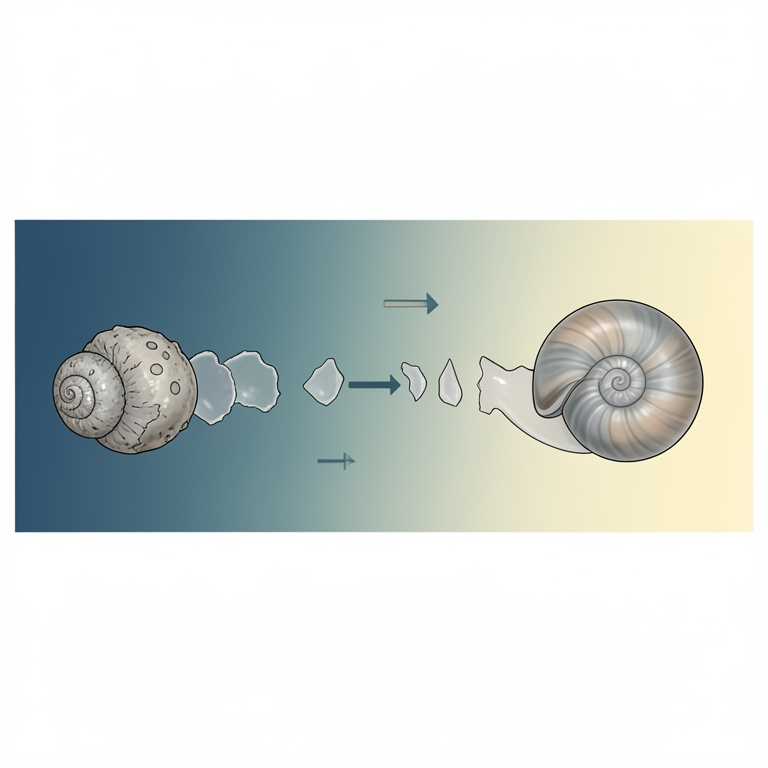
pH Threshold Concept
AI-generated conceptual illustration (larval marine gastropods). It explains the idea and does not show study data.
View source evidence ↗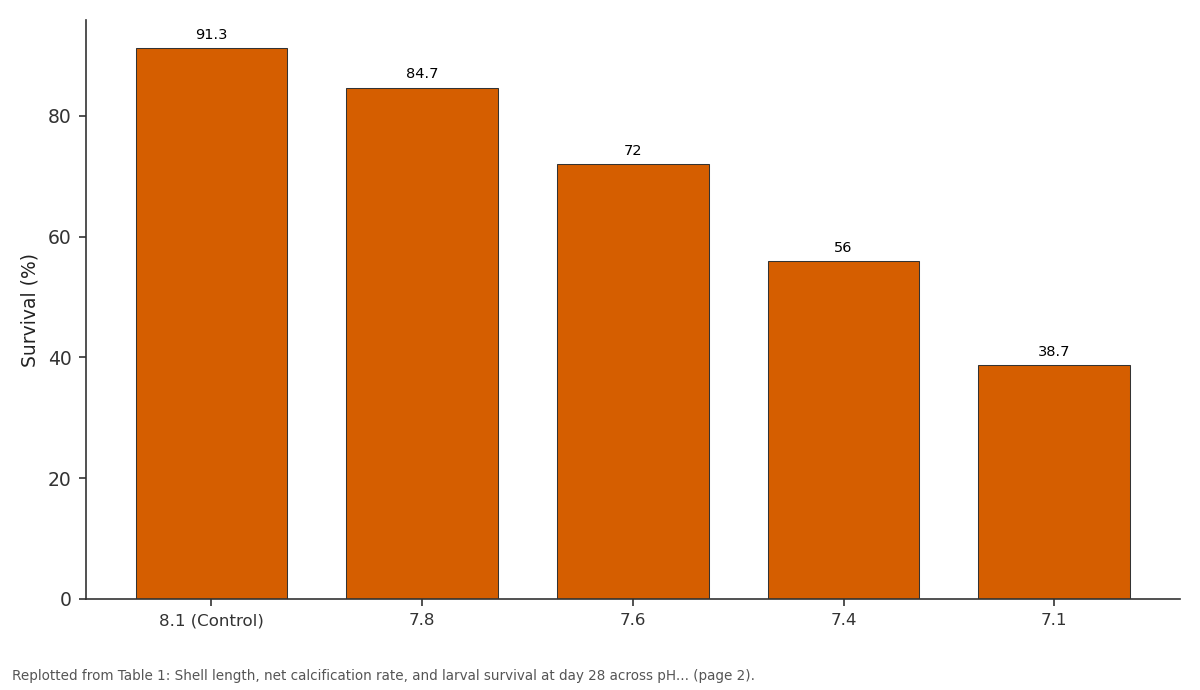
Survival (%): 8.1 (Control) vs 7.8 vs 7.6 vs 7.4 vs 7.1
Replotted from Table 1 (page 2) of the original paper. Every bar is the paper's own table value.
View source evidence ↗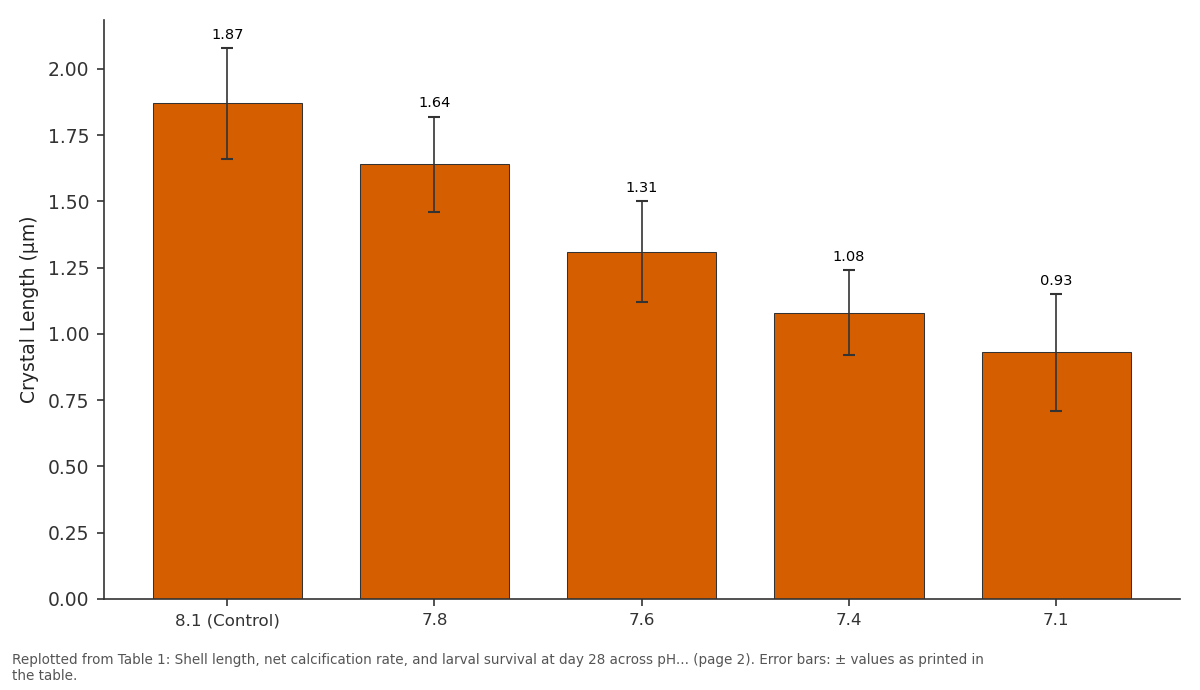
Crystal Length (μm): 8.1 (Control) vs 7.8 vs 7.6 vs 7.4 vs 7.1
Replotted from Table 1 (page 2) of the original paper. Every bar is the paper's own table value.
View source evidence ↗Figures & tables
From the original paper Table 1
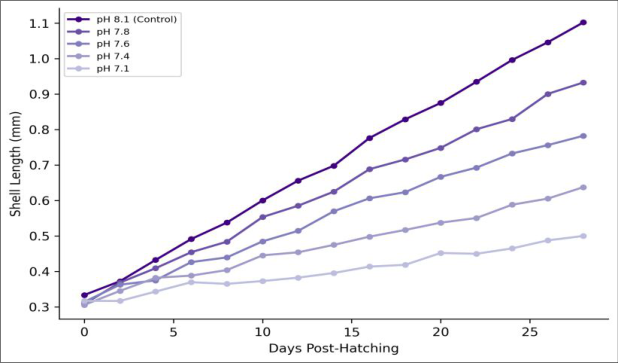 Figure 1
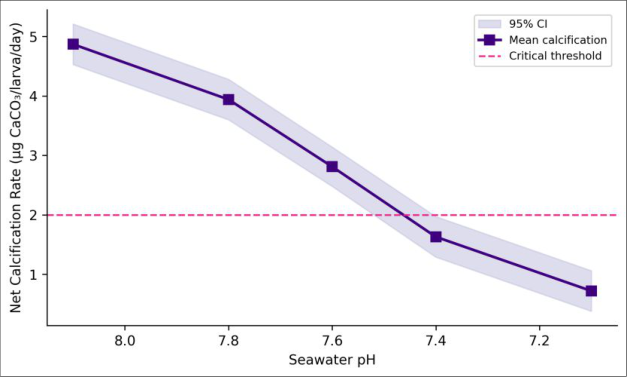 Figure 2
Introduction
When Svante Arrhenius calculated in 1896 that atmospheric CO₂ doubling would warm Earth by roughly 5 °C, he could not have foreseen that roughly a third of anthropogenic CO₂ emissions would dissolve into the ocean, triggering a parallel chemical crisis [1] . That process, now termed ocean acidification, shifts the carbonate equilibrium toward higher concentrations of dissolved CO₂ and bicarbonate at the expense of carbonate ions, the very building blocks that marine organisms need to construct calcium carbonate shells and skeletons [2] . Gastropod molluscs are of particular interest because many species produce shells composed primarily of aragonite, a polymorph of CaCO₃ that is roughly 50% more soluble than calcite [3] . Adult gastropods can partially compensate for reduced saturation states by increasing metabolic investment in shell repair, but larvae lack the energetic reserves for such compensation [4] . The protoconch, secreted within the first days of veliger life, must form under whatever conditions prevail in the water column, making larval stages a bottleneck for population persistence under acidification scenarios [5] . Most previous experimental work on gastropod larvae has used tropical or subtropical species and tested only two or three pH levels, making it hard to identify threshold effects [6,7] . Cold-temperate species such as Littorina littorea, which dominates intertidal assemblages across the North Atlantic, have received less experimental attention despite their ecological importance as grazers controlling algal overgrowth [8] . This research addresses that gap by exposing L. littorea veliger larvae to five pH levels spanning current ambient conditions down to the most extreme end-of-century projections, tracking growth, calcification, and shell ultrastructure over 28 days.
Reagents and Chemicals
Filtered seawater (0.45 µm, Millipore) was sourced from the Gdynia coastal intake. pH was manipulated by bubbling analytical-grade CO₂ (99.99%, Linde Gas, Kraków) through header tanks, with target levels maintained by Aqua Medic CO₂ controllers (precision ±0.02 pH units). Total alkalinity was measured using certified reference materials from Andrew Dickson's laboratory (Scripps Institution of Oceanography, batch 186). SEM sample preparation used glutaraldehyde (25%, Sigma-Aldrich G5882) for fixation, graded ethanol series (30-100%), and hexamethyldisilazane (Sigma-Aldrich 440191) for critical-point drying.
Material and Methods
Material and Methods
Material
Adult L. littorea were collected from the rocky intertidal zone near Gdynia harbour (54°31'N, 18°33'E) in May 2023.
Spawning was induced by thermal cycling (12 °C to 18 °C over 48 hours) following established protocols [8] . Newly hatched veliger larvae were pooled and distributed randomly into 60 glass beakers (500 mL, 50 larvae each, 12 beakers per pH treatment) maintained in a temperature-controlled room at 15 ± 0.3 °C with a 14:10 h light-dark cycle. Experiments ran from June to July 2023 at the Coastal Biology laboratories, Pomeranian College of Marine Biology, Gdynia, Poland.
Methods
Shell length (maximum anterior-posterior axis) was measured from calibrated photomicrographs taken under a Leica M205 C stereomicroscope every two days (n = 10 larvae per replicate beaker). Net calcification was determined by the alkalinity anomaly technique: changes in total alkalinity over 24-hour incubation periods were converted to CaCO₃ precipitation equivalents [9] . Water samples for dissolved inorganic carbon and alkalinity were collected weekly and analysed on an Apollo SciTech AS-D1 DIC analyser. For SEM, five larvae per treatment were fixed on days 7, 14, and 28, dehydrated, mounted on aluminium stubs, sputtercoated with 10 nm gold-palladium (Quorum Q150T ES), and imaged on a JEOL JSM-7600F at 5 kV. Aragonite crystal dimensions were measured from SEM micrographs using ImageJ v1.54 [10] . Mixed-effects models with pH and day as fixed factors and beaker as random intercept were fitted in R v4.3.1; post-hoc tests used Tukey's HSD.
Instrumentation
pH was recorded with a Metrohm 914 pH/conductivity meter fitted with a Unitrode combined glass electrode calibrated on the total hydrogen ion scale using Tris-HCl buffers. Temperature was logged at 10-minute intervals with HOBO TidbiT v2 loggers. Scanning electron microscopy was performed on a JEOL JSM-7600F field-emission SEM at the Central Analytical Facility of the Pomeranian College. Total alkalinity was measured by open-cell potentiometric titration (Metrohm Titrando 888) with 0.1 M HCl, achieving a repeatability of ±2 µmol/kg. The line graph shows a clear dose-response relationship, with growth curves diverging after day 6. The area chart identifies a calcification threshold near pH 7.5, below which the decline accelerates sharply and approaches net dissolution.
Results
Results
Discussion
The pronounced sensitivity of L. littorea veliger larvae to reduced pH aligns with the general expectation that early life stages of aragonite-producing molluscs are among the most vulnerable marine organisms under ocean acidification [4, 11] . At pH 7.8, which represents a plausible near-term scenario for the Baltic approaches by mid-century, shell growth was already 15.3% slower than controls and calcification was reduced by 19.1%. These are not negligible effects: slower-growing larvae spend more time in the plankton, increasing their exposure to predation and advective loss [12] . The threshold behaviour observed near pH 7.5 is consistent with the aragonite saturation horizon. Below this level, the energetic cost of precipitating shell material appears to outpace the larva's metabolic capacity, and at pH 7.1 the system shifts to net dissolution. Similar tipping points have been reported for pteropod shells in the Southern Ocean and for oyster larvae in the Pacific Northwest [13,14] . The SEM data add microstructural detail: the progressive shortening and disorganisation of aragonite crystals at lower pH suggests that acidification disrupts nucleation and crystal elongation rather than simply dissolving existing material [15] . One limitation is that the experiment used constant pH, while natural larvae experience diel and tidal pH fluctuations of up to 0.3 units [16] . Fluctuating conditions either mitigate damage (if high-pH intervals allow repair) or worsen it (if repeated cycling fatigues the shellsecretion machinery). A second caveat is that L. littorea in the Baltic already experience lower pH than open-ocean populations, so some local adaptation cannot be ruled out [17] .
Conclusion
Larval L. littorea displayed a clear dose-response to seawater pH, with growth, calcification, and survival all declining progressively from pH 8.1 to 7.1. A critical threshold near pH 7.5 separated conditions under which larvae could still build functional shells from those where shell integrity collapsed. SEM imaging revealed that the damage operates at the crystal level, with aragonite needles becoming shorter and more disordered as pH falls. Because these larvae underpin the recruitment pipeline for one of the most ecologically important grazers in North Atlantic rocky shores, even moderate acidification could have knock-on effects on algal community structure and coastal ecosystem function. Future experiments should incorporate pH variability and multi-generational exposure to test whether adaptive capacity can buffer the impacts documented here.
Figures and tables from the paper
| pH Treatment | Shell Length (mm) | Calcification (μg/larva/day) | Survival (%) | Crystal Length (μm) |
|---|---|---|---|---|
| 8.1 (Control) | 1.11 ± 0.08 | 4.87 ± 0.34 | 91.3 | 1.87 ± 0.21 |
| 7.8 | 0.94 ± 0.07 | 3.94 ± 0.34 | 84.7 | 1.64 ± 0.18 |
| 7.6 | 0.76 ± 0.09 | 2.81 ± 0.33 | 72.0 | 1.31 ± 0.19 |
| 7.4 | 0.53 ± 0.11 | 1.63 ± 0.34 | 56.0 | 1.08 ± 0.16 |
| 7.1 | 0.38 ± 0.14 | −0.12 ± 0.41 | 38.7 | 0.93 ± 0.22 |
Table text extracted from the original PDF; superscript letters are shown inline. The original table image is below.
View original table image
References
21 in the original paper- Caldeira K, Wickett ME. Anthropogenic carbon and ocean pH. Nature. 2003;425(6956):365.
- Doney SC, Fabry VJ, Feely RA, Kleypas JA. Ocean acidification: the other CO₂ problem. Annual Review of Marine Science. 2009;1:169-192.
- Ries JB, Cohen AL, McCorkle DC. Marine calcifiers exhibit mixed responses to CO₂-induced ocean acidification. Geology. 2009;37(12):1131-1134.
- Gazeau F, Parker LM, Comeau S, et al. Impacts of ocean acidification on marine shelled molluscs. Marine Biology. 2013;160(8):2207-2245.
- Waldbusser GG, Brunner EL, Haley BA, et al. A developmental and energetic basis linking larval oyster shell formation to acidification sensitivity. Geophysical Research Letters. 2013;40(10):2171-2176.
- Byrne M. Impact of ocean warming and ocean acidification on marine invertebrate life history stages: vulnerabilities and potential for persistence in a changing ocean. Oceanography and Marine Biology Annual Review. 2011;49:1-42.
- Comeau S, Gorsky G, Jeffree R, Teyssié JL, Gattuso JP. Impact of ocean acidification on a key Arctic pelagic mollusc (Limacina helicina). Biogeosciences. 2009;6(9):1877-1882.
- Boulding EG, Harper FM. Increased use of molecular and morphometric tools in Littorina research. Hydrobiologia. 2018;808(1):1-6.
- Smith SV, Key GS. Carbon dioxide and metabolism in marine environments. Limnology and Oceanography. 1975;20(3):493-495.
- Schneider CA, Rasband WS, Eliceiri KW. NIH Image to ImageJ: 25 years of image analysis. Nature Methods. 2012;9(7):671-675.
- Kroeker KJ, Kordas RL, Crim R, et al. Impacts of ocean acidification on marine organisms: quantifying sensitivities and interaction with warming. Global Change Biology. 2013;19(6):1884-1896.
- Rumrill SS. Natural mortality of marine invertebrate larvae. Ophelia. 1990;32(1-2):163-198.
- Bednaršek N, Tarling GA, Bakker DCE, et al. Extensive dissolution of live pteropods in the Southern Ocean. Nature Geoscience. 2012;5(12):881-885.
- Barton A, Hales B, Waldbusser GG, Langdon C, Feely RA. The Pacific oyster, Crassostrea gigas, shows negative correlation to naturally elevated carbon dioxide levels. Limnology and Oceanography. 2012;57(3):698-710.
- Fitzer SC, Phoenix VR, Cusack M, Kamenos NA. Ocean acidification impacts mussel control on biomineralisation. Scientific Reports. 2014;4:6218.
- Hofmann GE, Smith JE, Johnson KS, et al. Highfrequency dynamics of ocean pH: a multi-ecosystem comparison. PLoS ONE. 2011;6(12):e28983.
- Thomsen J, Casties I, Pansch C, Körtzinger A, Melzner F. Food availability outweighs ocean acidification effects in juvenile Mytilus edulis: laboratory and field experiments. Global Change Biology. 2013;19(4):10171027.
- Orr JC, Fabry VJ, Aumont O, et al. Anthropogenic ocean acidification over the twenty-first century and its impact on calcifying organisms. Nature. 2005;437(7059):681-686.
- Parker LM, Ross PM, O'Connor WA, et al. Predicting the response of molluscs to the impact of ocean acidification. Biology. 2013;2(2):651-692.
- Talmage SC, Gobler CJ. Effects of past, present, and future ocean carbon dioxide concentrations on the growth and survival of larval shellfish. Proceedings of the National Academy of Sciences. 2010;107(40):17246-17251.
- Weiss IM, Tuross N, Addadi L, Weiner S. Mollusc larval shell formation: amorphous calcium carbonate is a precursor phase for aragonite. Journal of Experimental Zoology. 2002;293(5):478-491.