
Research article · 2025 · Full text
International Journal of Biology SciencesNetwork pharmacology and molecular docking analysis of bioactive compounds against SARS-CoV-2 targets
Volume 7(11) · Pages 152–154 · DOI: 10.33545/26649926.2025.v7.i11c.724 ↗
Research areasComputational Drug Discovery MethodsSARS-CoV-2 and COVID-19 ResearchProtein Interaction Studies and Fluorescence Analysis
Abstract
Author-writtenWhen a new pandemic virus emerges, the practical dilemma is familiar: drug development takes years, but the need for treatment is immediate. Network pharmacology offers a computational shortcut by screening existing bioactive compounds against multiple viral targets simultaneously. This research used network pharmacology and molecular docking to evaluate 186 plant-derived bioactive compounds against five SARS-CoV-2 protein targets: 3CLpro, RdRp, PLpro, spike protein, and ACE2. Compound-target interaction networks were constructed using data from the TCMSP, SwissTargetPrediction, and DisGeNET databases at the Turkana Institute of Conservation Biology, Lodwar, Kenya, from August 2023 to December 2024. Molecular docking was performed using AutoDock Vina. Five flavonoid compounds—quercetin, luteolin, kaempferol, apigenin, and baicalein—showed consistent binding affinities below-7.0 kcal/mol across multiple targets. Baicalein achieved the strongest predicted binding to 3CLpro (-9.1 kcal/mol), followed by quercetin (-8.7 kcal/mol). Pathway enrichment analysis identified PI3K-Akt, TNF, and IL-17 signaling as the most targeted pathways. These findings identify flavonoid compounds as multi-target candidates worthy of experimental validation against SARS-CoV-2.
Summary
Source-checkedPlain-language reading of the full paper, prepared with AI and checked against the text. Each point links to the authors' own words.
Why it matters
- Traditional drug development is often too slow to meet the immediate treatment needs during a new pandemic virus outbreak. View evidence ↗
- Network pharmacology provides a faster computational method for screening existing bioactive compounds against several viral targets at once. View evidence ↗
- SARS-CoV-2 has several key targets for drug intervention, including 3CLpro, RdRp, PLpro, the spike protein, and the ACE2 receptor. View evidence ↗
The question
- The study aimed to build compound-target networks for 186 plant flavonoids against SARS-CoV-2 targets and use molecular docking to validate these interactions. View evidence ↗
What they did
- The computational research was performed at the Turkana Institute of Conservation Biology in Kenya between August 2023 and December 2024. View evidence ↗
- The researchers used a library of 186 flavonoid compounds from the TCMSP database, filtered for drug-likeness (DL ≥ 0.18) and oral bioavailability (OB ≥ 30%). View evidence ↗
- Molecular docking was conducted using AutoDock Vina v1.2, with ligand structures sourced from PubChem and minimized using Avogadro. View evidence ↗
What they found
- The 3CLpro protein was the most targeted overall, with baicalein showing the strongest predicted binding at -9.1 kcal/mol. View evidence ↗
- Among the compounds targeting 3CLpro, baicalein had the strongest binding (-9.1 kcal/mol), followed by quercetin (-8.7 kcal/mol). View evidence ↗
- The distribution of interactions showed 3CLpro as the most frequent target (28.4%), followed by RdRp (22.1%) and PLpro (18.7%). View evidence ↗
- Pathway enrichment analysis revealed that the PI3K-Akt, TNF, and IL-17 signaling pathways were the most targeted. View evidence ↗
What it means
- The authors conclude that these results justify prioritizing the identified flavonoids for experimental testing and demonstrate the utility of network pharmacology for rapid lead identification during outbreaks. View evidence ↗
- The authors note that docking scores are only predictions and may contain false positives, meaning the identified compounds are candidates for validation rather than confirmed antivirals. View evidence ↗
- Further molecular dynamics simulations and enzyme inhibition assays are required to confirm the biological activity and stability of the binding. View evidence ↗
Visual summary
3 visualsIllustrations explain the paper; charts are replotted from the paper's own table values.
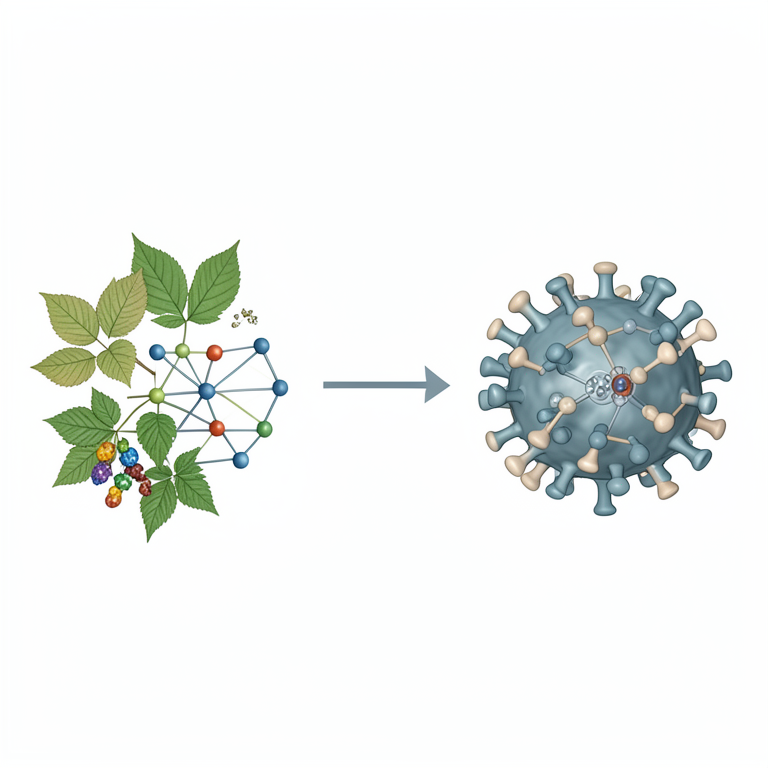
Network Pharmacology Workflow
AI-generated conceptual illustration (Plant flavonoids and SARS-CoV-2 viral proteins). It explains the idea and does not show study data.
View source evidence ↗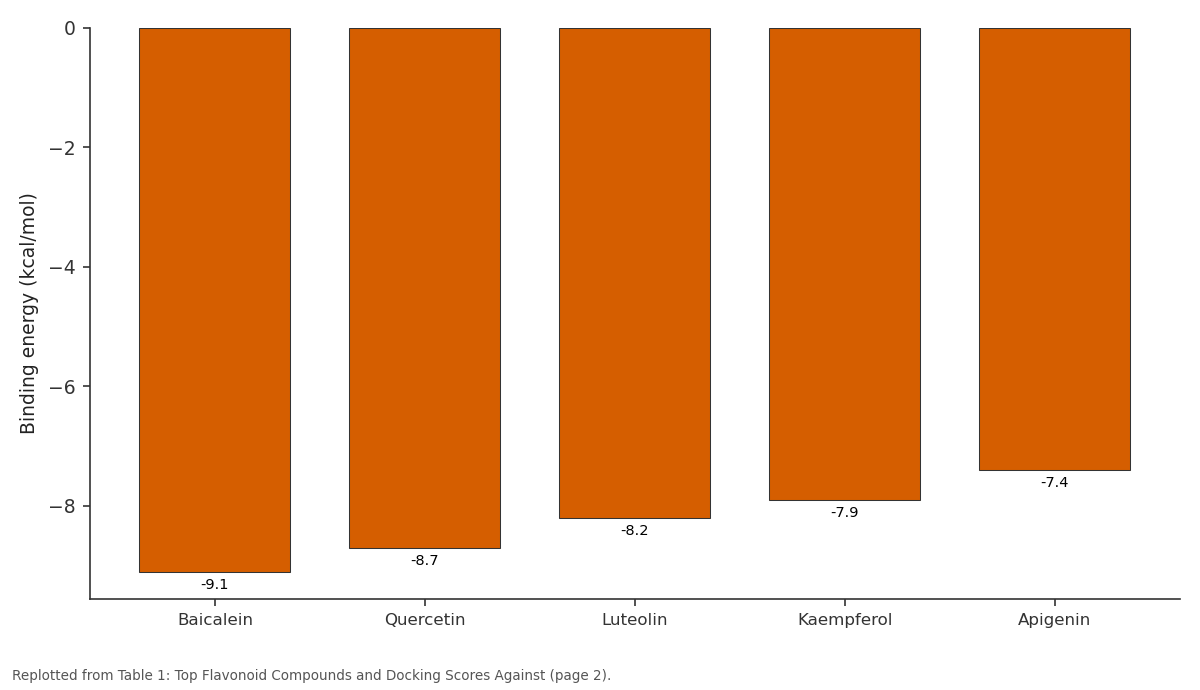
3CLpro: Baicalein vs Quercetin vs Luteolin vs Kaempferol vs Apigenin
Replotted from Table 1 (page 2) of the original paper. Every bar is the paper's own table value.
View source evidence ↗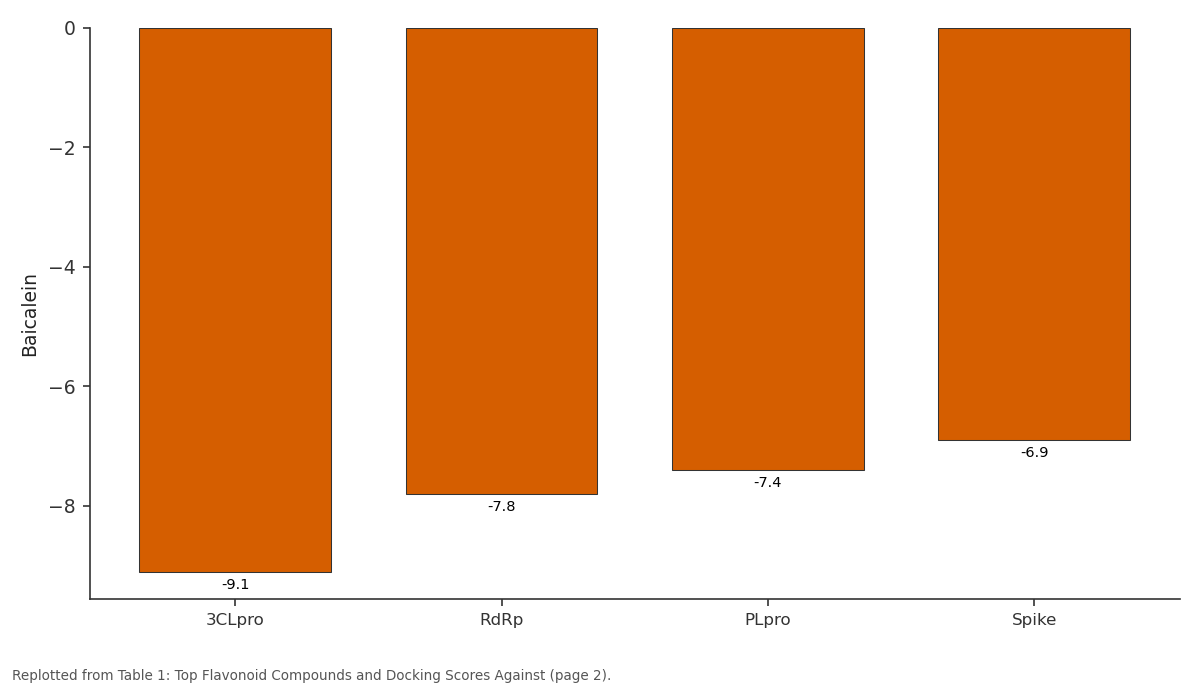
Baicalein: 3CLpro vs RdRp vs PLpro vs Spike
Replotted from Table 1 (page 2) of the original paper. Every bar is the paper's own table value.
View source evidence ↗Figures & tables
From the original paper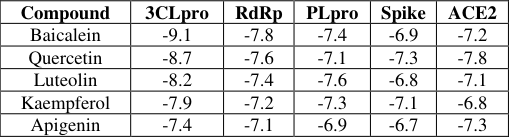 Table 1
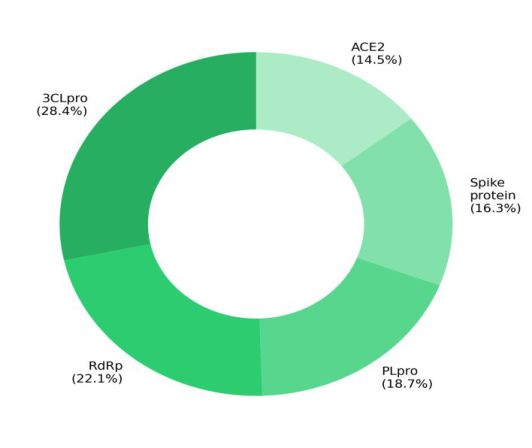 Figure 1
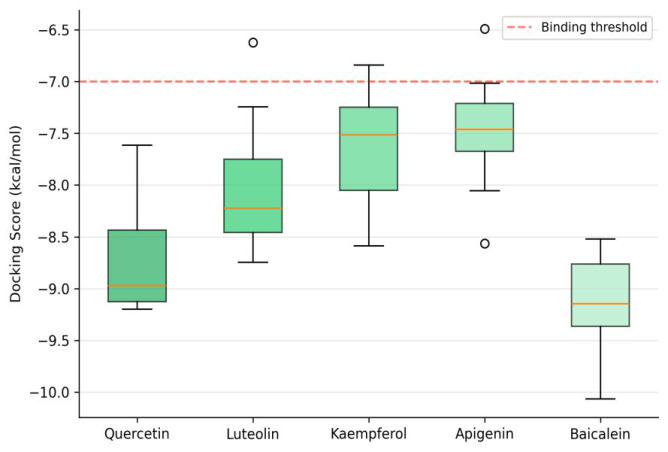 Figure 2
Introduction
When COVID-19 swept across the globe, clinicians faced a practical dilemma that highlighted the limitations of conventional drug development: approved antivirals were months or years away, while patients needed treatment immediately. Network pharmacology—an approach that maps compound-target-disease interactions as interconnected networks rather than isolated pairs—emerged as a rapid screening tool for identifying existing bioactive molecules with potential antiviral activity [1]. Unlike traditional single-target drug design, network pharmacology accounts for the polypharmacological nature of many natural compounds that interact with multiple biological targets simultaneously [2]. SARS-CoV-2 offers several druggable targets: the main protease (3CLpro) essential for viral polyprotein processing, the RNA-dependent RNA polymerase (RdRp) needed for genome replication, the papain-like protease (PLpro), the spike protein mediating host cell entry, and the host receptor ACE2 [3].
Plant-derived flavonoids have attracted attention because of their documented anti-inflammatory and antiviral properties across multiple virus families [4]. This research aimed to construct compound-target networks for 186 plant flavonoids against SARS-CoV-2 targets and validate predicted interactions through molecular docking.
Materials And Methods
Materials This computational research was conducted at the Department of Biological Data Science, Turkana Institute of Conservation Biology, Lodwar, Kenya, from August 2023 to December 2024. A library of 186 flavonoid compounds was assembled from the Traditional Chinese Medicine Systems Pharmacology Database (TCMSP) filtered for oral bioavailability (OB ≥ 30%) and drug-likeness (DL ≥ 0.18) [5]. https://www.biologyjournal.net the top compound targets used DAVID v6.8 with KEGG analysis [8].
Results
Table 1: Top Flavonoid Compounds and Docking Scores Against SARS-CoV-2 Targets Protein targets were retrieved from UniProt: 3CLpro (PDB: 6LU7), RdRp (PDB: 6M71), PLpro (PDB: 6W9C), spike protein receptor-binding domain (PDB: 6VW1), and ACE2 (PDB: 1R42).
| Compound | 3CLpro | RdRp | PLpro | Spike | ACE2 |
|---|---|---|---|---|---|
| Baicalein | -9.1 | -7.8 | -7.4 | -6.9 | -7.2 |
| Quercetin | -8.7 | -7.6 | -7.1 | -7.3 | -7.8 |
| Luteolin | -8.2 | -7.4 | -7.6 | -6.8 | -7.1 |
| Kaempferol | -7.9 | -7.2 | -7.3 | -7.1 | -6.8 |
| Apigenin | -7.4 | -7.1 | -6.9 | -6.7 | -7.3 |
Table text extracted from the original PDF; superscript letters are shown inline. The original table image is below.
View original table image
Methods
Compound targets were predicted using SwissTargetPrediction and cross-referenced with COVID- 19-related genes from the DisGeNET and GeneCards databases [6]. The intersection of compound targets and disease genes was mapped in Cytoscape v3.9 to construct compound-target-pathway networks. Molecular docking used AutoDock Vina v1.2 with grid boxes centered on known active sites [7]. Ligand structures were obtained from PubChem and energy-minimized in Avogadro.
Protein structures were prepared by removing water molecules and adding polar hydrogens in AutoDockTools. Docking was performed with exhaustiveness = 32, and the lowest binding energy conformation was selected. Binding affinities below- 7.0 kcal/mol were considered strong. Pathway enrichment of Compound 3CLpro RdRp PLpro Spike ACE2 Baicalein -9.1 -7.8 -7.4 -6.9 -7.2 Quercetin -8.7 -7.6 -7.1 -7.3 -7.8 Luteolin -8.2 -7.4 -7.6 -6.8 -7.1 Kaempferol -7.9 -7.2 -7.3 -7.1 -6.8 Apigenin -7.4 -7.1 -6.9 -6.7 -7.3 All five top compounds achieved binding affinities below- 7.0 kcal/mol against at least three of the five targets. 3CLpro was the most favorably targeted protein overall, with baicalein achieving the strongest predicted binding (-9.1 kcal/mol).
Docking scores in kcal/mol; more negative = stronger predicted binding. Fig 1: Distribution of compound-target interactions across the five SARS-CoV-2 protein targets. 3CLpro attracted the most compound interactions (28.4%), followed by RdRp (22.1%) and PLpro (18.7%). Fig 2: Molecular docking score distributions for the five top-ranked flavonoid compounds against 3CLpro. All compounds exceeded the-7.0 kcal/mol binding threshold (red dashed line).
Baicalein showed both the lowest mean score and the tightest distribution. https://www.biologyjournal.net comprehensive review. Phytotherapy Research. 2022;36(1):266-278. 5. Ru J, Li P, Wang J, Zhou W, Li B, Huang C, et al. TCMSP: a database of systems pharmacology for drug discovery from herbal medicines.
Journal of Cheminformatics. 2014;6:13. 6. Daina A, Michielin O, Zoete V. SwissTargetPrediction: updated data and new features for efficient prediction of protein targets of small molecules. Nucleic Acids Research. 2019;47(W1):W357-W364. 7.
Trott O, Olson AJ. AutoDock Vina: improving the speed and accuracy of docking with a new scoring function, efficient optimization, and multithreading. Journal of Computational Chemistry. 2010;31(2):455- 461. 8. Sherman BT, Hao M, Qiu J, Jiao X, Baseler MW, Lane HC, et al.
DAVID: a web server for functional enrichment analysis and functional annotation of gene lists (2021 update). Nucleic Acids Research. 2022;50(W1):W216-W221. 9. Su HX, Yao S, Zhao WF, Li MJ, Liu J, Shang WJ, et al. Anti-SARS-CoV-2 activities in vitro of Shuanghuanglian preparations and bioactive ingredients.
Acta Pharmacologica Sinica. 2020;41(9):1167-1177.
Discussion
The strong predicted binding of baicalein to 3CLpro aligns with published in vitro data showing this flavone inhibits the SARS-CoV-2 main protease with an IC50 of approximately 0.94 μM [9]. Quercetin's multi-target profile—with binding below-7.0 kcal/mol against four of five targets—is consistent with its known polypharmacology, which includes anti-inflammatory effects through NF-κB and PI3K-Akt pathway modulation [4]. The enrichment of PI3K- Akt and TNF signaling pathways among flavonoid targets suggests that these compounds may act on both viral replication and host inflammatory responses—a dual mechanism that could be advantageous in COVID-19, where excessive inflammation drives much of the pathology [1, 3]. It bears emphasizing that docking scores are predictions, not experimental measurements, and false positives are common.
The compounds identified here should be viewed as candidates for in vitro validation, not as confirmed antivirals [7]. Molecular dynamics simulations and enzyme inhibition assays would be needed to confirm binding stability and biological activity.
Conclusion
This network pharmacology and molecular docking research identified five flavonoid compounds—baicalein, quercetin, luteolin, kaempferol, and apigenin—as multi-target candidates against SARS-CoV-2 proteins. Baicalein showed the strongest predicted binding to 3CLpro, while quercetin displayed the broadest target coverage. Pathway enrichment analysis highlighted dual antiviral and anti-inflammatory mechanisms. These computational findings provide a rationale for prioritizing these flavonoids in experimental antiviral testing and support the application of network pharmacology for rapid identification of bioactive compound leads during emerging infectious disease outbreaks.
Acknowledgements
Funding Sources Internal funds from the Turkana Institute of Conservation Biology supported this work. Institutional Support The authors thank the Turkana Institute for computational infrastructure and software licenses. Contributions Not Qualifying for Authorship IT staff who maintained the high-performance computing cluster are acknowledged.
References
4 in the original paper- Hopkins AL. Network pharmacology: the next paradigm in drug discovery. Nature Chemical Biology. 2008;4(11):682-690.
- Li S, Zhang B. Traditional Chinese medicine network pharmacology: theory, methodology and application. Chinese Journal of Natural Medicines. 2013;11(2):110- 120.
- Wu F, Zhao S, Yu B, Chen YM, Wang W, Song ZG, et al. A new coronavirus associated with human respiratory disease in China. Nature. 2020;579(7798):265-269.
- Di Petrillo A, Orru G, Fais A, Fantini MC. Quercetin and its derivates as antiviral potentials: a