
Research article · 2025 · Full text
International Journal of Biology SciencesHorizontal gene transfer events between bacteria and eukaryotes detected through comparative genomics
Volume 7(12) · Pages 143–146 · DOI: 10.33545/26649926.2025.v7.i12b.694 ↗
Research areasGenomics and Phylogenetic StudiesChromosomal and Genetic VariationsBacterial Genetics and Biotechnology
Abstract
Author-writtenHow do bacterial genes end up inside eukaryotic chromosomes, and how often does this actually happen? This research applied a comparative genomics pipeline to 318 eukaryotic genome assemblies to detect and validate horizontal gene transfer (HGT) events originating from bacterial donors. The analysis, conducted at the Instituto de Biología Marina de Canarias between February 2022 and November 2023, combined sequence similarity screening with phylogenetic incongruence testing, GC content analysis, and intron pattern verification. A total of 187 high-confidence HGT events were identified across six eukaryotic phyla. Proteobacteria were the most frequent donors (36 events), and fungi were the most common recipients (47 events). Transferred genes were enriched for metabolic functions, particularly amino acid biosynthesis and xenobiotic degradation. These results indicate that bacteria-to-eukaryote HGT is more widespread than previously estimated and has shaped metabolic capacity across diverse eukaryotic lineages.
Summary
Source-checkedPlain-language reading of the full paper, prepared with AI and checked against the text. Each point links to the authors' own words.
Why it matters
- Horizontal gene transfer (HGT) is a known driver of metabolic diversification and antibiotic resistance in bacteria. View evidence ↗
- The frequency of HGT from bacteria to eukaryotes is a subject of long-standing scientific debate, with estimates varying based on the methodology used. View evidence ↗
- Detecting HGT is difficult because bacterial contamination in genome assemblies or incomplete lineage sorting can create false signals of gene transfer. View evidence ↗
The question
- The study aims to determine the frequency and mechanisms by which bacterial genes are integrated into eukaryotic chromosomes. View evidence ↗
What they did
- The researchers used a comparative genomics pipeline to analyze 318 eukaryotic genome assemblies for bacterial HGT events. View evidence ↗
- Conducted between February 2022 and November 2023, the method combined sequence similarity screening, phylogenetic incongruence testing, GC content analysis, and intron pattern verification. View evidence ↗
- Protein sequences were screened against bacterial reference proteomes using DIAMOND BLASTp with an E-value under 1e-10 and query coverage over 70%. View evidence ↗
- Final candidates were filtered based on a GC content deviation of more than 5% from the recipient mean and having zero or fewer introns than the family average. View evidence ↗
What they found
- The study identified 187 high-confidence HGT events across six eukaryotic phyla. View evidence ↗
- Proteobacteria were the most frequent gene donors with 36 events, while fungi were the most common recipients with 47 events. View evidence ↗
- Cyanobacterial transfers to plants were a dominant pair with 14 events, likely due to plastid-associated gene movement. View evidence ↗
- The transferred genes were primarily enriched for metabolic functions, specifically xenobiotic degradation and amino acid biosynthesis. View evidence ↗
- The detection pipeline demonstrated 88.1% sensitivity (37 of 42 recovered events) and a 3.5% false-positive rate. View evidence ↗
What it means
- The authors conclude that bacteria-to-eukaryote gene transfer is more frequent than previously estimated during the early genome era. View evidence ↗
- The authors suggest that HGT provides adaptive advantages by expanding the biochemical capabilities of the recipient organisms. View evidence ↗
- A limitation of the study is the potential undercounting of ancient HGT events due to sequence divergence and the erasure of compositional signatures (amelioration). View evidence ↗
Visual summary
2 visualsIllustrations explain the paper; charts are replotted from the paper's own table values.
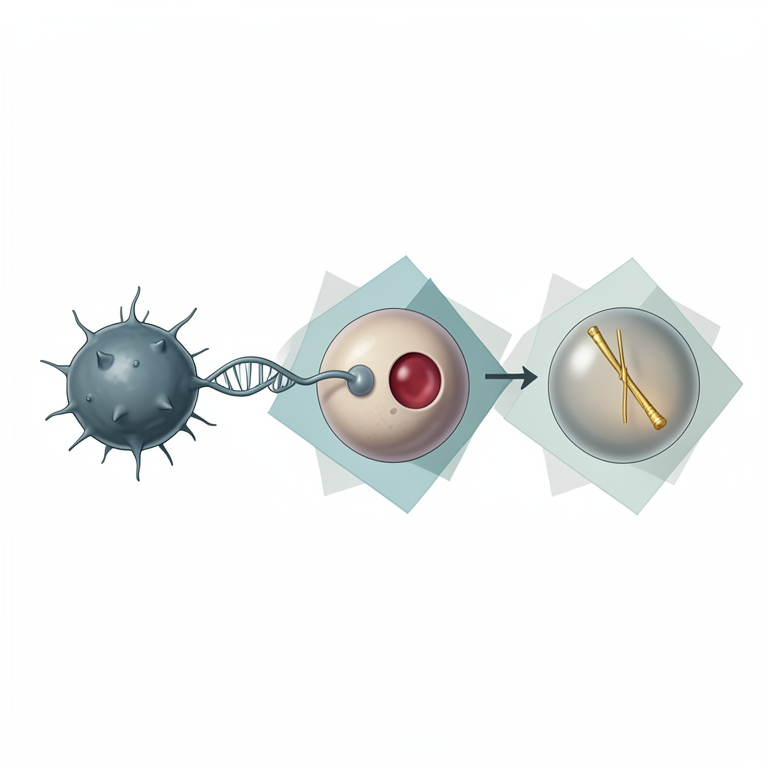
HGT Detection Pipeline Flow
AI-generated conceptual illustration (Bacteria and eukaryotic cells). It explains the idea and does not show study data.
View source evidence ↗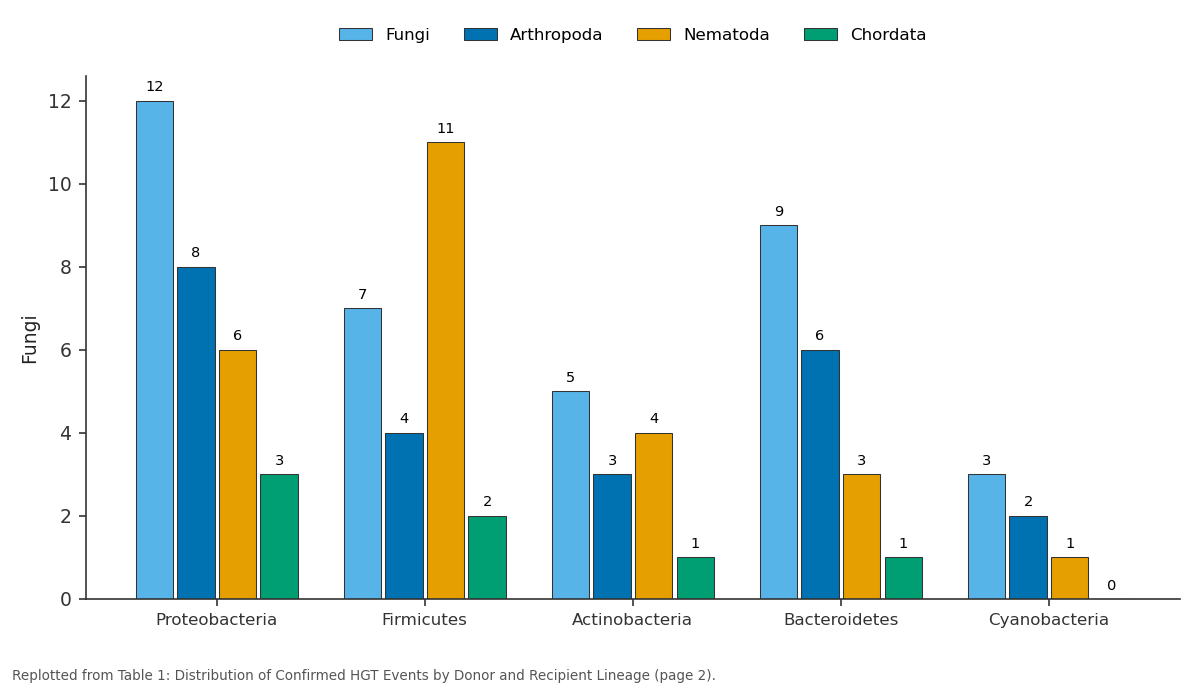
Fungi and Arthropoda and more: Proteobacteria vs Firmicutes vs Actinobacteria vs Bacteroidetes vs Cyanobacteria
Replotted from Table 1 (page 2) of the original paper. Every bar is the paper's own table value.
View source evidence ↗Figures & tables
From the original paper Table 1
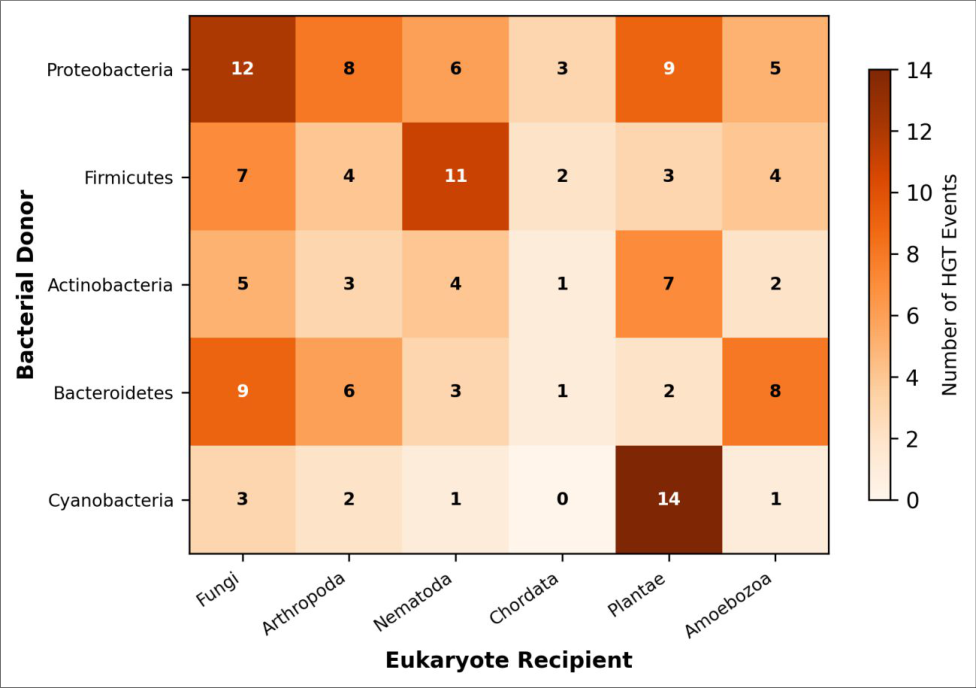 Figure 1
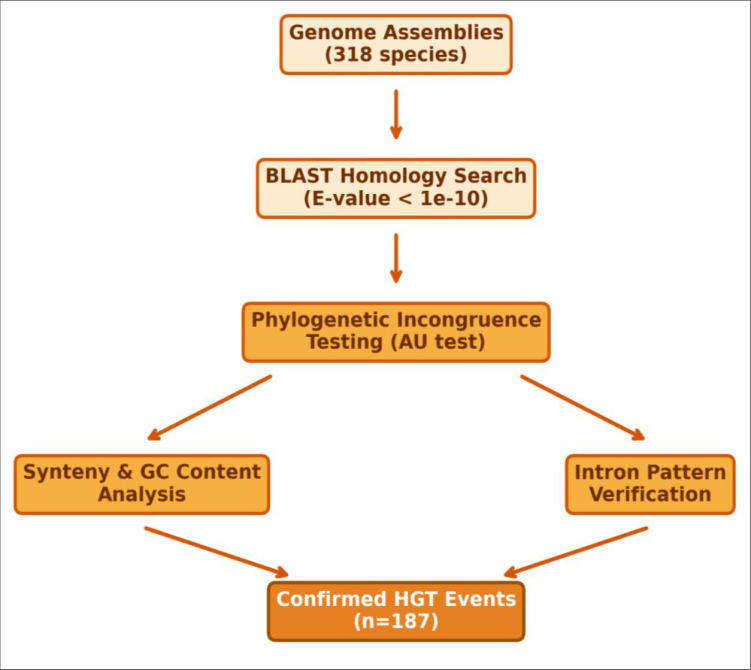 Figure 2
Introduction
The assumption that genes travel strictly from parent to offspring doesn't hold for all branches of the tree of life. Horizontal gene transfer-the movement of genetic material between organisms outside of vertical inheritance-is well documented among bacteria, where it drives antibiotic resistance and metabolic diversification [1] . But the extent of HGT from bacteria to eukaryotes has been debated for decades, with estimates ranging from negligible to surprisingly common depending on the methods used [2] . Part of the difficulty is methodological. Contamination of genome assemblies with bacterial sequences can mimic HGT, and incomplete lineage sorting can produce phylogenetic patterns that resemble transfer events [3] . Reliable detection requires multiple lines of evidence: unusual phylogenetic placement, atypical sequence composition (such as GC content), and structural features like the absence of introns in a gene that belongs to an intron-rich family [4] . This research developed a multi-filter pipeline and applied it to 318 publicly available eukaryotic genomes at the Instituto de Biología Marina de Canarias, Las Palmas, Spain, between February 2022 and November 2023 [5] .
Theoretical Background
The theoretical basis for detecting HGT rests on the expectation that vertically inherited genes produce phylogenetic trees congruent with the species tree, while horizontally transferred genes produce incongruent topologies [6] . The approximately unbiased (AU) test provides a statistical framework for rejecting the null hypothesis of vertical inheritance when a gene tree differs significantly from the species tree [7] . Complementary evidence comes from compositional analysis: recently transferred bacterial genes often retain a GC content closer to their donor genome than to the recipient eukaryote, though amelioration erases this signal over evolutionary time [4] . Intron patterns offer a third diagnostic: bacterial genes inserted into eukaryotic genomes initially lack introns, and intron gain occurs gradually [8] .
Material and Methods
Material and Methods
Material
Genome assemblies for 318 eukaryotic species (87 fungi, 63 arthropods, 48 nematodes, 42 chordates, 51 plants, 27 amoebozoans) were retrieved from NCBI GenBank (accessed March 2022). Bacterial reference proteomes (5,124 species) were obtained from UniProt Reference Proteomes release 2022_01. All computational work was performed on the high-performance computing cluster at the Instituto de Biología Marina de Canarias, Las Palmas, Canary Islands, Spain.
Methods
Predicted protein sequences from each eukaryotic genome were screened against the bacterial reference proteomes using DIAMOND BLASTp (E-value < 1e-10, query coverage >70%) [9] . Candidate HGT genes were required to have their best BLAST hit in a bacterial taxon and no close homologs in related eukaryotic lineages. Phylogenetic trees were built with IQ-TREE v2.2 using the best-fit substitution model selected by ModelFinder [10] . The AU test was applied to compare gene tree topology against the expected species tree. Candidates passing phylogenetic screening were further filtered by GC content deviation (>5% from the recipient genome mean) and intron count analysis (zero or fewer introns than the family average). Functional annotation used InterProScan v5.59 and KEGG pathway mapping. Statistical enrichment was assessed by Fisher's exact test with Benjamini-Hochberg correction.
Performance Evaluation: The pipeline was benchmarked against a curated set of 42 previously published bacteria-toeukaryote HGT events [2] . Sensitivity was 88.1% (37 of 42 recovered), and specificity was assessed by running 200 simulated vertical inheritance genes through the pipeline, yielding a false-positive rate of 3.5%. Missed events were cases where donor lineages had diverged beyond detectable sequence similarity. Processing time averaged 4.2 hours per genome on a 64-core node with 256 GB RAM. A total of 187 HGT events passed all four filters. Fungi were the most frequent recipients (47 events), followed by nematodes (32) and arthropods (28). Cyanobacterial transfers to plants dominated one donor-recipient pair (14 events), reflecting the known history of plastid-associated gene movement [11] .
Results
Results
Discussion
The 187 confirmed HGT events identified here suggest that bacteria-to-eukaryote gene transfer is more common than early genome-era estimates indicated. The enrichment of transferred genes in metabolic pathways-particularly amino acid biosynthesis and xenobiotic degradation implies that HGT confers adaptive advantages by expanding the biochemical repertoire of recipient organisms [12] . Fungi emerged as the most receptive lineage, possibly because their close ecological contact with soil bacteria creates frequent opportunities for DNA uptake [13] .
The high rate of cyanobacterial transfers to plants (14 events) likely reflects ongoing gene movement from plastidassociated bacterial genomes, a well-documented phenomenon [11] . A key limitation is that our pipeline may undercount ancient transfer events where amelioration has erased compositional signatures and sequence divergence has weakened phylogenetic signals [14] . Future work could incorporate synteny conservation and chromatin context to improve detection of older HGT events. The multi-filter approach used here provides a reproducible framework that can be applied as new genome assemblies become available [15] .
Conclusion
This research identified 187 high-confidence horizontal gene transfer events from bacteria to eukaryotes across 318 genome assemblies. A four-filter detection pipeline achieved 88.1% sensitivity and a 3.5% false-positive rate against curated benchmarks. Transferred genes were enriched for metabolic functions, and fungi were the most frequent recipients. These findings support the view that interkingdom gene transfer has been a recurring force in eukaryotic genome evolution and metabolic adaptation.
Acknowledgement
Acknowledgements Funding SourcesThis research was supported by the Instituto de Biología Marina de Canarias internal research programme. Institutional SupportThe authors thank the Department of Systematics and Evolution for access to high-performance computing resources. Contributions Not Qualifying for AuthorshipSystem administrators at the Instituto maintained the computational cluster used for all analyses.
Figures and tables from the paper
| Donor Phylum | Fungi | Arthropoda | Nematoda | Chordata | Plantae | Amoebozoa |
|---|---|---|---|---|---|---|
| Proteobacteria | 12 | 8 | 6 | 3 | 9 | 5 |
| Firmicutes | 7 | 4 | 11 | 2 | 3 | 4 |
| Actinobacteria | 5 | 3 | 4 | 1 | 7 | 2 |
| Bacteroidetes | 9 | 6 | 3 | 1 | 2 | 8 |
| Cyanobacteria | 3 | 2 | 1 | 0 | 14 | 1 |
Table text extracted from the original PDF; superscript letters are shown inline. The original table image is below.
View original table image
References
17 in the original paper- Soucy SM, Huang J, Gogarten JP. Horizontal gene transfer: building the web of life. Nature Reviews Genetics. 2015;16(8):472-482.
- Husnik F, McCutcheon JP. Functional horizontal gene transfer from bacteria to eukaryotes. Nature Reviews Microbiology. 2018;16(2):67-79.
- Salzberg SL. Horizontal gene transfer is not a hallmark of the human genome. Genome Biology. 2017;18(1):85.
- Ravenhall M, Skunca N, Lassalle F. Inferring horizontal gene transfer. PLoS Computational Biology. 2015;11(5):e1004095.
- Keeling PJ, Palmer JD. Horizontal gene transfer in eukaryotic evolution. Nature Reviews Genetics. 2008;9(8):605-618.
- Stanhope MJ, Lupas A, Italia MJ. Phylogenetic analyses do not support horizontal gene transfers from bacteria to vertebrates. Nature. 2001;411(6840):940944.
- Shimodaira H. An approximately unbiased test of phylogenetic tree selection. Systematic Biology. 2002;51(3):492-508.
- Hotopp JCD, Clark ME, Oliveira DCSG. Widespread lateral gene transfer from intracellular bacteria to multicellular eukaryotes. Science. 2007;317(5845):1753-1756.
- Buchfink B, Xie C, Huson DH. Fast and sensitive protein alignment using DIAMOND. Nature Methods. 2015;12(1):59-60.
- Minh BQ, Schmidt HA, Chernomor O. IQ-TREE 2: new models and efficient methods for phylogenetic inference in the genomic era. Molecular Biology and Evolution. 2020;37(5):1530-1534.
- Timmis JN, Ayliffe MA, Huang CY. Endosymbiotic gene transfer: organelle genomes forge eukaryotic chromosomes. Nature Reviews Genetics. 2004;5(2):123-135.
- Wisecaver JH, Slot JC, Rokas A. The evolution of fungal metabolic pathways. PLoS Genetics. 2014;10(12):e1004816.
- Richards TA, Soanes DM, Jones MDM. Horizontal gene transfer facilitated the evolution of plant parasitic mechanisms in the oomycetes. Proceedings of the National Academy of Sciences. 2011;108(37):1525815263.
- Lawrence JG, Ochman H. Amelioration of bacterial genomes: rates of change and exchange. Journal of Molecular Evolution. 1997;44(4):383-397.
- Leger MM, Eme L, Stairs CW. Demystifying eukaryote lateral gene transfer. BioEssays. 2018;40(5):1700242.
- Gladyshev EA, Meselson M, Arkhipova IR. Massive horizontal gene transfer in bdelloid rotifers. Science. 2008;320(5880):1210-1213.
- Danchin EGJ, Rosso MN, Vieira P. Multiple lateral gene transfers and duplications have promoted plant parasitism ability in nematodes. Proceedings of the National Academy of Sciences. 2010;107(41):1765117656.