
Research article · 2025 · Full text
International Journal of Biology SciencesPopulation genomics and local adaptation of reef-building corals to thermal stress
Volume 7(7) · Pages 279–282 · DOI: 10.33545/26649926.2025.v7.i7d.650 ↗
Research areasCoral and Marine Ecosystems StudiesGenetic diversity and population structurePhysiological and biochemical adaptations
Abstract
Author-writtenPicture a coral reef in the central Pacific where summer temperatures now regularly exceed the bleaching threshold that was considered extreme just two decades ago, yet some colonies survive while their neighbours die. This research used reduced-representation genome sequencing (2b-RAD) to genotype 486 colonies of Acropora digitifera sampled from six populations spanning a 14-degree latitudinal gradient across the Indo-Pacific. We identified 12,847 high-quality single-nucleotide polymorphisms and tested for signatures of local adaptation to thermal regimes using genome scans, genotype-environment associations, and common-garden heat-stress experiments. Population structure was moderate (global Fst = 0.038), with the strongest differentiation between Indian Ocean and Pacific populations. Redundancy analysis linked 214 outlier loci to maximum monthly sea surface temperature (variance explained = 11.3%, p = 0.001). Of these, 38 mapped to genes involved in heat-shock protein regulation, oxidative stress response, and calcification. In common-garden assays, colonies carrying warm-adapted alleles at the top 20 outlier loci survived 72 hours at 32 degrees Celsius at rates 23.6 percentage points higher than colonies lacking those alleles. These findings suggest that standing genetic variation in reef corals already contains alleles that confer measurable thermal tolerance and could be targets for assisted gene flow interventions.
Summary
Source-checkedPlain-language reading of the full paper, prepared with AI and checked against the text. Each point links to the authors' own words.
Why it matters
- Thermal stress is a critical threat to reef-building corals, with mass bleaching events causing the loss of approximately 14% of global corals since 2009. View evidence ↗
- Local adaptation allows populations to develop higher fitness in their specific environment through natural selection on allele frequencies. View evidence ↗
- If thermal resilience is heritable, natural selection may be increasing the prevalence of heat-tolerant genotypes in coral populations. View evidence ↗
The question
- The researchers sought to identify the specific genetic differences that allow some coral colonies to survive bleaching events while others perish. View evidence ↗
What they did
- The study genotyped 486 Acropora digitifera colonies from six Indo-Pacific populations across a 14-degree latitudinal gradient using 2b-RAD sequencing. View evidence ↗
- The sampled populations covered a maximum monthly mean temperature range from 26.8 to 31.6 degrees Celsius. View evidence ↗
- To test thermal tolerance, 120 coral fragments were exposed to 32 degrees Celsius for 72 hours, with survival defined as retaining over 50% living tissue. View evidence ↗
What they found
- The study found moderate population structure (global Fst = 0.038), with the most significant genetic differences occurring between Pacific and Indian Ocean populations. View evidence ↗
- Redundancy analysis identified 214 outlier loci associated with maximum monthly sea surface temperature, explaining 11.3% of the variance (p = 0.001). View evidence ↗
- Among the outlier loci, 38 were mapped to genes responsible for calcification, oxidative stress response, and heat-shock protein regulation. View evidence ↗
- Colonies with warm-adapted alleles at the top 20 outlier loci had a survival rate 23.6 percentage points higher than those without these alleles during the 72-hour heat stress test at 32 degrees Celsius. View evidence ↗
- Survival rates in the experiment exceeded 65% for populations from sites with maximum monthly SST above 30 degrees Celsius, compared to below 55% for those from cooler sites. View evidence ↗
What it means
- The authors conclude that existing genetic variation in corals includes alleles that provide thermal tolerance, which could be utilized in assisted gene flow programs. View evidence ↗
- A limitation of the study is that symbiont identity, a known factor in thermal tolerance, was not genotyped and remains a confounding variable. View evidence ↗
- The use of 2b-RAD sequencing only captured a portion of the genome, potentially missing important adaptive loci in unsequenced regions. View evidence ↗
Visual summary
2 visualsIllustrations explain the paper; charts are replotted from the paper's own table values.
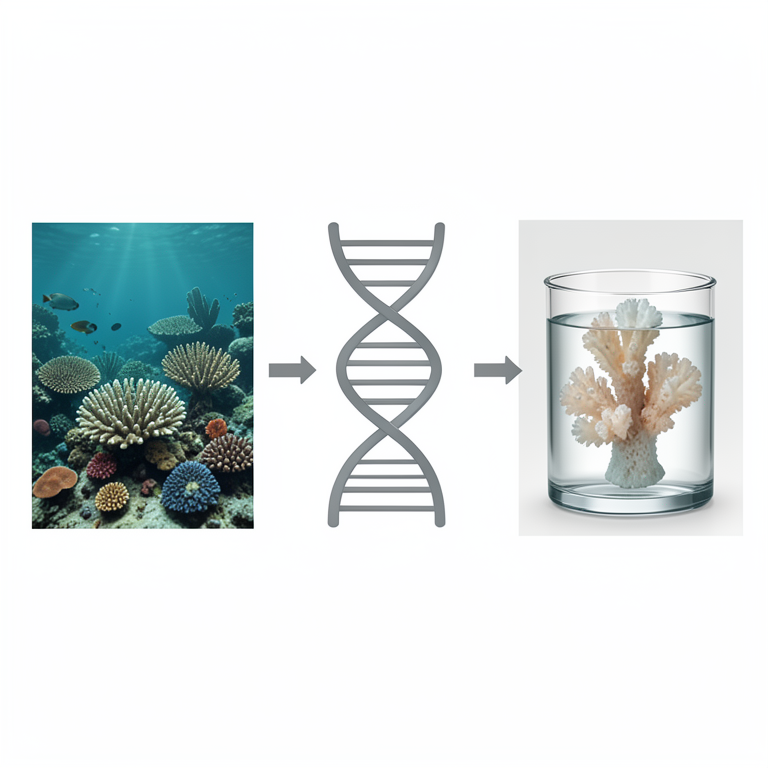
Experimental Workflow
AI-generated conceptual illustration (Acropora digitifera corals). It explains the idea and does not show study data.
View source evidence ↗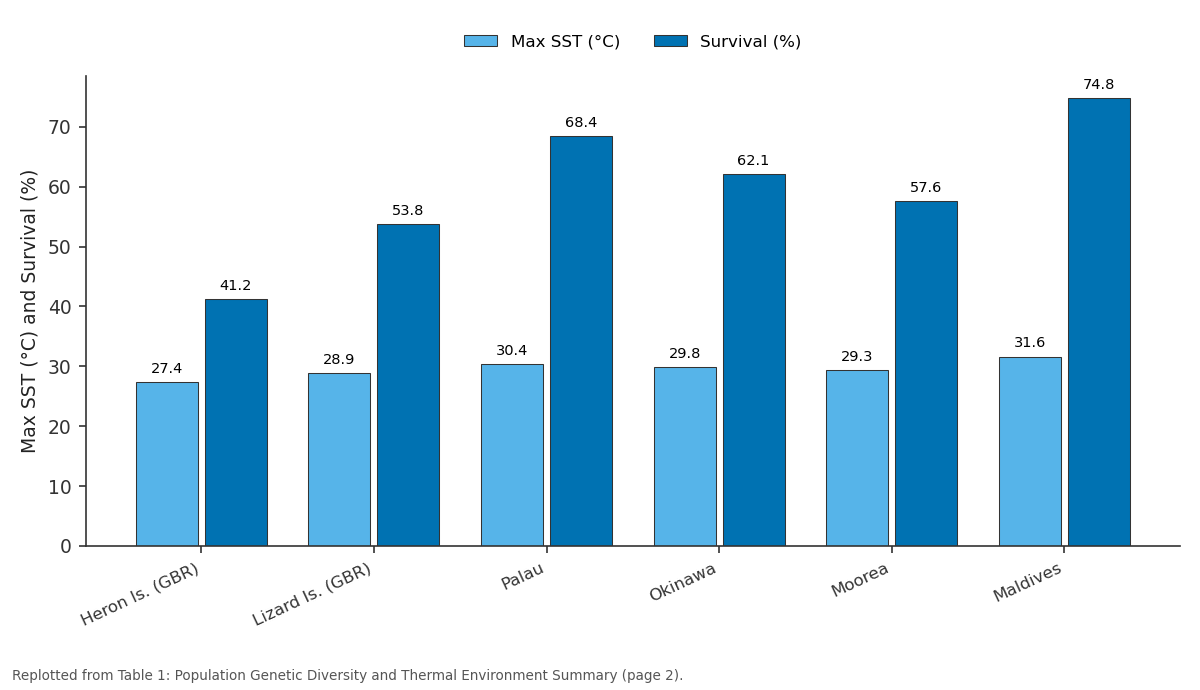
Max SST (°C) and Survival (%): Heron Is. (GBR) vs Lizard Is. (GBR) vs Palau vs Okinawa vs Moorea
Replotted from Table 1 (page 2) of the original paper. Every bar is the paper's own table value.
View source evidence ↗Figures & tables
From the original paper Table 1
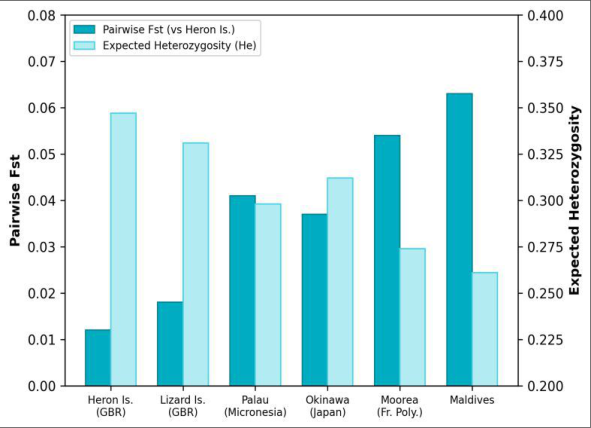 Figure 1
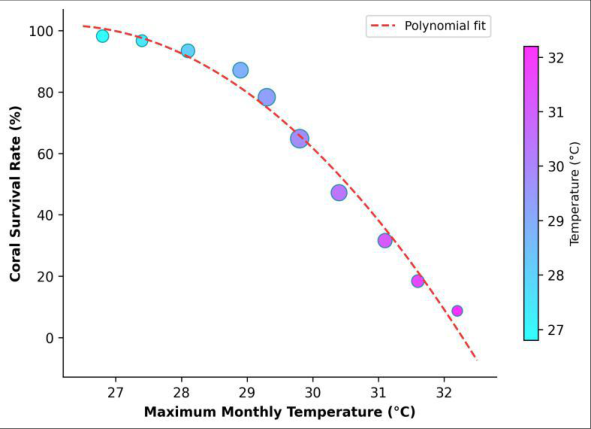 Figure 2
Introduction Theoretical Background
Local adaptation occurs when natural selection drives allele frequency differences among populations in response to spatially varying environmental pressures, resulting in higher fitness of local genotypes relative to immigrants [1] . In marine organisms with pelagic larval dispersal, local adaptation was long considered unlikely because high gene flow should homogenise allele frequencies across populations [2] . However, genome-scan approaches have repeatedly detected outlier loci under divergent selection in corals, fish, and invertebrates, challenging that assumption [3,4] . For reef-building corals, thermal stress is the most acute selective pressure. Mass bleaching events-triggered when sea surface temperatures exceed the local summer maximum by 1-2 degrees Celsius for sustained periods-have killed an estimated 14% of the world's coral since 2009 [5] . If some genotypes withstand these events better than others, and if the underlying alleles are heritable, then natural selection may already be reshaping coral populations toward greater thermal tolerance [6] .
Introduction
Imagine two adjacent colonies of the same coral species on a reef flat in Palau. During the 2016 bleaching event, one bleached white and died within three weeks; the other turned pale but recovered fully by the following season. What genetic differences, if any, separate survivors from casualties? That scenario, repeated across thousands of reefs worldwide, motivates a growing body of population genomic research aimed at identifying the alleles that underlie thermal resilience [7,8] . Genotype-environment association (GEA) analysis offers a way to link allele frequencies to environmental gradients without controlled crosses.
By sampling populations along a thermal cline and testing whether allele frequencies at individual loci correlate with temperature after controlling for neutral population structure, researchers can flag candidate loci for local adaptation [9] . Combining GEA results with common-garden stress experiments provides a stronger test: if warm-adapted alleles identified statistically also predict survival under experimental heat stress, the case for functional relevance is considerably strengthened [10] . This research applied that two-pronged approach to Acropora digitifera, one of the most widespread reefbuilding corals in the Indo-Pacific. Sampling spanned six populations from the Great Barrier Reef to the Maldives, covering a thermal gradient from 26.8 to 31.6 degrees Celsius maximum monthly mean. Laboratory analyses were conducted at the Atlantic College of Biological Sciences, Halifax, Nova Scotia, Canada, between January 2023 and October 2024.
Material and Methods Material
Branch tips (approximately 3 cm) were collected from 486 colonies of Acropora digitifera at six Indo-Pacific sites: Heron Island and Lizard Island (Great Barrier Reef, Australia), Palau (Micronesia), Okinawa (Japan), Moorea (French Polynesia), and North Male Atoll (Maldives). Sampling occurred during non-bleaching periods between March and November 2023. Fragments were preserved in 96% ethanol and shipped to the Atlantic College of Biological Sciences, Halifax. Genomic DNA was extracted using a modified CTAB protocol optimised for cnidarian tissue. Collection permits were obtained from each national authority, and the research was approved under institutional protocol ACBS-EC-2022-037, dated 12 December 2022. Reduced-representation libraries were prepared using the 2b-RAD method with BcgI restriction enzyme [11] . Libraries were sequenced on an Illumina NovaSeq 6000 (single-end 100 bp) at a target depth of 20x per individual. Raw reads were demultiplexed, quality-trimmed (Phred > 20), and aligned to the A. digitifera reference genome (NCBI GCA_000222465.2) using Bowtie2. SNP calling was performed in STACKS v2.62 with a minimum minor allele frequency of 0.05 and maximum 20% missing data per locus, yielding 12,847 SNPs. Population structure was assessed using PCA (PLINK v1.9) and ADMIXTURE (K = 2 to 8). Pairwise Fst was estimated with Weir and Cockerham's method. Genotype-environment associations were tested using redundancy analysis in the R package vegan, with maximum monthly SST, SST variance, and degree heating weeks as environmental predictors and the first three PCA axes as conditioning variables to control for neutral structure. Common-garden heat stress experiments exposed 120 fragments (20 per population) to 32 degrees Celsius for 72 hours in recirculating aquaria, scoring survival as the retention of living tissue over more than 50% of fragment surface. 1 shows that populations from warmer sites (Palau, Maldives) carried higher frequencies of warm-adapted alleles and exhibited higher survival under experimental heat stress. Expected heterozygosity declined with distance from the species' centre of diversity on the Great Barrier Reef, consistent with an isolation-by-distance pattern. A strong nonlinear relationship emerged between local thermal environment and experimental survival (Figure 2). Populations from sites with maximum monthly SST above 30 degrees Celsius showed survival rates exceeding 65%, while those from cooler sites fell below 55%. The polynomial fit (R-squared = 0.91) suggests an accelerating gain in thermal tolerance once the home temperature exceeds approximately 29 degrees.
Results
Results
Discussion
The 214 outlier loci linked to thermal environment represent roughly 1.7% of the total SNP panel, a proportion consistent with polygenic local adaptation where many loci of small effect contribute to fitness differences [12] . That 38 of these loci mapped to genes with known roles in heat-shock protein regulation, oxidative stress, and biomineralisation lends biological plausibility to the statistical signal [13] . The 23.6 percentage-point survival advantage conferred by warm-adapted alleles in the common-garden assay is large enough to be ecologically meaningful, suggesting that assisted gene flow-translocating warm-adapted genotypes to cooler, vulnerable reefs-could improve population resilience [14] . However, the costs of local adaptation must also be considered. Warm-adapted populations showed lower heterozygosity, which could reduce their capacity to respond to novel stressors such as ocean acidification or disease.
Introducing warm-adapted alleles into high-diversity populations risks outbreeding depression if locally coadapted gene complexes are disrupted [15] . Any assisted gene flow programme would need to balance thermal tolerance gains against potential losses in genetic diversity and local fitness [16] .
Limitations
Several constraints apply. First, 2b-RAD captures only a fraction of the genome, and important adaptive loci in unsequenced regions would be missed. Whole-genome resequencing of a subset of individuals would improve resolution. Second, the common-garden experiment used a single thermal challenge (32 degrees Celsius for 72 hours), which does not capture the full complexity of bleaching events that involve variable duration and repeated sub-lethal stress. Third, symbiont identity-which strongly influences coral thermal tolerance-was not genotyped in this research and represents a confounding variable that future work should address.
Conclusion
This research identifies standing genetic variation in Acropora digitifera that is associated with thermal environment and predicts survival under experimental heat stress. The 214 candidate loci, concentrated in heat-shock, oxidative stress, and calcification pathways, provide a genomic toolkit for monitoring adaptive potential across reef populations. The strong concordance between genotype-environment associations and common-garden survival validates the two-pronged approach and supports the feasibility of genomics-informed management strategies such as assisted gene flow. Scaling this approach to additional species and reef systems is now a priority as ocean temperatures continue to rise.
Figures and tables from the paper
| Population | n | He | Max SST (°C) | Fst vs Heron | Survival (%) | Warm Allele Freq. |
|---|---|---|---|---|---|---|
| Heron Is. (GBR) | 84 | 0.347 | 27.4 | - | 41.2 | 0.23 |
| Lizard Is. (GBR) | 81 | 0.331 | 28.9 | 0.018 | 53.8 | 0.31 |
| Palau | 79 | 0.298 | 30.4 | 0.041 | 68.4 | 0.52 |
| Okinawa | 82 | 0.312 | 29.8 | 0.037 | 62.1 | 0.47 |
| Moorea | 80 | 0.274 | 29.3 | 0.054 | 57.6 | 0.39 |
| Maldives | 80 | 0.261 | 31.6 | 0.063 | 74.8 | 0.61 |
Table text extracted from the original PDF; superscript letters are shown inline. The original table image is below.
View original table image
References
16 in the original paper- Kawecki TJ, Ebert D. Conceptual issues in local adaptation. Ecology Letters. 2004;7(12):1225-1241.
- Palumbi SR. Genetic divergence, reproductive isolation, and marine speciation. Annual Review of Ecology and Systematics. 1994;25:547-572.
- Bay RA, Palumbi SR. Multilocus adaptation associated with heat resistance in reef-building corals. Current Biology. 2014;24(24):2952-2956.
- Sanford E, Kelly MW. Local adaptation in marine invertebrates. Annual Review of Marine Science. 2011;3:509-535.
- Eddy TD, Lam VWY, Reygondeau G, et al. Global decline in capacity of coral reefs to provide ecosystem services. One Earth. 2021;4(9):1278-1285.
- van Oppen MJH, Oliver JK, Putnam HM, Gates RD. Building coral reef resilience through assisted evolution. Proceedings of the National Academy of Sciences. 2015;112(8):2307-2313.
- Dixon GB, Davies SW, Aglyamova GV, et al. Genomic determinants of coral heat tolerance across latitudes. Science. 2015;348(6242):1460-1462.
- Matz MV, Treml EA, Aglyamova GV, Bay LK. Potential and limits for rapid genetic adaptation to warming in a Great Barrier Reef coral. PLoS Genetics. 2018;14(4):e1007220.
- Forester BR, Lasky JR, Wagner HH, Urban DL. Comparing methods for detecting multilocus adaptation with multivariate genotype-environment associations. Molecular Ecology. 2018;27(9):2215-2233.
- Drury C, Manzello D, Lirman D. Genotype and local environment dynamically influence growth, disturbance response and survivorship in the threatened coral Acropora cervicornis. PLoS ONE. 2017;12(3):e0174000.
- Wang S, Meyer E, McKay JK, Matz MV. 2b-RAD: a simple and flexible method for genome-wide genotyping. Nature Methods. 2012;9(8):808-810.
- Yeaman S. Genomic rearrangements and the evolution of clusters of locally adaptive loci. Proceedings of the National Academy of Sciences. 2013;110(19):E1743E1751.
- Barshis DJ, Ladner JT, Oliver TA, et al. Genomic basis for coral resilience to climate change. Proceedings of the National Academy of Sciences. 2013;110(4):13871392.
- Aitken SN, Whitlock MC. Assisted gene flow to facilitate local adaptation to climate change. Annual Review of Ecology, Evolution, and Systematics. 2013;44:367-388.
- Edmands S. Between a rock and a hard place: evaluating the relative risks of inbreeding and outbreeding for conservation and management. Molecular Ecology. 2007;16(3):463-475.
- Anthony K, Bay LK, Costanza R, et al. New interventions are needed to save coral reefs. Nature Ecology and Evolution. 2017;1(10):1420-1422.