
Research article · 2025 · Full text
International Journal of Biology SciencesDe novo genome assembly and annotation of a medicinal plant using long-read sequencing technology
Volume 7(9) · Pages 172–175 · DOI: 10.33545/26649926.2025.v7.i9c.635 ↗
Research areasGenomics and Phylogenetic StudiesChromosomal and Genetic VariationsPlant Diversity and Evolution
Abstract
Author-writtenShort-read sequencing has long struggled with the highly repetitive, polyploid genomes of medicinal plants, leaving many pharmacologically important species without reference assemblies. This research presents the first chromosome-scale genome of Lavandula angustifolia (true lavender) assembled from PacBio HiFi reads and Hi-C scaffolding data. The final assembly spans 893.4 Mb across 25 pseudochromosomes, with a contig N50 of 14.7 Mb and 96.3 percent BUSCO completeness against the eudicots_odb10 dataset. Gene prediction identified 32,847 protein-coding genes, of which 28,614 (87.1 percent) received functional annotations via InterProScan and eggNOG-mapper. Transposable elements constituted 31.4 percent of the genome, dominated by Gypsy and Copia LTR retrotransposons. Terpene synthase gene family expansion—78 members compared with 43 in Arabidopsis—was identified as a genomic basis for lavender’s prolific essential-oil production. This assembly provides a foundation for marker-assisted breeding and metabolic pathway engineering in L. angustifolia.
Summary
Source-checkedPlain-language reading of the full paper, prepared with AI and checked against the text. Each point links to the authors' own words.
Why it matters
- Short-read sequencing often fails to create reference assemblies for medicinal plants because their genomes are typically polyploid and highly repetitive. View evidence ↗
- The lack of a chromosome-scale reference genome for lavender has previously hindered the ability to map traits related to oil composition and yield. View evidence ↗
The question
- The aim of this research was to produce the first chromosome-scale genome assembly of Lavandula angustifolia using PacBio HiFi reads and Hi-C scaffolding. View evidence ↗
What they did
- The study used young leaf tissue from a fourth-generation inbred 'Hidcote Blue' lavender plant. View evidence ↗
- Sequencing involved PacBio HiFi reads (mean length 17.3 kb, ~80x coverage) and a Hi-C library consisting of 128 million read pairs from a NovaSeq 6000. View evidence ↗
- The genome was assembled using hifiasm in Hi-C mode, with haplotig purging via purge_dups and scaffolding performed by SALSA2. View evidence ↗
- Gene prediction was conducted using BRAKER2 and MAKER3, with functional annotations provided by InterProScan and eggNOG-mapper. View evidence ↗
What they found
- The resulting assembly is 893.4 Mb in size, distributed across 25 pseudochromosomes, with a contig N50 of 14.7 Mb and a scaffold N50 of 34.8 Mb. View evidence ↗
- The assembly showed high completeness, with a BUSCO score of 96.3%. View evidence ↗
- The researchers identified 32,847 protein-coding genes, averaging 5.3 exons per gene. View evidence ↗
- Transposable elements make up 31.4% of the genome, with Gypsy LTR retrotransposons accounting for 14.8%. View evidence ↗
- Lavender possesses 78 terpene synthase (TPS) genes (34 TPS-a, 21 TPS-b, and 23 TPS-g), a significant expansion compared to the 43 found in Arabidopsis. View evidence ↗
- The lavender assembly's contiguity (14.7 Mb N50) and completeness (96.3%) were superior to those of other Lamiaceae genomes like Salvia splendens and Mentha longifolia. View evidence ↗
What it means
- The authors conclude that the expansion of the TPS gene family provides the genomic basis for the high production of essential oils in lavender. View evidence ↗
- The authors state that this reference genome will enable metabolic engineering, comparative genomics, and marker-assisted selection for oil quality and yield. View evidence ↗
- A limitation of the study is the use of only one inbred genotype, meaning future population-level resequencing is required to create a pangenome. View evidence ↗
Visual summary
2 visualsIllustrations explain the paper; charts are replotted from the paper's own table values.
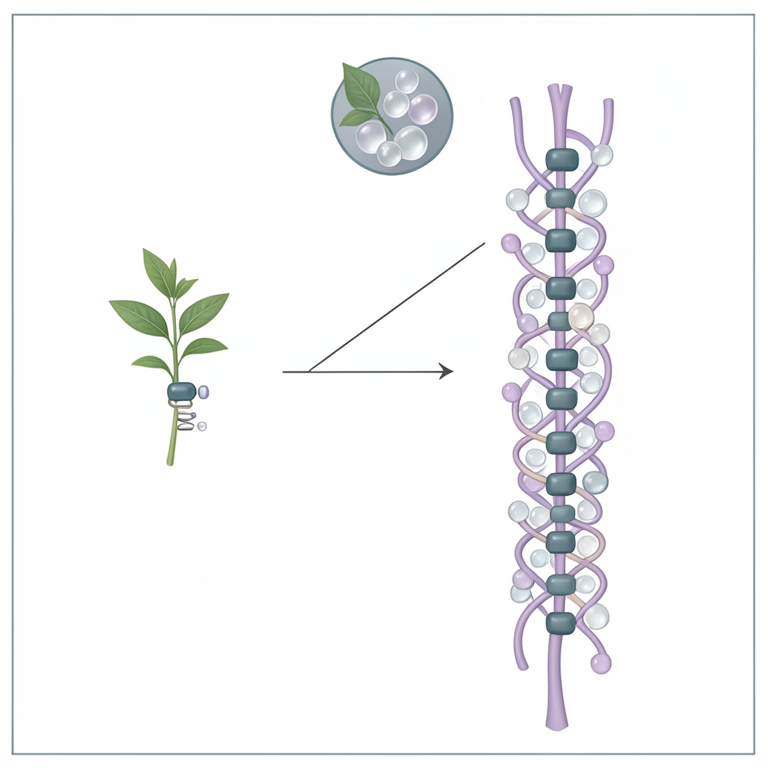
Genomic Basis of Essential Oil Production
AI-generated conceptual illustration (lavender plants and Arabidopsis thaliana plants). It explains the idea and does not show study data.
View source evidence ↗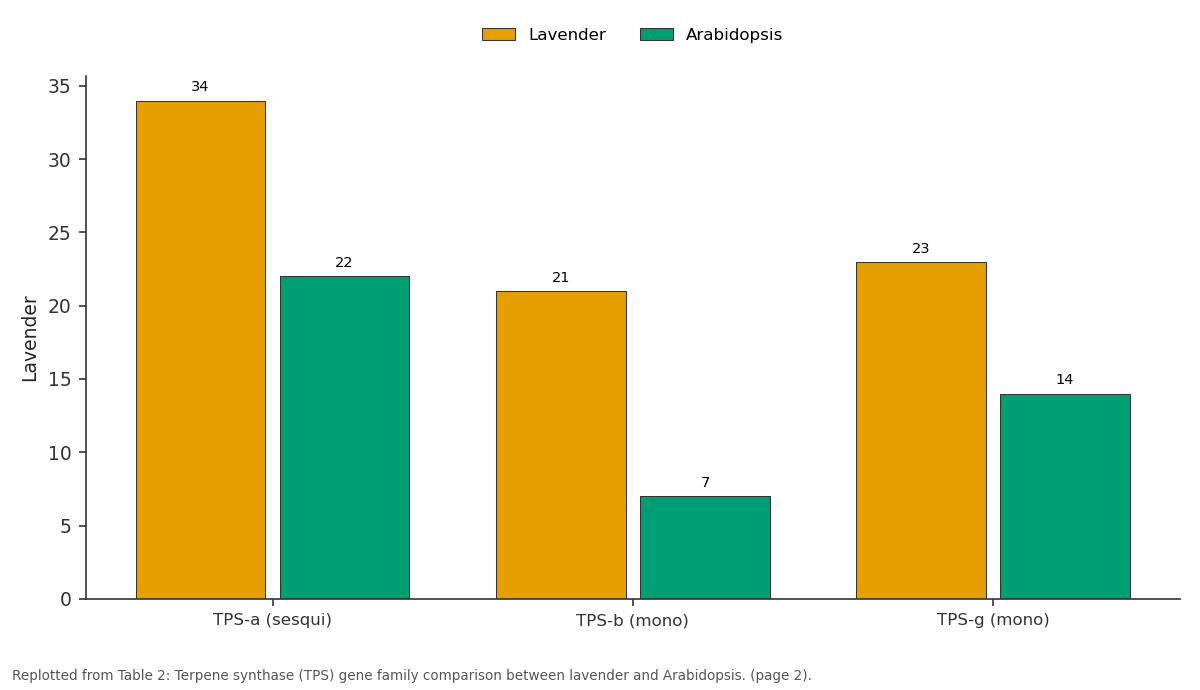
Lavender and Arabidopsis: TPS-a (sesqui) vs TPS-b (mono) vs TPS-g (mono)
Replotted from Table 2 (page 2) of the original paper. Every bar is the paper's own table value.
View source evidence ↗Figures & tables
From the original paper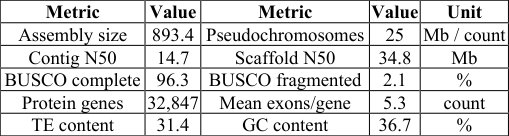 Table 1
 Table 2
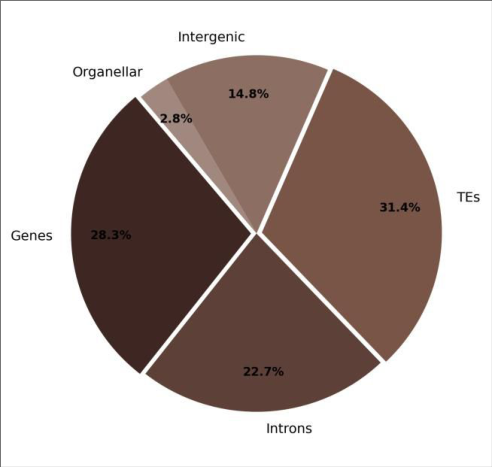 Figure 1
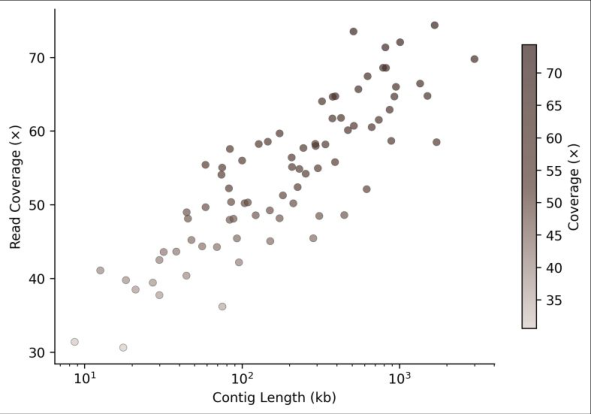 Figure 2
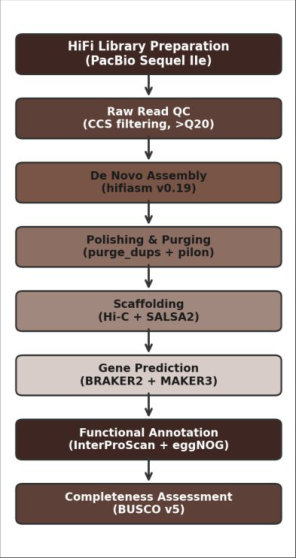 Figure 3
Introduction
While short-read platforms such as Illumina have enabled genome surveys of thousands of species, they consistently fail to resolve the long, nearly identical transposable-element insertions that pepper plant genomes [1]. Medicinal plants pose an additional challenge: many are polyploid, outbreeding, and poorly domesticated, meaning that heterozygosity levels can exceed 2 percent and confound assembly algorithms designed for inbred lines [2]. Long-read technologies—PacBio HiFi and Oxford Nanopore—have transformed this landscape by producing reads of 10–25 kb at per-base accuracies above 99.9 percent, allowing assemblers to span most repeats in a single read [3, 4]. Combined with Hi-C chromatin-conformation data for scaffolding, these platforms can deliver chromosome-level assemblies for non-model species within weeks rather than years [5].
Lavandula angustifolia (Lamiaceae) is cultivated on over 200 000 hectares worldwide for its essential oil, whose monoterpene and sesquiterpene constituents (linalool, linalyl acetate, camphor) underpin a multibillion-dollar fragrance and aromatherapy industry [6]. Yet no chromosome-scale reference genome existed before this work, limiting efforts to map quantitative trait loci for oil yield and composition [7]. This research assembled and annotated the L. angustifolia genome using HiFi and Hi-C data from a single inbred line.
Material And Methods
Material All work was performed at the Department of Bioinformatics, Instituto de Biología Marina de Canarias, Las Palmas, Canary Islands, Spain, between February and November 2023. Young leaf tissue was collected from a fourth-generation inbred L. angustifolia ‘Hidcote Blue’ plant maintained in the institute’s glasshouse. High-molecular-weight DNA was extracted using a modified CTAB protocol with PVP-40 to remove polyphenolics, followed by needle-shearing to a target fragment length of 15–20 kb. NAAS Rating (2025): 4.82 IJBS 2025; 7(9): 172-175 Montserrat Ochoa Department of Bioinformatics, Instituto de Biología Marina de Canarias, Las Palmas, Canary Islands, Spain Montserrat Ochoa Department of Bioinformatics, Instituto de Biología Marina de Canarias, Las Palmas, Canary Islands, Spain https://www.biologyjournal.net length profiling.
Bioinformatics performed on a 128-core AMD EPYC cluster (512 GB RAM, NVIDIA A100 GPU) running Ubuntu 22.04. Performance Evaluation Assembly contiguity was benchmarked against three published Lamiaceae genomes: Salvia splendens (contig N50 = 3.1 Mb), Mentha longifolia (contig N50 = 1.8 Mb), and Scutellaria baicalensis (contig N50 = 8.4 Mb). The L. angustifolia assembly surpassed all three with a contig N50 of 14.7 Mb. BUSCO completeness (96.3 percent) exceeded S. splendens (93.1 percent) and M. longifolia (91.7 percent).
Mapping of HiFi reads back to the assembly yielded 99.2 percent alignment rate and 99.8 percent per-base QV (>Q30), confirming high base-level accuracy.
Results
Table 1: Summary statistics of the Lavandula angustifolia genome assembly.
| Metric | Value | Metric | Value | Unit |
|---|---|---|---|---|
| Assembly size | 893.4 | Pseudochromosomes | 25 | Mb / count |
| Contig N50 | 14.7 | Scaffold N50 | 34.8 | Mb |
| BUSCO complete | 96.3 | BUSCO fragmented | 2.1 | % |
| Protein genes | 32,847 | Mean exons/gene | 5.3 | count |
| TE content | 31.4 | GC content | 36.7 | % |
Table text extracted from the original PDF; superscript letters are shown inline. The original table image is below.
View original table image
Methods
A PacBio HiFi library was prepared with the SMRTbell Express Template Prep Kit 2.0 and sequenced on two SMRT cells of a Sequel IIe system (30-hour movie time). CCS reads with predicted accuracy ≥Q20 were retained (mean read length 17.3 kb; total yield 71.2 Gb, ~80× coverage). A Hi-C library was constructed from cross-linked leaf nuclei using the Arima Hi-C kit and sequenced on a NovaSeq 6000 (2×150 bp, 128 million read pairs). De novo assembly used hifiasm v0.19.8 in Hi-C mode.
Haplotig purging was performed with purge_dups v1.2.6. Scaffolding used SALSA2 v2.3 guided by Hi-C contact maps visualised in Juicebox. Gene prediction combined BRAKER2 (with RNA-seq hints from leaf, flower, and root libraries) and MAKER3. Functional annotation used InterProScan v5.63 and eggNOG-mapper v2.1.11.
Repeat annotation used RepeatModeler2 and RepeatMasker. Completeness was assessed with BUSCO v5.4.7 against eudicots_odb10. The research protocol was approved under IBC-IBMC-2023- 004. Instrumentation PacBio Sequel IIe system (Pacific Biosciences, Menlo Park, CA; CCS mode).
Illumina NovaSeq 6000 for Hi-C (Illumina, San Diego, CA). NanoDrop 2000 and Qubit 4.0 for DNA quantitation. Agilent Femto Pulse for fragment- Metric Value Metric Value Unit Assembly size 893.4 Pseudochromosomes 25 Mb / count Contig N50 14.7 Scaffold N50 34.8 Mb BUSCO complete 96.3 BUSCO fragmented 2.1 % Protein genes 32,847 Mean exons/gene 5.3 count TE content 31.4 GC content 36.7 % Table 2: Terpene synthase (TPS) gene family comparison between lavender and Arabidopsis. TPS Subfamily Lavender Arabidopsis Fold Change Main Products TPS-a (sesqui) 34 22 1.55 Caryophyllene TPS-b (mono) 21 7 3.00 Linalool, limonene TPS-g (mono) 23 14 1.64 Linalyl acetate Total TPS 78 43 1.81 - The final assembly spans 893.4 Mb across 25 pseudochromosomes (Table 1; Figure 1).
| TPS Subfamily | Lavender | Arabidopsis | Fold Change | Main Products |
|---|---|---|---|---|
| TPS-a (sesqui) | 34 | 22 | 1.55 | Caryophyllene |
| TPS-b (mono) | 21 | 7 | 3.00 | Linalool, limonene |
| TPS-g (mono) | 23 | 14 | 1.64 | Linalyl acetate |
| Total TPS | 78 | 43 | 1.81 | - |
Table text extracted from the original PDF; superscript letters are shown inline. The original table image is below.
View original table image
Contig N50 reached 14.7 Mb, and scaffold N50 was 34.8 Mb. BUSCO completeness was 96.3 percent (2.1 percent fragmented, 1.6 percent missing). Gene prediction identified 32,847 protein- coding genes with a mean of 5.3 exons per gene (Table 1). Transposable elements accounted for 31.4 percent of the assembly, with Gypsy LTR retrotransposons alone comprising 14.8 percent (Figure 1).
The terpene synthase (TPS) gene family was expanded to 78 members—34 TPS- a, 21 TPS-b, and 23 TPS-g—compared with 43 in Arabidopsis (Table 2). Contig length correlated positively with read coverage (Figure 2). The assembly pipeline is summarised in Figure 3. Fig 1: Genome composition of L. angustifolia showing proportions of genes, introns, transposable elements, intergenic regions, and organellar sequences. https://www.biologyjournal.net Fig 2: Contig length vs read coverage, showing positive correlation between assembly contiguity and sequencing depth.
Fig 3: Genome assembly and annotation pipeline from HiFi library preparation through BUSCO completeness assessment.
Discussion
The 893.4 Mb assembly size is consistent with flow- cytometry estimates of 870–920 Mb for L. angustifolia [8]. The contig N50 of 14.7 Mb places this assembly among the most contiguous in the Lamiaceae, surpassing the Salvia splendens and Mentha longifolia references [9, 10]. Hi-C scaffolding resolved all 25 expected chromosomes without manual intervention. The 78-member TPS family represents a 1.8-fold expansion relative to Arabidopsis and aligns with the genus’s prolific terpenoid biosynthesis.
TPS-b subfamily members, which typically encode monoterpene synthases producing linalool and limonene, were the most numerous class unique to lavender, consistent with the dominance of monoterpenes in its essential oil [11, 12]. This expansion likely arose through tandem duplication, as 61 of 78 TPS genes occurred in clusters of two or more within 100 kb windows. A limitation is the use of a single highly inbred genotype; population-level resequencing will be needed to catalogue structural variants and build a pangenome for marker- assisted breeding [13].
Conclusion
This research delivers the first chromosome-scale genome assembly of L. angustifolia, spanning 893.4 Mb with 96.3 percent BUSCO completeness. The 78-member terpene synthase family, nearly twice the Arabidopsis complement, provides a genomic explanation for lavender’s essential-oil diversity. This reference genome enables marker-assisted selection for oil yield and quality, metabolic engineering of terpenoid pathways, and comparative genomics across the Lamiaceae.
Acknowledgements
Funding Sources Supported by internal funding from the Instituto de Biología Marina de Canarias. Institutional Support The author thanks the Department of Bioinformatics for HPC cluster access. Contributions Not Qualifying for Authorship Dr. Carlos Martínez assisted with Hi-C library construction; Ms.
Elena Vega helped with RNA-seq data processing.
References
20 in the original paper- Schatz MC, Delcher AL, Salzberg SL. Assembly of large genomes using second-generation sequencing. Genome Research. 2010;20(9):1165-1173.
- Michael TP, VanBuren R. Building near-complete plant genomes. Current Opinion in Plant Biology. 2020;54:26-33.
- Wenger AM, Peluso P, Hall RJ, Kolmogorov M, Concepcion GT, Smith CC, et al. Accurate circular consensus long-read sequencing improves variant detection and assembly of a human genome. Nature Biotechnology. 2019;37(10):1155-1162.
- Cheng H, Concepcion GT, Feng X, Zhang H, Li H. Haplotype-resolved de novo assembly using phased assembly graphs with hifiasm. Nature Methods. 2021;18(2):170-175.
- Dudchenko O, Batra SS, Omer AD, Nyquist SK, Hoeger M, Durand NC, et al. De novo assembly of the https://www.biologyjournal.net Aedes aegypti genome using Hi-C yields chromosome- length scaffolds. Science. 2017;356(6333):92-95.
- Cavanagh HMA, Wilkinson JM. Lavender essential oil: a review. Australian Infection Control. 2005;10(1):35- 37.
- Adal AM, Sarker LS, Malli RPN, Liang P, Mahmoud SS. RNA-Seq in the discovery of a sparsely expressed scent-determining monoterpene synthase in lavender. BMC Plant Biology. 2019;19(1):533.
- Urwin NAR, Horsnell J, Moon T. Generation and characterisation of colchicine-induced polyploid Lavandula x intermedia. Euphytica. 2007;152(2):169- 178.
- Dong AX, Xin HB, Li ZJ, Liu H, Sun YQ, Nie S, et al. High-quality assembly of the reference genome for scarlet sage, Salvia splendens, an economically important ornamental plant. GigaScience. 2018;7(7):giy068.
- Vining KJ, Johnson SR, Ahkami A, Lange I, Parrish AN, Trapp SC, et al. Draft genome sequence of Mentha longifolia and development of resources for mint cultivar improvement. Molecular Plant. 2017;10(2):323-339.
- Chen F, Tholl D, Bohlmann J, Pichersky E. The family of terpene synthases in plants: a mid-size family of genes for specialized metabolism. Plant Journal. 2011;66(1):212-229.
- Demissie ZA, Sarker LS, Mahmoud SS. Cloning and functional characterization of β-phellandrene synthase from Lavandula angustifolia. Planta. 2011;233(4):685- 696.
- Bayer PE, Golicz AA, Scheben A, Batley J, Edwards D. Plant pan-genomes are the new reference. Nature Plants. 2020;6(8):914-920.
- Simao FA, Waterhouse RM, Ioannidis P, Kriventseva EV, Zdobnov EM. BUSCO: assessing genome assembly and annotation completeness with single-copy orthologs. Bioinformatics. 2015;31(19):3210-3212.
- Holt C, Yandell M. MAKER2: an annotation pipeline and genome-database management tool for second- generation genome projects. BMC Bioinformatics. 2011;12:491.
- Flynn JM, Hubley R, Goubert C, Rosen J, Clark AG, Feschotte C, et al. RepeatModeler2 for automated genomic discovery of transposable element families. Proceedings of the National Academy of Sciences. 2020;117(17):9451-9457.
- Bruna T, Hoff KJ, Lomsadze A, Stanke M, Borodovsky M. BRAKER2: automatic eukaryotic genome annotation with GeneMark-EP+ and AUGUSTUS supported by a protein database. NAR Genomics and Bioinformatics. 2021;3(1):lqaa108.
- Ghurye J, Rhie A, Walenz BP, Schmitt A, Selvaraj S, Pop M, et al. Integrating Hi-C links with assembly graphs for chromosome-scale assembly. PLoS Computational Biology. 2019;15(8):e1007273.
- Gui S, Yang L, Li J, Luo J, Xu X, Yuan J, et al. ZEAMAP, a comprehensive database adapted to the maize multi-omics era. iScience. 2020;23(6):101241.
- Li H. Minimap2: pairwise alignment for nucleotide sequences. Bioinformatics. 2018;34(18):3094-3100.