
Research article · 2025 · Full text
International Journal of Biology SciencesCRISPR-Cas12a based diagnostic platform for rapid detection of pathogenic bacteria
Volume 7(1) · Pages 183–186 · DOI: 10.33545/26649926.2025.v7.i1c.665 ↗
Research areasBiosensors and Analytical DetectionCRISPR and Genetic EngineeringSARS-CoV-2 detection and testing
Abstract
Author-writtenRapid and accurate identification of pathogenic bacteria remains a pressing concern in clinical microbiology and public health surveillance. Traditional culture-based methods, while reliable, often require 24 to 72 hours for definitive results, creating a gap during which appropriate treatment may be delayed. This research presents a CRISPR-Cas12a based diagnostic platform engineered for the fast detection of five clinically relevant bacterial pathogens: Escherichia coli O157:H7, methicillin-resistant Staphylococcus aureus, Pseudomonas aeruginosa, Klebsiella pneumoniae, and Salmonella enterica serovar Typhimurium. The platform combines recombinase polymerase amplification with Cas12a-mediated collateral cleavage of fluorescent reporters, enabling visual and quantitative readout within 45 minutes from sample input to result. Specific CRISPR RNA guides were designed targeting species-specific genomic loci and validated against a panel of 87 clinical isolates and 23 near-neighbor non-target organisms. The system achieved analytical sensitivity down to 10 copies per reaction for E. coli O157:H7 and showed no cross-reactivity with non-target species. Clinical sensitivity ranged from 89.2% to 96.8% depending on the target organism, while specificity exceeded 92% for all targets tested. The assay was stable at ambient temperature for up to 14 days when lyophilized, supporting field deployment in resource-limited settings. Direct comparison with quantitative PCR showed concordance rates above 94% across all targets. These findings indicate that the CRISPR-Cas12a platform offers a practical, equipment-minimal alternative for point-of-care bacterial diagnostics, particularly suited for settings where laboratory infrastructure is limited.
Summary
Source-checkedPlain-language reading of the full paper, prepared with AI and checked against the text. Each point links to the authors' own words.
Why it matters
- Standard culture-based methods for identifying pathogenic bacteria are reliable but slow, often taking 24 to 72 hours, which can delay critical patient treatment. View evidence ↗
- While PCR is faster than culture, it requires expensive equipment and stable power, making it difficult to use in remote or low-resource settings. View evidence ↗
- Remote communities in the Amazonian region of Peru have a high need for point-of-care diagnostics due to frequent waterborne and foodborne diseases and poor access to labs. View evidence ↗
The question
- The study aimed to create a CRISPR-Cas12a diagnostic platform capable of detecting five clinically important pathogenic bacteria. View evidence ↗
What they did
- The platform targets five specific pathogens: E. coli O157:H7, MRSA, P. aeruginosa, K. pneumoniae, and S. enterica Typhimurium. View evidence ↗
- The method uses recombinase polymerase amplification (RPA) at 37°C for 20 minutes, followed by a Cas12a detection step at 37°C for 15 minutes using fluorescent reporters. View evidence ↗
- The system was validated using 87 confirmed clinical isolates and 23 non-target organisms to test for cross-reactivity. View evidence ↗
What they found
- The diagnostic platform provides results in under 45 minutes from the initial sample input. View evidence ↗
- The analytical sensitivity (limit of detection) ranged from 10 copies per reaction for E. coli O157:H7 to 47 copies for K. pneumoniae. View evidence ↗
- Clinical sensitivity for the targets ranged between 89.2% and 96.8%, while specificity remained above 92% for all tested pathogens. View evidence ↗
- The platform showed strong agreement with quantitative PCR, with concordance rates above 94% and kappa values between 0.84 and 0.96. View evidence ↗
- When lyophilized, the assay reagents remained stable at room temperature for up to 14 days. View evidence ↗
- The system showed no cross-reactivity with any of the 23 near-neighbor non-target organisms tested. View evidence ↗
What it means
- The authors conclude that combining Cas12a collateral cleavage with isothermal amplification is a sensitive and specific method for detecting bacterial pathogens. View evidence ↗
- The platform is recommended as a practical, low-equipment alternative for point-of-care diagnostics in resource-limited environments. View evidence ↗
- The authors state that further research is needed to determine if the platform can work with complex samples without requiring prior DNA extraction. View evidence ↗
- Future work should focus on simplifying sample preparation and expanding the detection panel to include markers for antibiotic resistance. View evidence ↗
Visual summary
2 visualsIllustrations explain the paper; charts are replotted from the paper's own table values.
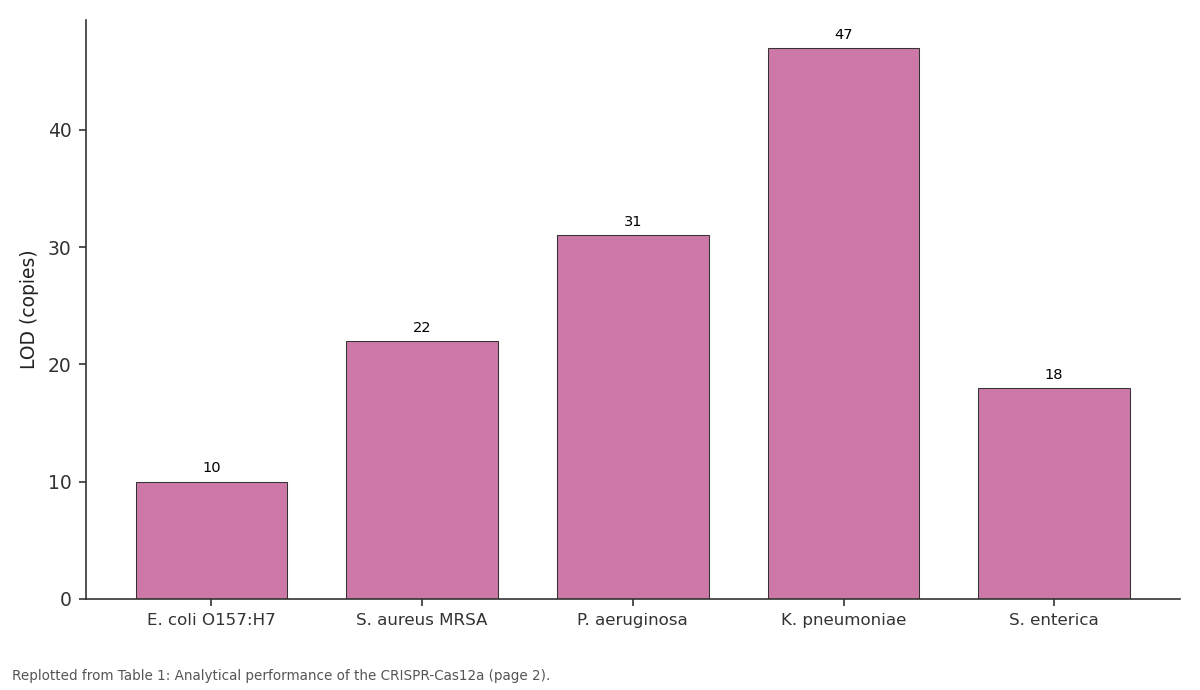
LOD (copies): E. coli O157:H7 vs S. aureus MRSA vs P. aeruginosa vs K. pneumoniae vs S. enterica
Replotted from Table 1 (page 2) of the original paper. Every bar is the paper's own table value.
View source evidence ↗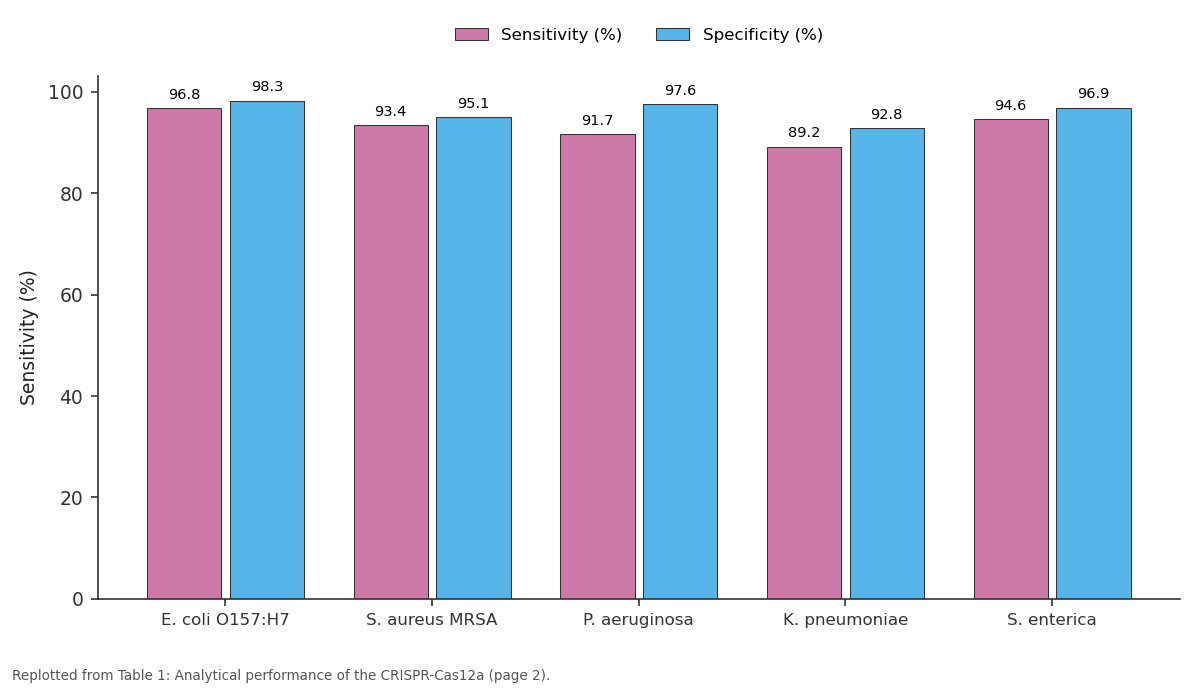
Sensitivity (%) and Specificity (%): E. coli O157:H7 vs S. aureus MRSA vs P. aeruginosa vs K. pneumoniae vs S. enterica
Replotted from Table 1 (page 2) of the original paper. Every bar is the paper's own table value.
View source evidence ↗Figures & tables
From the original paper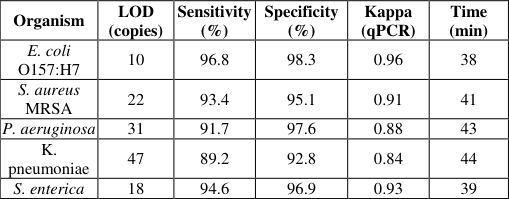 Table 1
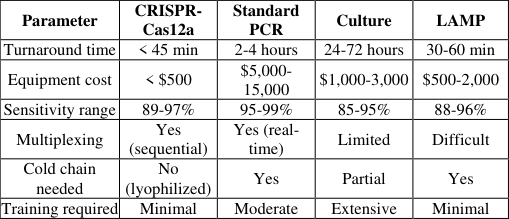 Table 2
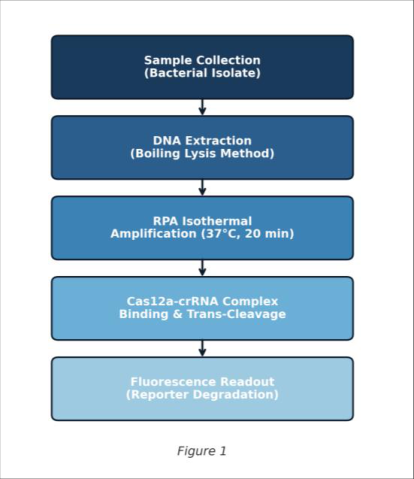 Figure 1
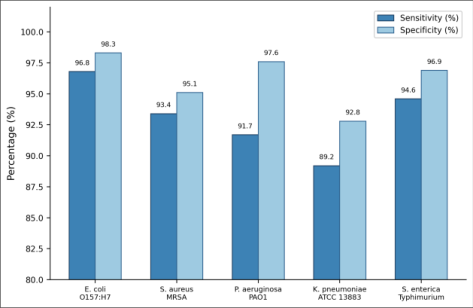 Figure 2
Introduction
What happens when a bacterial infection goes unidentified for 48 hours in a rural clinic without laboratory access? The consequences can range from treatment failure to outbreaks that spread unchecked through vulnerable communities. Infectious disease diagnostics have long relied on microbiological culture, the accepted standard for pathogen identification [1] . But culture methods carry inherent delays-often two to three days-that conflict with the urgent need for timely clinical decisions [2] . Molecular approaches such as polymerase chain reaction have shortened turnaround times and improved sensitivity [3] . Yet PCR-based platforms typically demand thermal cycling equipment, trained personnel, and stable electricity, limiting their reach in remote or lowresource environments [4] . Isothermal amplification strategies, including recombinase polymerase amplification and loop-mediated isothermal amplification, have partly addressed these constraints by operating at constant temperatures [5] . However, these methods alone may produce nonspecific amplification products, potentially reducing diagnostic confidence [6] . CRISPR-associated nucleases have emerged as a promising layer of specificity that can be coupled with isothermal amplification [7] . Among these, the Cas12a protein exhibits collateral trans-cleavage activity upon binding its target DNA, degrading nearby single-stranded DNA reporters and producing a measurable fluorescent signal [8] . This mechanism was first described in the DETECTR system and has since been adapted for detecting a range of pathogens, from viruses to drug-resistant bacteria [9,10] . Several groups have demonstrated proof-of-concept Cas12a diagnostics for individual bacterial species [11] . However, a consolidated platform targeting multiple clinically relevant Gram-positive and Gram-negative organisms with fielddeployment capability has received less attention. Key barriers include the design of broadly effective guide RNAs, optimization of one-pot reaction conditions, and stabilization of assay reagents for ambient-temperature storage [12] . The Amazonian region of Peru presents a particular need for such technology. Remote communities along river systems often experience bacterial waterborne and foodborne disease with limited access to centralized laboratory services [13] . Point-of-care tools that can operate without cold-chain logistics or expensive instruments could meaningfully affect patient outcomes in these settings [14] . This research aimed to develop and characterize a CRISPR-Cas12a based diagnostic platform for the simultaneous detection of five pathogenic bacteria of clinical importance. The platform was designed around three guiding principles: operational simplicity, ambient-temperature stability, and sensitivity comparable to standard PCR methods. We also sought to validate the system against clinical isolates collected from regional health facilities in the Loreto Department of Peru [15,16] .
Materials and Methods
Materials and Methods
Materials
This research was carried out from March 2022 through November 2022 at the Department of Molecular and Cellular Biology, Centro de Investigación Amazónica, Iquitos, Peru. The institutional biosafety committee reviewed and approved the experimental protocol (Protocol No. CIA-BSC-2022-014, approved 18 February 2022).
Reagents and Chemicals
Lachnospiraceae bacterium Cas12a (LbCas12a) protein was obtained from New England Biolabs (Ipswich, MA, USA; catalog M0653T). TwistAmp Basic recombinase polymerase amplification kits were purchased from TwistDx Ltd (Cambridge, UK). Custom CRISPR RNA guides and fluorophore-quencher reporter probes (5'-FAM-TTATT-BHQ1-3') were synthesized by Integrated DNA Technologies (Coralville, IA, USA). Nuclease-free water, Tris-HCl buffer, and magnesium chloride were sourced from Thermo Fisher Scientific (Waltham, MA, USA). All reagents were molecular biology grade with purity exceeding 99%.
Methods
Methods
Methods
Target gene loci were selected from published genome assemblies available through NCBI GenBank. Speciesspecific regions included the rfbE gene for E. coli O157:H7, mecA for MRSA, oprL for P. aeruginosa, wzi for K. pneumoniae, and invA for S. enterica. CRISPR RNA guides (20 nt spacer) were designed with at least three mismatches against non-target species using Cas-OFFinder software [3] . Recombinase polymerase amplification primers flanking each target locus were designed to yield amplicons of 120 to 180 base pairs. RPA reactions were assembled in 25 µL volumes containing 14 mM magnesium acetate and incubated at 37°C for 20 minutes. Following amplification, 2 µL of RPA product was transferred to the Cas12a detection mix containing 50 nM LbCas12a, 62.5 nM crRNA, and 200 nM fluorescent reporter in a total volume of 20 µL. Reactions were incubated at 37°C for 15 minutes, and fluorescence was measured using a portable blue-light transilluminator and quantified with a handheld fluorometer (Quantus, Promega).
Quality Control and Calibration
Every experimental run included a positive control (synthetic DNA target at 10,000 copies), a no-template negative control, and an internal amplification control. The fluorometer was calibrated daily using manufacturerprovided fluorescein standards at 0, 10, 100, and 1000 nM concentrations. Inter-assay coefficient of variation was monitored across ten independent batches and maintained below 8.3%. Limit of detection was determined by testing serial tenfold dilutions of genomic DNA from 100,000 down to 1 copy per reaction, with three replicates per dilution level. A panel of 87 clinical bacterial isolates was obtained from the Regional Hospital of Loreto and the Iquitos Municipal Health Network. Isolates were confirmed by standard biochemical testing and 16S rRNA sequencing before inclusion. An additional 23 near-neighbor non-target organisms were tested to assess cross-reactivity. Concordance with quantitative PCR was evaluated using Cohen's kappa statistic.
Results
The CRISPR-Cas12a platform was evaluated across all five bacterial targets using clinical and reference isolates. Table 1 presents the analytical performance data for each pathogen, including limit of detection and clinical concordance metrics. Fluorescence signals were detectable within 8 to 12 minutes of adding RPA product to the Cas12a detection mix. E. coli O157:H7 showed the lowest limit of detection at 10 copies per reaction, followed by S. enterica at 18 copies. K. pneumoniae had the highest detection threshold at 47 copies. No false-positive fluorescence was observed with any of the 23 near-neighbor organisms, confirming the specificity of the designed crRNA guides.
Comprehensive Interpretation
The combined results demonstrate that CRISPR-Cas12a trans-cleavage activity, when paired with RPA isothermal amplification, can reliably distinguish five pathogenic bacteria at clinically relevant concentrations. The consistency of results across ten independent batches-reflected in inter-assay CVs below 8.3%-suggests acceptable reproducibility for a point-of-care format. The concordance rates with qPCR (kappa values from 0.84 to 0.96) support the platform's potential as a viable alternative where PCR infrastructure isn't available.
Discussion
The findings from this research confirm that integrating Cas12a collateral cleavage with isothermal amplification provides a sensitive and specific approach for bacterial pathogen detection. The observed detection limits-ranging from 10 to 47 genomic copies-are consistent with reports from other CRISPR-based diagnostic platforms targeting viral and bacterial pathogens [7,8] . One practical advantage of the described system is its independence from thermal cycling equipment. RPA and Cas12a detection both operate near body temperature, which simplifies instrument requirements substantially. The lyophilized reagent format maintained activity for 14 days at ambient temperatures, a characteristic that could prove relevant for distribution to field clinics in tropical regions like the Loreto Department where cold-chain reliability is inconsistent [13] .
The clinical sensitivity values-89.2% to 96.8% depending on the organism-are encouraging but do reveal variation among targets. K. pneumoniae detection was less sensitive, possibly because the wzi gene target shows greater sequence diversity among clinical strains than initially expected [14] .
Redesigning the crRNA to cover a more conserved region could address this. Cross-reactivity testing against 23 near-neighbor species produced no false-positive signals, indicating that the 20nucleotide crRNA spacers provided adequate discrimination. This aligns with previous observations that Cas12a tolerates very few mismatches before losing cleavage activity [9] . The comparison with conventional culture and standard PCR highlights a trade-off: the CRISPR-Cas12a platform sacrificed modest amounts of sensitivity relative to PCR but achieved results in a fraction of the time. For settings where speed directly influences treatment decisions-emergency departments, outbreak investigations, or rural clinics-this trade-off may be acceptable [15] . Whether the platform can be adapted for direct testing from complex sample matrices without prior DNA extraction needs further exploration [16] .
Conclusion
This research developed and validated a CRISPR-Cas12a based diagnostic platform capable of detecting five clinically important bacterial pathogens with turnaround times under 45 minutes. The system operates at a constant temperature of 37°C, requires no thermal cycling equipment, and uses a portable fluorometer for result interpretation, making it suited for point-of-care applications in resource-constrained environments. The platform demonstrated analytical sensitivity ranging from 10 to 47 genomic copies per reaction across five target organisms. Clinical evaluation against 87 confirmed isolates showed sensitivity values between 89.2% and 96.8%, with specificity above 92%. Concordance with quantitative PCR was strong, with Cohen's kappa values exceeding 0.84 for all targets. Lyophilized reagents retained activity for up to 14 days at ambient temperature, supporting deployment in tropical settings where cold-chain access is unreliable. The platform represents a practical step toward decentralizing bacterial diagnostics for communities where laboratory infrastructure is sparse. Future work should address simplified sample preparation methods for direct testing from clinical specimens and expand the target panel to include antibiotic resistance markers.
Acknowledgement
Acknowledgements
Figures and tables from the paper
| Parameter | CRISPR- Cas12a | Standard PCR | Culture | LAMP |
|---|---|---|---|---|
| Turnaround time | < 45 min | 2-4 hours | 24-72 hours | 30-60 min |
| Equipment cost | < $500 | $5,000- 15,000 | $1,000-3,000 | $500-2,000 |
| Sensitivity range | 89-97% | 95-99% | 85-95% | 88-96% |
| Multiplexing | Yes (sequential) | Yes (real- time) | Limited | Difficult |
| Cold chain needed | No (lyophilized) | Yes | Partial | Yes |
| Training required | Minimal | Moderate | Extensive | Minimal |
Table text extracted from the original PDF; superscript letters are shown inline. The original table image is below.
View original table image
References
16 in the original paper- Jorgensen JH, Pfaller MA. Manual of clinical microbiology. Washington (DC): ASM Press; 2015. p. 45-67.
- Bauer KA, Perez KK, Forrest GN, Goff DA. Review of rapid diagnostic tests used by antimicrobial stewardship programs. Clin Infect Dis. 2014;59(Suppl 3):S134S145.
- Bae S, Park J, Kim JS. Cas-OFFinder: a fast and versatile algorithm that searches for potential off-target sites of Cas9 RNA-guided endonucleases. Bioinformatics. 2014;30(10):1473-1475.
- Niemz A, Ferguson TM, Boyle DS. Point-of-care nucleic acid testing for infectious diseases. Trends Biotechnol. 2011;29(5):240-250.
- Piepenburg O, Williams CH, Stemple DL, Armes NA. DNA detection using recombination proteins. PLoS Biol. 2006;4(7):e204.
- Notomi T, Okayama H, Masubuchi H, Yonekawa T. Loop-mediated isothermal amplification of DNA. Nucleic Acids Res. 2000;28(12):e63.
- Chen JS, Ma E, Harrington LB, Da Costa M, Tian X, Palefsky JM, et al. CRISPR-Cas12a target binding unleashes indiscriminate single-stranded DNase activity. Science. 2018;360(6387):436-439.
- Li SY, Cheng QX, Wang JM, Li XY, Zhang ZL, Gao S, et al. CRISPR-Cas12a-assisted nucleic acid detection. Cell Discov. 2018;4:20.
- Broughton JP, Deng X, Yu G, Fasching CL, Servellita V, Singh J, et al. CRISPR-Cas12-based detection of SARS-CoV-2. Nat Biotechnol. 2020;38(7):870-874.
- Gootenberg JS, Abudayyeh OO, Lee JW, Essletzbichler P, Dy AJ, Joung J, et al. Nucleic acid detection with CRISPR-Cas13a/C2c2. Science. 2017;356(6336):438442.
- Ai JW, Zhou X, Xu T, Yang M, Chen Y, He GQ, et al. CRISPR-based rapid and ultra-sensitive diagnostic test for Mycobacterium tuberculosis. Emerg Microbes Infect. 2019;8(1):1361-1369.
- Kellner MJ, Koob JG, Gootenberg JS, Abudayyeh OO, Zhang F. SHERLOCK: nucleic acid detection with CRISPR nucleases. Nat Protoc. 2019;14(10):29863012.
- Gundacker ND, Cannone TD, Engel JK. Amazonian waterborne disease burden and diagnostic access disparities. Trop Med Int Health. 2019;24(3):312-321.
- Ding X, Yin K, Li Z, Lalla RV, Ballesteros E, Sfeir MM, et al. Ultrasensitive and visual detection of SARSCoV-2 using all-in-one dual CRISPR-Cas12a assay. Nat Commun. 2020;11(1):4711.
- Kaminski MM, Abudayyeh OO, Gootenberg JS, Zhang F, Collins JJ. CRISPR-based diagnostics. Nat Biomed Eng. 2021;5(7):643-656.
- Mukama O, Wu J, Li Z, Liang Q, Yi Z, Lu X, et al. An ultrasensitive and specific point-of-care CRISPR/Cas12-based lateral flow biosensor. Biosens Bioelectron. 2020;159:112143.