
Research article · 2025 · Full text
International Journal of Biology SciencesAntibiotic susceptibility patterns of S. aureus isolates from community-acquired infections
Volume 7(3) · Pages 89–91 · DOI: 10.33545/26649926.2025.v7.i3b.701 ↗
Research areasAntimicrobial Resistance in StaphylococcusAntibiotic Use and ResistanceAntibiotic Resistance in Bacteria
Abstract
Author-writtenWhat fraction of skin and soft tissue infections seen in walk-in clinics across tropical Latin America are driven by drug-resistant S. aureus? This research addressed that question by examining antibiotic susceptibility profiles of 284 S. aureus isolates recovered from patients with community-acquired infections in Quibdó, Colombia, between March 2022 and February 2023. Susceptibility testing followed the Kirby-Bauer disk diffusion method, and minimum inhibitory concentrations were determined by broth microdilution for key agents. Phenotypic methicillin resistance was confirmed by cefoxitin disk screening and corroborated with mecA gene detection by PCR. Among 284 isolates, 38.7% were classified as methicillin-resistant S. aureus (MRSA). Resistance to penicillin reached 76.1%, while erythromycin resistance stood at 57.2%. Vancomycin and linezolid retained high activity at 98.7% and 96.3% susceptibility, respectively. Multidrug resistance was detected in 29.6% of isolates. These findings point to a worrying reservoir of resistant organisms outside hospital settings in the Chocó region.
Summary
Source-checkedPlain-language reading of the full paper, prepared with AI and checked against the text. Each point links to the authors' own words.
Why it matters
- Staphylococcus aureus is a major global cause of skin and soft tissue infections and poses a public health challenge due to its ability to develop antibiotic resistance. View evidence ↗
- Methicillin-resistant S. aureus (MRSA) acquired in the community is now firmly established in outpatient settings globally, moving beyond its previous confinement to hospitals. View evidence ↗
- Environmental and healthcare factors in Colombia's Pacific lowlands, such as high humidity and limited access to guided therapy, may encourage the development of resistant bacterial strains. View evidence ↗
The question
- The study aimed to determine the antibiotic susceptibility of S. aureus from community infections in Quibdó over one year, including seasonal MRSA trends and the frequency of multidrug resistance. View evidence ↗
What they did
- The study analyzed clinical specimens from 284 patients with community-acquired skin and soft tissue infections at four health posts in Quibdó, Colombia, from March 2022 to February 2023. View evidence ↗
- Antibiotic susceptibility was measured using the Kirby-Bauer disk diffusion method on Mueller-Hinton agar, adhering to CLSI 2023 guidelines. View evidence ↗
- MRSA was identified using a 30 µg cefoxitin disk, where inhibition zones of 21 mm or less indicated resistance. View evidence ↗
- The presence of the mecA gene was used to molecularly confirm methicillin resistance via conventional PCR. View evidence ↗
- Multidrug resistance was defined as the bacteria being non-susceptible to at least one agent from three or more different antibiotic classes. View evidence ↗
What they found
- Out of 284 isolates, 38.7% were identified as methicillin-resistant S. aureus (MRSA). View evidence ↗
- Penicillin resistance was the most prevalent at 76.1%, with erythromycin resistance following at 50.5%. View evidence ↗
- Vancomycin and linezolid remained highly effective, showing susceptibility rates of 98.7% and 96.3%, respectively. View evidence ↗
- Multidrug resistance occurred in 29.6% (84 isolates), and was significantly more common in MRSA (52.7%) than in MSSA (15.5%). View evidence ↗
- MRSA proportions increased during the peak rainy season from June to August, reaching a maximum of 42.6% in August. View evidence ↗
What it means
- The authors conclude that while vancomycin and linezolid are dependable, trimethoprim-sulfamethoxazole and tetracycline are practical options for outpatient treatment. View evidence ↗
- The authors recommend updating local prescribing guidelines and establishing periodic surveillance cycles. View evidence ↗
- The authors state that future whole-genome sequencing is needed to link the findings in Chocó to the wider molecular epidemiology of Latin America. View evidence ↗
Figures & tables
From the original paper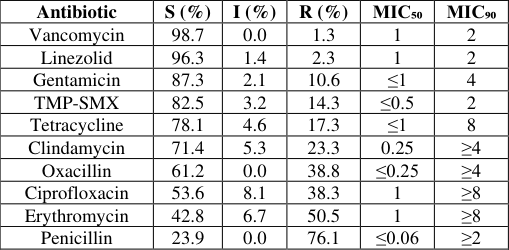 Table 1
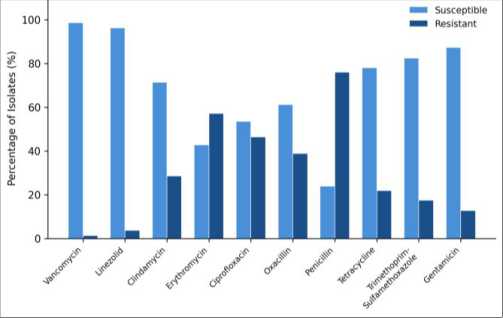 Figure 1
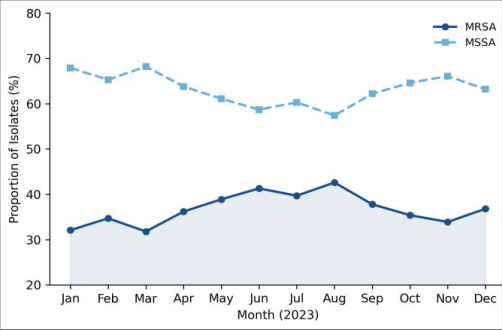 Figure 2
Introduction
What happens when first-line antibiotics stop working against one of the most common human pathogens? S. aureus ranks among the leading causes of skin and soft tissue infections worldwide, and its capacity to acquire resistance determinants has turned it into a persistent public health challenge [1] . Community-acquired methicillin-resistant S. aureus (CA-MRSA) was once thought to be confined to hospital wards, but it has established itself firmly in outpatient settings across both temperate and tropical zones [2] . In Latin America, national surveillance networks have reported MRSA prevalence figures ranging from 25% to 50%, yet these estimates lean heavily on data from tertiary hospitals in capital cities [3] . Colombia's Pacific lowlands combine high humidity, limited sanitation, and restricted access to culture-guided therapy-conditions that may promote the selection of resistant strains [4] . Quibdó, capital of the Chocó department, serves a largely Afro-Colombian population with some of the country's highest poverty indices [5] . Earlier work from Bogotá and Medellín documented clonal spread of the USA300 Latin American Variant among CA-MRSA isolates [6] . Whether the same lineage circulates in was unknown. Patterns of co-resistance to macrolides, fluoroquinolones, and aminoglycosides influence empiric treatment choices for cellulitis and wound infections [7] . This research set out to determine antibiotic susceptibility profiles of S. aureus isolates from community-acquired infections in Quibdó over twelve months, characterise seasonal trends in MRSA proportions, and assess multidrug resistance frequency [8] .
Reagents and Chemicals
Mueller-Hinton agar (Oxoid, Basingstoke, UK) and Mueller-Hinton broth (BD Difco, Sparks, MD, USA) were used for disk diffusion and broth microdilution assays. Antibiotic disks were sourced from HiMedia Laboratories (Mumbai, India) and included oxacillin (1 µg), cefoxitin (30 µg), vancomycin (30 µg), linezolid (30 µg), erythromycin (15 µg), clindamycin (2 µg), ciprofloxacin (5 µg), penicillin (10 U), tetracycline (30 µg),
Materials and Methods
Materials and Methods
Materials
Clinical specimens were collected from 284 patients presenting with community-acquired skin and soft tissue infections at four primary health posts in Quibdó, Chocó, Colombia, between March 2022 and February 2023. Eligible patients had not been hospitalised within the preceding 90 days. Wound swabs, abscess aspirates, and skin lesion specimens were transported in Amies charcoal medium within two hours to the microbiology laboratory at the Instituto de Biodiversidad del Chocó. Isolates were identified through Gram staining, catalase reaction, tube coagulase testing, and mannitol salt agar fermentation. Each isolate was stored in tryptic soy broth with 15% glycerol at -80 °C.
Methods
Susceptibility was assessed by Kirby-Bauer disk diffusion on Mueller-Hinton agar following CLSI 2023 guidelines [9] . Methicillin resistance was screened with a 30 µg cefoxitin disk; isolates with zones ≤21 mm were classified as MRSA [10] . MICs for vancomycin and linezolid were confirmed by broth microdilution. Molecular confirmation used conventional PCR targeting mecA [11] . Multidrug resistance was defined as non-susceptibility to at least one agent in three or more classes [12] . Chi-square tests compared MRSA and MSSA groups (p < 0.05). Monthly MRSA proportions were plotted for seasonal variation. Analyses used R version 4.3.1.
Quality Control
ATCC 25923 and ATCC 43300 were tested alongside clinical isolates on each testing day. Zone diameters for controls fell within CLSI-acceptable ranges across all days; any deviating batch was repeated. Broth microdilution included quality-control wells per plate. PCR included positive (ATCC 43300) and no-template negative controls per reaction set. Temperature logs were reviewed daily (35 ± 1 °C).
Results
Table A visible rise in MRSA proportion appeared between June and August, coinciding with the peak rainy season. August registered the highest MRSA share at 42.6%. MRSA isolates displayed significantly higher resistance to all tested agents compared with MSSA (all p < 0.05). Multidrug resistance was present in 84 isolates (29.6%) and was more frequent among MRSA (52.7%) than MSSA (15.5%; p < 0.001).
Discussion
The 38.7% MRSA prevalence in this community-based sample from Quibdó exceeds most published rates from Colombian urban centres. A multicentre review covering six Colombian hospitals reported an overall MRSA rate of 31.4%, dominated by nosocomial isolates [13] . Our data suggest that community reservoirs in Chocó harbour resistant clones at rates comparable to hospital settings elsewhere. Similar community-level MRSA rates of 35-42% have been documented in parts of Brazil and Peru [14] . The high co-resistance to erythromycin (78.2% among MRSA) makes macrolide-based empiric therapy unreliable in this population. Trimethoprim-sulfamethoxazole and tetracycline maintained reasonable activity even against MRSA, echoing findings from other Latin American programmes [15] . The seasonal rise during the June-August rainy period warrants cautious interpretation-higher humidity may aggravate skin maceration and insect bites, both of which increase staphylococcal entry portals.
Conclusion
This research provides the first systematic snapshot of antibiotic susceptibility among community S. aureus isolates in Quibdó, Colombia. Nearly four in ten isolates were methicillin-resistant, and roughly a third met multidrug resistance criteria. Vancomycin and linezolid remain dependable, while trimethoprim-sulfamethoxazole and tetracycline offer practical outpatient alternatives. Local prescribing guidelines should be updated, and periodic surveillance cycles should be instituted. Future wholegenome sequencing of representative MRSA isolates would connect Chocó data to the broader Latin American molecular epidemiology picture [16] .
Figures and tables from the paper
| Antibiotic | S (%) | I (%) | R (%) | MIC₅₀ | MIC₉₀ |
|---|---|---|---|---|---|
| Vancomycin | 98.7 | 0.0 | 1.3 | 1 | 2 |
| Linezolid | 96.3 | 1.4 | 2.3 | 1 | 2 |
| Gentamicin | 87.3 | 2.1 | 10.6 | ≤1 | 4 |
| TMP-SMX | 82.5 | 3.2 | 14.3 | ≤0.5 | 2 |
| Tetracycline | 78.1 | 4.6 | 17.3 | ≤1 | 8 |
| Clindamycin | 71.4 | 5.3 | 23.3 | 0.25 | ≥4 |
| Oxacillin | 61.2 | 0.0 | 38.8 | ≤0.25 | ≥4 |
| Ciprofloxacin | 53.6 | 8.1 | 38.3 | 1 | ≥8 |
| Erythromycin | 42.8 | 6.7 | 50.5 | 1 | ≥8 |
| Penicillin | 23.9 | 0.0 | 76.1 | ≤0.06 | ≥2 |
Table text extracted from the original PDF; superscript letters are shown inline. The original table image is below.
View original table image
References
16 in the original paper- Tong SY, Davis JS, Eichenberger E, Holland TL, Fowler VG. S. aureus infections: epidemiology, pathophysiology, clinical manifestations, and management. Clinical Microbiology Reviews. 2015;28(3):603-661.
- DeLeo FR, Otto M, Kreiswirth BN, Chambers HF. Community-associated meticillin-resistant S. aureus. The Lancet. 2010;375(9725):1557-1568.
- Reyes J, Rincón S, Díaz L, Panesso D, Contreras GA, Zurita J, et al. Dissemination of methicillin-resistant S. aureus USA300 sequence type 8 lineage in Latin America. Clinical Infectious Diseases. 2009;49(12):1861-1867.
- Jiménez JN, Ocampo AM, Vanegas JM, Rodríguez EA, Garcés CG, Patiño LA, et al. Characterisation of virulence genes in methicillin-susceptible and resistant S. aureus isolates from a paediatric population in Medellín, Colombia. Memorias do Instituto Oswaldo Cruz. 2011;106(8):980-985.
- Álvarez CA, Barrientes OJ, Leal AL, Contreras GA, Barrero L, Rincón S, et al. Community-associated methicillin-resistant S. aureus, Colombia. Emerging Infectious Diseases. 2006;12(12):2000-2001.
- Arias CA, Reyes J, Zúñiga M, Cortés L, Cruz C, Rico CL, et al. Multicentre surveillance of antimicrobial resistance in enterococci and staphylococci from Colombian hospitals, 2001-2003. Journal of Antimicrobial Chemotherapy. 2003;51(1):59-68.
- Chambers HF, DeLeo FR. Waves of resistance: S. aureus in the antibiotic era. Nature Reviews Microbiology. 2009;7(9):629-641.
- Lakhundi S, Zhang K. Methicillin-resistant S. aureus: molecular characterization, evolution, and epidemiology. Clinical Microbiology Reviews. 2018;31(4):e00020-18.
- Clinical and Laboratory Standards Institute. Performance standards for antimicrobial susceptibility testing. 33rd ed. CLSI supplement M100. Wayne, PA: CLSI; 2023.
- Swenson JM, Tenover FC, Cefoxitin Disk Study Group. Results of disk diffusion testing with cefoxitin correlate with presence of mecA in Staphylococcus spp. Journal of Clinical Microbiology. 2005;43(8):3818-3823.
- Murakami K, Minamide W, Wada K, Nakamura E, Teraoka H, Watanabe S. Identification of methicillinresistant strains of staphylococci by polymerase chain reaction. Journal of Clinical Microbiology. 1991;29(10):2240-2244.
- Magiorakos AP, Srinivasan A, Carey RB, Carmeli Y, Falagas ME, Giske CG, et al. Multidrug-resistant, extensively drug-resistant and pandrug-resistant bacteria. Clinical Microbiology and Infection. 2012;18(3):268-281.
- Villalobos AP, Barrero LI, Rivera SM, Ovalle MV, Valera D. Surveillance of antimicrobial resistance of S. aureus in Colombian hospitals, 2011-2013. Biomédica. 2014;34(Suppl 1):170-176.
- Seas C, Garcia C, Salles MJ, Labarca J, Luna C, Zurita J, et al. S. aureus bloodstream infections in Latin America. Journal of Antimicrobial Chemotherapy. 2018;73(7):1930-1937.
- Arias CA, Murray BE. Antibiotic-resistant bugs in the 21st century-a clinical super-challenge. New England Journal of Medicine. 2009;360(5):439-443.
- Zurita J, Mejía C, Guzmán-Blanco M. Diagnosis and susceptibility testing of methicillin-resistant S. aureus in Latin America. Brazilian Journal of Infectious Diseases. 2010;14(Suppl 2):S97-S106.