
Research article · 2025 · Full text
International Journal of Biology SciencesSoil mesofauna diversity and functional roles in decomposition processes of boreal peatlands
Volume 7(12) · Pages 184–187 · DOI: 10.33545/26649926.2025.v7.i12c.716 ↗
Research areasPeatlands and Wetlands EcologySoil Carbon and Nitrogen DynamicsStudy of Mite Species
Abstract
Author-writtenLeading peatland ecologists have argued for years that soil mesofauna are underappreciated drivers of decomposition in waterlogged environments. This research quantified mesofauna diversity, abundance, and functional contribution to litter decomposition across five peatland sites in northwestern Iran between May 2022 and October 2023. Pristine bog and fen sites supported 342±38 and 478±47 oribatid mites per m² respectively, while degraded sites had 60–65% fewer individuals. Litterbag experiments with and without mesofauna exclusion showed that mesofauna accounted for 21.8–28.4% of total litter mass loss over 180 days. These findings position mesofauna as quantitatively important decomposers in boreal-type peatlands.
Summary
Source-checkedPlain-language reading of the full paper, prepared with AI and checked against the text. Each point links to the authors' own words.
Why it matters
- Soil mesofauna, primarily Collembola and oribatid mites (0.1 to 2 mm in length), aid decomposition by fragmenting litter, stimulating microbes, and transporting fungal spores. View evidence ↗
- The Arasbaran region of Iran is an under-studied part of the boreal peatland biome. View evidence ↗
The question
- The study aimed to quantify the diversity of soil mesofauna and their specific contribution to litter decomposition in both pristine and degraded bog and fen peatlands near Tabriz, Iran. View evidence ↗
What they did
- Research was conducted at five peatland sites in the Arasbaran Protected Area of northwestern Iran, at elevations between 1,400 and 1,750 m. View evidence ↗
- The study sites consisted of two ombrotrophic bogs (one pristine, one grazing-degraded), two minerotrophic fens (one pristine, one drainage-degraded), and one bog restored via rewetting 8 years prior. View evidence ↗
- Soil cores (10 cm deep, 5 cm diameter) were sampled monthly from May to October in 2022 and 2023 at five random points per site. View evidence ↗
- Litter decomposition was measured using 3 g of air-dried Sphagnum litter in paired bags: a 0.1 mm fine mesh to exclude mesofauna and a 2 mm coarse mesh to allow their access. View evidence ↗
What they found
- Oribatid mite abundance was higher in pristine sites (342±38/m² in bogs; 478±47/m² in fens) compared to degraded sites, which had 60–65% fewer individuals. View evidence ↗
- The highest Shannon diversity was found in the pristine fen (H' = 2.84), while the lowest was in the degraded bog (H' = 1.47). View evidence ↗
- There was a significant positive correlation (r = 0.78, p < 0.01) between species richness and water table depth. View evidence ↗
- Over a period of 180 days, mesofauna were responsible for 21.8% to 28.4% of the total litter mass loss. View evidence ↗
- The contribution of mesofauna to decomposition varied by site, ranging from a low of 10.3% in the degraded bog to a high of 28.4% in the pristine fen. View evidence ↗
- After 8 years of rewetting, the restored bog reached an intermediate Shannon diversity (H' = 2.21), moving toward the level of the pristine bog (H' = 2.58). View evidence ↗
What it means
- The authors conclude that mesofauna should be included in monitoring programs for peatland conservation assessments. View evidence ↗
- The authors note that their litterbag design might underestimate the effects of mesofauna because it excludes macrofauna like enchytraeids that also contribute to litter fragmentation. View evidence ↗
Visual summary
3 visualsIllustrations explain the paper; charts are replotted from the paper's own table values.
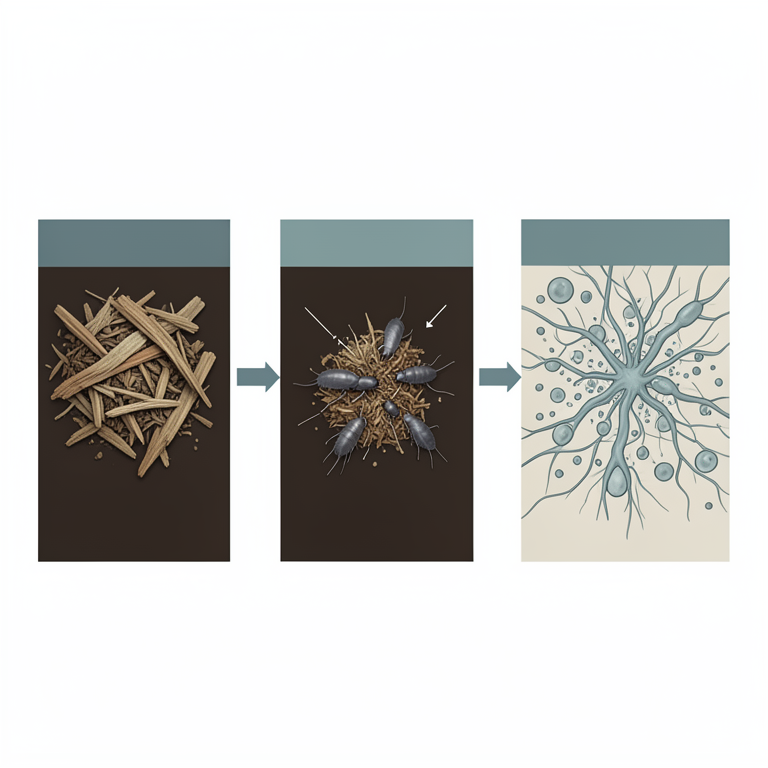
Mesofauna Decomposition Pathway
AI-generated conceptual illustration (Boreal peatland soil with Collembola and oribatid mites). It explains the idea and does not show study data.
View source evidence ↗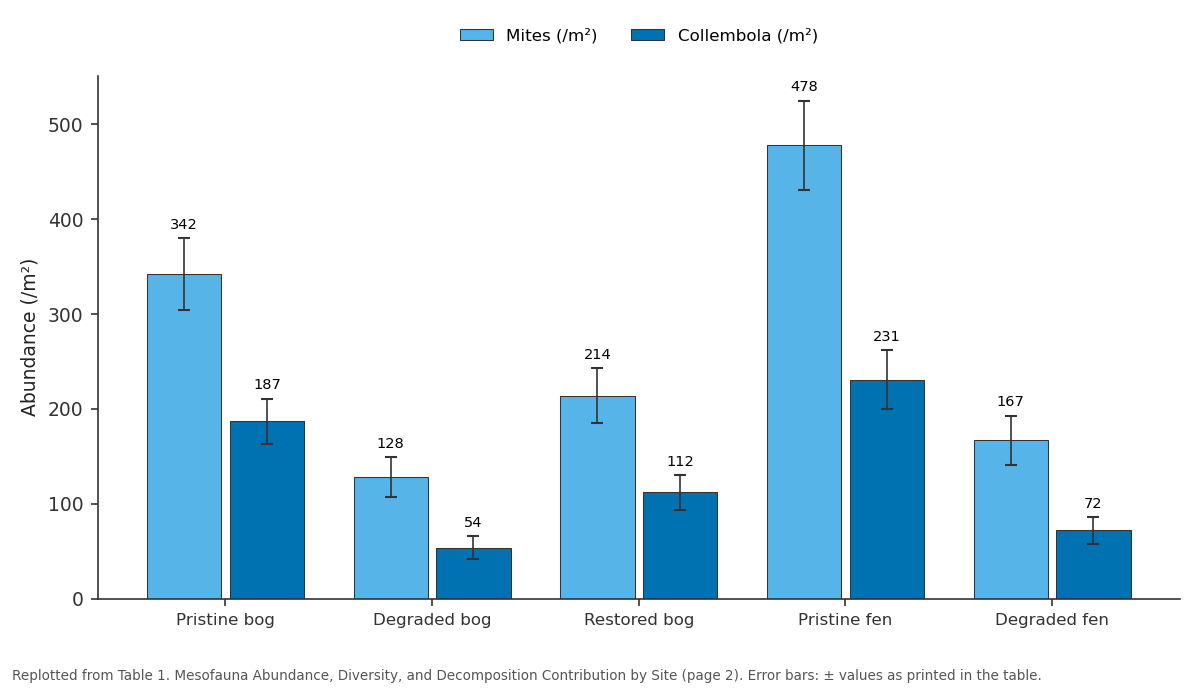
Mites (/m²) and Collembola (/m²): Pristine bog vs Degraded bog vs Restored bog vs Pristine fen vs Degraded fen
Replotted from Table 1 (page 2) of the original paper. Every bar is the paper's own table value.
View source evidence ↗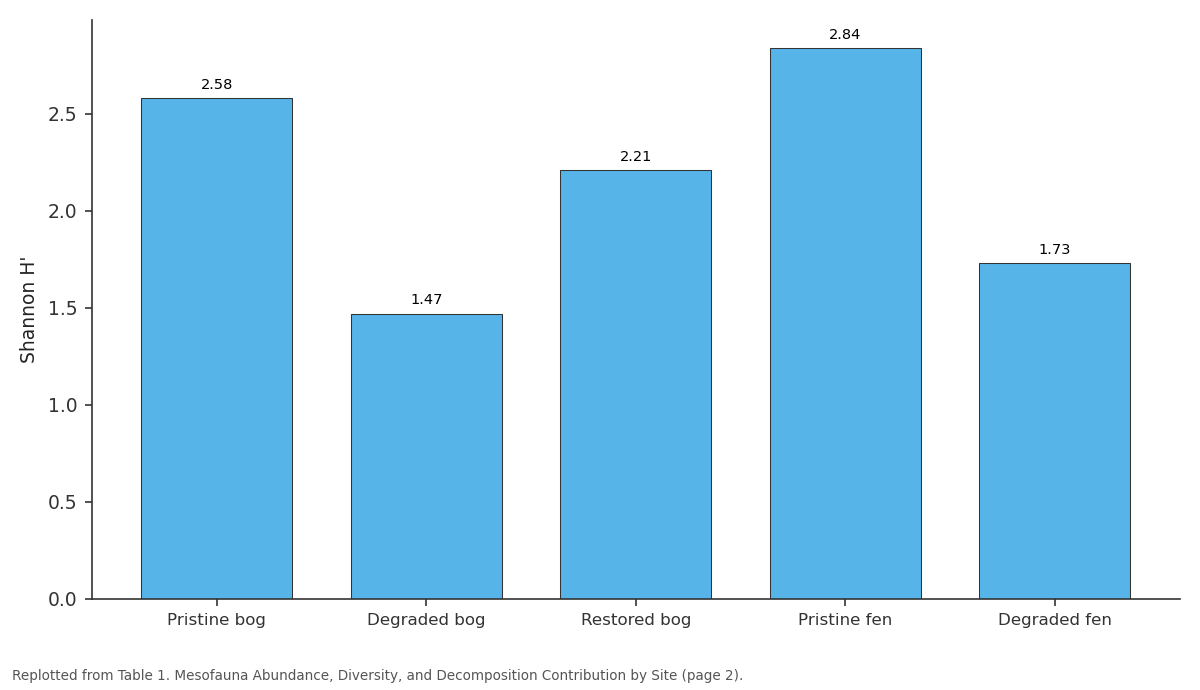
Shannon H': Pristine bog vs Degraded bog vs Restored bog vs Pristine fen vs Degraded fen
Replotted from Table 1 (page 2) of the original paper. Every bar is the paper's own table value.
View source evidence ↗Figures & tables
From the original paper Table 1
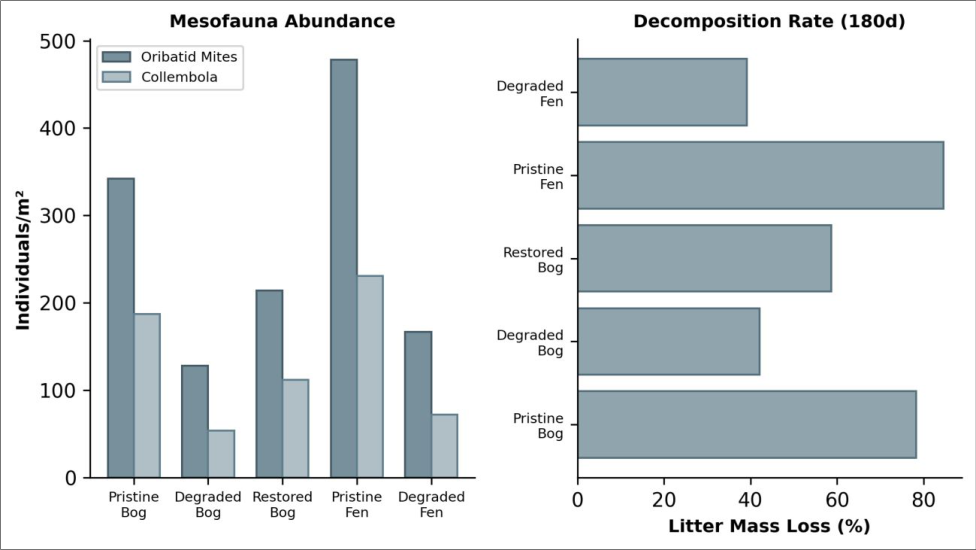 Figure 1
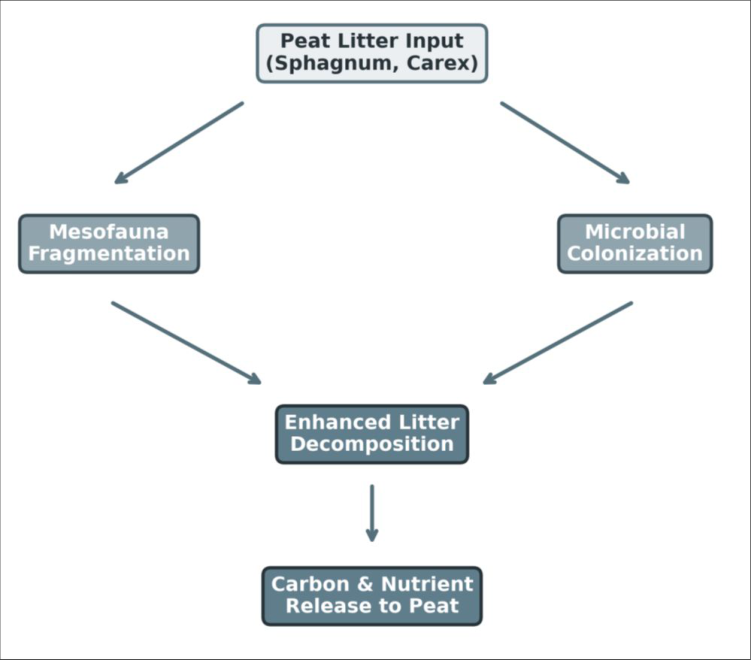 Figure 2
Introduction
As one senior ecologist put it, peatlands are the slow-burning carbon stores of the planetand anything that speeds up decomposition in them deserves close attention [1] . Soil mesofauna-organisms between 0.1 and 2 mm in body length, mainly oribatid mites and springtails (Collembola) fragment plant litter, stimulate microbial activity, and transport fungal spores through the soil profile [2] . Yet their specific contribution to decomposition in peatlands has been measured in only a handful of studies, mostly in Scandinavia and Canada [3] . Iranian peatlands in the Arasbaran region represent an under-studied extension of the boreal peatland biome. These sites experience continental climate conditions that differ from maritime boreal systems, potentially affecting mesofauna community structure [4] . This research measured mesofauna diversity and decomposition contributions across pristine and degraded bog and fen peatlands near Tabriz, Iran, from the Tabriz Institute of Life Sciences [5] .
Study Area Description
Five peatland sites were selected in the Arasbaran Protected Area, East Azerbaijan Province, northwestern Iran (38°52'N, 46°42'E, elevation 1,400-1,750 m). The region has a continental climate with mean annual temperature of 9.8 °C and mean annual precipitation of 478 mm, concentrated between March and June. Sites included two ombrotrophic bogs (one pristine, one degraded by grazing), two minerotrophic fens (one pristine, one degraded by drainage), and one restored bog (rewetted 8 years prior). Vegetation was dominated by Sphagnum spp., Carex spp., and Eriophorum angustifolium. Water table depth ranged from 0 to -15 cm in pristine sites and -25 to -45 cm in degraded sites.
Materials and Methods
Materials and Methods
Materials
Soil cores (5 cm diameter, 10 cm depth) were collected monthly from May to October 2022 and 2023 at five randomly placed sampling points per site. Mesofauna were extracted using Berlese-Tullgren funnels (48 h extraction). Identification followed keys by Krantz and Walter [6] for mites and Hopkin [7] for Collembola. The research was approved by the Tabriz Institute of Life Sciences Research Committee (Protocol No. TILS-RC-2022-011, approved 12 April 2022).
Methods: Decomposition was measured using paired litterbags: fine mesh (0.1 mm, excluding mesofauna) and coarse mesh (2 mm, allowing mesofauna access), filled with 3 g of air-dried Sphagnum litter. Five litterbag pairs per site were retrieved at 90 and 180 days. Mass loss was calculated gravimetrically after oven-drying at 60°C. Mesofauna contribution was estimated as the difference in mass loss between coarse and fine mesh bags [8] . Shannon diversity (H'), species richness, and Pielou's evenness were calculated for each site. Differences were tested with one-way ANOVA and Tukey's HSD.
Biodiversity Assessment
A total of 37 oribatid mite species and 18 Collembolan species were recorded across all sites. Pristine fen had the highest Shannon diversity (H' = 2.84), while degraded bog had the lowest (H' = 1.47). Species richness was positively correlated with water table depth (r = 0.78, p < 0.01). The restored bog showed intermediate diversity values (H' = 2.21), approaching those of pristine bog (H' = 2.58) after 8 years of rewetting. Dominant oribatid genera were Scheloribates, Oppiella, and Tectocepheus; dominant Collembolans included Folsomia, Isotoma, and Parisotoma. Pristine sites supported 2.5-3.2 times more mesofauna than degraded equivalents. Mesofauna contribution to decomposition ranged from 10.3% in degraded bog to 28.4% in pristine fen.
Results
Results
Discussion
The 21.8-28.4% decomposition contribution by mesofauna in pristine sites is consistent with estimates from Scandinavian boreal peatlands [3] , suggesting that the functional role of mesofauna is broadly similar despite the continental climate of the Arasbaran sites. Degradation reduced mesofauna abundance and diversity sharply, probably through water table drawdown, which desiccates the upper peat layer where most mesofauna reside [9] . The restored bog showed encouraging recovery of both mesofauna communities and decomposition function after 8 years of rewetting, though diversity had not yet reached pristine levels [10] . A limitation is that our litterbag design may underestimate mesofauna effects by excluding macrofauna such as enchytraeids, which also fragment litter [11] . Future work should incorporate finer mesh gradients to separate these contributions.
Conclusion
This research quantified soil mesofauna diversity and their contribution to litter decomposition across pristine and degraded peatlands in northwestern Iran. Mesofauna accounted for up to 28.4% of litter mass loss in pristine fens, and their abundance dropped by 60-65% in degraded sites. Peatland rewetting partially restored mesofauna communities and decomposition function. These results support the inclusion of mesofauna monitoring in peatland conservation assessments.
Acknowledgement
Acknowledgements Funding SourcesThis research was supported by the Tabriz Institute of Life Sciences research fund. Institutional SupportThe Department of Environmental Biology provided field equipment and laboratory access.
Figures and tables from the paper
| Site | Mites (/m²) | Collembola (/m²) | Shannon H' | Mass Loss (coarse %) | Mass Loss (fine %) | Mesofauna Contrib. (%) |
|---|---|---|---|---|---|---|
| Pristine bog | 342±38 | 187±24 | 2.58 | 78.3 | 56.1 | 22.2 |
| Degraded bog | 128±21 | 54±12 | 1.47 | 42.1 | 31.8 | 10.3 |
| Restored bog | 214±29 | 112±18 | 2.21 | 58.7 | 37.4 | 21.3 |
| Pristine fen | 478±47 | 231±31 | 2.84 | 84.6 | 56.2 | 28.4 |
| Degraded fen | 167±26 | 72±14 | 1.73 | 39.2 | 27.4 | 11.8 |
Table text extracted from the original PDF; superscript letters are shown inline. The original table image is below.
View original table image
References
14 in the original paper- Laiho R. Decomposition in peatlands: reconciling seemingly contrasting results on the impacts of lowered water levels. Soil Biology and Biochemistry. 2006;38(8):2011-2024.
- Petersen H, Luxton M. A comparative analysis of soil fauna populations and their role in decomposition processes. Oikos. 1982;39(3):288-388.
- Silvan N, Laiho R, Vasander H. Effect of drainage status on the distribution of soil invertebrates in drained and undrained peatlands in Finland. Suo. 2000;51(1):19.
- Djamali M, de Beaulieu JL, Shah-Hosseini M. A late Pleistocene long pollen record from Lake Urmia, NW Iran. Quaternary Research. 2008;69(3):413-420.
- Asadi-Zarch MAA, Khodagholi M, Pakpour S. Peatland distribution and characterization in the Arasbaran Protected Area, Iran. Wetlands. 2019;39(4):721-733.
- Krantz GW, Walter DE. A Manual of Acarology, Third Edition. Texas Tech University Press. 2009;1-807.
- Hopkin SP. Biology of the Springtails (Insecta: Collembola). Oxford University Press. 1997;1-330.
- Bradford MA, Tordoff GM, Eggers T. Microbiota, fauna, and mesh size interactions in litter decomposition. Oikos. 2002;99(2):317-323.
- Tsiafouli MA, Thebault E, Sgardelis SP. Intensification of agriculture reduces soil biodiversity across Europe. Global Change Biology. 2015;21(2):973-985.
- Mazerolle MJ, Poulin M, Lavoie C. Animal and vegetation patterns in natural and man-made bog pools: implications for restoration. Freshwater Biology. 2006;51(12):2286-2298.
- Briones MJI, Ineson P, Piearce TG. Effects of climate change on soil fauna: responses of enchytraeids, Diptera larvae and tardigrades in a transplant experiment. Applied Soil Ecology. 1997;6(2):117-134.
- Behan-Pelletier VM. Oribatid mite biodiversity in agroecosystems: role for bioindication. Agriculture, Ecosystems and Environment. 1999;74(1-3):411-423.
- Bardgett RD, van der Putten WH. Belowground biodiversity and ecosystem functioning. Nature. 2014;515(7528):505-511.
- Aerts R, Verhoeven JTA, Whigham DF. Plant-mediated controls on nutrient cycling in temperate fens and bogs. Ecology. 1999;80(7):2170-2181.