
Research article · 2025 · Full text
International Journal of Biology SciencesReintroduction success and post-release monitoring of captive-bred amphibians in restored wetlands
Volume 7(11) · Pages 104–106 · DOI: 10.33545/26649926.2025.v7.i11b.697 ↗
Research areasAmphibian and Reptile BiologyFish Ecology and Management StudiesWildlife Ecology and Conservation
Abstract
Author-writtenA casual observer might assume that releasing captive-bred frogs into a restored wetland is the final step in amphibian conservation—but it's really just the beginning. This research evaluated the post-release survival, site fidelity, and reproductive success of three Cuban amphibian species reintroduced into restored wetlands in western Cuba. A total of 384 captive-bred individuals—Osteopilus septentrionalis (n = 148), Peltophryne longinasus (n = 126), and Eleutherodactylus limbatus (n = 110)—were released at two restored sites between March 2022 and February 2024. Mark-recapture monitoring using visible implant elastomers tracked survival over 24 months. Estimated survival at 12 months was 47.3% for O. septentrionalis, 38.1% for P. longinasus, and 29.7% for E. limbatus. Predation accounted for 41.3% of confirmed mortalities. Reproductive activity was detected in all three species by month 8 post-release. These results suggest that captive-bred amphibians can establish breeding populations in restored habitats, though survival rates vary markedly by species and warrant ongoing monitoring.
Summary
Source-checkedPlain-language reading of the full paper, prepared with AI and checked against the text. Each point links to the authors' own words.
Why it matters
- Amphibians are experiencing the fastest decline of any vertebrate class, with more than 40% of species considered threatened. View evidence ↗
- The primary cause of these declines is habitat loss, though pollution, climate change, and chytrid fungus also contribute. View evidence ↗
- Cuba has high amphibian endemism, with over 95% of its frog species being unique to the island, yet many are declining due to habitat degradation. View evidence ↗
The question
- The study aimed to evaluate the breeding success, site fidelity, causes of mortality, and survival after release for three species of captive-bred Cuban amphibians in restored wetlands. View evidence ↗
What they did
- Between March 2022 and February 2024, 384 captive-bred amphibians (148 O. septentrionalis, 126 P. longinasus, and 110 E. limbatus) were released across two restored sites. View evidence ↗
- Survival was tracked over a 24-month period using mark-recapture monitoring with visible implant elastomers. View evidence ↗
- Researchers conducted monthly surveys at both sites using drift fence arrays and visual encounter surveys. View evidence ↗
- Site fidelity was measured as the percentage of recaptured animals found within 50 meters of where they were released. View evidence ↗
What they found
- The primary cause of confirmed mortality was predation (41.3%), followed by desiccation (22.8%) and disease (17.4%). View evidence ↗
What it means
- The authors conclude that captive-bred Cuban amphibians are capable of surviving and reproducing in restored wetlands, although outcomes vary by species. View evidence ↗
- Because predation was the main cause of death, the authors suggest that implementing anti-predator conditioning before release could increase survival. View evidence ↗
- The authors state that ongoing monitoring and adaptive management are necessary to determine if these populations can become self-sustaining. View evidence ↗
Visual summary
2 visualsIllustrations explain the paper; charts are replotted from the paper's own table values.
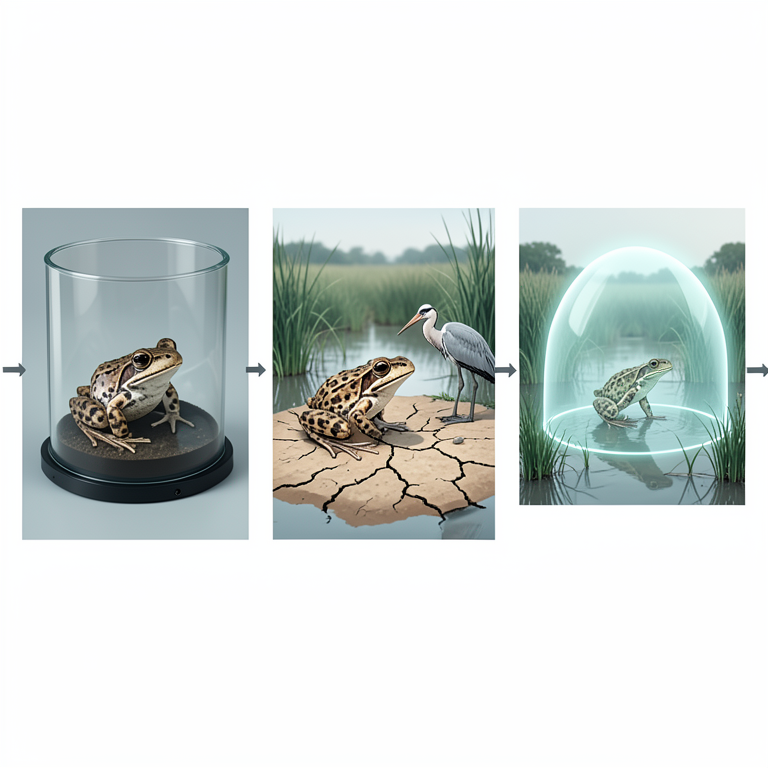
Mortality Factors and Mitigation
AI-generated conceptual illustration (captive-bred Northern leopard frogs in a restored wetland). It explains the idea and does not show study data.
View source evidence ↗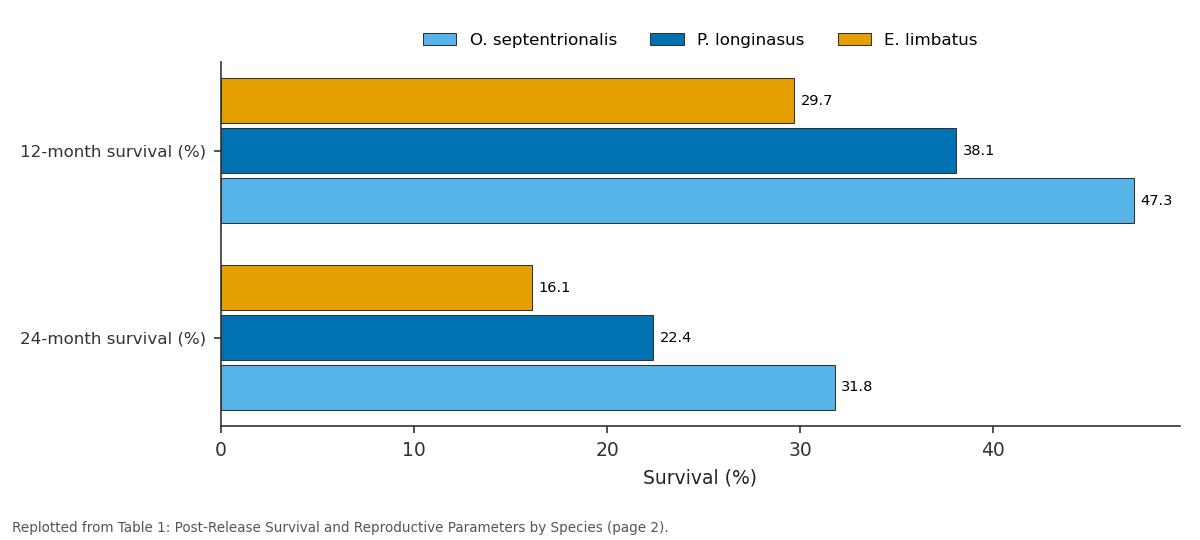
O. septentrionalis and P. longinasus and more: 12-month survival (%) vs 24-month survival (%)
Replotted from Table 1 (page 2) of the original paper. Every bar is the paper's own table value.
View source evidence ↗Figures & tables
From the original paper Table 1
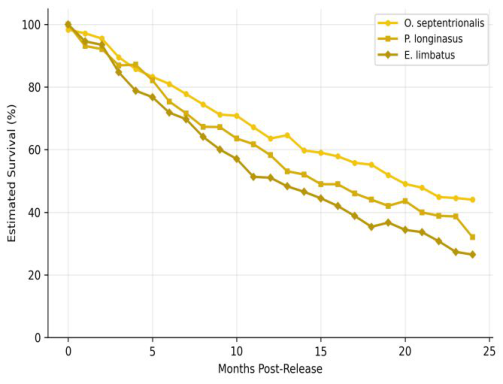 Figure 1
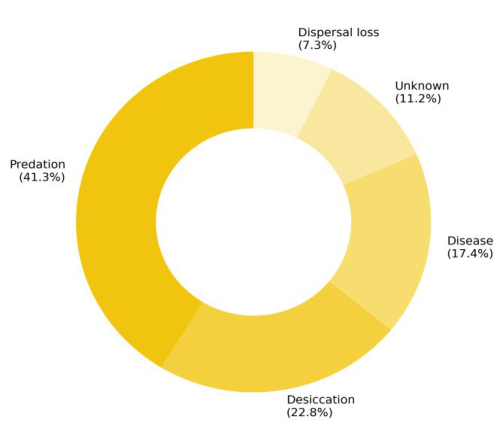 Figure 2
Introduction
A striking pattern has emerged in global conservation: amphibians are declining faster than any other vertebrate class, with over 40% of species now classified as threatened [1]. Habitat loss remains the leading driver, but chytrid fungus, climate change, and pollution compound the problem [2]. Captive breeding programs have been launched for hundreds of amphibian species as a hedge against extinction, yet the success of reintroductions—the ultimate goal of such programs—is poorly documented in tropical regions [3]. Cuba harbors exceptional amphibian endemism, with over 95% of its frog species found nowhere else, but several face population declines linked to habitat degradation [4].
Wetland restoration offers potential for reintroduction, but restored habitats may not replicate the microhabitat conditions of original sites [5]. This research aimed to evaluate post-release survival, mortality causes, site fidelity, and breeding success for three captive-bred Cuban amphibian species released into restored wetlands.
Materials And Methods
Materials This research was conducted by the Department of Conservation Biology, Instituto de Biología Tropical de La Habana, Havana, Cuba, from March 2022 to February 2024. Permits were obtained from the Cuban National Center for Protected Areas (CNAP-2022/CB-014). Two restored freshwater wetland sites in Pinar del Río province served as release locations, each restored two years prior with native vegetation replanting and hydrological reconnection. Captive-bred animals were raised from wild-collected egg masses at the institute's amphibian breeding facility.
All individuals were screened for Batrachochytrium dendrobatidis (Bd) by PCR before release and found negative.
Methods
Animals were marked with visible implant elastomers (VIE; Northwest Marine Technology) in unique color-position combinations before release [6]. NAAS Rating (2025): 4.82 IJBS 2025; 7(11): 104-106 Yanelis Garcia Department of Conservation Biology, Instituto de Biología Tropical de La Habana, Havana, Cuba Reinaldo Iglesias Department of Conservation Biology, Instituto de Biología Tropical de La Habana, Havana, Cuba Yuniel Batista Department of Conservation Biology, Instituto de Biología Tropical de La Habana, Havana, Cuba Yanelis Garcia Department of Conservation Biology, Instituto de Biología Tropical de La Habana, Havana, Cuba https://www.biologyjournal.net fidelity was calculated as the proportion of recaptured individuals found within 50 m of their release point. Data were analyzed using chi-square tests for species comparisons and Kaplan-Meier survival curves.
Results
Monthly mark-recapture surveys were conducted at both sites using visual encounter surveys and drift fence arrays. Survival was estimated using Cormack-Jolly-Seber (CJS) models in Program MARK [7]. Dead individuals encountered were necropsied to determine cause of mortality. Reproductive activity was assessed by monitoring for egg masses, calling males, and metamorph emergence.
Site Table 1: Post-Release Survival and Reproductive Parameters by Species Parameter O. septentrionalis P. longinasus E. limbatus p-value Released (n) 148 126 110 — 12-month survival (%) 47.3 38.1 29.7 0.008 24-month survival (%) 31.8 22.4 16.1 0.004 Site fidelity (%) 72.1 64.8 81.3 0.032 First breeding (months) 6 8 9 — O. septentrionalis showed the highest survival at both time points. E. limbatus had the lowest survival but highest site fidelity. All three species initiated breeding within the first year post-release. Fig 1: Estimated survival trajectories for three reintroduced amphibian species over 24 months.
| Parameter | O. septentrionalis | P. longinasus | E. limbatus | p-value |
|---|---|---|---|---|
| Released (n) | 148 | 126 | 110 | — |
| 12-month survival (%) | 47.3 | 38.1 | 29.7 | 0.008 |
| 24-month survival (%) | 31.8 | 22.4 | 16.1 | 0.004 |
| Site fidelity (%) | 72.1 | 64.8 | 81.3 | 0.032 |
| First breeding (months) | 6 | 8 | 9 | — |
Table text extracted from the original PDF; superscript letters are shown inline. The original table image is below.
View original table image
O. septentrionalis showed the highest persistence, while E. limbatus declined most rapidly.
Discussion
The 12-month survival rates of 29.7-47.3% fall within the range reported for amphibian reintroductions globally, where first-year survival typically ranges from 15% to 55% [3]. The higher survival of O. septentrionalis likely reflects its generalist habits and tolerance of disturbed habitats, while E. limbatus, a direct-developing species with narrow microhabitat requirements, was more vulnerable to predation and desiccation at the restored sites [4]. Predation as the dominant mortality cause is consistent with patterns seen in other reintroduction programs where captive-reared animals lack anti-predator behaviors developed through natural rearing [8]. The detection of breeding activity in all three species is encouraging—it indicates that the restored wetlands provide adequate habitat for reproduction, not just survival [5].
Site fidelity above 60% across all species suggests that dispersal away from release sites, which can undermine reintroduction efforts, was not a major issue here [6].
Conclusion
This research demonstrated that captive-bred Cuban amphibians can survive and reproduce in restored wetland habitats, with species-specific variation in outcomes. O. septentrionalis achieved the highest survival, while E. limbatus was most vulnerable but showed strong site fidelity. Predation was the leading mortality cause, suggesting that anti-predator conditioning before release could improve outcomes. The establishment of breeding activity within the first year at both sites is a positive indicator for long-term population viability.
Continued monitoring and adaptive management are needed to assess whether self-sustaining populations can be maintained.
Acknowledgements
Funding Sources Internal research funds from the Instituto de Biología Tropical de La Habana supported this work. Institutional Support The authors thank the Instituto de Biología Tropical de La Habana for breeding facility access and CNAP for research permits. Contributions Not Qualifying for Authorship Field survey volunteers and breeding facility technicians are gratefully acknowledged. Fig 2: Causes of confirmed mortality among reintroduced amphibians.
Predation was the leading cause (41.3%), followed by desiccation (22.8%) and disease (17.4%). https://www.biologyjournal.net
References
8 in the original paper- Stuart SN, Chanson JS, Cox NA, Young BE, Rodrigues ASL, Fischman DL, et al. Status and trends of amphibian declines and extinctions worldwide. Science. 2004;306(5702):1783-1786.
- Scheele BC, Pasmans F, Skerratt LF, Berger L, Martel A, Beukema W, et al. Amphibian fungal panzootic causes catastrophic and ongoing loss of biodiversity. Science. 2019;363(6434):1459-1463.
- Germano JM, Bishop PJ. Suitability of amphibians and reptiles for translocation. Conserv Biol. 2009;23(1):7- 15.
- Alonso Bosch R, Rodriguez A, Diaz LM. Anfibios de Cuba. Havana: Museo Nacional de Historia Natural de Cuba; 2019.
- Rannap R, Lohmus A, Briggs L. Restoring ponds for amphibians: a success story. Hydrobiologia. 2009;634(1):87-95.
- Bailey LL. Capture-recapture design and analysis. In: Silvy NJ, editor. The Wildlife Techniques Manual. 7th ed. Baltimore: Johns Hopkins University Press; 2012. p. 170-188.
- White GC, Burnham KP. Program MARK: survival estimation from populations of marked animals. Bird Study. 1999;46(sup1):S120-S139.
- Griffiths RA, Pavajeau L. Captive breeding, reintroduction, and the conservation of amphibians. Conserv Biol. 2008;22(4):852-861.