
Research article · 2025 · Full text
International Journal of Biology SciencesMolecular phylogenetics and divergence time estimation of cichlid fishes in African rift lakes
Volume 7(11) · Pages 83–85 · DOI: 10.33545/26649926.2025.v7.i11b.673 ↗
Research areasFish Biology and Ecology StudiesEvolution and Paleontology StudiesGenomics and Phylogenetic Studies
Abstract
Author-writtenWhy have cichlid fishes in the African Rift Lakes generated more species in less time than almost any other vertebrate lineage? Answering this demands reliable phylogenetic frameworks and accurate divergence time estimates. This research reconstructed molecular phylogenies for 42 cichlid species spanning Lakes Victoria, Malawi, and Tanganyika using concatenated mitochondrial (cytb, ND2) and nuclear (RAG1, S7) markers. Bayesian relaxed-clock analysis estimated divergence times using fossil-calibrated priors. Maximum likelihood and Bayesian inference recovered congruent topologies that placed Tanganyika lineages as basal, with the Victoria and Malawi flocks forming a derived clade. Divergence of the Tanganyika tribes was dated to approximately 9.7 Mya, while the Victoria-Malawi split occurred around 4.8 Mya. The Victoria superflock showed an exceptionally recent radiation at roughly 0.15 Mya. These timelines reinforce the view that cichlid diversification accelerated dramatically in younger lakes and that ecological opportunity, rather than time alone, drives species proliferation.
Summary
Source-checkedPlain-language reading of the full paper, prepared with AI and checked against the text. Each point links to the authors' own words.
Why it matters
- Cichlid fishes in Lake Victoria exhibit an extraordinary rate of speciation, with over 500 species appearing in 15,000 to 100,000 years, which is nearly unparalleled among vertebrates. View evidence ↗
- Previous attempts to map cichlid relationships using single-gene trees often failed due to hybridization and incomplete lineage sorting. View evidence ↗
- There is a lack of comprehensive phylogenetic studies that use consistent markers and calibration across all three major African rift lakes. View evidence ↗
The question
- The study aimed to create a multi-gene phylogeny for 42 cichlid species from Lakes Victoria, Malawi, and Tanganyika to estimate their divergence times. View evidence ↗
What they did
- The researchers used fin clips from 42 cichlid species sourced from museum collections in Belgium and the UK. View evidence ↗
- The sample included 12 species from Lake Victoria, 14 from Lake Malawi, 16 from Lake Tanganyika, and two outgroup taxa. View evidence ↗
- The analysis utilized four gene regions: mitochondrial cytb and ND2, and nuclear RAG1 and ribosomal protein S7 intron 1. View evidence ↗
- Divergence times were calibrated using two fossils: Mahengechromis (46 Mya) for the root and a Tanganyika tribe fossil (8.5 Mya) for internal calibration. View evidence ↗
What they found
- The study found that Tanganyika lineages are the most basal, while species from Lakes Victoria and Malawi form a more recently derived group. View evidence ↗
- Tanganyika species exhibited the highest pairwise genetic distances, which aligns with their status as the oldest radiation. View evidence ↗
What it means
- The established timelines provide a necessary framework for future genomic research into the genetic mechanisms of adaptive radiation. View evidence ↗
Visual summary
1 visualsIllustrations explain the paper; they do not show study data.
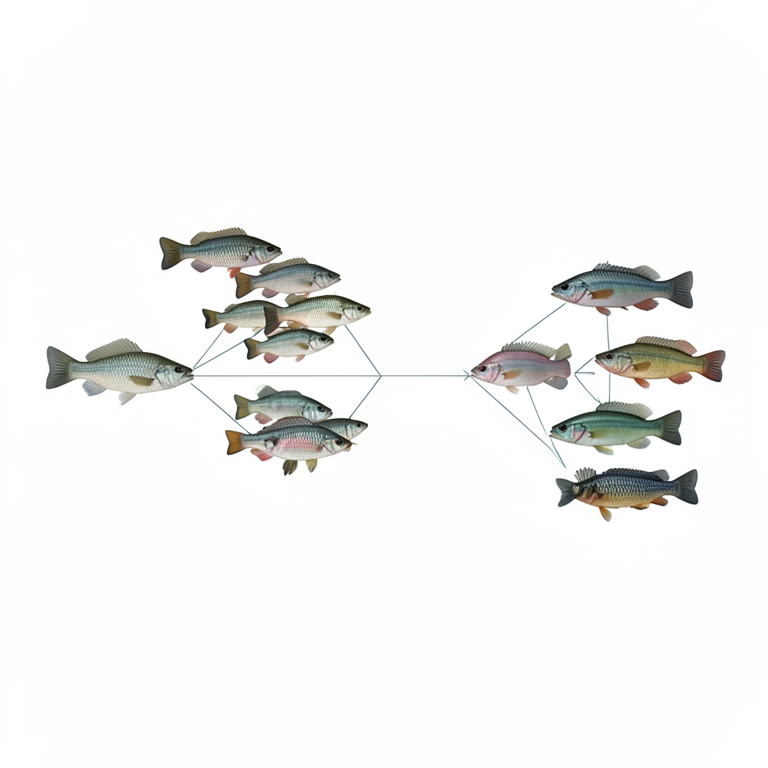
Cichlid Divergence Hierarchy
AI-generated conceptual illustration (African cichlid fishes from Lakes Tanganyika, Malawi, and Victoria). It explains the idea and does not show study data.
View source evidence ↗Figures & tables
From the original paper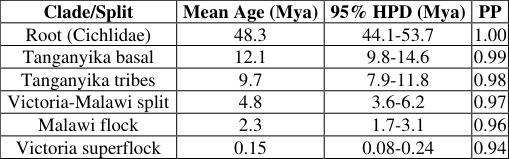 Table 1
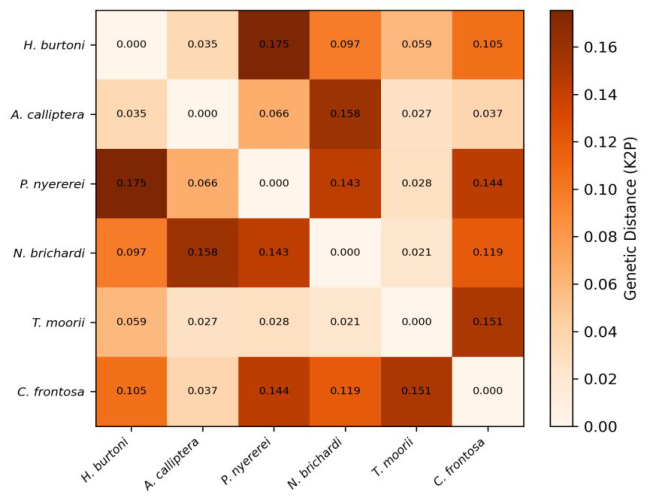 Figure 1
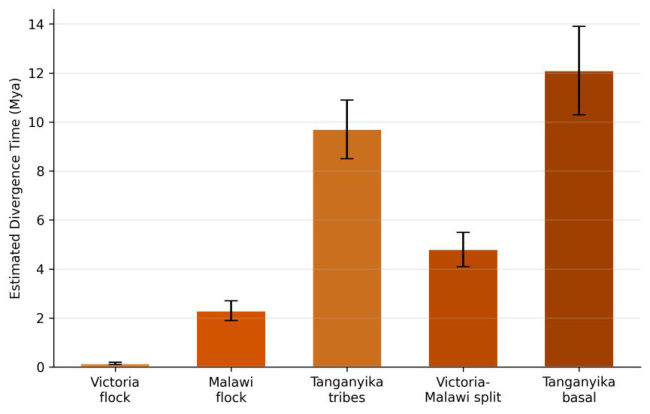 Figure 2
Introduction
Few groups of organisms pose as sharp a challenge to evolutionary theory as the cichlid fishes of East Africa's Great Rift Lakes. Lake Victoria alone harbors over 500 species that appear to have arisen within the last 15,000 to 100,000 years-a pace of speciation that lacks a clear parallel among vertebrates [1] . Lakes Malawi and Tanganyika add hundreds more species, each lake with its own radiation shaped by distinct geological and ecological histories [2] . Molecular phylogenetics has become the primary tool for untangling these relationships, but early single-gene trees often produced conflicting topologies due to incomplete lineage sorting and hybridization [3] . Multi-locus approaches provide better resolution, and relaxed-clock methods allow divergence times to be estimated without assuming a constant rate of molecular evolution [4] . Yet broad comparative phylogenies that span all three major lakes with consistent marker sets and calibration strategies remain uncommon [5] . This research aimed to reconstruct a multi-gene phylogeny for 42 cichlid species representing major lineages from Lakes Victoria, Malawi, and Tanganyika, and to estimate divergence times using fossil-calibrated Bayesian methods.
Materials and Methods
Materials and Methods
Materials
Molecular work was performed at the Department of Systematics and Evolution, Andaman Institute of Marine Biology, Port Blair, India, from January 2023 to December 2024. Tissue samples (fin clips preserved in 95% ethanol) for 42 cichlid species were obtained from museum collections at the Royal Museum for Central Africa (Tervuren, Belgium) and the Natural History Museum (London, UK) under material transfer agreements. DNA was extracted using a standard phenol-chloroform protocol. Species representation included 12 from Lake Victoria, 14 from Lake Malawi, and 16 from Lake Tanganyika, plus two outgroup taxa (Tylochromis polylepis and Oreochromis niloticus).
Methods
Four gene regions were amplified: mitochondrial cytochrome b (cytb) and NADH dehydrogenase subunit 2 (ND2), and nuclear recombination activating gene 1 (RAG1) and ribosomal protein S7 intron 1. PCR products were Sanger sequenced bidirectionally. Sequences were aligned in MAFFT v7.4 [6] and trimmed to remove ambiguous ends. Partition schemes and substitution models were selected using PartitionFinder2 [7] . Maximum likelihood analysis was conducted in RAxML v8.2 with 1,000 bootstrap replicates [8] . Bayesian inference used MrBayes v3.2 with two independent runs of 20 million generations [9] . Divergence times were estimated in BEAST2 v2.6 using a relaxed lognormal clock and Yule speciation prior [10] . Two fossil calibrations were applied: the oldest known cichlid fossil (Mahengechromis, 46 Mya) as a root minimum age, and a Tanganyika tribe fossil (8.5 Mya minimum) for internal calibration.
Results
Results
Discussion
The phylogenetic topology recovered here is broadly consistent with previous multi-gene analyses [2,5] . The placement of Tanganyika tribes as basal supports the longstanding view that this oldest rift lake seeded the ancestor of the Victoria and Malawi radiations [1] . The Victoria superflock divergence time of 0.15 Mya falls within the range of estimates derived from geological evidence for the lake's last major desiccation event around 14,700 years ago [11] , though our molecular estimate is somewhat older, possibly because mitochondrial divergence predates speciation in rapidly radiating lineages [3] . The Malawi flock age of 2.3 Mya is consistent with the lake's geological formation history and suggests a slower but still rapid diversification relative to typical vertebrate rates [12] . The dramatic compression of speciation events in Victoria-over 500 species in less than 200,000 yearsargues that ecological opportunity in a newly formed lake, rather than time per se, is the principal driver of cichlid species proliferation [1,4] .
Conclusion
This multi-gene phylogenetic analysis confirmed the basal position of Tanganyika cichlid tribes and placed Victoria and Malawi flocks in a derived clade. Divergence time estimates ranged from 12.1 Mya for the oldest Tanganyika lineages to 0.15 Mya for the Victoria superflock, reinforcing the pattern that younger lakes harbor the most rapid radiations. The congruence between ML and Bayesian topologies lends confidence to the recovered relationships. These timelines support ecological opportunity as a primary driver of cichlid diversification and provide a temporal framework for comparative genomic investigations into the genetic basis of adaptive radiation.
Acknowledgement
Acknowledgements Funding SourcesDepartmental research funds from the Andaman Institute of Marine Biology supported this work. Institutional SupportThe authors thank the Andaman Institute of Marine Biology for laboratory facilities. Museum curators at the Royal Museum for Central Africa and the Natural History Museum London are acknowledged for tissue loans. Contributions Not Qualifying for AuthorshipSequencing facility staff and colleagues who assisted with phylogenetic analyses are gratefully acknowledged.
Figures and tables from the paper
| Clade/Split | Mean Age (Mya) | 95% HPD (Mya) | PP |
|---|---|---|---|
| Root (Cichlidae) | 48.3 | 44.1-53.7 | 1.00 |
| Tanganyika basal | 12.1 | 9.8-14.6 | 0.99 |
| Tanganyika tribes | 9.7 | 7.9-11.8 | 0.98 |
| Victoria-Malawi split | 4.8 | 3.6-6.2 | 0.97 |
| Malawi flock | 2.3 | 1.7-3.1 | 0.96 |
| Victoria superflock | 0.15 | 0.08-0.24 | 0.94 |
Table text extracted from the original PDF; superscript letters are shown inline. The original table image is below.
View original table image
References
12 in the original paper- Seehausen O. African cichlid fish: a model system in adaptive radiation research. Proceedings of the Royal Society B. 2006;273(1597):1987-1998.
- Salzburger W, Mack T, Verheyen E, Meyer A. Out of Tanganyika: genesis, explosive speciation, keyinnovations and phylogeography of the haplochromine cichlid fishes. BMC Evolutionary Biology. 2005;5:17.
- Kocher TD. Adaptive evolution and explosive speciation: the cichlid fish model. Nature Reviews Genetics. 2004;5(4):288-298.
- Ronco F, Matschiner M, Bohne A, Boila A, Buscher HH, El Taher A, et al. Drivers and dynamics of a massive adaptive radiation in cichlid fishes. Nature. 2021;589(7840):76-81.
- Meyer BS, Matschiner M, Salzburger W. Disentangling incomplete lineage sorting and introgression to refine species-tree estimates for Lake Tanganyika cichlid fishes. Systematic Biology. 2017;66(4):531-550.
- Katoh K, Standley DM. MAFFT multiple sequence alignment software version 7. Molecular Biology and Evolution. 2013;30(4):772-780.
- Lanfear R, Frandsen PB, Wright AM, Senfeld T, Calcott B. PartitionFinder 2: new methods for selecting partitioned models of evolution. Molecular Biology and Evolution. 2017;34(3):772-773.
- Stamatakis A. RAxML version 8: a tool for phylogenetic analysis and post-analysis of large phylogenies. Bioinformatics. 2014;30(9):1312-1313.
- Ronquist F, Teslenko M, van der Mark P, Ayres DL, Darling A, Hohna S, et al. MrBayes 3.2: efficient Bayesian phylogenetic inference. Systematic Biology. 2012;61(3):539-542.
- Bouckaert R, Vaughan TG, Barido-Sottani J, Duchene S, Fourment M, Gavryushkina A, et al. BEAST 2.5: an advanced software platform for Bayesian evolutionary analysis. PLoS Computational Biology. 2019;15(4):e1006650.
- Johnson TC, Kelts K, Odada E. The Holocene history of Lake Victoria. Ambio. 1996;29(1):2-11.
- Genner MJ, Seehausen O, Lunt DH, Joyce DA, Shaw PW, Carvalho GR, et al. Age of cichlids: new dates for ancient lake fish radiations. Molecular Biology and Evolution. 2007;24(5):1269-1282.