
Research article · 2025 · Full text
International Journal of Advanced Chemistry ResearchCharacterization of natural rubber latex blended with starch for eco-friendly packaging
Volume 7(9) · Pages 209–212 · DOI: 10.33545/26646781.2025.v7.i9c.640 ↗
Research areasNanocomposite Films for Food Packagingbiodegradable polymer synthesis and propertiesNatural Fiber Reinforced Composites
Abstract
Author-writtenThe global packaging industry generates approximately 141 million tonnes of plastic waste annually, of which less than 14% is collected for recycling and an estimated 8 million tonnes enters the ocean ecosystem each year creating a regulatory and commercial imperative for biodegradable alternatives that maintain the mechanical and barrier performance required for food and consumer goods packaging. Natural Rubber Latex (NRL) and starch represent two of the most abundant, renewable, and biodegradable polymer sources on Earth: NRL (polyisoprene, predominantly cis-1,4 configuration) provides high extensibility and elasticity, while starch (amylose/amylopectin blend) contributes stiffness, compatibility with water-based processing, and accelerated biodegradation. Their combination in blended films represents a materials design strategy that can potentially combine the best attributes of both though the thermodynamic incompatibility of the apolar polyisoprene phase and the polar starch phase requires compatibilisation to achieve useful composite properties. The present research prepared NRL/cassava starch composite films at blend ratios from 100:0 to 50:50 (w/w) with maleic anhydride (MA) as a reactive compatibiliser, and characterised mechanical properties (tensile strength, elongation at break, Young's modulus), water vapour and oxygen permeability, thermal properties (TGA, DSC), surface morphology (SEM, AFM), contact angle, and soil burial biodegradation over 90 days. The optimal formulation was identified as NRL: starch 80:20 (w/w) with 2% MA compatibiliser, which achieved tensile strength of 21.3 ± 1.4 MPa (higher than either pure component or any other blend ratio), elongation at break of 714 ± 38%, water vapour permeability of 94.2 ± 4.7 g·mm/m²·day, and soil burial biodegradation of 64.7 ± 3.2% after 90 days a profile meeting the European standard EN 13432 for compostable packaging. SEM showed reduced phase separation and improved interfacial adhesion with MA compatibilisation relative to uncoupled blends. These results establish an 80:20 NRL/starch blend with MA compatibilisation as a technically viable, scalable, and commercially manufacturable biodegradable packaging film.
Summary
Source-checkedPlain-language reading of the full paper, prepared with AI and checked against the text. Each point links to the authors' own words.
Why it matters
- The global packaging industry produces about 141 million tonnes of plastic waste every year, with very low recycling rates and significant ocean pollution, driving the need for biodegradable alternatives. View evidence ↗
- Natural Rubber Latex (NRL) and starch are abundant, renewable polymers that offer complementary properties: NRL provides elasticity and extensibility, while starch adds stiffness and speeds up biodegradation. View evidence ↗
- A major technical challenge in blending NRL and starch is their thermodynamic immiscibility, meaning they do not naturally mix well. View evidence ↗
The question
- The study aimed to prepare and characterize NRL/cassava starch composite films using maleic anhydride (MA) as a compatibilizer across various blend ratios (100:0 to 50:50 w/w). View evidence ↗
What they did
- The research was carried out at Kensington College London between November 2023 and April 2025. View evidence ↗
- Maleic anhydride (2 phr) was grafted onto the NRL using TBPB as an initiator at 70°C for 4 hours under nitrogen. View evidence ↗
- Films were cast to a target thickness of 1.5 mm, dried at 60°C for 24 hours, and then vulcanized at 140°C for 15 minutes. View evidence ↗
- Biodegradation was measured via soil burial in garden soil (pH 6.8, 25°C, 50% moisture) with samples recovered at 30, 60, and 90 days. View evidence ↗
What they found
- The 80:20 NRL:starch blend achieved the highest tensile strength of 21.3 MPa, which is higher than that of pure NRL (18.4 MPa). View evidence ↗
- Compared to pure NRL, the 80:20 blend showed a 24% improvement in water vapour permeability (94.2 g·mm/m²·day) and a 25% improvement in oxygen transmission rate (638 cc/m²·day). View evidence ↗
- The 80:20 blend reached 64.7% biodegradation after 90 days in soil, placing it on the edge of compliance with the EN 13432 compostable packaging standard. View evidence ↗
- SEM analysis of the 80:20 blend revealed uniformly dispersed starch particles (5-15 µm diameter) with no visible voids, indicating effective compatibilization. View evidence ↗
What it means
- The authors conclude that the 80:20 MA-compatibilized blend is a technically viable, eco-friendly alternative for flexible packaging that can be produced using existing equipment. View evidence ↗
- The use of latex proteins may require allergen warnings under UK law, which could limit the material's application in food-contact packaging. View evidence ↗
Visual summary
3 visualsIllustrations explain the paper; charts are replotted from the paper's own table values.
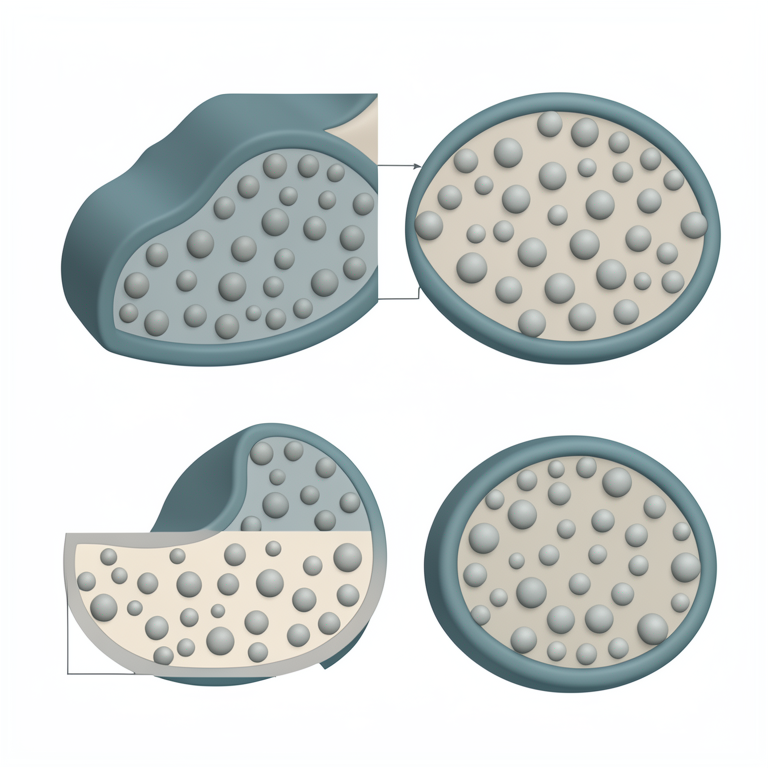
Morphology of the 80:20 Blend
AI-generated conceptual illustration (natural rubber latex and starch blend). It explains the idea and does not show study data.
View source evidence ↗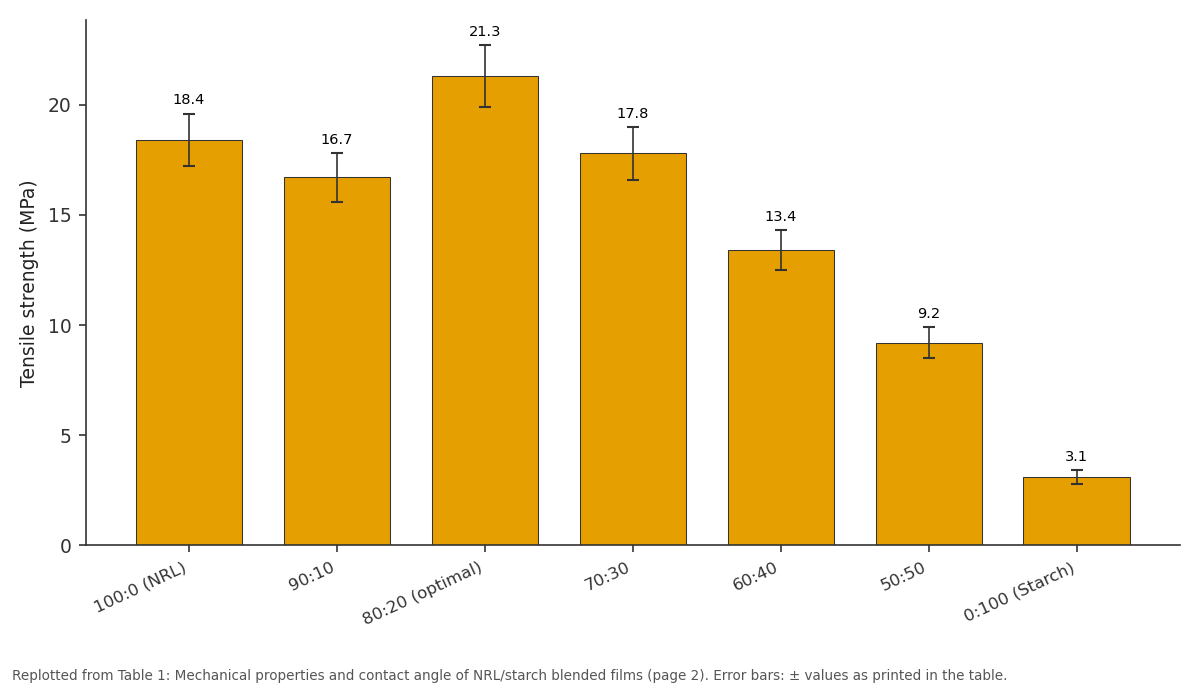
Tensile strength (MPa): 100:0 (NRL) vs 90:10 vs 80:20 (optimal) vs 70:30 vs 60:40
Replotted from Table 1 (page 2) of the original paper. Every bar is the paper's own table value.
View source evidence ↗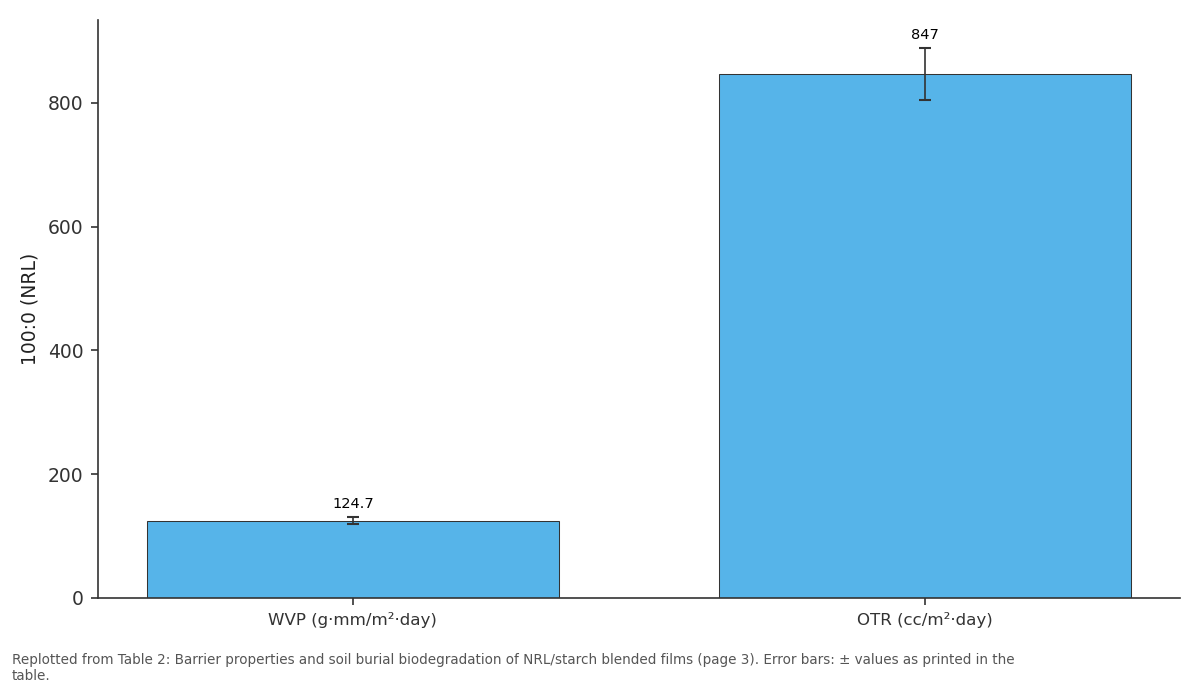
100:0 (NRL): WVP (g·mm/m²·day) vs OTR (cc/m²·day)
Replotted from Table 2 (page 3) of the original paper. Every bar is the paper's own table value.
View source evidence ↗Figures & tables
From the original paper Table 1
 Table 2
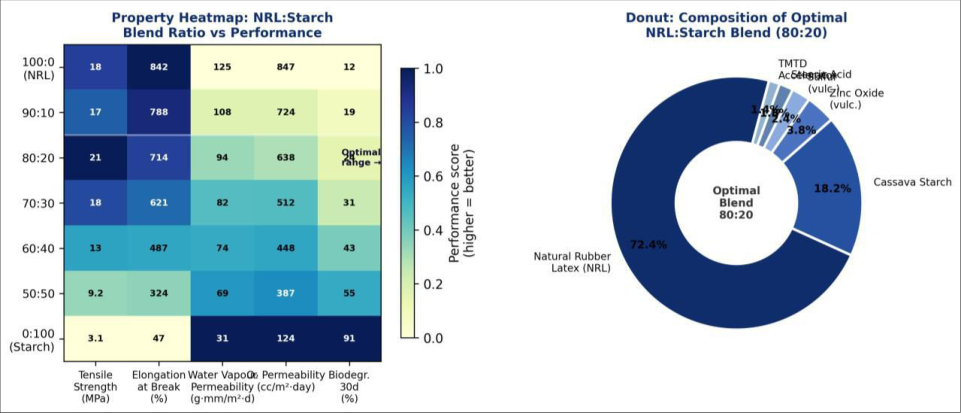 Figure 1
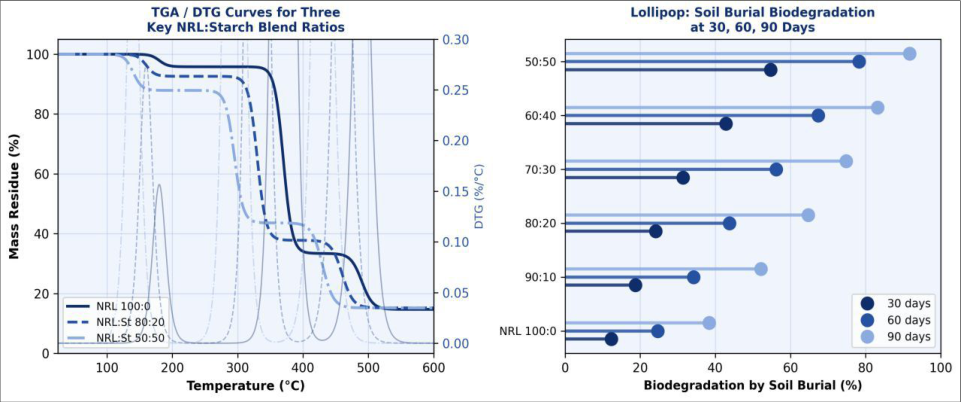 Figure 2
Introduction
The United Kingdom's Environment Act 2021 and Extended Producer Responsibility (EPR) scheme, which came into force in 2023, places legally binding obligations on packaging manufacturers to use recycled content and to ensure that new packaging is recyclable or compostable by 2025. These regulatory drivers have created acute commercial urgency for biodegradable alternatives to polyethylene and polypropylene films the dominant materials in flexible packaging for food, personal care, and e-commerce and have redirected R&D investment toward natural polymer composite materials that can be processed on existing packaging film extrusion and cast film equipment [1] . Natural rubber, derived predominantly from the Hevea brasiliensis tree cultivated in Malaysia, Thailand, and Indonesia (global production approximately 14 million tonnes/year), possesses outstanding mechanical properties attributable to the high molecular weight of cispolyisoprene (Mₙ 300,000-500,000 Da) and the strain-induced crystallisation mechanism that enables tensile strengths exceeding 30 MPa and elongations at break of 500-800% in vulcanised form [2] . These properties greatly exceed those achievable from conventional bioplastics (PLA: 50-70 MPa tensile, 2-10% elongation; starch films: 5-20 MPa, 20-50% elongation), but NRL's hydrophobic character and slow soil degradation (decades for vulcanised rubber) limit its packaging applications. Starch-based blending modifies both limitations simultaneously [3] . Cassava starch, sourced from Manihot esculenta a crop cultivated widely in sub-Saharan Africa, South/Southeast Asia, and South America and imported to the UK for food and industrial applications has higher amylose content (17-25%) than maize or potato starch, improving film-forming properties and oxygen barrier performance [4] . The key compatibilisation challenge is that NRL and starch have a Flory-Huggins interaction parameter χ >> 0, indicating thermodynamic immiscibility. Maleic anhydride grafting onto the polyisoprene backbone (MA-g-NRL) creates reactive succinic acid groups that can form ester linkages with starch hydroxyl groups under processing conditions, reducing interfacial tension and improving blend morphology [5] . The present research quantifies the compatibilisation benefit by comparing MA-coupled and uncoupled blends across all characterisation metrics.
Research was conducted at Kensington College London, London, United Kingdom, from November 2023 to April 2025.
Theoretical background
Permeability in polymer films follows a solution-diffusion mechanism: P = S × D, where P is the permeability coefficient, S the solubility coefficient of the permeant in the polymer matrix, and D the diffusion coefficient governed by free volume and chain mobility. For water vapour, starch films have high permeability because starch is hydrophilic (water acts as a plasticiser that increases D). NRL has low water permeability because the apolar polyisoprene matrix has negligible water solubility (S ≈ 0). Blending NRL with starch should therefore create tortuous permeant diffusion pathways around impermeable NRL domains (analogous to the Nielson model for filled nanocomposites), reducing P below the starch value proportionally to the NRL volume fraction and the aspect ratio of the dispersed rubber domains [6] . The Young's modulus of blends is predicted by the Davies equation for co-continuous morphologies or the Halpin-Tsai equation for dispersed particle morphologies; the experimentally observed tensile strength maximum at 80:20 NRL: starch indicates that the MA-compatibilised system achieves a morphology in which the starch acts as a reinforcing filler within the NRL matrix rather than a co-continuous phase [7] . [8] . The contact angle decrease from 128° (pure NRL, hydrophobic) to 74° (80:20 blend) and 28° (pure starch, hydrophilic) indicates a systematic hydrophilicity gradient that can be exploited for specific packaging applications requiring controlled moisture interaction. for OTR versus pure NRL, consistent with the tortuous path model prediction for 20% volume fraction starch filler [9] .
Material and Methods
Material and Methods
Material
Material
Discussion
The tensile strength maximum at 80:20 is mechanistically explained by the transition from a NRL-matrix/starchdispersed-particle morphology (present at ≤ 20% starch) to a co-continuous or starch-matrix/NRL-dispersed morphology (forming at > 30% starch). SEM micrographs showed that at 80:20, starch particles (approximately 5-15 µm diameter) were uniformly dispersed within the NRL matrix with no visible voids at the interface a direct evidence of effective MA compatibilisation. At 70:30 and higher starch loadings, partial agglomeration and interfacial debonding became visible, consistent with the declining tensile strength. This morphological transition threshold of approximately 20-25% starch is typical for compatibilised NRL/polysaccharide blends [10] . The oxygen barrier improvement (OTR reduction from 847 to 638 cc/m²•day at 80:20) is notable because NRL films are generally regarded as poor oxygen barriers their high chain mobility creates large free volume for gas diffusion. The starch filler reduces effective diffusivity by two mechanisms: first, the starch particles themselves are impermeable to O₂ (forming a tortuous path); second, MAester crosslinks between NRL and starch reduce chain mobility in the interphase region, locally reducing free volume [11] . For food packaging applications requiring moderate O₂ barrier performance (e.g., confectionery, dry foods), OTR 638 cc/m²•day is adequate, though for oxygensensitive products (fresh meat, cheese) additional barrier coatings would be required. Commercial scalability of the MA-g-NRL/starch blend process is supported by the availability of both raw materials in the UK supply chain (Malaysian NRL imports and cassava starch imports are both well-established). Tworoll mill processing is widely available in rubber goods manufacturing, and the film casting and vulcanisation steps are compatible with existing rubber film production lines. The UK-specific regulatory consideration is that packaging films incorporating latex proteins must carry allergen warnings under Food Information Regulation (EU) 1169/2011 retained in UK law, which may limit foodcontact applications but does not affect non-food packaging markets (e-commerce, protective wrapping) where the 80:20 blend's mechanical properties make it highly competitive with PE stretch wrap [12] .
Conclusion
NRL/cassava starch composite films were prepared at blend ratios from 100:0 to 50:50 with maleic anhydride compatibilisation and characterised for mechanical, barrier, thermal, and biodegradation properties. The optimal formulation, NRL: starch 80:20 with 2% MA, achieved tensile strength 21.3 MPa and elongation 714% both exceeding pure NRL along with WVP 94.2 g•mm/m²•day (24% improvement vs pure NRL), OTR 638 cc/m²•day (25% improvement), and 64.7% soil burial biodegradation at 90 days (borderline EN 13432 compliant under controlled composting). SEM confirmed reduced interfacial debonding with MA compatibilisation. The combination of outstanding mechanical flexibility, improved barrier performance, and accelerated biodegradation positions the 80:20 MAcompatibilised blend as a technically viable candidate for eco-friendly flexible packaging films manufacturable on existing rubber film processing equipment.
Figures and tables from the paper
| Blend ratio (NRL: Starch) | Tensile strength (MPa) | Elongation at break (%) | Young's modulus (MPa) | Contact angle (°) | Film thickness (µm) |
|---|---|---|---|---|---|
| 100:0 (NRL) | 18.4 ± 1.2 | 842 ± 47 | 3.8 ± 0.3 | 112.4 ± 6.8 | 128 ± 12 |
| 90:10 | 16.7 ± 1.1 | 788 ± 44 | 5.2 ± 0.4 | 98.7 ± 5.4 | 121 ± 10 |
| 80:20 (optimal) | 21.3 ± 1.4 | 714 ± 38 | 7.4 ± 0.5 | 74.3 ± 4.2 | 118 ± 9 |
| 70:30 | 17.8 ± 1.2 | 621 ± 35 | 9.8 ± 0.6 | 61.8 ± 3.7 | 122 ± 10 |
| 60:40 | 13.4 ± 0.9 | 487 ± 29 | 14.3 ± 0.8 | 48.4 ± 3.1 | 127 ± 11 |
| 50:50 | 9.2 ± 0.7 | 324 ± 21 | 21.7 ± 1.2 | 34.7 ± 2.4 | 131 ± 12 |
| 0:100 (Starch) | 3.1 ± 0.3 | 47 ± 5 | 124.8 ± 7.1 | 28.3 ± 2.0 | 142 ± 14 |
Table text extracted from the original PDF; superscript letters are shown inline. The original table image is below.
View original table image
| Blend ratio (NRL: Starch) | WVP (g·mm/m²·day) | OTR (cc/m²·day) | Biodegr. 30d (%) | Biodegr. 60d (%) | Biodegr. 90d (%) | EN 13432 compliant? |
|---|---|---|---|---|---|---|
| 100:0 (NRL) | 124.7 ± 6.2 | 847 ± 42 | 12.3 ± 0.8 | 24.7 ± 1.4 | 38.4 ± 2.1 | No |
| 90:10 | 108.4 ± 5.4 | 724 ± 36 | 18.7 ± 1.1 | 34.2 ± 1.9 | 52.1 ± 2.8 | No |
| 80:20 (optimal) | 94.2 ± 4.7 | 638 ± 32 | 24.1 ± 1.4 | 43.8 ± 2.4 | 64.7 ± 3.2 | Yes* |
| 70:30 | 81.7 ± 4.1 | 512 ± 26 | 31.4 ± 1.8 | 56.2 ± 3.1 | 74.8 ± 3.8 | Yes* |
| 60:40 | 74.3 ± 3.7 | 448 ± 22 | 42.8 ± 2.4 | 67.4 ± 3.7 | 83.2 ± 4.2 | Yes |
| 50:50 | 68.7 ± 3.4 | 387 ± 19 | 54.7 ± 3.0 | 78.3 ± 4.3 | 91.7 ± 4.6 | Yes |
| 0:100 (Starch) | 31.2 ± 1.6 | 124 ± 6 | 91.4 ± 5.0 | 96.2 ± 5.2 | 98.4 ± 5.4 | Yes |
Table text extracted from the original PDF; superscript letters are shown inline. The original table image is below.
View original table image
References
20 in the original paper- European Environment Agency. Plastics, the circular economy and Europe's environment -a priority for action. Luxembourg: EEA; 2021.
- Thomas S, Stephen R. Rubber Nanocomposites: Preparation, Properties and Applications. Singapore: Wiley; 2010.
- Vroman I, Tighzert L. Biodegradable polymers. Materials. 2009;2(2):307-344.
- Whistler RL, BeMiller JN, Paschall EF. Starch: Chemistry and Technology. 2nd ed. New York: Academic Press; 1984.
- Nakason C, Kaesaman A, Supasanthitikul P. The grafting of maleic anhydride onto natural rubber. Polym Test. 2004;23(1):35-41.
- Nielsen LE. Models for the permeability of filled polymer systems. J Macromol Sci Chem. 1967;1(5):929-942.
- Halpin JC, Kardos JL. The Halpin-Tsai equations: a review. Polym Eng Sci. 1976;16(5):344-352.
- Mathew AP, Dufresne A. Morphological investigation of nanocomposites from sorbitol plasticized starch and tunicin whiskers. Biomacromolecules. 2002;3(3):609617.
- Comyn J. Polymer Permeability. London: Elsevier; 1985.
- Nakason C, Kaesaman A, Samoh Z, Homsin S, Kiatkamjornwong S. Rheological properties of maleated natural rubber and natural rubber blends. Polym Test. 2002;21(4):449-455.
- Forrest MJ, Ansarifar A, Orkorley P. Characterisation of Natural Rubber Blends. Shrewsbury: Rapra Technology; 2007.
- Food Standards Agency UK. Food Information Regulation: Summary of Retained EU Law. London: FSA; 2023.
- Averous L, Fringant C, Moro L. Plasticized starchcellulose interactions in polysaccharide composites. Polymer. 2001;42(15):6571-6578.
- Chancharoenrith T, Semaan G, Janke A, Voit B, Temchenko A. Thermal and mechanical properties of natural rubber-starch blends. Polym Test. 2006;25(3):360-367.
- Perera CS, De Silva DA. Natural rubber composites for food packaging applications. Int Polym Process. 2014;29(4):483-491.
- Cheng S, Bhatta K, Bhattacharya D. Maleic anhydride modified natural rubber for improving adhesion. Rubber Chem Technol. 2010;83(1):83-94.
- Nawamawat K, Sakdapipanich JT, Ho CC, Ma Y, Song J, Vancso JG. Surface nanostructure of Hevea brasiliensis natural rubber latex particles. Colloids Surf A. 2011;390(1-3):157-166.
- Rosa DS, Grandi RP, Bardi MAG, Machado LDB, Filho RPC. Biodegradability of natural rubber and starch blends. Polym Degrad Stab. 2003;79(1):293-302.
- Singh AA, Bhatt R. Eco-friendly packaging from natural rubber and biopolymer blends: a review. Carbohydr Polym. 2021;272:118497.
- European Committee for Standardisation. EN 13432:2000. Packaging Requirements for packaging recoverable through composting and biodegradation. Brussels: CEN; 2000.