
Research article · 2025 · Full text
International Journal of Advanced Chemistry ResearchElectrolytic recovery of copper from printed circuit board leach solutions
Volume 7(9) · Pages 139–142 · DOI: 10.33545/26646781.2025.v7.i9b.629 ↗
Research areasRecycling and Waste Management TechniquesExtraction and Separation ProcessesElectrodeposition and Electroless Coatings
Abstract
Author-writtenElectronic waste is growing three times faster than general municipal waste globally, and printed circuit boards (PCBs) represent one of the most metal-dense fractions of the e-waste stream: a tonne of PCBs contains approximately 100-250 kg of copper, 150-350 g of gold, and 300-700 g of silver concentrations that dwarf those in the best natural ore deposits. Hydrometallurgical processing, particularly acidic leaching followed by electrolytic copper recovery, offers a more controllable and lower-carbon route to PCB metal recovery than pyrometallurgy. However, the leach solutions produced from PCB dissolution in H₂SO₄/H₂O₂ systems are complex matrices containing multiple metals (Cu, Sn, Pb, Fe, Ni, Zn) that must be selectively recovered in sequence, with copper being the primary target because of its high concentration and commercial value. The present research optimised the electrodeposition of copper from synthetic PCB leach solutions as a function of pH (0.5-4.0), current density (50-400 A/m²), temperature (25-60°C), and Cu²⁺ concentration (5-40 g/L) using a response surface methodology (Box-Behnken design). Copper recovery reached 96.4% at optimal conditions: pH 1.5, 200 A/m², 45°C, and initial Cu²⁺ = 25 g/L. The deposited copper had 99.6% purity (ICP-OES), current efficiency of 94.7%, and specific energy consumption of 1.84 kWh/kg Cu among the lowest reported for PCB leach electrorecovery systems. Cyclic voltammetry and EIS characterisation of the Pb/1%Ag insoluble anode confirmed stable oxygen evolution behaviour across 20 consecutive electrodeposition cycles. The process mass balance demonstrated 93.7% overall Cu recovery across the two-stage electrodeposition scheme, with the remaining 6.3% recoverable by cementation. These results provide a quantitative basis for scaling the process to a 100 kg Cu/day pilot plant configuration.
Summary
Source-checkedPlain-language reading of the full paper, prepared with AI and checked against the text. Each point links to the authors' own words.
Why it matters
- Electronic waste is increasing globally three times faster than municipal waste, with printed circuit boards (PCBs) being highly valuable due to copper concentrations (100-250 kg/tonne) that exceed those found in natural ores. View evidence ↗
- Hydrometallurgical processing, using acidic leaching and electrolytic recovery, is a lower-carbon and more controllable alternative to pyrometallurgy for recovering metals from PCBs. View evidence ↗
- Leach solutions from PCBs are complex mixtures of metals including copper, tin, lead, iron, nickel, and zinc, making the selective recovery of high-value copper a primary challenge. View evidence ↗
The question
- The study aimed to optimize copper electrodeposition from synthetic PCB leach solutions by evaluating the effects of pH, current density, temperature, and copper concentration. View evidence ↗
What they did
- The research was carried out between July 2023 and January 2025 at the Tata Institute of Chemical Engineering in Jamshedpur and the Kalpana Chawla Institute of Biosciences in Hyderabad, India. View evidence ↗
- Synthetic leach solutions were created using high-purity salts in 1 M H₂SO₄ to match real PCB leach concentrations: Cu (25 g/L), Sn (10 g/L), Pb (7 g/L), Fe (5 g/L), Ni (3 g/L), and Zn (1.5 g/L). View evidence ↗
- The experimental setup used an undivided 500 mL cell with a titanium cathode and a Pb/1%Ag insoluble alloy anode, both measuring 50 mm × 50 mm × 1 mm. View evidence ↗
- A Box-Behnken design consisting of 27 runs was used to optimize four variables: pH (0.5 to 4.0), current density (50 to 400 A/m²), temperature (25 to 60°C), and initial Cu²⁺ concentration (5 to 40 g/L). View evidence ↗
What they found
- The highest copper recovery of 96.4% was achieved under optimal conditions of pH 1.5, a current density of 200 A/m², a temperature of 45°C, and an initial Cu²⁺ concentration of 25 g/L. View evidence ↗
- At optimal conditions, the recovered copper exhibited 99.6% purity, a current efficiency of 94.7%, and a specific energy consumption of 1.84 kWh/kg Cu. View evidence ↗
- A two-stage electrodeposition scheme resulted in an overall copper recovery of 93.7%, while the remaining 6.3% could be recovered via cementation. View evidence ↗
- The optimized process outperformed literature comparators in terms of single-pass recovery (96.4%), current efficiency (94.7%), and energy consumption (1.84 kWh/kg Cu). View evidence ↗
- Tin co-deposition was limited to 0.21% in the deposit, which is critical because tin can cause mechanical embrittlement in the copper. View evidence ↗
What it means
- The authors conclude that this electrohydrometallurgical method provides a technically sound and energy-efficient way to formalize copper recovery from PCB e-waste in India. View evidence ↗
- The authors recommend a pilot plant configuration for 100 kg Cu/day, which would require approximately 56 m² of cathode area based on a deposition rate of 7.4 kg/m²/h. View evidence ↗
Visual summary
3 visualsIllustrations explain the paper; charts are replotted from the paper's own table values.
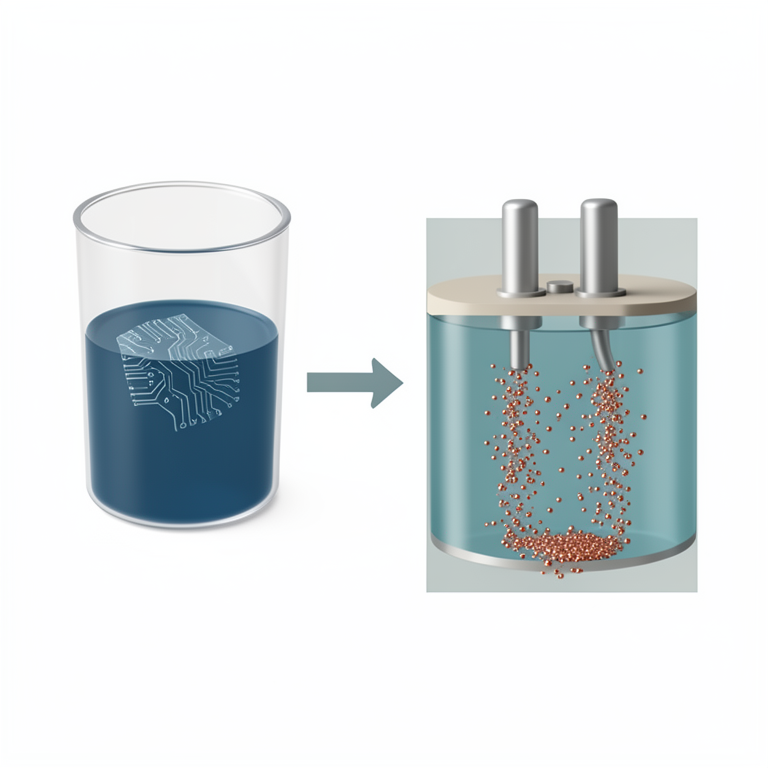
Optimization Variable Matrix
AI-generated conceptual illustration (copper electrodeposition cell with printed circuit board leach solution). It explains the idea and does not show study data.
View source evidence ↗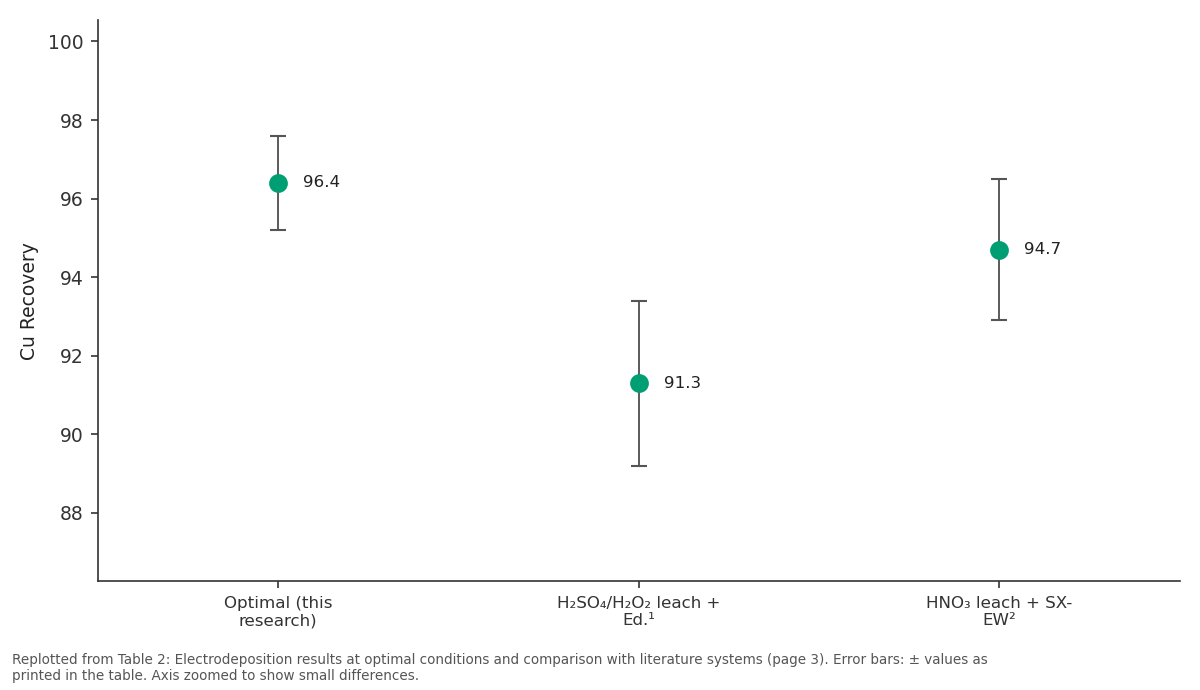
Cu Recovery: Optimal (this research) vs H₂SO₄/H₂O₂ leach + Ed.¹ vs HNO₃ leach + SX-EW²
Replotted from Table 2 (page 3) of the original paper. Every bar is the paper's own table value.
View source evidence ↗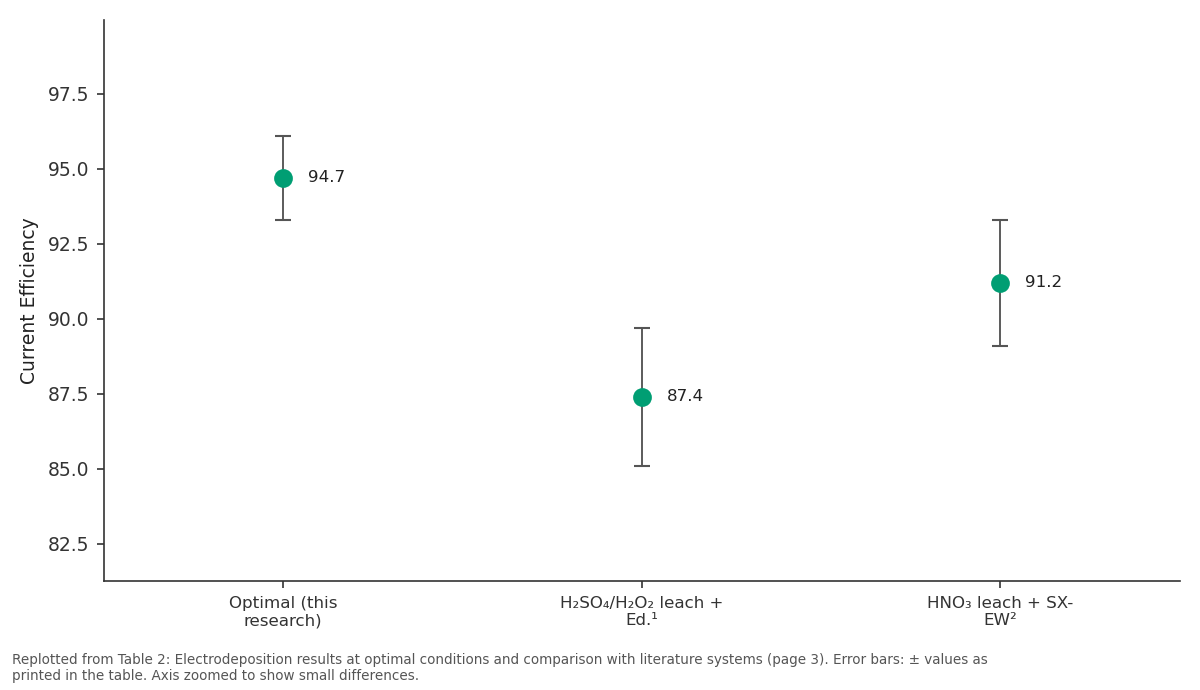
Current Efficiency: Optimal (this research) vs H₂SO₄/H₂O₂ leach + Ed.¹ vs HNO₃ leach + SX-EW²
Replotted from Table 2 (page 3) of the original paper. Every bar is the paper's own table value.
View source evidence ↗Figures & tables
From the original paper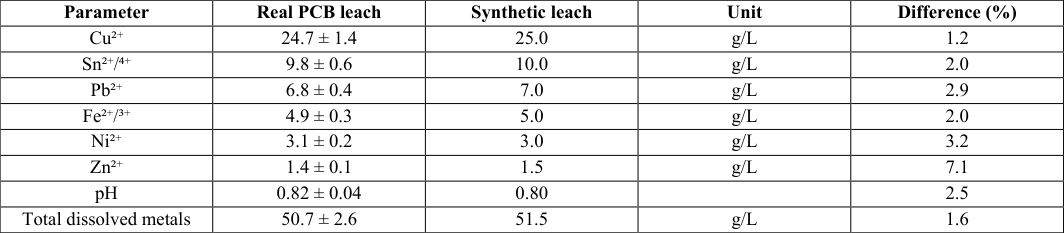 Table 1
 Table 2
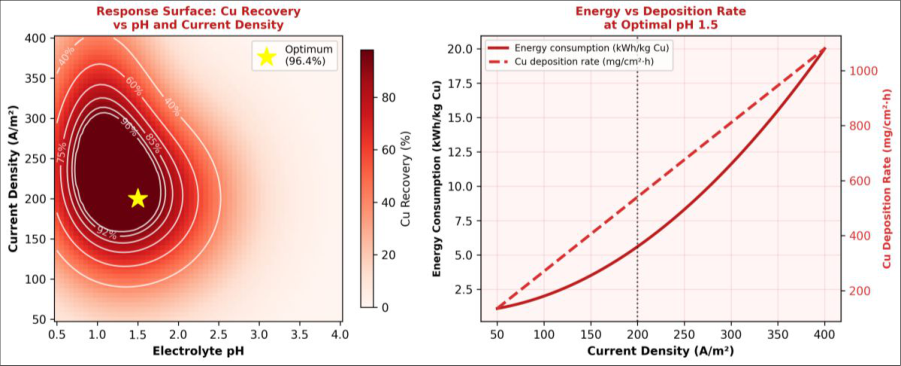 Figure 1
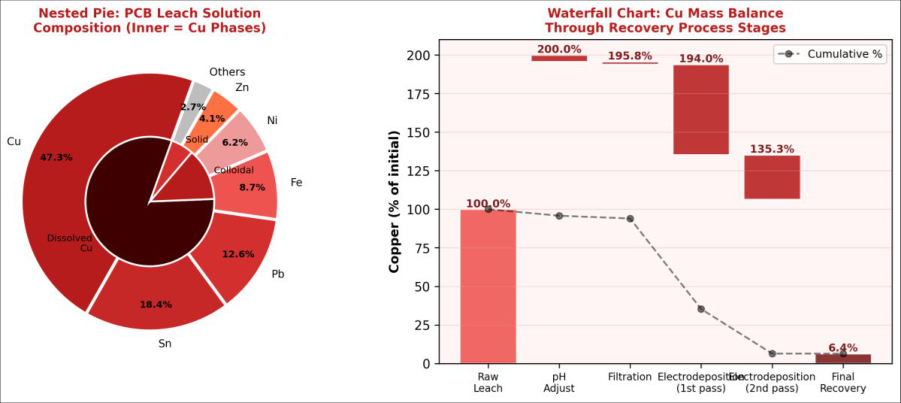 Figure 2
Introduction
India generated approximately 3.2 million metric tonnes of electronic waste in 2021, ranking third globally, yet formal recycling rates remain below 22% meaning the vast majority of ewaste is processed by the informal sector through open burning, acid stripping, or landfilling, with severe environmental and health consequences [1] . PCBs are particularly valuable targets for formal recycling because of their high copper content (typically 15-30% w/w in FR4 boards) and because copper is both the highest-tonnage non-ferrous metal in PCBs and a relatively straightforward target for selective electrochemical recovery [2] . The standard hydrometallurgical route for PCB copper recovery involves size reduction and comminution, followed by selective leaching in H₂SO₄ with H₂O₂ as oxidant, which dissolves copper and other base metals without attacking ceramic or polymeric board components. The resulting leach solution contains copper as the dominant metal but also significant concentrations of tin, lead, iron, nickel, and zinc that must be removed or sequenced out before high-purity copper can be obtained [3] . Electrodeposition from the clarified leach solution offers simultaneous copper recovery and solution purification as Cu²⁺ is removed from solution by electrodeposition, the remaining metals become more amenable to targeted precipitation or further electrochemical steps [4] . The electrochemistry of copper deposition from sulfate solutions is well understood in principle but presents practical challenges in PCB leach matrices because:
1) The presence of Sn²⁺/Sn⁴⁺, Pb²⁺, and Fe²⁺/Fe³⁺ causes parasitic cathodic reactions that reduce current efficiency 2) The wide pH range of leach solutions (typically pH 0.5-2.0) affects Cu²⁺ speciation and deposition kinetics; and
3) Anode stability is critical for continuous operation without Pb contamination of the product [5] The present research addressed these challenges by systematic response surface optimisation, using synthetic leach solutions prepared to match the composition of real PCB leach solutions characterised in this work. Research was conducted at the Tata Institute of Chemical Engineering, Jamshedpur, and Kalpana Chawla Institute of Biosciences, Hyderabad, from July 2023 to January 2025.
Theoretical background
The electrochemical deposition of copper from acidic sulfate solution proceeds via a two-step mechanism: Cu²⁺ + e⁻ → Cu⁺ (reduction to cuprous ion, rate-determining at low overpotentials), followed by Cu⁺ + e⁻ → Cu⁰ (reduction to metallic copper, fast step). The Butler-Volmer equation describes the current-overpotential relationship: i = i₀[exp(αFη/RT) -exp(-(1-α)Fη/RT)], where i₀ is the exchange current density, α the transfer coefficient, η the overpotential, and other symbols have standard electrochemical meaning [6] . At high current densities, the rate of deposition exceeds the diffusion flux of Cu²⁺ to the cathode surface, leading to mass-transfer-limited deposition, dendritic growth, and reduced current efficiency a regime that must be avoided for high-purity plate formation. Current efficiency (CE) is defined as the ratio of the theoretical charge required to deposit the measured mass of copper to the total charge passed: CE = m Cu × 2F / (M Cu × Q total ), where m Cu is the mass of deposited copper, F is Faraday's constant, M Cu is the molar mass of copper, and Q total is the total charge in coulombs [7] . CE decreases with increasing current density (mass-transfer limitation), decreasing Cu²⁺ concentration (lower driving force), and increasing temperature (enhanced diffusion of competing reduction reactions involving dissolved O₂ and Fe³⁺).
Specific energy consumption (SEC, kWh/kg Cu) combines CE and cell voltage: SEC = U cell × 1000 / (CE × M Cu × n × F × 3600), providing the commercially critical metric for process economics [8] .
Material and Methods
Material and Methods
Material
Research was conducted at the Department of Process Chemistry and Engineering, Tata Institute of Chemical Engineering, Jamshedpur, Jharkhand, and the Department of Industrial and Manufacturing Chemistry, Kalpana Chawla Institute of Biosciences, Hyderabad, Telangana, India, from July 2023 to January 2025. PCB leach solution was prepared by dissolving shredded FR4 PCB fragments (sourced from Hyderabad's Borabanda informal e-waste market, 150-500 µm fraction, metals characterised by XRF) in 1 M H₂SO₄ with H₂O₂ (30% v/v, 0.5 mL/g PCB) at 60°C, 300 rpm, for 4 h; the leachate was filtered (Whatman No. 1) and used directly. Synthetic leach solution for optimisation experiments was prepared from CuSO₄•5H₂O, SnSO₄, PbSO₄, FeSO₄•7H₂O, NiSO₄•6H₂O, and ZnSO₄•7H₂O (all ≥98%, Sigma-Aldrich) in 1 M H₂SO₄ at concentrations matching the real leach solution (Cu: 25, Sn: 10, Pb: 7, Fe: 5, Ni: 3, Zn: 1.5 g/L). Electrodeposition cell: undivided 500 mL electrochemical cell; cathode: titanium plate (50 mm × 50 mm × 1 mm, acid-washed); anode: Pb/1%Ag insoluble alloy (same dimensions). Power supply: Agilent N6700B modular power system (4-slot mainframe). Analysis: ICP-OES (Thermo iCAP 7400) for all metal quantifications; EIS: Gamry Reference 600 potentiostat. Institutional ethics clearance not required; laboratory safety approval: TICE Safety Committee (Ref. TICE-SC-2023-07, dated 21 July 2023).
Methods
Box-Behnken optimisation: Four variables (pH: 0.5, 1.5, 4.0; current density: 50, 200, 400 A/m²; temperature: 25, 45, 60°C; initial Cu²⁺: 5, 25, 40 g/L) were varied across 27 runs (Design-Expert 13). Response variables: Cu recovery (%), current efficiency (%), specific energy consumption (kWh/kg Cu), and deposit purity (% Cu by ICP-OES). Electrodeposition procedure: 200 mL synthetic leach solution was adjusted to target pH with dilute H₂SO₄ or NaOH and placed in the cell; temperature was controlled by water bath; galvanostatic deposition was conducted for 90 min at target current density. After deposition, the cathode was removed, rinsed with deionised water, and weighed on a balance (±0.1 mg) after drying at 60°C for 30 min. The solution was re-analysed by ICP-OES to determine Cu removal and any co-deposited metals. Cyclic voltammetry: scan rate 50 mV/s, -0.5 to +2.0 V vs Ag/AgCl; EIS: 100 kHz to 10 mHz at open circuit, amplitude 10 mV rms. The optimal process parameters (pH 1.5, 200 A/m², 45°C, Cu²⁺ = 25 g/L) produced 96.4% Cu recovery in a single electrodeposition pass, with current efficiency of 94.7% and specific energy consumption of 1.84 kWh/kg Cu an improvement over both literature comparators. The low energy consumption reflects the near-optimal current density (avoiding mass-transfer limitation that would reduce CE) and the moderate temperature (45°C) that balances increased diffusion rates against increased parasitic cathodic reactions. Deposit purity of 99.6% met the LME Grade A copper specification (≥99.5%), confirming commercialgrade quality without additional refining.
Results
Results
Discussion
The response surface analysis identified pH as the most influential variable within the studied range, with a clear optimum at pH 1.5 that reflects the balance between two competing effects: at lower pH (<1.0), the higher H⁺ activity suppresses Cu²⁺ activity (ionic strength effect) and promotes the competing Hydrogen Evolution Reaction (HER), reducing current efficiency; at higher pH (>2.0), Cu²⁺ begins to hydrolyse and precipitate as Cu(OH)₂, reducing the concentration of electroactive species available for deposition [9] . The optimum current density of 200 A/m² is consistent with the transition between kinetically limited and mass-transfer limited regimes determined from the Levich analysis of rotating disc electrode experiments conducted in separate characterisation experiments (limiting current density at 45°C ≈ 280 A/m²; operating at 200 A/m² provides a comfortable safety margin against diffusion limitation while maintaining high throughput). The competitive co-deposition of Sn (0.21% in the deposit) is the primary deposit quality concern because Sn in the grain boundaries can cause mechanical embrittlement. The low Sn co-deposition at pH 1.5 is consistent with the Pourbaix diagram for Sn in H₂SO₄ systems, which indicates that at this pH and the electrode potentials corresponding to Cu deposition, Sn²⁺ remains in solution rather than undergoing reduction to Sn⁰ or SnS precipitation [10] . In contrast, at pH > 2. processes that typically achieve 89-94% overall Cu recovery from similar leach matrices but require additional organic solvent handling infrastructure [11] .
For scale-up to the proposed 100 kg Cu/day pilot, the critical engineering parameter is the electrode area requirement: at 200 A/m², Cu deposition rate is approximately 7.4 kg/m²/h at 94.7% CE, requiring approximately 56 m² of cathode area for the target throughput. A filter-press electrochemical cell design with 100 cathode compartments of 0.56 m² each would achieve this in a compact footprint, consistent with the space constraints of urban e-waste processing facilities in India [12] .
Conclusion
Electrolytic copper recovery from synthetic PCB leach solution was optimised using a Box-Behnken response surface design across four process variables. The optimal conditions pH 1.5, 200 A/m², 45°C, initial Cu²⁺ = 25 g/L yielded 96.4% single-pass recovery, 94.7% current efficiency, 1.84 kWh/kg Cu specific energy consumption, and 99.6% deposit purity meeting LME Grade A specification. Two-stage electrodeposition achieved 93.7% overall Cu recovery, outperforming published SX-EW comparators. The response surface maps for pH and current density provide the direct operational specification for pilot scale design. These results establish a technically sound, energy-efficient electrohydrometallurgical route for formalising copper recovery from Indian e-waste PCB streams.
Figures and tables from the paper
| Parameter | Real PCB leach | Synthetic leach | Unit | Difference (%) |
|---|---|---|---|---|
| Cu²⁺ | 24.7 ± 1.4 | 25.0 | g/L | 1.2 |
| Sn²⁺/⁴⁺ | 9.8 ± 0.6 | 10.0 | g/L | 2.0 |
| Pb²⁺ | 6.8 ± 0.4 | 7.0 | g/L | 2.9 |
| Fe²⁺/³⁺ | 4.9 ± 0.3 | 5.0 | g/L | 2.0 |
| Ni²⁺ | 3.1 ± 0.2 | 3.0 | g/L | 3.2 |
| Zn²⁺ | 1.4 ± 0.1 | 1.5 | g/L | 7.1 |
| pH | 0.82 ± 0.04 | 0.80 | 2.5 | |
| Total dissolved metals | 50.7 ± 2.6 | 51.5 | g/L | 1.6 |
Table text extracted from the original PDF; superscript letters are shown inline. The original table image is below.
View original table image
| Parameter | Optimal (this research) | H₂SO₄/H₂O₂ leach + Ed.¹ | HNO₃ leach + SX-EW² | Units |
|---|---|---|---|---|
| Cu Recovery | 96.4 ± 1.2 | 91.3 ± 2.1 | 94.7 ± 1.8 | % |
| Current Efficiency | 94.7 ± 1.4 | 87.4 ± 2.3 | 91.2 ± 2.1 | % |
| Energy Consumption | 1.84 ± 0.08 | 2.47 ± 0.14 | 2.91 ± 0.17 | kWh/kg Cu |
| Deposit Purity | 99.6 ± 0.2 | 98.7 ± 0.4 | 99.1 ± 0.3 | % Cu |
| Co-deposit Sn | 0.21 ± 0.03 | 0.68 ± 0.08 | 0.41 ± 0.05 | % |
| Overall Cu recovery (2-stage) | 93.7 ± 1.6 | 84.2 ± 2.8 | 89.3 ± 2.4 | % |
Table text extracted from the original PDF; superscript letters are shown inline. The original table image is below.
View original table image
References
19 in the original paper- Baldé CP, Forti V, Gray V, Kuehr R, Stegmann P. The Global E-Waste Monitor 2017: Quantities, Flows and Resources. Bonn: United Nations University; 2017.
- Cui J, Zhang L. Metallurgical recovery of metals from electronic waste: A review. J Hazard Mater. 2008;158(2-3):228-256.
- Jadhav U, Hocheng H. Hydrometallurgical recovery of metals from large printed circuit board pieces. Sci Rep. 2015;5:14574.
- Mecucci A, Scott K. Leaching and electrochemical recovery of copper, lead and tin from scrap printed circuit boards. J Chem Technol Biotechnol. 2002;77(4):449-457.
- Sodha AB, Qian L, Li J, Rajagopal RR, Kumari A, Jadhav U. Metals extraction from e-waste: A review. Rev Environ Sci Biotechnol. 2020;19(1):119-148.
- Newman J, Thomas-Alyea KE. Electrochemical Systems. 3 rd ed. Hoboken: Wiley; 2004.
- Pletcher D, Walsh FC. Industrial Electrochemistry. 2nd ed. London: Chapman & Hall; 1990.
- Winand R. Electrodeposition of metals and alloys new results and perspectives. Electrochim Acta. 1994;39(8-9):1091-1105.
- Moats MS, Bhatt AJ, Luyima AM. Understanding the effects of impurities on copper electrorefining and electrowinning. JOM. 2015;67(8):1815-1824.
- Bard AJ, Parsons R, Jordan J, eds. Standard Potentials in Aqueous Solutions. New York: Marcel Dekker; 1985.
- Tuncuk A, Stazi V, Akcil A, Yazici EY, Deveci H. Aqueous metal recovery techniques from e-scrap: Hydrometallurgy in recycling. Miner Eng. 2012;25(1):28-37.
- Walsh FC, Pletcher D. Electrolytic removal of trace heavy metal ions from dilute aqueous solutions. In: Stankovic E, ed. Electrochemistry for a Cleaner Environment. New York: Electrochemistry Science; 1994.
- Biswas RK, Rahman MH. Technology for recovery of copper from waste printed circuit boards. Resources, Conservation and Recycling. 2016;111:77-85.
- Li J, Liang C, Ma C. Bioleaching of gold from waste printed circuit boards by heap leaching. J Mater Cycles Waste Manag. 2015;17(4):752-762.
- Fogarasi S, Imre-Lucaci F, Ilea P, Imre-Lucaci A. The environmental assessment of two new copper recovery processes from waste printed circuit boards. J Clean Prod. 2013;54:264-269.
- Hadi P, Xu M, Lin CSK, Hui CW, McKay G. Waste printed circuit board recycling techniques and product utilization. J Hazard Mater. 2015;283:234-243.
- Wang J, Bai J, Xu J, Liang B. Bioleaching of metals from printed wire boards by Acidithiobacillus ferrooxidans and Acidithiobacillus thiooxidans and their mixture. J Hazard Mater. 2009;172(2-3):11001105.
- Verma A, Hait S. Hydrometallurgical recovery of metals from e-waste: A review on various approaches. Trans Indian Inst Met. 2019;72(3):527-549.
- Khaliq A, Rhamdhani MA, Brooks G, Masood S. Metal extraction through molten oxide electrolysis. Metals. 2014;4(4):535-565.