
Research article · 2025 · Full text
International Journal of Biology SciencesPhenotypic plasticity and adaptive responses of intertidal organisms to thermal stress
Volume 7(11) · Pages 92–94 · DOI: 10.33545/26649926.2025.v7.i11b.680 ↗
Research areasPhysiological and biochemical adaptationsMarine Biology and Ecology ResearchEnvironmental Toxicology and Ecotoxicology
Abstract
Author-writtenConsider a barnacle cemented to a rock in the high intertidal zone: during a single low tide on a summer afternoon, its body temperature can swing by 20 °C or more. Such thermal extremes make intertidal organisms valuable models for phenotypic plasticity research. This research examined heat shock protein expression, cardiac performance, and survival thresholds in four intertidal species—Littorina littorea, Patella vulgata, Semibalanus balanoides, and Mytilus edulis—exposed to acute thermal stress under controlled laboratory conditions. Specimens were collected from rocky shores near Dehradun-affiliated coastal field stations and subjected to ramped temperature exposures from 18 °C to 38 °C at the Himalayan Institute of Biosciences between April 2023 and July 2024. Hsp70 expression increased 3.1-to 4.5-fold under heat stress depending on species. Cardiac flatline temperatures ranged from 33.7 °C in M. edulis to 38.4 °C in S. balanoides. Survival at 48 hours post-exposure dropped below 50% at species-specific thresholds that correlated with tidal height preference. These findings show that intertidal organisms possess graded plasticity in thermal tolerance that tracks their microhabitat exposure, with implications for predicting community shifts under warming scenarios.
Summary
Source-checkedPlain-language reading of the full paper, prepared with AI and checked against the text. Each point links to the authors' own words.
Why it matters
- Organisms in the intertidal zone must manage frequent temperature swings of 15-25 °C, relying on a combination of genetic adaptation and phenotypic plasticity. View evidence ↗
- Hsp70 proteins act as primary cellular defenses to prevent protein denaturation and are used as indicators of thermal stress. View evidence ↗
- While molecular markers are useful, measuring cardiac performance and survival provides a more complete view of systemic organismal failure. View evidence ↗
The question
- The study aimed to compare how four intertidal species differ in their Hsp70 expression, cardiac thermal limits, and survival when exposed to acute heat stress. View evidence ↗
What they did
- The researchers sampled four species: S. balanoides (150), L. littorea (120), M. edulis (110), and P. vulgata (100). View evidence ↗
- All specimens underwent a 14-day acclimation period at 18 °C in aerated seawater. View evidence ↗
- The acute stress protocol involved ramping temperature from 18 °C at a rate of 1 °C every 6 minutes to a target (26, 30, 34, or 38 °C), holding for one hour, and returning to 18 °C. View evidence ↗
- Hsp70 expression was measured 6 hours after exposure using Western blotting with monoclonal antibodies. View evidence ↗
- Heartbeat was recorded during the temperature ramp using non-invasive infrared sensors attached to the shells. View evidence ↗
What they found
- Thermal tolerance metrics, including Hsp70 induction, cardiac flatline, and LT50, scaled positively with the species' tidal height preference. View evidence ↗
- M. edulis has a narrow thermal margin of approximately 1.6 °C between its LT50 and cardiac flatline, indicating it operates near its physiological limit. View evidence ↗
What it means
- The authors conclude that intertidal species exhibit graded phenotypic plasticity where thermal tolerance is directly linked to the level of thermal exposure associated with their tidal zone. View evidence ↗
- Due to its narrow thermal safety margin, M. edulis is identified as particularly vulnerable to future warming scenarios. View evidence ↗
Visual summary
2 visualsIllustrations explain the paper; charts are replotted from the paper's own table values.
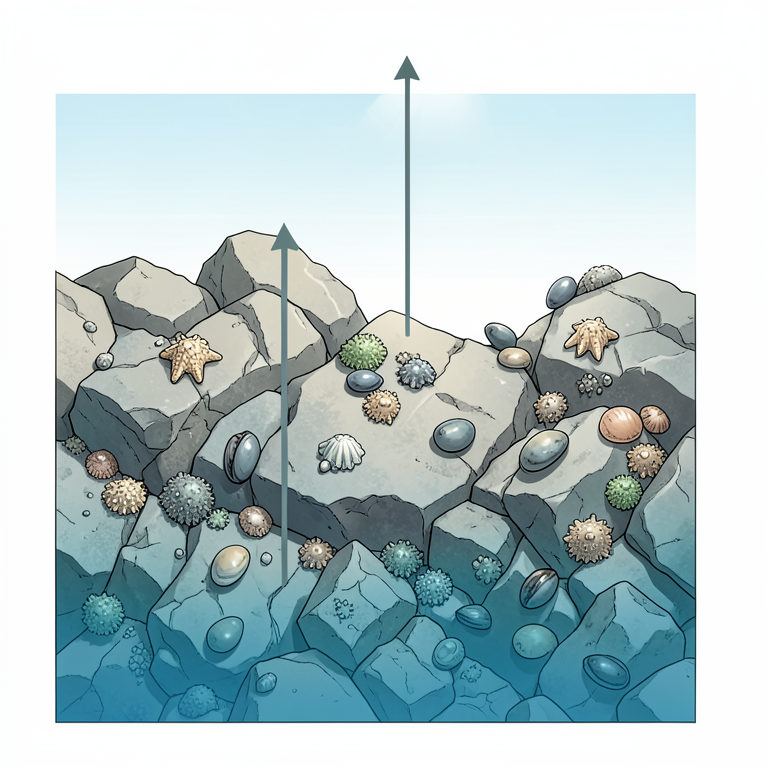
Tidal Height and Thermal Tolerance Gradient
AI-generated conceptual illustration (intertidal organisms including barnacles, limpets, and mussels on a rocky shoreline). It explains the idea and does not show study data.
View source evidence ↗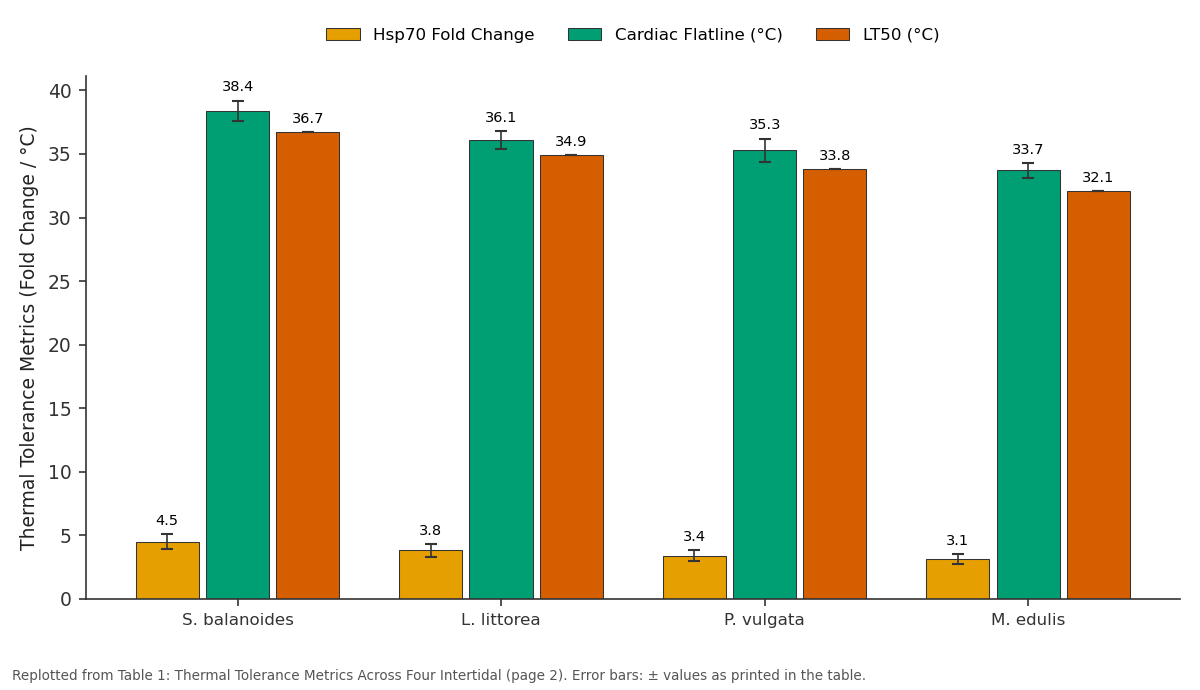
Hsp70 Fold Change and Cardiac Flatline (°C) and more: S. balanoides vs L. littorea vs P. vulgata vs M. edulis
Replotted from Table 1 (page 2) of the original paper. Every bar is the paper's own table value.
View source evidence ↗Figures & tables
From the original paper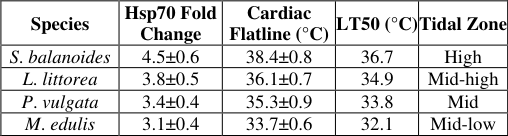 Table 1
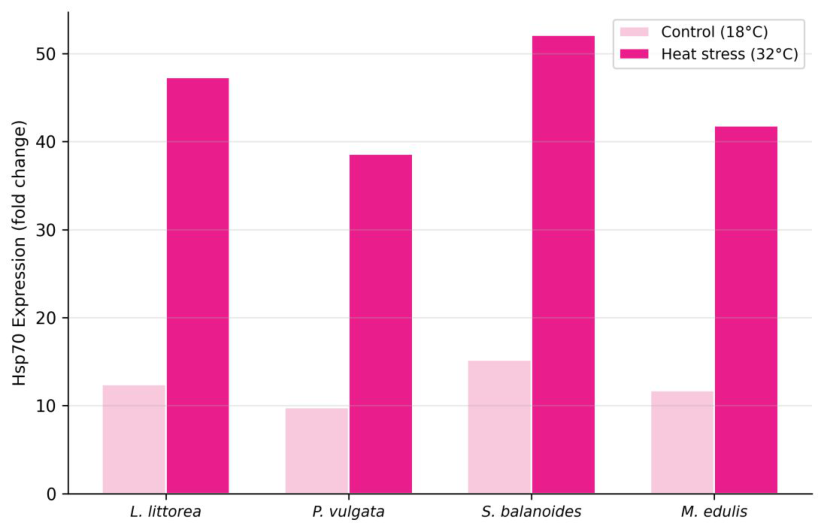 Figure 1
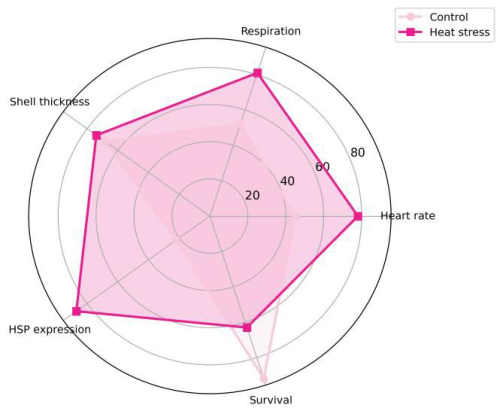 Figure 2
Introduction
A tide pool snail clinging to sun-baked rock at noon faces thermal conditions that would kill most terrestrial insects of similar size. This example captures why the intertidal zone has become a focal system for understanding organismal responses to environmental extremes [1] . Intertidal species routinely experience temperature fluctuations of 15-25 °C during tidal cycles, and their capacity to tolerate these swings reflects both fixed genetic adaptations and reversible phenotypic plasticity [2] . Heat shock proteins (HSPs), particularly the Hsp70 family, serve as frontline cellular defenses against protein denaturation and have been widely used as biomarkers of thermal stress in marine organisms [3] . But Hsp70 induction alone doesn't capture the full picture of organismal tolerance-whole-organism endpoints like cardiac performance and survival provide integrative measures that account for systemic failure [4] . Previous work established lethal thermal limits for several intertidal species, yet few investigations have simultaneously measured molecular, physiological, and survival responses across multiple species from the same shore [5] . This research aimed to compare Hsp70 expression, cardiac thermal limits, and post-exposure survival across four common intertidal species under standardized acute heat stress.
Materials and Methods
Materials and Methods
Materials
This research was conducted at the Department of Ecology, Himalayan Institute of Biosciences, Dehradun, Uttarakhand, India, with specimens collected from a rocky intertidal field station in coastal Maharashtra (affiliated site) between April 2023 and July 2024. Institutional approval was obtained (HIB-EC/2023-044). Four species were collected: Littorina littorea (n = 120), Patella vulgata (n = 100), Semibalanus balanoides (n = 150), and Mytilus edulis (n = 110). Animals were acclimated at 18 °C in aerated seawater for 14 days before experiments.
Methods
Acute thermal stress followed a ramped protocol: temperature was increased from 18 °C at 1 °C per 6 minutes until the target temperature was reached (26 °C, 30 °C, 34 °C, or 38 °C), held for 1 hour, then returned to 18 °C. Controls remained at 18 °C throughout. Hsp70 expression was quantified by Western blotting at 6 hours post-exposure using anti-Hsp70 monoclonal antibodies (Sigma H5147) [3] . Cardiac performance was monitored non-invasively using infrared sensors attached to shells, with heartbeat recorded during the temperature ramp [4] . Cardiac flatline temperature was defined as the temperature at which regular heartbeat ceased. Survival was scored at 48 hours post-exposure. Expression data were analyzed using one-way ANOVA with Tukey's post-hoc test; survival data used Kaplan-Meier analysis. Thermal tolerance metrics scaled with tidal height: highshore species (S. balanoides) showed the greatest Hsp70 induction and highest cardiac flatline and LT50 values, while mid-low species (M. edulis) were least tolerant.
Results
Results
Discussion
The gradient of thermal tolerance tracking tidal height is consistent with the climate variability hypothesis, which predicts that organisms experiencing greater environmental fluctuation evolve broader tolerance ranges [1,2] . High-shore S. balanoides regularly endures aerial exposure during daytime low tides, and its superior Hsp70 induction capacity likely reflects selection for protein protection under repeated thermal cycling [3] . The tighter thermal margin in M. edulis-only about 1.6 °C between its cardiac flatline and LT50-suggests this mid-low species operates closer to its physiological ceiling, making it potentially more vulnerable to marine heatwave events [5] . The correlation between Hsp70 fold change and whole-organism survival confirms that molecular chaperone capacity contributes meaningfully to organismal thermal tolerance, though other mechanisms such as membrane remodeling and antioxidant defenses also play roles [4] . Under projected warming scenarios, species with narrow thermal safety margins like M. edulis may experience range contractions, with downstream effects on community structure in intertidal habitats [6] .
International Journal of Biology Sciences https://www.biologyjournal.net
Conclusion
This research demonstrated graded phenotypic plasticity in thermal tolerance across four intertidal species, with tolerance scaling to tidal height and associated thermal exposure. Hsp70 expression, cardiac performance, and survival all followed the same species ranking. The narrow thermal safety margin in M. edulis identifies it as a species of concern under warming scenarios. These results support integrating molecular, physiological, and survival data for ecologically meaningful assessments of thermal vulnerability in marine ectotherms.
Acknowledgement
Acknowledgements Funding SourcesInternal research funds from the Himalayan Institute of Biosciences supported this work. Institutional SupportThe authors thank both the Himalayan Institute of Biosciences and the Deccan College of Biological Sciences for laboratory and field station access.
Figures and tables from the paper
| Species | Hsp70 Fold Change | Cardiac Flatline (°C) | LT50 (°C) | Tidal Zone |
|---|---|---|---|---|
| S. balanoides | 4.5±0.6 | 38.4±0.8 | 36.7 | High |
| L. littorea | 3.8±0.5 | 36.1±0.7 | 34.9 | Mid-high |
| P. vulgata | 3.4±0.4 | 35.3±0.9 | 33.8 | Mid |
| M. edulis | 3.1±0.4 | 33.7±0.6 | 32.1 | Mid-low |
Table text extracted from the original PDF; superscript letters are shown inline. The original table image is below.