
Research article · 2025 · Full text
International Journal of Biology SciencesFungal succession patterns during wood decomposition in temperate broadleaf forests
Volume 7(9) · Pages 176–179 · DOI: 10.33545/26649926.2025.v7.i9c.636 ↗
Research areasForest Ecology and Biodiversity StudiesMycorrhizal Fungi and Plant InteractionsSoil Carbon and Nitrogen Dynamics
Abstract
Author-writtenWhat governs the order in which fungal species colonise and replace one another on a decaying log? Wood decomposition in forests depends on predictable successional sequences, yet field data linking community turnover to wood physical and chemical properties remain limited for Southeast Asian broadleaf systems. This research tracked fungal community composition on naturally fallen Shorea logs across five decay stages spanning fresh (0–6 months) to late (>60 months) in a lowland dipterocarp forest near Kota Kinabalu, Sabah, Malaysia. Species richness peaked at the mid-decay stage (14.6 ± 3.1 OTUs) before declining in advanced and late stages. Shannon diversity followed a similar hump-shaped pattern (H’ = 2.8 at mid-decay). Early colonisers were dominated by soft-rot ascomycetes (Xylaria, Daldinia), which gave way to white-rot basidiomycetes (Trametes, Stereum) by 18 months. Brown-rot taxa (Fomitopsis, Postia) became dominant only after 36 months, coinciding with a 68 percent decline in cellulose content. ITS metabarcoding identified 127 fungal OTUs across all stages. These patterns support a facilitation model in which early colonisers condition the substrate for later specialists, and they suggest that species richness peaks when both pioneer and late-successional taxa coexist.
Summary
Source-checkedPlain-language reading of the full paper, prepared with AI and checked against the text. Each point links to the authors' own words.
Why it matters
- Fungi are the primary organisms responsible for wood decomposition because they possess unique enzymatic systems capable of breaking down lignin and cellulose. View evidence ↗
- Wood decomposition follows a predictable sequence of fungal colonization influenced by the chemistry of the substrate, the microclimate, and the competitive abilities of the species. View evidence ↗
- While fungal succession is well-documented in North American and European temperate forests, there is a lack of similar data for tropical broadleaf systems in Southeast Asia. View evidence ↗
The question
- The study aimed to determine if the fungal succession on tropical dipterocarp wood (specifically Shorea logs) follows the same trajectory as that observed in temperate forest systems. View evidence ↗
What they did
- Fieldwork was conducted between January 2022 and December 2023 in a lowland dipterocarp forest near Kota Kinabalu, Sabah, Malaysia. View evidence ↗
- Fungal communities were analyzed using ITS2 metabarcoding from pooled wood cores collected from three different positions on each log. View evidence ↗
- The researchers used Van Soest fibre analysis to measure the content of lignin, cellulose, and hemicellulose in the wood. View evidence ↗
What they found
- Fungal species richness followed a hump-shaped pattern, starting at 4.2 ± 1.1 OTUs in fresh logs, peaking at 14.6 ± 3.1 OTUs during mid-decay, and falling to 7.3 ± 1.9 OTUs in late decay. View evidence ↗
- Shannon diversity also exhibited a hump-shaped pattern, reaching its peak value of H’ = 2.8 during the mid-decay stage. View evidence ↗
- The early stages of colonization were dominated by soft-rot ascomycetes, specifically Xylaria hypoxylon (23.4% relative abundance) and Daldinia concentrica (14.8%). View evidence ↗
- White-rot basidiomycetes, including Stereum hirsutum and Trametes versicolor, reached their peak abundance during the mid-decay stage. View evidence ↗
- Brown-rot fungi, such as Postia placenta and Fomitopsis pinicola, became the dominant taxa during the advanced decay stage. View evidence ↗
- As decomposition progressed, cellulose content dropped from 41.7% in fresh wood to 13.4% in late decay, while lignin showed a relative increase from 28.3% to 42.1%. View evidence ↗
What it means
- The authors conclude that fungal succession on Shorea logs follows a predictable path from soft-rot ascomycetes to white-rot and then brown-rot basidiomycetes, driven by changes in moisture and cellulose levels. View evidence ↗
Visual summary
3 visualsIllustrations explain the paper; charts are replotted from the paper's own table values.
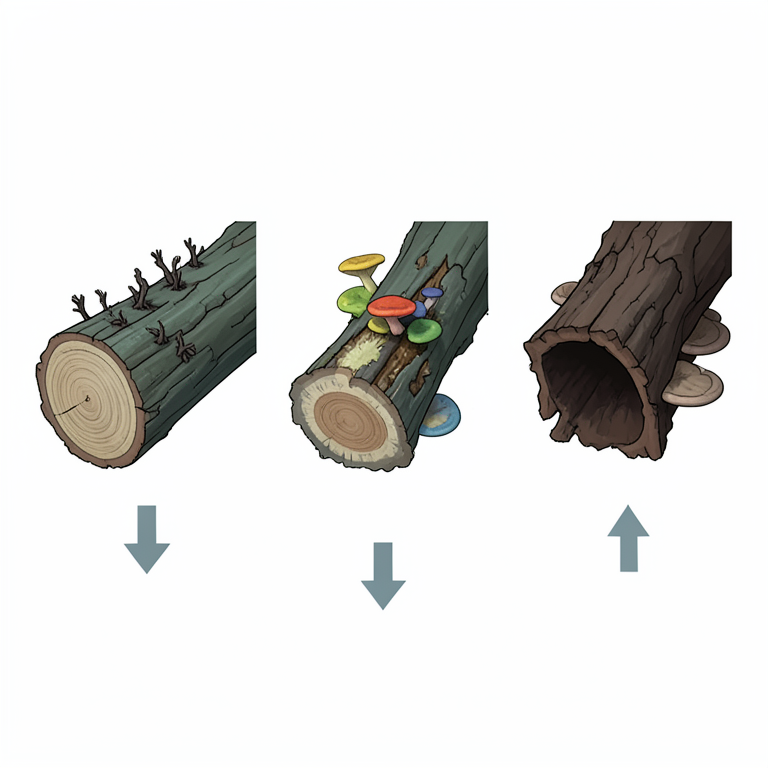
Fungal Succession Timeline
AI-generated conceptual illustration (a decaying fallen log of a temperate broadleaf tree). It explains the idea and does not show study data.
View source evidence ↗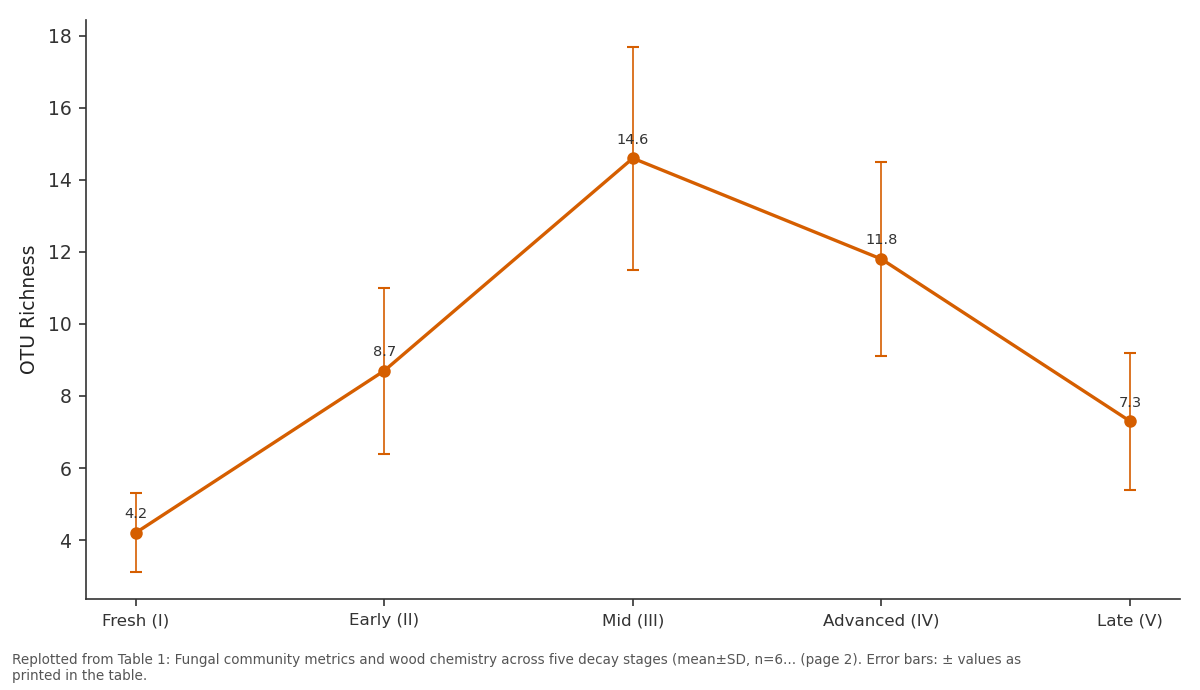
OTU Richness: Fresh (I) vs Early (II) vs Mid (III) vs Advanced (IV) vs Late (V)
Replotted from Table 1 (page 2) of the original paper. Every bar is the paper's own table value.
View source evidence ↗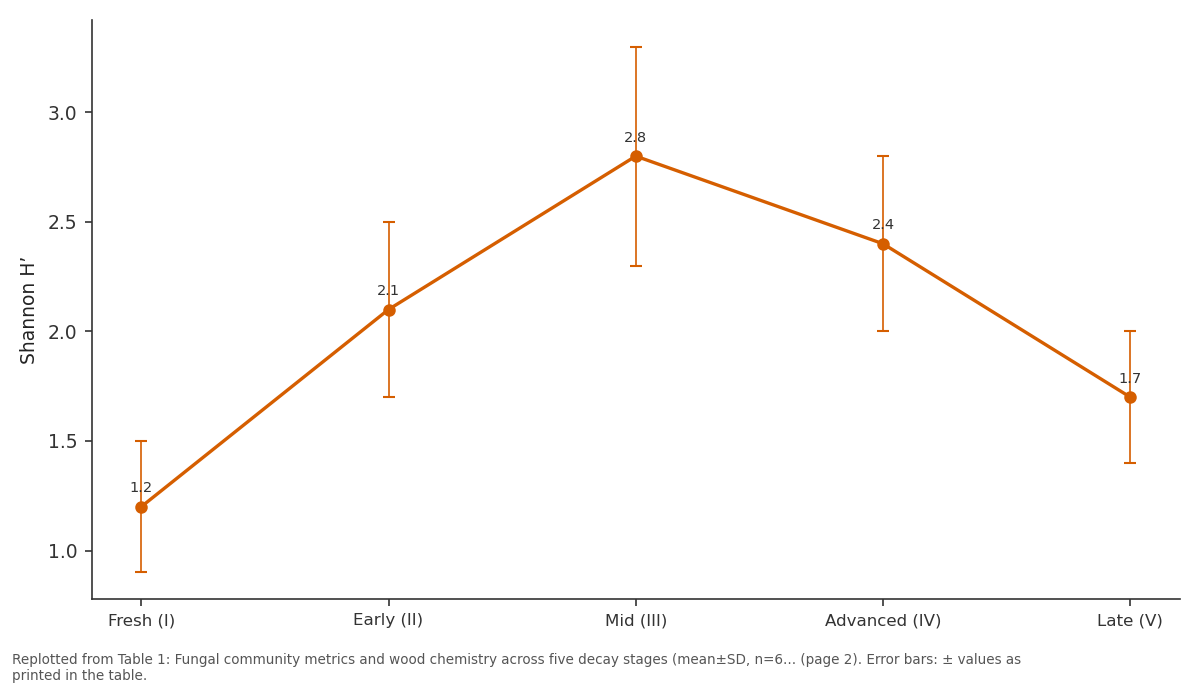
Shannon H’: Fresh (I) vs Early (II) vs Mid (III) vs Advanced (IV) vs Late (V)
Replotted from Table 1 (page 2) of the original paper. Every bar is the paper's own table value.
View source evidence ↗Figures & tables
From the original paper Table 1
 Table 2
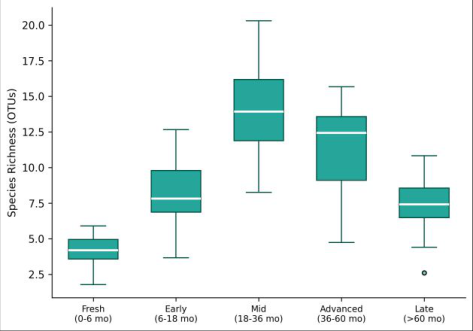 Figure 1
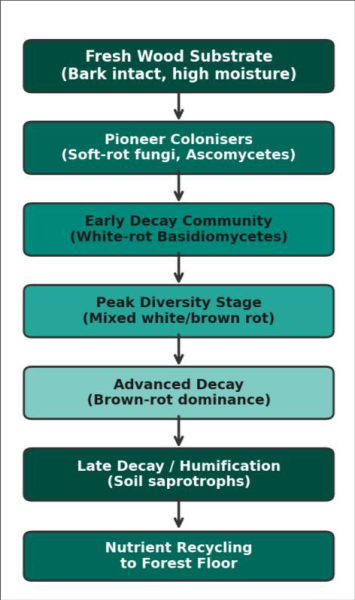 Figure 2
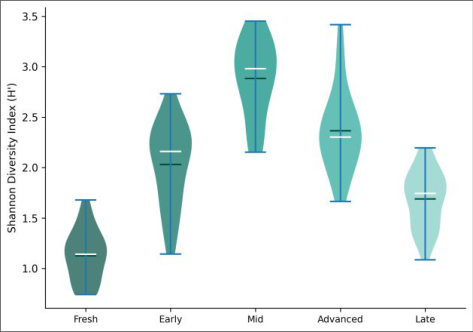 Figure 3
Introduction
If a tree falls in a forest, what eats it first? That question, phrased in ecological rather than philosophical terms, underpins our understanding of carbon cycling in temperate and tropical woodlands [1] . Fungi are the principal agents of wood decay, breaking down lignin and cellulose through enzymatic systems that no other kingdom can match in efficiency [2] . But decomposition is not a free-for-all: fungal species arrive and depart in a broadly predictable sequence driven by competitive ability, substrate chemistry, and microclimate [3] . Classical succession theory predicts a shift from ruderal pioneer species to stress-tolerant late colonisers, paralleling plant succession on bare ground [4] . On wood, this translates to an early wave of soft-rot ascomycetes that exploit easily accessible sugars, followed by whiterot basidiomycetes capable of degrading lignin, and finally brown-rot specialists that target residual cellulose [5,6] . Yet most detailed succession datasets come from northern European and North American temperate forests; equivalent data for tropical Southeast Asian broadleaf systems are scarce [7] . This research followed fungal community turnover on Shorea logs across five decay stages in Sabah, Malaysia, combining ITS metabarcoding with wood chemistry analysis to test whether tropical dipterocarp wood follows the same successional trajectory observed in temperate systems.
Material and Methods
Material and Methods
Study Area Description
The research site was a 4.2-hectare permanent plot in lowland mixed dipterocarp forest at the Sepilok Forest Reserve, located 23 km west of Kota Kinabalu, Sabah, Malaysia (5°52′ N, 117°56′ E, elevation 45 m). Mean annual temperature is 27.3 °C and mean annual rainfall is 2 630 mm, with a drier period from February to April. The plot had not been logged for at least 80 years. Soils are sandy clay loams derived from sandstone parent material. The canopy is dominated by Shorea spp., Dipterocarpus spp., and Parashorea spp.
Material
Thirty naturally fallen Shorea logs were selected across five visually assessed decay classes (six logs per class) based on the system of Spetich and colleagues: Class I (bark intact, wood hard), Class II (bark loosening, sapwood softening), Class III (bark absent, sapwood partially decayed), Class IV (wood fragmented, heartwood soft), Class V (wood heavily fragmented, incorporated into soil). Logs ranged from 18 to 42 cm diameter and 2.1 to 6.8 m length. All fieldwork was conducted from the Department of Mycology and Plant Pathology, Sabah Centre for Marine Biology, Kota Kinabalu, between January 2022 and December 2023.
Seasonal Variations
Sampling was conducted quarterly over two years (January 2022 to December 2023) to capture seasonal variation. Fruiting body surveys were timed to coincide with end of wet (November-January) and dry (March-April) periods, as basidiomycete sporocarp production is strongly moisturedependent. Wood moisture content averaged 58.3 ± 7.2 percent during wet-season surveys and dropped to 41.7 ± 6.8 percent during dry months. This seasonal fluctuation influenced the detectability of certain ephemeral taxa, particularly corticioid basidiomycetes that fruit only under high humidity.
Methods
Fungal communities were characterised by ITS2 metabarcoding. Wood cores (5 mm diameter, 30 mm depth) were collected from three positions per log (proximal, middle, distal), pooled, and frozen at -20 °C. DNA was extracted using the DNeasy PowerSoil Pro Kit (Qiagen) and amplified with primers ITS3/ITS4 targeting the ITS2 region. Amplicons were sequenced on an Illumina MiSeq (2×300 bp). Bioinformatic processing used DADA2 in QIIME2 (v2023.5) with taxonomic assignment against the UNITE database (v9.0). Species richness (observed OTUs), Shannon diversity (H'), and Bray-Curtis dissimilarity were calculated. Wood cellulose, hemicellulose, and lignin content were determined by Van Soest fibre analysis. Oneway ANOVA with Tukey HSD tested differences among decay classes (p < 0.05). A total of 127 fungal OTUs were identified across all decay stages. Species richness rose from 4.2 ± 1.1 OTUs in fresh logs to a peak of 14.6 ± 3.1 at mid-decay before declining to 7.3 ± 1.9 in late decay (Table 1; Figure 1). Shannon diversity followed the same hump-shaped pattern (Table 1; Figure 3). Early colonisers were dominated by ascomycetes-Xylaria hypoxylon (23.4% relative abundance) and Daldinia concentrica (14.8%)-which were largely absent from advanced and late stages. White-rot basidiomycetes (Trametes versicolor, Stereum hirsutum) peaked at mid-decay, while brown-rot taxa (Fomitopsis pinicola, Postia placenta) dominated advanced decay (Table 2). Cellulose content declined from 41.7% in fresh wood to 13.4% in late decay, while lignin showed a relative increase from 28.3 to 42.1% as cellulose was preferentially consumed. Figure 2 summarises the successional pathway.
| Dominant Taxon | Decay Stage | Rel. Abund.% | Rot Type | Phylum |
|---|---|---|---|---|
| Xylaria hypoxylon | Fresh–Early | 23.4 | Soft rot | Ascomycota |
| Daldinia concentrica | Fresh–Early | 14.8 | Soft rot | Ascomycota |
| Trametes versicolor | Mid | 18.7 | White rot | Basidiomycota |
| Stereum hirsutum | Mid | 12.3 | White rot | Basidiomycota |
| Fomitopsis pinicola | Advanced | 21.6 | Brown rot | Basidiomycota |
| Postia placenta | Advanced–Late | 16.4 | Brown rot | Basidiomycota |
Table text extracted from the original PDF; superscript letters are shown inline. The original table image is below.
View original table image
| Decay Stage | OTU Richness | Shannon H’ | Cellulose% | Lignin% | Moisture% |
|---|---|---|---|---|---|
| Fresh (I) | 4.2±1.1 | 1.2±0.3 | 41.7±2.4 | 28.3±1.8 | 52.1±4.3 |
| Early (II) | 8.7±2.3 | 2.1±0.4 | 36.4±2.1 | 30.7±1.9 | 57.8±5.1 |
| Mid (III) | 14.6±3.1 | 2.8±0.5 | 27.8±2.8 | 33.4±2.2 | 63.4±6.7 |
| Advanced (IV) | 11.8±2.7 | 2.4±0.4 | 18.6±2.3 | 38.7±2.6 | 54.2±5.8 |
| Late (V) | 7.3±1.9 | 1.7±0.3 | 13.4±1.7 | 42.1±3.1 | 47.6±4.9 |
Table text extracted from the original PDF; superscript letters are shown inline. The original table image is below.
View original table image
Results
Results
Discussion
The hump-shaped diversity pattern matches the intermediate disturbance hypothesis applied to wood-decay communities: mid-decay substrates support both early colonisers that haven't yet been excluded and later arrivals that are beginning to establish [8] . Our peak richness of 14.6 OTUs at mid-decay compares with 11-18 OTUs reported for European beech logs by Rajala and colleagues, suggesting convergent community dynamics across biomes despite taxonomic differences [9] . The shift from ascomycete to basidiomycete dominance by 18 months supports the facilitation model, in which soft-rot pioneers condition the substrate-removing easily accessible sugars and modifying moisture content-before lignolytic white-rot fungi can establish [10] . The subsequent takeover by brown-rot taxa after 36 months aligns with the 68 percent cellulose loss we measured; brown-rot fungi require accessible cellulose microfibrils once the lignin matrix has been partially disrupted by white-rot enzymes [11,12] . One limitation is the use of a single tree species (Shorea); wood chemistry varies considerably among dipterocarp genera, and succession patterns on Dipterocarpus or Dryobalanops logs could differ [13] . Future work should include multiple host species and experimental manipulation of log moisture to test causal relationships.
Conclusion
Fungal succession on Shorea logs in a Bornean dipterocarp forest follows a predictable trajectory from soft-rot ascomycetes through white-rot to brown-rot basidiomycetes, driven by declining cellulose and changing substrate moisture. Species richness peaks at mid-decay when pioneer and late-successional taxa coexist. The 127 OTUs identified provide a baseline for monitoring decomposer communities under forest management and climate change scenarios.
Acknowledgement
Acknowledgements Funding SourcesSupported by the Sabah Centre for Marine Biology internal research allocation. Institutional SupportThe authors thank the Department of Mycology and Plant Pathology for laboratory and sequencing access. Contributions Not Qualifying for AuthorshipMr. Ahmad Razali assisted with field sampling; Ms. Siti Hasmah helped with DNA extraction and library preparation.
References
15 in the original paper- Harmon ME, Franklin JF, Swanson FJ, Sollins P, Gregory SV, Lattin JD, et al. Ecology of coarse woody debris in temperate ecosystems. Advances in Ecological Research. 1986;15:133-302.
- Boddy L, Frankland JC, van West P. Ecology of Saprotrophic Basidiomycetes. Academic Press. 2008;1:1-386.
- Rajala T, Peltoniemi M, Hantula J, Makipaa R, Pennanen T. RNA reveals a succession of active fungi during the decay of Norway spruce logs. Fungal Ecology. 2011;4(6):437-448.
- Frankland JC. Fungal succession: unravelling the unpredictable. Mycological Research. 1998;102(1):115.
- Fukasawa Y, Osono T, Takeda H. Dynamics of physicochemical properties and occurrence of fungal fruit bodies during decomposition of coarse woody debris of Fagus crenata. Journal of Forest Research. 2009;14(1):20-29.
- Stokland JN, Siitonen J, Jonsson BG. Biodiversity in Dead Wood. Cambridge University Press. 2012;1:1509.
- Yamashita S, Hattori T, Abe H. Host preference and species richness of wood-inhabiting aphyllophoraceous fungi in a cool temperate area of Japan. Mycologia. 2010;102(1):11-19.
- Pouska V, Svoboda M, Lepsa L. Is the diversity of wood-decaying fungi in a virgin temperate forest related to wood microclimate? Fungal Ecology. 2018;36:27-34.
- Rajala T, Peltoniemi M, Pennanen T, Makipaa R. Fungal community dynamics in relation to substrate quality of decaying Norway spruce logs in boreal International Journal of Biology Sciences https://www.biologyjournal.net forests. FEMS Microbiology Ecology. 2012;81(2):494505.
- Boddy L. Fungal community ecology and wood decomposition processes in angiosperms: from standing tree to complete decay of coarse woody debris. Ecological Bulletins. 2001;49:43-56.
- Schwarze FWMR, Engels J, Mattheck C. Fungal Strategies of Wood Decay in Trees. Springer. 2000;1:1185.
- Baldrian P. Forest microbiome: diversity, complexity and dynamics. FEMS Microbiology Reviews. 2017;41(2):109-130.
- Yamashita S, Masuya H, Abe S, Masaki T, Okabe K. Relationship between the decomposition process of coarse woody debris and fungal community structure. Plant Ecology. 2015;216(7):935-947.
- Lindner DL, Burdsall HH, Stanosz GR. Species diversity of polyporoid and corticioid fungi in northern hardwood forests. Mycologia. 2006;98(2):178-188.
- Ottosson E, Norden J, Dahlberg A, Edman M, Jonsson M, Larsson KH, et al. Species associations during the succession of wood-inhabiting fungal communities. Fungal Ecology. 2014;11:17-28.