
Research article · 2025 · Full text
International Journal of Biology SciencesOntogenetic dietary shifts and trophic niche partitioning in sympatric freshwater turtle species
Volume 7(9) · Pages 161–164 · DOI: 10.33545/26649926.2025.v7.i9c.632 ↗
Research areasIsotope Analysis in EcologyTurtle Biology and ConservationAmphibian and Reptile Biology
Abstract
Author-writtenCan two turtle species that share the same river avoid competing for food? Many sympatric species reduce interspecific competition through niche partitioning, yet few field data exist for tropical Asian freshwater turtles. This research examined the diets of Siebenrockiella crassicollis (black marsh turtle) and Cuora amboinensis (Asian box turtle) across juvenile and adult life stages in peat-swamp streams near Samarinda, East Kalimantan, Indonesia. Stomach content analysis (n = 87 individuals) and stable isotope ratios (δ¹³C, δ¹⁵N) from claw keratin revealed pronounced ontogenetic dietary shifts in both species. Juveniles of both taxa were primarily carnivorous (insects constituted 41.7 and 38.4 percent of stomach contents, respectively). Adults of S. crassicollis shifted toward omnivory (plants 38.6 percent), while adult C. amboinensis became predominantly herbivorous (plants 48.2 percent). Isotope mixing models confirmed that adult trophic niches were significantly separated (δ¹⁵N difference of 2.8‰, p < 0.001). These ontogenetic shifts reduce dietary overlap between species and between age classes within species, facilitating coexistence in resource-limited peat-swamp habitats.
Summary
Source-checkedPlain-language reading of the full paper, prepared with AI and checked against the text. Each point links to the authors' own words.
Why it matters
- Sympatric species often use niche partitioning to avoid competition for food, but there is a lack of field data regarding this process in tropical Asian freshwater turtles. View evidence ↗
- Turtles frequently undergo ontogenetic dietary shifts, moving from carnivory as juveniles to herbivory or omnivory as adults due to changes in their biology and energy needs. View evidence ↗
- The trophic ecology of the black marsh turtle (S. crassicollis) and the Asian box turtle (C. amboinensis), which coexist in Borneo and Sumatra peat-swamps, is largely undocumented. View evidence ↗
The question
- The study aimed to characterize the dietary shifts that occur as these two turtle species age and to quantify the overlap in their trophic niches. View evidence ↗
What they did
- Research was conducted in three peat-swamp stream reaches in the Sungai Wain Protection Forest of East Kalimantan, Indonesia. View evidence ↗
- Dietary data were collected using non-lethal gastric lavage with 10 mL of warm saline, and the contents were identified using a stereomicroscope. View evidence ↗
- Stable isotope analysis was performed on 2–3 mm clips of keratin taken from the fourth forelimb claw of the turtles. View evidence ↗
- The SIBER package in R was used to quantify trophic niche overlap via the standard ellipse area (SEAc). View evidence ↗
What they found
- Juveniles of both species were mainly carnivorous, with insects making up 41.7% of the stomach contents for S. crassicollis and 38.4% for C. amboinensis. View evidence ↗
- As adults, S. crassicollis shifted to omnivory (38.6% plants), whereas C. amboinensis became predominantly herbivorous (48.2% plants). View evidence ↗
- Stable isotope analysis showed that adult C. amboinensis had a δ¹⁵N value 2.8‰ lower than adult S. crassicollis (p < 0.001), confirming they occupy a lower trophic position. View evidence ↗
- Trophic niche overlap between the two species decreased from 34.7% in juveniles to 11.2% in adults, demonstrating effective partitioning. View evidence ↗
What it means
- The authors conclude that ontogenetic dietary shifts serve as a mechanism that allows these sympatric freshwater turtles to coexist. View evidence ↗
- The authors note that the use of gastric lavage may lead to an underrepresentation of soft-bodied prey that are digested quickly. View evidence ↗
Visual summary
3 visualsIllustrations explain the paper; charts are replotted from the paper's own table values.
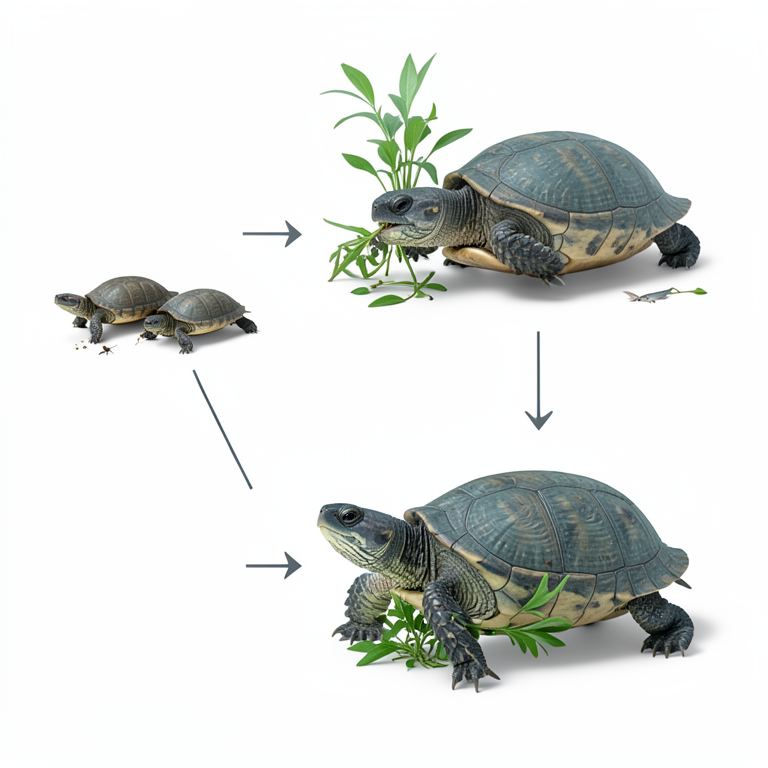
Trophic Divergence Model
AI-generated conceptual illustration (Freshwater turtles (Sternotherus crassicollis and Chelmyis amboinensis)). It explains the idea and does not show study data.
View source evidence ↗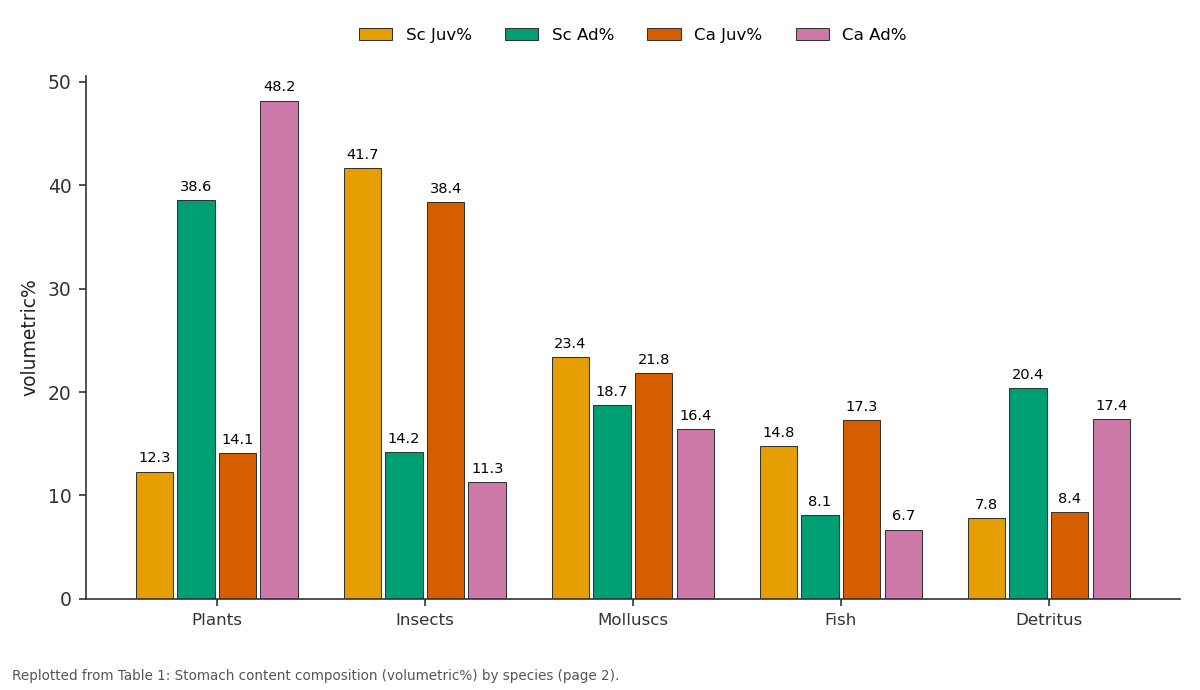
Sc Juv% and Sc Ad% and more: Plants vs Insects vs Molluscs vs Fish vs Detritus
Replotted from Table 1 (page 2) of the original paper. Every bar is the paper's own table value.
View source evidence ↗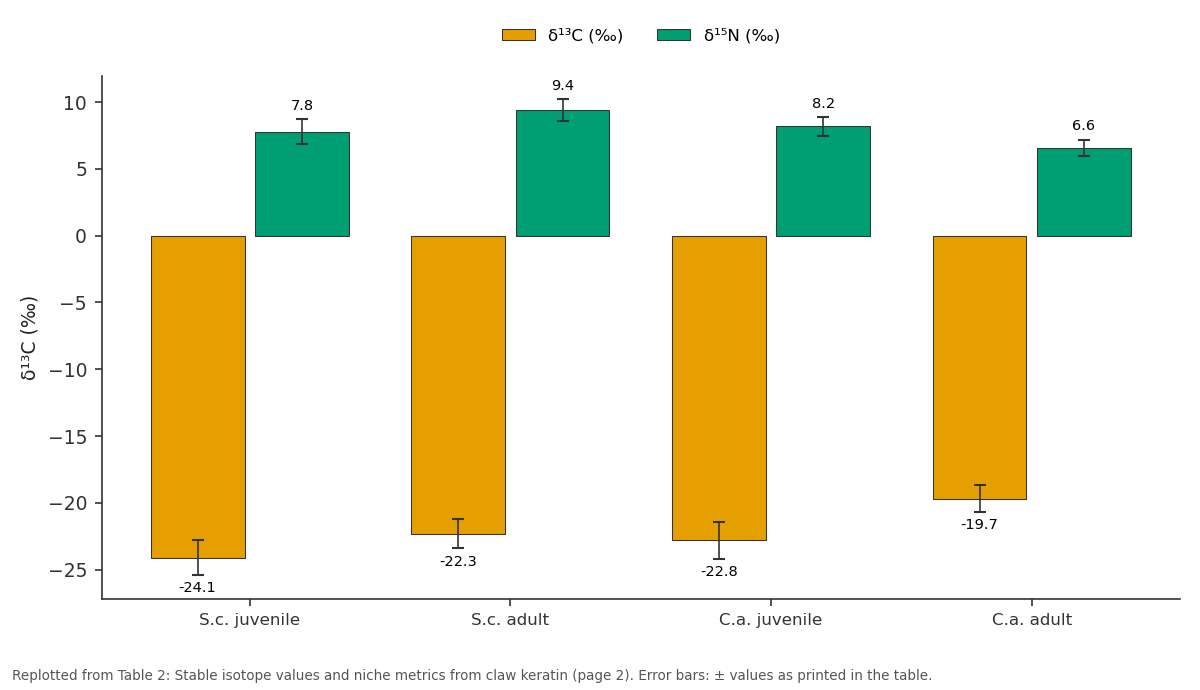
δ¹³C (‰) and δ¹⁵N (‰): S.c. juvenile vs S.c. adult vs C.a. juvenile vs C.a. adult
Replotted from Table 2 (page 2) of the original paper. Every bar is the paper's own table value.
View source evidence ↗Figures & tables
From the original paper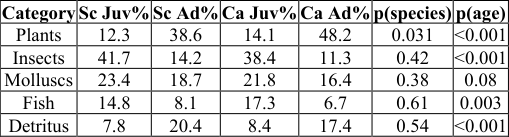 Table 1
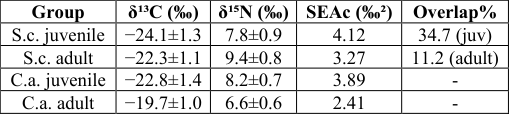 Table 2
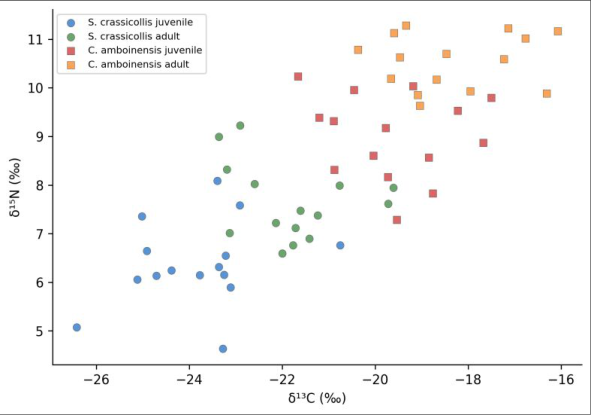 Figure 1
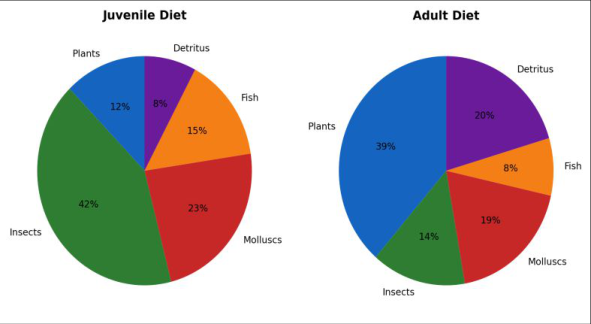 Figure 2
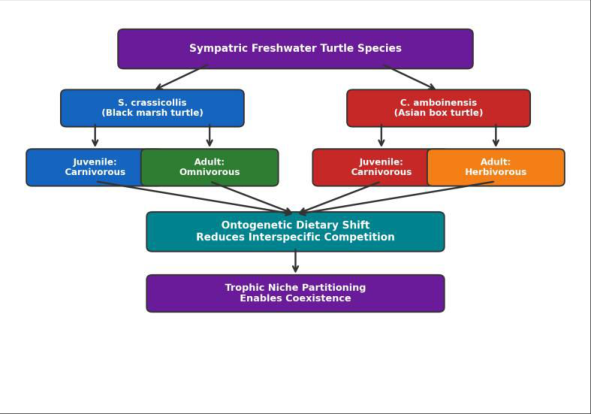 Figure 3
Introduction
How do similar species living in the same habitat avoid eating each other out of house and home? That challenge-the competitive exclusion problem-has occupied ecologists since Gause's classic paramecium experiments, and niche partitioning remains the dominant explanatory framework [1,2] . In freshwater systems, dietary partitioning is especially common among turtles, where morphological differences in jaw structure and head width can steer species toward different prey types [3] . Ontogenetic dietary shifts add another layer of complexity. Many turtles switch from carnivory as juveniles to herbivory or omnivory as adults, a transition driven by changes in energetic requirements, gape size, and gut microbiome composition [4,5] . If two sympatric species undergo parallel but offset shifts, the result can be reduced interspecific overlap at every life stage-a pattern that would be invisible from adult-only sampling. Siebenrockiella crassicollis and Cuora amboinensis cooccur in peat-swamp forests across Borneo and Sumatra, yet their trophic ecology remains almost entirely undocumented [6,7] . This research combined stomach content analysis with stable isotope ratios to characterise ontogenetic dietary shifts and quantify niche overlap between these two species.
Material and Methods
Material and Methods
Study Area Description
Fieldwork was conducted in three peat-swamp stream reaches within the Sungai Wain Protection Forest, located 15 km north of Samarinda, East Kalimantan, Indonesia (1°01′ S, 116°51′ E, elevation 8-24 m). The forest covers 9 780 hectares of lowland peat-swamp and kerangas heath forest with blackwater streams (pH 3.8-4.6, dissolved organic carbon >50 mg/L). Mean annual temperature is 27.1 °C; mean annual rainfall 2 480 mm with two peaks (November-January and April-May).
Material
Turtles were captured using baited hoop traps (n = 40 traps, checked daily) between March and October 2023, following a protocol approved by the Institut Biologi Tropis Kalimantan Animal Ethics Committee (IBTK-AEC-2022-031). Eighty-seven individuals were sampled: S. crassicollis (23 juveniles, 21 adults) and C. amboinensis (22 juveniles, 21 adults). Juveniles were defined as carapace length <12 cm for S. crassicollis and <15 cm for C. amboinensis. Stomach contents were obtained by gastric lavage (nonlethal flushing with 10 mL warm saline via silicone tubing) and preserved in 70 percent ethanol for identification under a stereomicroscope. Claw keratin samples (2-3 mm clips from the fourth forelimb claw) were collected for stable isotope analysis.
Methods
Stomach contents were sorted into five categories: plants (leaves, fruits, seeds), insects (Coleoptera, Odonata, Orthoptera), molluscs (gastropods, bivalves), fish, and detritus. Frequency of occurrence (%) and volumetric proportion (%) were calculated. Claw keratin was cleaned with 2:1 chloroform: methanol, dried, and analysed for δ¹³C and δ¹⁵N by continuous-flow isotope ratio mass spectrometry (CF-IRMS; Thermo Scientific Delta V Advantage coupled to a Flash EA 2000). Vienna Pee Dee Belemnite and atmospheric N₂ served as reference standards. Bayesian mixing models (MixSIAR v3.1) estimated proportional contributions of prey sources using published trophic discrimination factors for freshwater turtles (+1.3‰ δ¹³C, +2.6‰ δ¹⁵N). Niche overlap was quantified using the SIBER package in R (standard ellipse area, SEAc). Two-way ANOVA (species × age class) tested isotope differences; p < 0.05.
Biodiversity Assessment
Preliminary surveys identified 11 freshwater turtle and tortoise species in the research area. S. crassicollis and C. amboinensis were the two most abundant, together accounting for 68 percent of all captures. Other species recorded included Notochelys platynota, Cyclemys dentata, Heosemys spinosa, and Orlitia borneensis. Fish diversity in the study streams comprised 23 species across 12 families, with Cyprinidae (8 species) and Osphronemidae (4 species) being the most species-rich. Aquatic invertebrate surveys yielded 47 taxa, dominated by Odonata larvae (14 taxa) and Ephemeroptera (8 taxa). This invertebrate community represents the primary prey base for juvenile turtles. amboinensis adults than in S. crassicollis adults (p < 0.001), indicating a lower trophic position (Table 2; Figure 1). SIBER analysis showed that juvenile niche ellipses overlapped by 34.7 percent between species, but adult overlap dropped to just 11.2 percent, indicating effective trophic partitioning (Figure 3).
| Group | δ¹³C (‰) | δ¹⁵N (‰) | SEAc (‰²) | Overlap% |
|---|---|---|---|---|
| S.c. juvenile | −24.1±1.3 | 7.8±0.9 | 4.12 | 34.7 (juv) |
| S.c. adult | −22.3±1.1 | 9.4±0.8 | 3.27 | 11.2 (adult) |
| C.a. juvenile | −22.8±1.4 | 8.2±0.7 | 3.89 | - |
| C.a. adult | −19.7±1.0 | 6.6±0.6 | 2.41 | - |
Table text extracted from the original PDF; superscript letters are shown inline. The original table image is below.
View original table image
Results
Results
Discussion
The ontogenetic shift from carnivory to herbivory/omnivory mirrors patterns documented in North American emydids, where juveniles depend on protein-rich invertebrate prey for rapid growth before switching to more abundant but lowerquality plant resources as energetic demands shift from growth to reproduction [8,9] . The 2.8‰ δ¹⁵N separation between adult species is ecologically meaningful, roughly equivalent to one trophic level's worth of fractionation, confirming that C. amboinensis adults feed substantially lower on the food web than S. crassicollis adults [10] . The reduction in niche overlap from 34.7 percent (juveniles) to 11.2 percent (adults) suggests that ontogenetic shifts function as a coexistence mechanism. Both species start in similar dietary space as juveniles but diverge as they mature, reducing competition precisely when body size-and therefore total food demand-is greatest [11,12] . This pattern is consistent with the size-structured competition hypothesis proposed by Werner and Gilliam [13] . Peat-swamp streams are nutrient-poor and highly acidic, limiting primary productivity and making interspecific competition more intense than in eutrophic lowland rivers. The strong niche separation we measured may therefore be an adaptive response to chronic resource limitation [14] . A limitation is that gastric lavage may underrepresent soft-bodied prey items that digest rapidly.
Conclusion
Conclusion
Acknowledgement
Acknowledgements Funding SourcesInternal allocation from the Institut Biologi Tropis Kalimantan. Institutional SupportThe author thanks the Department of Zoology for field equipment and stable isotope facility access. Contributions Not Qualifying for AuthorshipMr. Hadi Pratama assisted with trap deployment; Ms. Dewi Lestari helped with invertebrate identification.
Figures and tables from the paper
| Category | Sc Juv% | Sc Ad% | Ca Juv% | Ca Ad% | p(species) | p(age) |
|---|---|---|---|---|---|---|
| Plants | 12.3 | 38.6 | 14.1 | 48.2 | 0.031 | <0.001 |
| Insects | 41.7 | 14.2 | 38.4 | 11.3 | 0.42 | <0.001 |
| Molluscs | 23.4 | 18.7 | 21.8 | 16.4 | 0.38 | 0.08 |
| Fish | 14.8 | 8.1 | 17.3 | 6.7 | 0.61 | 0.003 |
| Detritus | 7.8 | 20.4 | 8.4 | 17.4 | 0.54 | <0.001 |
Table text extracted from the original PDF; superscript letters are shown inline. The original table image is below.
View original table image
References
21 in the original paper- Hardin G. The competitive exclusion principle. Science. 1960;131(3409):1292-1297.
- Schoener TW. Resource partitioning in ecological communities. Science. 1974;185(4145):27-39.
- Herrel A, O'Reilly JC, Richmond AM. Evolution of bite performance in turtles. Journal of Evolutionary Biology. 2002;15(6):1083-1094.
- Clark DB, Gibbons JW. Dietary shift in the turtle Pseudemys scripta from youth through maturity. Copeia. 1969;1969(4):704-706.
- Bouchard SS, Bjorndal KA. Sea turtles as biological transporters of nutrients and energy from marine to terrestrial ecosystems. Ecology. 2000;81(8):2305-2313.
- Iverson JB. A revised checklist with distribution maps of the turtles of the world. Privately Published. 1992;1:1-363.
- Schoppe S. Status, trade dynamics and management of the Southeast Asian Box Turtle Cuora amboinensis in Indonesia. TRAFFIC Southeast Asia. 2009;1:1-67.
- Lindeman PV. Resource use of five sympatric turtle species: effects of competition, phylogeny, and morphology. Canadian Journal of Zoology. 2000;78(6):992-1008.
- Bjorndal KA. Diet mixing: nonadditive interactions of diet items in an omnivorous freshwater turtle. Ecology. 1991;72(4):1234-1241.
- Post DM. Using stable isotopes to estimate trophic position: models, methods, and assumptions. Ecology. 2002;83(3):703-718.
- Seminoff JA, Jones TT, Eguchi T, Jones DR, Dutton PH. Stable isotope discrimination in soft tissues of the leatherback turtle. Journal of Experimental Marine Biology and Ecology. 2006;381(1):33-41.
- Congdon JD, Greene JL, Gibbons JW. Biomass of freshwater turtles: a geographic comparison. American Midland Naturalist. 1986;115(1):165-173.
- Werner EE, Gilliam JF. The ontogenetic niche and species interactions in size-structured populations. Annual Review of Ecology and Systematics. 1984;15:393-425.
- Voris HK, Inger RF. Herpetological exploration of Borneo: historical overview and prospectus. Hamadryad. 1995;20:1-14.
- Petrov K, Spencer RJ, Janzen FJ, Thompson MB. Australian freshwater turtle ecology: a review and comparison with turtles worldwide. Journal of Comparative Physiology B. 2018;188(2):251-275.
- Aresco MJ, James FC. Ecological relationships of turtles in northern Florida lakes: a novel assembly of species. Chelonian Conservation and Biology. 2005;4(4):833-842.
- Layman CA, Arrington DA, Montana CG, Post DM. Can stable isotope ratios provide for community-wide measures of trophic structure? Ecology. 2007;88(1):4248.
- Jackson AL, Inger R, Parnell AC, Bearhop S. Comparing isotopic niche widths among and within communities: SIBER-Stable Isotope Bayesian Ellipses in R. Journal of Animal Ecology. 2011;80(3):595-602.
- Lovich JE, Ennen JR, Agha M, Gibbons JW. Where have all the turtles gone, and why does it matter? BioScience. 2018;68(10):771-781.
- Kennett R, Christian K, Pritchard D. Underwater nesting by the tropical freshwater turtle, Chelodina rugosa. Australian Journal of Zoology. 1993;41(1):4752.
- Spencer RJ. Growth patterns of two widely distributed freshwater turtles and a comparison of common methods used to estimate age. Australian Journal of Zoology. 2002;50(5):477-490.