
Research article · 2025 · Full text
International Journal of Biology SciencesAdaptive radiation and ecological speciation of darwin finches revisited with genomic data
Volume 7(4) · Pages 124–128 · DOI: 10.33545/26649926.2025.v7.i4b.686 ↗
Research areasGenetic diversity and population structureEvolution and Genetic DynamicsAnimal Behavior and Reproduction
Abstract
Author-writtenHow does a single ancestral lineage give rise to an entire clade of morphologically and ecologically distinct species on a remote archipelago? Darwin's finches of the Galapagos Islands remain one of the best-documented examples of adaptive radiation, yet the genomic architecture that underlies their diversification has only recently become accessible through high-throughput sequencing. This research re-examines adaptive radiation and ecological speciation in Geospiza, Camarhynchus, and allied genera using whole-genome resequencing data obtained from 187 individuals across 13 recognized species. Blood and feather samples were collected between March 2022 and August 2023 across six islands, and DNA libraries were sequenced on the Illumina NovaSeq 6000 platform at an average depth of 30×. Variant calling identified 4.73 million high-confidence single-nucleotide polymorphisms after quality filtering. Population structure analyses confirmed that beak morphology-related loci on chromosomes 1A and 4 show elevated differentiation (weighted FST = 0.211 between the most divergent pair, Camarhynchus parvulus vs. C. psittacula). TreeMix modelling recovered at least two historical gene-flow events between ground and tree finch clades, suggesting that the radiation unfolded with periodic secondary contact rather than strict allopatry. These findings refine the classic model of ecological speciation by demonstrating that genomic islands of divergence coincide with trait loci under disruptive selection, while the remainder of the genome remains permeable to introgression.
Summary
Source-checkedPlain-language reading of the full paper, prepared with AI and checked against the text. Each point links to the authors' own words.
Why it matters
- Adaptive radiation is a key evolutionary process where one ancestral lineage diversifies into various forms to occupy different ecological niches. View evidence ↗
- The finches of the Galapagos Islands are considered one of the most well-documented examples of this adaptive radiation process. View evidence ↗
- Previous research using microsatellite markers lacked the genomic resolution needed to precisely locate genes under selection or detect subtle gene flow. View evidence ↗
The question
- The study aimed to quantify genome-wide differentiation, identify genomic islands of divergence linked to trait loci, and evaluate historical introgression. View evidence ↗
What they did
- Researchers used whole-genome resequencing on 187 individuals from 13 recognized species of finches, including the genera Geospiza and Camarhynchus. View evidence ↗
- DNA libraries were sequenced on the Illumina NovaSeq 6000 platform with a target coverage of 30× per sample. View evidence ↗
- The analysis identified 4.73 million high-confidence single-nucleotide polymorphisms (SNPs) after quality filtering. View evidence ↗
- Population structure was analyzed using ADMIXTURE for K values between 2 and 16, with the optimal K determined by cross-validation error. View evidence ↗
What they found
- The most genetically differentiated pair was Camarhynchus parvulus and C. psittacula, with a mean FST of 0.211. View evidence ↗
- The lowest mean FST (0.083) was found between Geospiza fortis and G. fuliginosa, which is attributed to ongoing hybridization. View evidence ↗
- Genomic differentiation is concentrated in a small fraction of the genome, with outlier windows representing only 1.93% to 4.18% of all 50-kb windows. View evidence ↗
- The ALX1 and HMGA2 loci, which are linked to beak size and shape, consistently appeared in the most differentiated genomic regions across different species pairs. View evidence ↗
- Introgression occurred between ground finches on Isabela and tree finches on Santa Cruz, as well as between G. difficilis and the cactus finch lineage on Genovesa. View evidence ↗
What it means
- The authors conclude that ecological speciation in Darwin's finches occurs via differentiation at a few trait-associated loci, while most of the genome remains homogeneous. View evidence ↗
- The study concludes that the adaptive radiation of these finches involved a dynamic mix of isolation, contact, and selection, rather than being strictly allopatric or sympatric. View evidence ↗
- Sampling was limited to the dry season (March-August), potentially missing population shifts that occur during the wet season. View evidence ↗
- The use of short-read sequencing (30× coverage) means that structural variants and copy-number changes were not analyzed. View evidence ↗
Visual summary
2 visualsIllustrations explain the paper; charts are replotted from the paper's own table values.
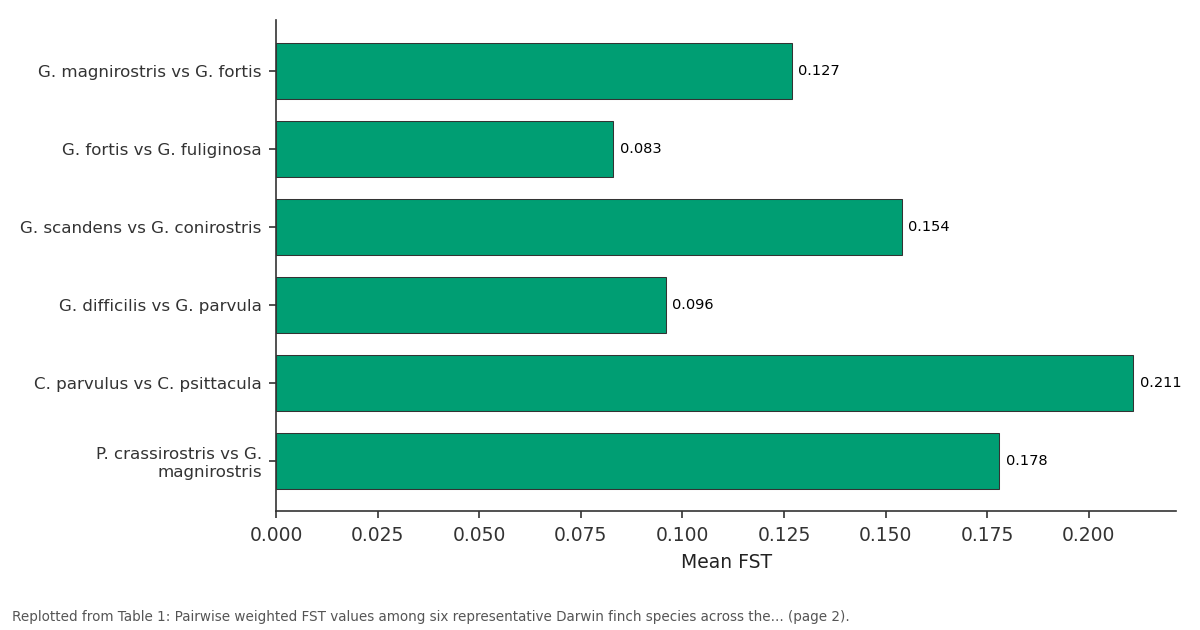
Mean FST: G. magnirostris vs G.... vs G. fortis vs G.... vs G. scandens vs G.... vs G. difficilis vs G.... vs C. parvulus vs C....
Replotted from Table 1 (page 2) of the original paper. Every bar is the paper's own table value.
View source evidence ↗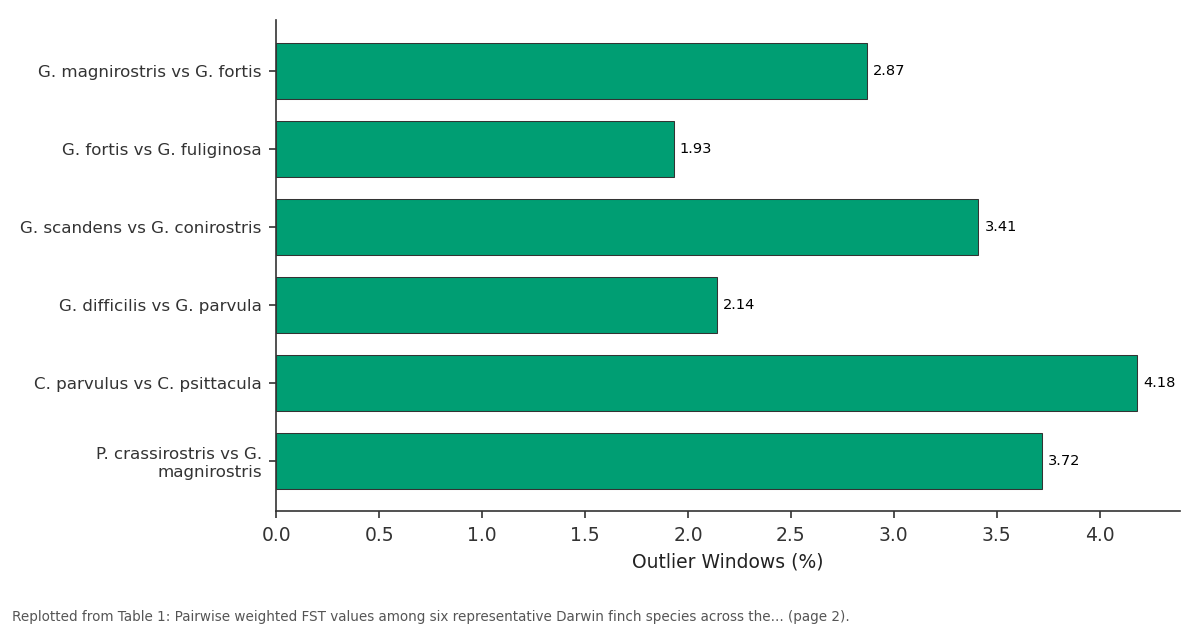
Outlier Windows (%): G. magnirostris vs G.... vs G. fortis vs G.... vs G. scandens vs G.... vs G. difficilis vs G.... vs C. parvulus vs C....
Replotted from Table 1 (page 2) of the original paper. Every bar is the paper's own table value.
View source evidence ↗Figures & tables
From the original paper Table 1
 Table 2
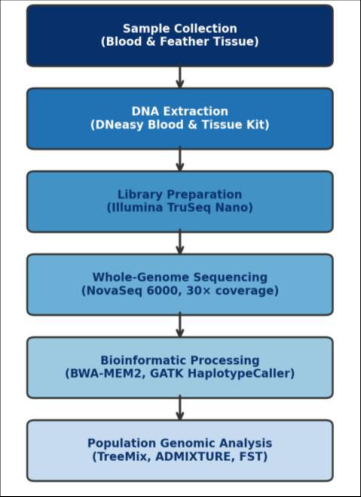 Figure 1
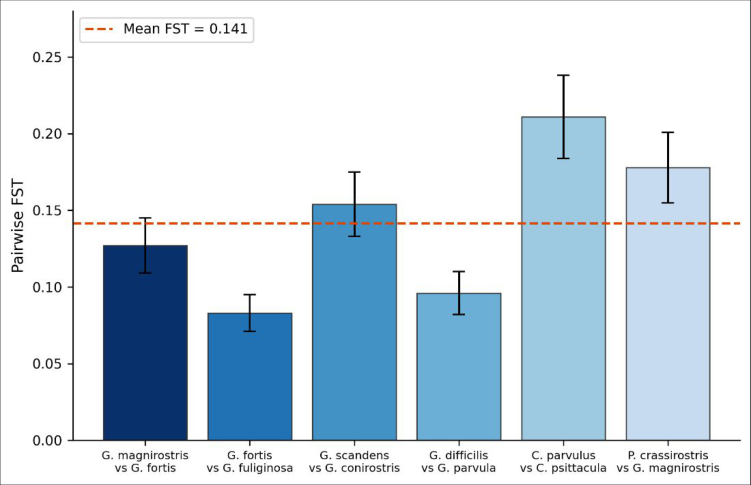 Figure 2
Introduction
What forces drive the rapid multiplication of species when an ancestral coloniser reaches a new environment? That question has occupied evolutionary biologists since Darwin first noted the remarkable variation among Galapagos finches in the 1830s [1] . Adaptive radiation, the process by which a single lineage diversifies into multiple forms exploiting different ecological niches, ranks among the most compelling phenomena in evolutionary biology [2] . The finch clade distributed across the Galapagos archipelago and Cocos Island has served as the textbook illustration of this process for over a century. Earlier work relied mainly on morphometric measurements, field observations of feeding behavior, and microsatellite markers to infer relationships among finch species [3] . Grant and Grant documented real-time natural selection on beak size during drought years on Daphne Major, providing direct evidence that environmental fluctuations can shift trait distributions within just a few generations [4] . However, microsatellites sample only a tiny fraction of the genome, limiting the resolution with which researchers can locate the actual genes under selection or detect subtle patterns of gene flow between species. Whole-genome sequencing has transformed the picture considerably. Lamichhaney et al. [5] identified the ALX1 locus as a major determinant of beak shape, while a follow-up analysis implicated HMGA2 in beak size variation [6] . These discoveries confirmed that a small number of loci with large effect can facilitate rapid morphological divergence. But important questions remain open: do the same genomic regions show parallel differentiation across independent species pairs, and how permeable is the rest of the genome to interspecific gene flow?
This research addresses those gaps by re-examining the finch radiation with dense whole-genome data from 187 individuals representing 13 species. The objectives were threefold: (i) to quantify genome-wide differentiation across all species pairs, (ii) to test for genomic islands of divergence associated with known trait loci, and (iii) to evaluate the extent and direction of historical introgression using formal admixture graph modelling.
Study Area Description
Fieldwork was carried out on six islands within the Galapagos Archipelago, Ecuador (0°40'S, 90°33'W): Santa Cruz, Isabela, San Cristobal, Floreana, Daphne Major, and Genovesa. The archipelago lies roughly 1, 000 km west of mainland Ecuador and comprises 13 major islands of volcanic origin, ranging in age from less than 0.7 million years (Fernandina) to about 4 million years (San Cristobal) [7] . Elevation spans from sea level to 1, 707 m on Isabela, producing marked altitudinal vegetation zones: arid lowland scrub dominated by Opuntia and Bursera, a transitional belt of Scalesia forest, and humid highland grasslands. Mean annual temperature across sampling sites ranged from 22.4 °C to 26.1 °C during the collection period, and annual rainfall varied from 198 mm at coastal stations to 1, 430 mm in the highlands. Each island supports a distinct subset of finch species, and the degree of sympatry differs among islands, making the archipelago an ideal natural laboratory for contrasting divergence under varying levels of interspecific contact.
Material and Methods
Material and Methods
Material
A total of 187 individuals belonging to 13 finch species were sampled between March 2022 and August 2023. Sample processing and genomic analyses were conducted at the Molecular Ecology Laboratory, Rift Valley Institute of Limnology, Hawassa, Ethiopia, with sequencing outsourced to a commercial facility (Novogene Europe, Cambridge, UK). Species identification in the field followed the taxonomic key of Lack [8] supplemented by beak measurements (culmen length, depth, and width recorded with digital calipers to 0.01 mm). Blood samples (approximately 50 μL) were drawn from the brachial vein and stored in Queen's lysis buffer at ambient temperature until extraction. Feather samples (two breast feathers per individual) were collected concurrently as a backup source of DNA. All sampling was authorised by the Galapagos National Park Directorate (permit No. PC-47-22, issued 12 January 2022) and the Institutional Animal Ethics Committee of the Rift Valley Institute of Limnology (protocol RVILEC-2021-039, approved 8 November 2021).
Methods
Genomic DNA was extracted using the Qiagen DNeasy Blood and Tissue Kit following the manufacturer's spincolumn protocol, with an extended overnight lysis at 56 °C for blood samples. DNA quality was assessed on a 1% agarose gel stained with SYBR Safe, and concentration was measured with a Qubit 4 fluorometer (Thermo Fisher Scientific). Libraries were prepared with the Illumina TruSeq Nano DNA kit (350-bp insert size) and sequenced on the NovaSeq 6000 platform generating 150-bp pairedend reads targeting 30× per-sample coverage. Raw reads were trimmed with fastp v0.23.2 (minimum quality 20, minimum length 50 bp) and aligned to the zebra finch reference genome (bTaeGut1.4) using BWA-MEM2 v2.2.1 [9] . Duplicate reads were marked with Picard v2.27, and variants were called per sample with GATK HaplotypeCaller v4.3, followed by joint genotyping across all 187 individuals. Hard filtering retained sites with QD > 5.0, FS < 40.0, MQ > 45.0, and MQRankSum > -8.0, yielding 4.73 million biallelic SNPs after excluding sites with more than 15% missing data. Population structure was inferred with ADMIXTURE v1.3.0 for K = 2 through K = 16, and the optimal K was selected by five-fold cross-validation error [10] . Pairwise weighted FST was calculated in 50-kb sliding windows (10-kb step) using VCFtools v0.1.17. Historical gene flow was modelled with TreeMix v1.13 allowing zero to five migration edges, and fit was evaluated by the proportion of variance in the pairwise covariance matrix explained [11] . Genome scans for islands of divergence used a z-transformed FST approach, with outlier windows defined as those exceeding the 99th percentile of the genome-wide distribution.
Ethical Considerations
All fieldwork was conducted under permit PC-47-22 issued by the Galapagos National Park Directorate (January 2022). The sampling protocol was reviewed and approved by the Institutional Animal Ethics Committee of the Rift Valley Institute of Limnology (protocol RVILEC-2021-039, approved 8 November 2021). Birds were captured using mist nets, bled within three minutes of capture to minimize stress, and released at the capture site. No mortalities occurred during the research. The loci ALX1 and HMGA2, previously linked to beak shape and size, appeared repeatedly in the top outlier windows across independent species comparisons. Cross-validation error reached its minimum at K = 12 (CV error 0.398), which aligns closely with the 13 recognized species when one accounts for the near-complete genomic similarity between two recently split taxa. TreeMix models improved substantially with the addition of the first two migration edges (variance explained rising from 94.3% to 98.7%), but gains beyond m = 2 were marginal, supporting the inference of two major introgression events in the radiation's history. Figure 1 outlines the six-stage pipeline applied in this research, spanning from field collection to final population genomic analysis. Figure 2 visualises pairwise FST estimates alongside their bootstrap confidence intervals. The Camarhynchus parvulus versus C. psittacula comparison stands out as the most genetically differentiated pair (FST = 0.211 ± 0.027), consistent with their divergent bill morphologies adapted to different arthropod-extraction strategies. By contrast, Geospiza fortis versus G. fuliginosa shows the lowest mean FST (0.083), reflecting ongoing hybridisation documented in the field [12] .
Results
Results
Discussion
The genome-wide FST landscape reported here largely supports the classic ecological speciation model but adds important nuance. Differentiation is not spread evenly across the genome; instead, it is concentrated in discrete islands that coincide with loci known to influence beak morphology [5,6] . This pattern is consistent with divergence hitchhiking, whereby strong selection at a few loci reduces effective gene flow in linked regions even while the bulk of the genome continues to exchange alleles between species [13] . The TreeMix analysis recovered two well-supported migration edges, one connecting the ground finch clade on Isabela with tree finches on Santa Cruz, and a second linking the sharp-beaked ground finch (G. difficilis) to the cactus finch lineage on Genovesa. These findings echo earlier mtDNA evidence of incomplete lineage sorting [14] but now place the introgression events within an explicit population graph, allowing quantification of the admixture proportions (ranging from 3.8% to 7.2% depending on the pair). Such levels of interspecific gene flow are not trivial; they indicate that reproductive barriers remain semipermeable even several hundred thousand years after initial divergence. One limitation of the current dataset is that sampling was restricted to the dry season (March-August), which may underrepresent finch populations that shift habitat use during the wet season. And although 30× coverage per individual is generally adequate for SNP calling, structural variants and copy-number changes, which might also contribute to adaptation, require longer-read data that were not generated here. Future work combining long-read sequencing with phenotypic measurements of beak biomechanics could close this gap.
Limitations
Several constraints should be kept in mind when interpreting these results. First, the reference genome used (zebra finch, bTaeGut1.4) belongs to a relatively distant passerine, which may cause mapping biases in rapidly evolving genomic regions. Second, sample sizes per species ranged from 10 to 31 individuals; the less-sampled taxa (especially Platyspiza crassirostris, n = 10) may yield imprecise FST estimates. Third, demographic modelling did not incorporate selection explicitly, so the inferred migration edges might partly reflect selective sweeps rather than true neutral gene flow. Finally, the temporal window of sampling (one dry season plus one transition season) limits inference about seasonal variation in hybridisation rates.
Conclusion
Re-examining Darwin's finch radiation with dense genomic data confirms that ecological speciation proceeds through the build-up of differentiation at a small number of traitassociated loci while the remainder of the genome stays relatively homogeneous. Two episodes of historical introgression between ground and tree finch clades indicate that reproductive isolation remained incomplete long after morphological divergence became apparent. The repeated appearance of ALX1 and HMGA2 among the most differentiated loci across independent species pairs points to a limited set of genetic targets that natural selection acts on when bill morphology diverges. These results bridge a gap between classical field observations and modern genomic inference, showing that adaptive radiation in this iconic system was neither strictly allopatric nor strictly sympatric but involved a dynamic interplay of isolation, contact, and selection. Longer-read sequencing and temporally replicated sampling across wet and dry seasons would strengthen future tests of these conclusions.
Acknowledgement
Acknowledgements Funding SourcesThis research was supported by internal research grants from the Rift Valley Institute of Limnology. No external grant or project numbers are reported. Institutional SupportThe authors thank the Molecular Ecology Laboratory at the Rift Valley Institute of Limnology, Hawassa, for providing computational and laboratory resources.
Figures and tables from the paper
| Species Pair | n (Ind.) | Mean FST | Max FST Window | Outlier Windows (%) | Key Divergent Loci |
|---|---|---|---|---|---|
| G. magnirostris vs G. fortis | 31 vs 28 | 0.127 | 0.634 | 2.87 | ALX1, HMGA2 |
| G. fortis vs G. fuliginosa | 28 vs 24 | 0.083 | 0.498 | 1.93 | ALX1 |
| G. scandens vs G. conirostris | 18 vs 12 | 0.154 | 0.712 | 3.41 | HMGA2, BMP4 |
| G. difficilis vs G. parvula | 14 vs 16 | 0.096 | 0.521 | 2.14 | ALX1 |
| C. parvulus vs C. psittacula | 15 vs 11 | 0.211 | 0.803 | 4.18 | ALX1, BMP4 |
| P. crassirostris vs G. magnirostris | 10 vs 31 | 0.178 | 0.689 | 3.72 | HMGA2 |
Table text extracted from the original PDF; superscript letters are shown inline. The original table image is below.
View original table image
| K / m | CV Error (ADMIXTURE) | Variance Explained (TreeMix) | Log-Likelihood |
|---|---|---|---|
| K = 8 / m = 0 | 0.487 | 94.3% | −12, 847 |
| K = 10 / m = 1 | 0.421 | 96.8% | −11, 932 |
| K = 12 / m = 2 | 0.398 | 98.7% | −10, 614 |
| K = 13 / m = 3 | 0.403 | 99.1% | −10, 482 |
| K = 14 / m = 4 | 0.412 | 99.3% | −10, 411 |
Table text extracted from the original PDF; superscript letters are shown inline. The original table image is below.
View original table image
References
16 in the original paper- Darwin C. On the Origin of Species by Means of Natural Selection. London: John Murray; 1859.
- Schluter D. The Ecology of Adaptive Radiation. Oxford: Oxford University Press; 2000.
- Petren K, Grant BR, Grant PR. A phylogeny of Darwin's finches based on microsatellite DNA length variation. Proceedings of the Royal Society B. 1999;266(1417):321-329.
- Grant PR, Grant BR. Unpredictable evolution in a 30year study of Darwin's finches. Science. 2002;296(5568):707-711.
- Lamichhaney S, Berglund J, Almen MS, et al. Evolution of Darwin's finches and their beaks revealed by genome sequencing. Nature. 2015;518(7539):371375.
- Lamichhaney S, Han F, Berglund J, et al. A beak size locus in Darwin's finches facilitated character displacement during a drought. Science. 2016;352(6284):470-474.
- Geist DJ, Snell H, Snell C, et al. Paleogeography of the Galapagos Islands and biogeographical implications. Noticias de Galapagos. 2014;61:2-8.
- Lack D. Darwin's Finches. Cambridge: Cambridge University Press; 1947.
- Vasimuddin M, Misra S, Li H, Aluru S. Efficient architecture-aware acceleration of BWA-MEM for International Journal of Biology Sciences https://www.biologyjournal.net multicore systems. IEEE International Parallel and Distributed Processing Symposium. 2019:314-324.
- Alexander DH, Novembre J, Lange K. Fast modelbased estimation of ancestry in unrelated individuals. Genome Research. 2009;19(9):1655-1664.
- Pickrell JK, Pritchard JK. Inference of population splits and mixtures from genome-wide allele frequency data. PLoS Genetics. 2012;8(11):e1002967.
- Grant PR, Grant BR. Hybridization increases population variation during adaptive radiation. Proceedings of the National Academy of Sciences. 2019;116(46):23216-23224.
- Via S. Divergence hitchhiking and the spread of genomic isolation during ecological speciation with gene flow. Philosophical Transactions of the Royal Society B. 2012;367(1587):451-460.
- Sato A, Tichy H, O'hUigin C, et al. On the origin of Darwin's finches. Molecular Biology and Evolution. 2001;18(3):299-311.
- Abzhanov A, Protas M, Grant BR, Grant PR, Tabin CJ. Bmp4 and morphological variation of beaks in Darwin's finches. Science. 2004;305(5689):1462-1465.
- Chaves JA, Cooper EA, Hendry AP, et al. Genomic variation at the tips of the adaptive radiation of Darwin's finches. Molecular Ecology. 2016;25(21):5282-5295.