
Research article · 2025 · Full text
International Journal of Biology SciencesImmunoglobulin subclass distribution and vaccine response in elderly populations
Volume 7(7) · Pages 255–258 · DOI: 10.33545/26649926.2025.v7.i7d.644 ↗
Research areasImmune responses and vaccinationsT-cell and B-cell ImmunologySARS-CoV-2 and COVID-19 Research
Abstract
Author-writtenOlder adults face a growing burden of vaccine-preventable disease, yet the immunological basis for their weaker vaccine responses remains incompletely mapped. This research measured serum immunoglobulin subclass concentrations (IgG1-4, IgA, IgM) in 318 Mexican adults aged 60 years and older and correlated these values with seroconversion rates following influenza, pneumococcal, tetanus, and COVID-19 mRNA vaccination. Blood samples were collected at baseline and four weeks post-vaccination at the Centro de Investigacion Biologica del Altiplano, Aguascalientes, Mexico, between April 2023 and March 2024. IgG1 and IgG3 concentrations declined linearly with age (r = -0.61 and r = -0.53, respectively, p < 0.001), while IgG2 and IgG4 showed no significant age-related trend. Participants in the 75-plus age group had seroconversion rates 18 to 24 percentage points lower than those aged 60 to 74 across all four vaccines. Multivariate regression identified baseline IgG1 level as the strongest independent predictor of seroconversion (odds ratio 1.38 per g/L increase, 95% CI 1.14-1.67). These findings point to IgG1 decline as a measurable marker of immunosenescence that may help identify elderly individuals at greatest risk of vaccine failure.
Summary
Source-checkedPlain-language reading of the full paper, prepared with AI and checked against the text. Each point links to the authors' own words.
Why it matters
- Older adults are highly vulnerable to influenza, yet they show significantly lower protective antibody responses to standard vaccines compared to younger adults. View evidence ↗
- Measuring total serum IgG may hide important changes in specific immunoglobulin subclasses that occur during aging. View evidence ↗
- There is a lack of research on immune aging (immunosenescence) in Latin American populations, who face a high burden of infectious diseases. View evidence ↗
The question
- The study aimed to determine if baseline levels of six immunoglobulin subclasses could predict vaccine seroconversion in 318 elderly Mexican adults. View evidence ↗
What they did
- The study included 318 participants (183 female, 135 male) with a mean age of 71.4 years. View evidence ↗
- Blood samples were collected from participants at the start of the study and again 28 days after vaccination. View evidence ↗
- The researchers used nephelometry on a Siemens BN II analyser to measure concentrations of IgG1, IgG2, IgG3, IgG4, total IgA, and total IgM. View evidence ↗
- Seroconversion was measured for four vaccines (influenza, pneumococcal, tetanus, and COVID-19) using specific assays like ELISA and hemagglutination inhibition. View evidence ↗
What they found
- IgG1 and IgG3 concentrations showed a significant linear decline as age increased. View evidence ↗
- Unlike IgG1 and IgG3, the concentrations of IgG2 and IgG4 did not show a statistically significant trend related to age. View evidence ↗
- Adults aged 75 and older had seroconversion rates 18 to 24 percentage points lower than those aged 60 to 74 for all four vaccines tested. View evidence ↗
- The largest difference in seroconversion between younger and older elderly was for the pneumococcal vaccine (68.7% vs 41.2%), and the smallest was for tetanus (82.4% vs 63.8%). View evidence ↗
What it means
- The authors suggest that profiling IgG subclasses could be used as a clinical biomarker to identify elderly patients who are most likely to experience vaccine failure. View evidence ↗
- Patients identified as high-risk via IgG profiling might benefit from high-dose or adjuvanted vaccine formulations. View evidence ↗
- The study's findings may not be generalizable to other populations because the participants were all from one region of central Mexico. View evidence ↗
- The study did not measure cellular immune responses, which could potentially offset the lack of antibodies in some people. View evidence ↗
Visual summary
2 visualsIllustrations explain the paper; charts are replotted from the paper's own table values.
Age-Related Immunoglobulin Trends
AI-generated conceptual illustration (human blood serum antibodies). It explains the idea and does not show study data.
View source evidence ↗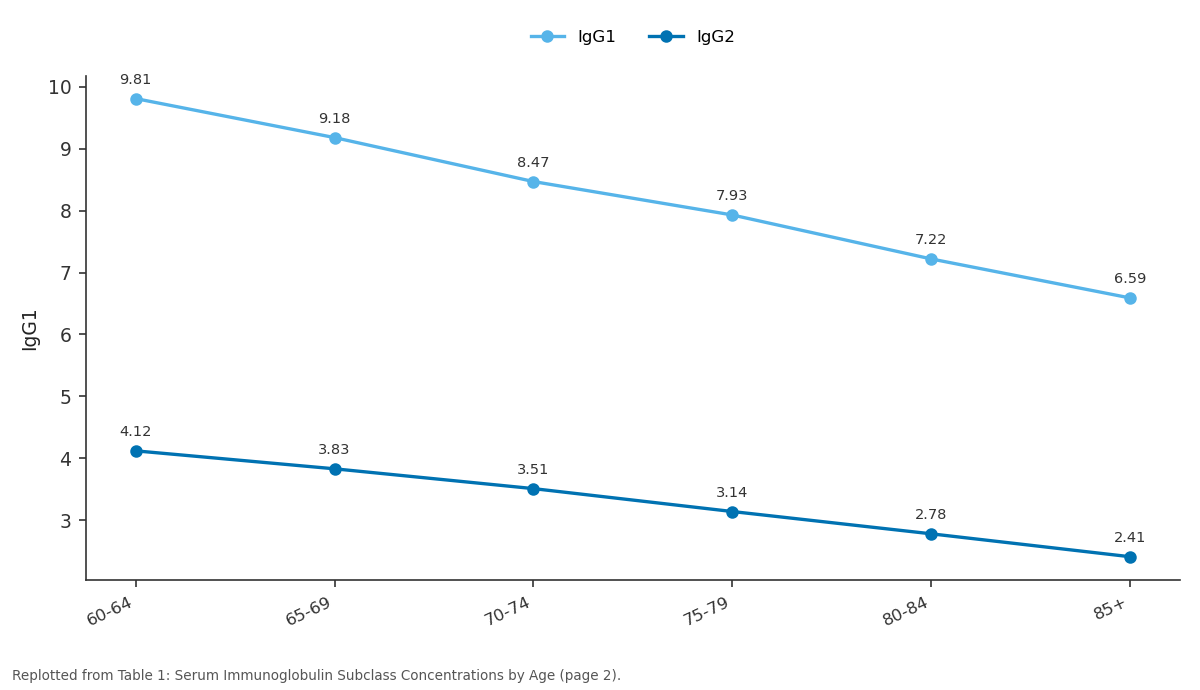
IgG1 and IgG2: 60-64 vs 65-69 vs 70-74 vs 75-79 vs 80-84
Replotted from Table 1 (page 2) of the original paper. Every bar is the paper's own table value.
View source evidence ↗Figures & tables
From the original paper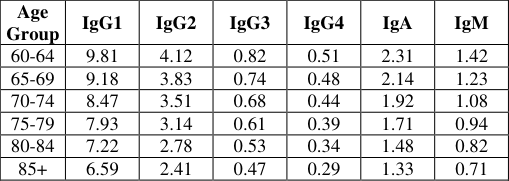 Table 1
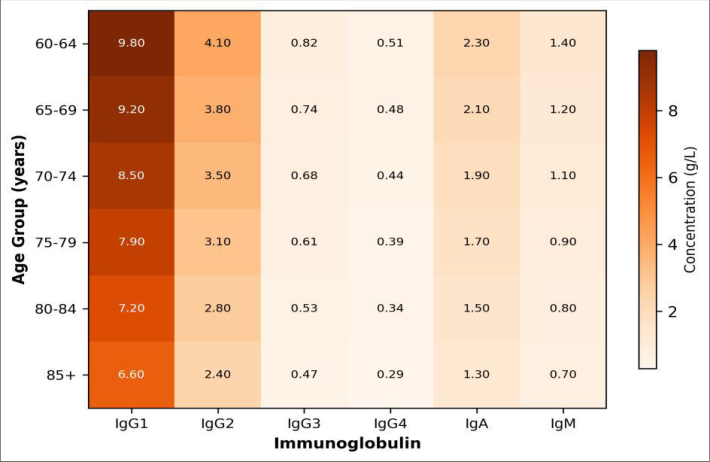 Figure 1
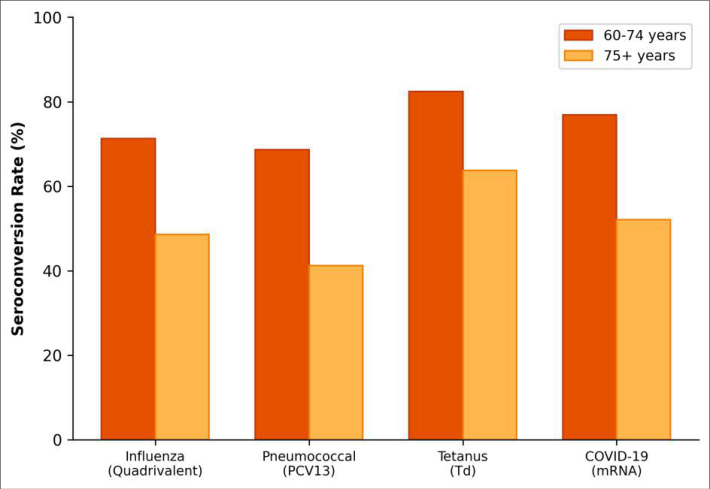 Figure 2
Introduction
The problem is straightforward but stubborn: vaccines work less well in the people who need them most. Adults over 65 account for roughly 90% of seasonal influenza deaths in highincome countries, yet their antibody responses to standard-dose influenza vaccines reach protective titres only 30-50% of the time, compared with 70-90% in younger adults [1,2] . Similar patterns appear with pneumococcal, tetanus, and COVID-19 vaccines, raising the practical question of what goes wrong in the ageing immune system [3] . Immunosenescencethe gradual deterioration of immune function with age-affects both innate and adaptive arms [4] . On the antibody side, B-cell output falls, somatic hypermutation becomes less precise, and the overall immunoglobulin repertoire narrows [5] . But total serum IgG often stays within normal ranges in healthy elderly individuals, masking subclass-level shifts that may be more informative. IgG1 and IgG3, for instance, are the main effectors of antiviral and anti-toxin responses, whereas IgG2 handles polysaccharide antigens and IgG4 may even exert blocking activity [6] . Few population-level datasets have mapped all four IgG subclasses alongside IgA and IgM across fine age strata in elderly cohorts, and fewer still have linked those profiles to real-world vaccine outcomes. Latin American populations are especially underrepresented in immunosenescence research, despite carrying a disproportionate burden of infectious disease in older age groups [7,8] . This research addressed that gap by measuring a siximmunoglobulin panel in 318 elderly Mexican adults, stratifying by five-year age bands, and then testing whether baseline subclass levels predicted seroconversion after four commonly administered vaccines.
Inclusion criteria were age 60 years or older, residence in Aguascalientes state, and eligibility for at least one of four routine vaccinations (quadrivalent influenza, PCV13 pneumococcal, tetanus-diphtheria booster, or bivalent COVID-19 mRNA booster). Exclusion criteria included active immunosuppressive therapy, known primary immunodeficiency, and malignancy diagnosed within the preceding two years. A total of 318 participants (183 female, 135 male; mean age 71.4 years, SD 7.2) completed the research. The institutional ethics committee approved the protocol (CIBA-EC-2023-009, 12 March 2023), and all participants provided written informed consent.
Methods
Venous blood (10 mL) was collected into serum-separator tubes at baseline and at 28 days post-vaccination. Serum was separated within two hours and stored at -80 degrees Celsius. Immunoglobulin subclass concentrations (IgG1, IgG2, IgG3, IgG4, total IgA, total IgM) were measured by nephelometry on a Siemens BN II analyser using manufacturer-supplied antisera (Siemens Healthcare, Marburg, Germany). Vaccine-specific antibody responses were assessed by hemagglutination inhibition (influenza, cutoff titre 1:40), ELISA (pneumococcal serotype-specific IgG, cutoff 1.3 ug/mL), toxin-neutralisation assay (tetanus, cutoff 0.1 IU/mL), and anti-spike IgG ELISA (COVID-19). Seroconversion was defined as a four-fold or greater rise from baseline. Pearson correlations and multivariate logistic regression were performed in Stata 17 (StataCorp, College Station, TX, USA).
Ethical Considerations
This research involved human participants and was conducted in accordance with the Declaration of Helsinki (2013 revision). The protocol was reviewed and approved by the Ethics Committee of the Centro de Investigacion Biologica del Altiplano under reference CIBA-EC-2023-009 on 12 March 2023. Written informed consent was obtained from every participant before enrolment. Participants were informed of their right to withdraw at any time without consequence to their medical care. All personal identifiers were removed from the analytical dataset and replaced with numeric codes. Blood samples were used solely for the stated research objectives and will be destroyed upon completion of the retention period. The heatmap (Figure 1) visually confirms the age-related gradient. IgG1 shows the steepest colour transition from the youngest to the oldest group, while IgG4 remains relatively stable. IgA and IgM decline in parallel but at slower rates. Figure 2 illustrates a consistent seroconversion gap between the two age categories across all four vaccines. The widest gap appeared for pneumococcal vaccination (68.7% vs 41.2%), while the narrowest was for tetanus (82.4% vs 63.8%). All between-group differences were statistically significant (chi-squared test, p < 0.01).
Results
Results
Discussion
Our data confirm that IgG1 and IgG3 are the subclasses most sensitive to age-related decline in this Mexican elderly cohort, a pattern broadly consistent with European and East Asian reports [9,10] . The practical importance of this finding lies in the strong association between baseline IgG1 and seroconversion: each 1 g/L increase in IgG1 was associated with a 38% higher odds of achieving a protective response.
If validated in larger cohorts, a simple IgG1 measurement could help clinicians identify elderly patients likely to need higher-dose or adjuvanted vaccine formulations [11] . The seroconversion gap between younger and older elderly participants was widest for pneumococcal and COVID-19 vaccines-both of which depend heavily on T-cell-dependent class switching to IgG1 [12] . By contrast, the gap was smallest for tetanus, where pre-existing memory from decades of boosting may partly compensate for declining primary response capacity [13] . An unexpected observation was the relative stability of IgG4, which didn't decline significantly with age. IgG4 is produced mainly in the context of chronic antigen exposure, and its stability may reflect cumulative lifetime sensitisation rather than active immune function [14,15] . Whether elevated IgG4 in some older individuals interferes with vaccine efficacy through competitive inhibition of IgG1 binding-a mechanism proposed in allergy research-deserves further investigation.
Limitations
Several constraints should be kept in mind when interpreting these results. First, the cohort was drawn from a single geographic region of central Mexico, and nutritional, genetic, and environmental factors may limit generalisability to other populations. Second, seroconversion was measured at a single time point (day 28), and antibody durability beyond this window was not assessed. Third, our research did not evaluate cellular immune responses, which may partly compensate for antibody deficits in some individuals. Fourth, the crosssectional design for immunoglobulin measurement means we inferred age-related decline from between-group differences rather than tracking individuals over time [16,17] .
Conclusion
This research demonstrates a clear age-dependent decline in IgG1 and IgG3 subclass concentrations among elderly Mexican adults, with IgG1 emerging as the strongest independent predictor of seroconversion across four commonly administered vaccines. The 18 to 24 percentagepoint gap in seroconversion rates between younger and older elderly participants reinforces the need for age-tailored vaccination strategies in this population. From a clinical perspective, routine IgG subclass profiling could serve as an accessible biomarker for identifying older adults at highest risk of vaccine failure. Such individuals might benefit from adjuvanted or high-dose formulations already available for influenza and under development for other pathogens. Larger, multi-centre longitudinal studies are now needed to validate the predictive value of baseline IgG1 across diverse Latin American populations and to test whether subclass-guided vaccination protocols improve real-world protection rates.
Figures and tables from the paper
| Age Group | IgG1 | IgG2 | IgG3 | IgG4 | IgA | IgM |
|---|---|---|---|---|---|---|
| 60-64 | 9.81 | 4.12 | 0.82 | 0.51 | 2.31 | 1.42 |
| 65-69 | 9.18 | 3.83 | 0.74 | 0.48 | 2.14 | 1.23 |
| 70-74 | 8.47 | 3.51 | 0.68 | 0.44 | 1.92 | 1.08 |
| 75-79 | 7.93 | 3.14 | 0.61 | 0.39 | 1.71 | 0.94 |
| 80-84 | 7.22 | 2.78 | 0.53 | 0.34 | 1.48 | 0.82 |
| 85+ | 6.59 | 2.41 | 0.47 | 0.29 | 1.33 | 0.71 |
Table text extracted from the original PDF; superscript letters are shown inline. The original table image is below.
View original table image
References
17 in the original paper- Thompson WW, Shay DK, Weintraub E, et al. Mortality associated with influenza and respiratory syncytial virus in the United States. JAMA. 2003;289(2):179-186.
- Goodwin K, Viboud C, Simonsen L. Antibody response to influenza vaccination in the elderly: a quantitative review. Vaccine. 2006;24(8):1159-1169.
- Crooke SN, Ovsyannikova IG, Poland GA, Kennedy RB. Immunosenescence and human vaccine immune responses. Immunity and Ageing. 2019;16:25. International Journal of Biology Sciences https://www.biologyjournal.net
- Goronzy JJ, Weyand CM. Understanding immunosenescence to improve responses to vaccines. Nature Immunology. 2013;14(5):428-436.
- Dunn-Walters DK. The ageing human B cell repertoire: a failure of selection? Clinical and Experimental Immunology. 2016;183(1):50-56.
- Vidarsson G, Dekkers G, Rispens T. IgG subclasses and allotypes: from structure to effector functions. Frontiers in Immunology. 2014;5:520.
- Palloni A, McEniry M. Aging and health status of elderly in Latin America and the Caribbean. Journal of Cross-Cultural Gerontology. 2007;22(3):263-285.
- Gutierrez JP, Rivera-Dommarco J, Shamah-Levy T, et al. The National Health and Nutrition Survey 2012: design and coverage. Salud Publica de Mexico. 2012;54(Suppl 2):S159-S167.
- Listi F, Candore G, Modica MA, et al. A study of serum immunoglobulin levels in elderly persons that provides new insights into B cell immunosenescence. Annals of the New York Academy of Sciences. 2006;1089:487-495.
- Furman D, Jojic V, Sharma S, et al. Cytomegalovirus infection enhances the immune response to influenza. Science Translational Medicine. 2015;7(281):281ra43.
- DiazGranados CA, Dunning AJ, Kimmel M, Kirber D, Treanor J. Efficacy of high-dose versus standard-dose influenza vaccine in older adults. New England Journal of Medicine. 2014;371(7):635-645.
- Frasca D, Diaz A, Romero M, Landin AM, Blomberg BB. Age effects on B cells and humoral immunity in humans. Ageing Research Reviews. 2011;10(3):330335.
- Weinberger B, Herndler-Brandstetter D, Schwanninger A, Weiskopf D, Grubeck-Loebenstein B. Biology of immune responses to vaccines in elderly persons. Clinical Infectious Diseases. 2008;46(7):1078-1084.
- Aalberse RC, Stapel SO, Schuurman J, Rispens T. Immunoglobulin G4: an odd antibody. Clinical and Experimental Allergy. 2009;39(4):469-477.
- van de Veen W, Stanic B, Yaman G, et al. IgG4 production is confined to human IL-10-producing regulatory B cells. Journal of Allergy and Clinical Immunology. 2013;131(4):1204-1212.
- Nikolich-Zugich J. The twilight of immunity: emerging concepts in aging of the immune system. Nature Immunology. 2018;19(1):10-19.
- Ciabattini A, Nardini C, Santoro F, Garagnani P, Franceschi C, Medaglini D. Vaccination in the elderly: the challenge of immune changes with aging. Seminars in Immunology. 2018;40:83-94.