
Research article · 2025 · Full text
International Journal of Biology SciencesIsolation and characterization of thermophilic bacteria from hot springs for industrial enzyme production
Volume 7(11) · Pages 86–88 · DOI: 10.33545/26649926.2025.v7.i11b.674 ↗
Research areasEnzyme Production and CharacterizationEnzyme Catalysis and ImmobilizationMicrobial Community Ecology and Physiology
Abstract
Author-writtenThermophilic microorganisms are defined by their ability to thrive at temperatures above 55 °C, a trait that makes their enzymes attractive candidates for industrial processes requiring heat stability. This research isolated and characterized thermophilic bacteria from three hot spring sites in the eastern Black Sea region of Turkey to evaluate their potential for industrial enzyme production. Water and sediment samples were collected from springs with temperatures ranging from 52 °C to 87 °C between July 2023 and March 2024 at sites near Trabzon. A total of 23 distinct thermophilic isolates were recovered on Thermus agar incubated at 65 °C and 80 °C. Molecular identification based on 16S rRNA gene sequencing assigned isolates to genera Geobacillus, Thermus, Anoxybacillus, and Aeribacillus. Enzyme screening revealed that 17 of 23 isolates (73.9%) produced thermostable amylase, 14 (60.9%) produced protease, and 9 (39.1%) produced lipase. The most active amylase producer, Geobacillus stearothermophilus strain TRB-14, retained 87.3% of peak activity after 4 hours at 80 °C. These findings confirm the eastern Black Sea hot springs as a productive source of industrially relevant thermophilic bacteria.
Summary
Source-checkedPlain-language reading of the full paper, prepared with AI and checked against the text. Each point links to the authors' own words.
Why it matters
- Thermophilic microorganisms can survive in temperatures exceeding 55 °C, making their enzymes useful for industrial applications that require heat stability. View evidence ↗
- Heat-stable enzymes are beneficial for biofuel production, textile processing, and starch hydrolysis because high temperatures lower contamination risks and improve reaction kinetics. View evidence ↗
- While the eastern Black Sea coast has many thermal springs, they have not been studied as extensively as geothermal fields in Iceland or Yellowstone. View evidence ↗
The question
- The study aimed to isolate thermophilic bacteria from three previously unsampled hot springs near Trabzon and screen them for industrially useful thermostable enzymes. View evidence ↗
What they did
- Samples were collected from three sites near Trabzon, Turkey: Ayder (52-61 °C, pH 7.2), Camlihemsin (63-74 °C, pH 6.8), and Uzungol (78-87 °C, pH 7.6). View evidence ↗
- Water and sediment samples were gathered using sterile bottles from July 2023 to March 2024. View evidence ↗
- Water and sediment dilutions were plated on Thermus agar and incubated aerobically at 65 °C and 80 °C for 48 to 72 hours. View evidence ↗
- Bacteria were identified by amplifying the 16S rRNA gene using universal primers 27F and 1492R, followed by Sanger sequencing. View evidence ↗
- Enzyme screening used plate assays: tributyrin agar for lipase, skim milk agar for protease, and starch agar with iodine flooding for amylase. View evidence ↗
What they found
- The researchers recovered 23 distinct thermophilic isolates using Thermus agar incubated at 65 °C and 80 °C. View evidence ↗
- Among the 23 isolates, Geobacillus was the most frequent genus (9), followed by Anoxybacillus (7), Thermus (5), and Aeribacillus (2). View evidence ↗
- The site with the highest temperature, Uzungol, provided the most isolates (11), whereas the lowest-temperature site, Ayder, provided 5. View evidence ↗
- Screening showed that 73.9% (17/23) of isolates produced thermostable amylase, 60.9% (14/23) produced protease, and 39.1% (9/23) produced lipase. View evidence ↗
- Geobacillus stearothermophilus strain TRB-14 was the most active amylase producer, maintaining 87.3% of its peak activity after 4 hours at 80 °C. View evidence ↗
- For Geobacillus stearothermophilus strain TRB-14, growth was optimal at 80 °C and significantly reduced at 95 °C. View evidence ↗
What it means
- The authors conclude that their results increase the known diversity of thermophilic bacteria in Turkey and identify candidates for industrial development and further enzyme characterization. View evidence ↗
- The authors state that future research is needed to purify enzymes, optimize fermentation, and test activity across more pH ranges to confirm industrial applicability. View evidence ↗
Visual summary
1 visualsIllustrations explain the paper; they do not show study data.
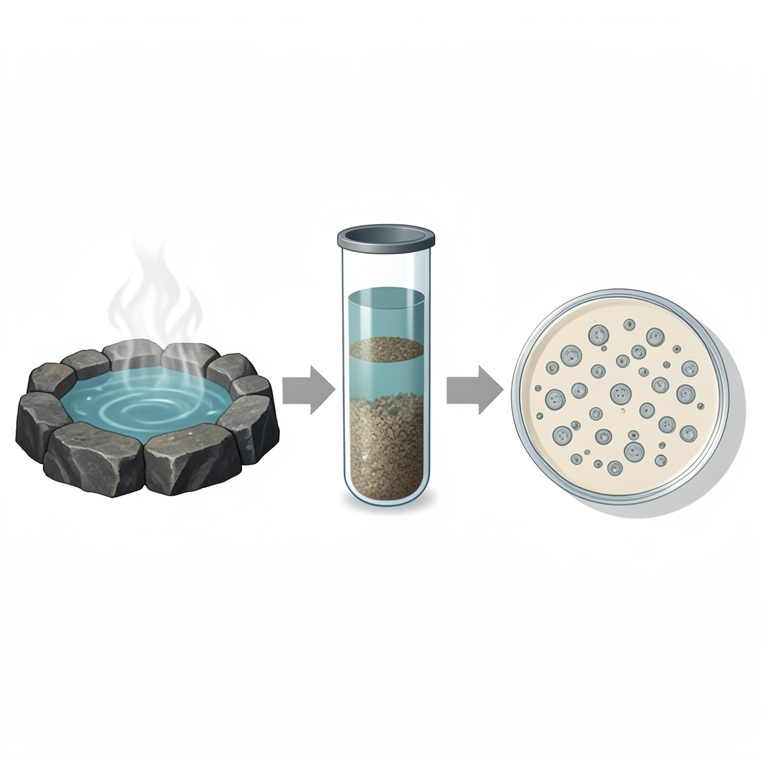
Bioprospecting Workflow
AI-generated conceptual illustration (thermophilic bacteria from hot spring water and sediment). It explains the idea and does not show study data.
View source evidence ↗Figures & tables
From the original paper Table 1
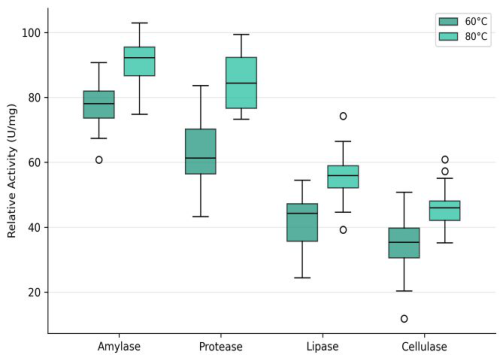 Figure 1
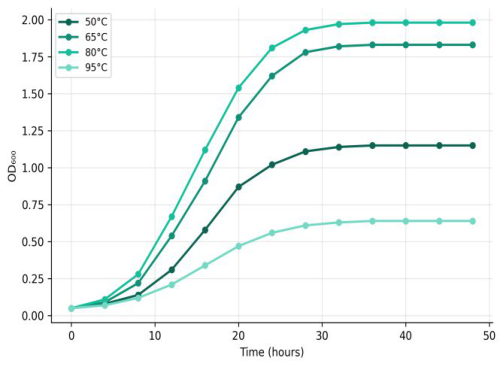 Figure 2
Introduction
The word "thermophile" literally means heat-lover, and these organisms have attracted industrial interest precisely because their molecular machinery operates at temperatures that would destroy conventional enzymes. Thermostable enzymes offer clear advantages in processes like starch hydrolysis, textile processing, and biofuel production, where high operating temperatures improve reaction kinetics and reduce contamination risks [1] . Hot springs represent natural laboratories for discovering novel thermophiles, and Turkey sits atop one of the most geothermally active zones in the Mediterranean basin [2] . The eastern Black Sea coast alone contains dozens of thermal springs, yet microbiological surveys of these sites remain sparse compared to well-characterized locations like Yellowstone or Icelandic geothermal fields [3] . Previous Turkish bioprospecting efforts focused mainly on western Anatolian springs [4] . Genera such as Geobacillus, Thermus, and Anoxybacillus have been recovered from Turkish hot springs and shown to produce heat-stable hydrolases [5] . This research aimed to isolate thermophilic bacteria from three previously unsampled hot springs near Trabzon and to screen isolates for production of industrially relevant thermostable enzymes.
Materials and Methods
Materials and Methods
Materials
Sampling was carried out at three hot spring sites within 80 km of Trabzon, Turkey: Ayder (52-61 °C, pH 7.2), Camlihemsin (63-74 °C, pH 6.8), and Uzungol (78-87 °C, pH 7.6). Water and sediment samples were collected in sterile bottles between July 2023 and March 2024. Temperature, pH, and dissolved oxygen were recorded on-site with a portable multiparameter probe (YSI ProDSS). Samples were transported in insulated containers and processed within 6 hours at the Department of Microbiology and Immunology, Black Sea
Methods
Serial dilutions of water and sediment suspensions were plated on Thermus agar (Castenholz TYE medium) and incubated at 65 °C and 80 °C for 48-72 hours under aerobic conditions [6] . Morphologically distinct colonies were purified by repeated streaking. Genomic DNA was extracted using the DNeasy Blood and Tissue Kit (Qiagen). The 16S rRNA gene was amplified with universal primers 27F and 1492R [7] , and amplicons were Sanger sequenced. Sequences were compared against the NCBI GenBank database using BLASTn, and phylogenetic trees were built in MEGA X using the neighbor-joining method [8] . Enzyme screening employed plate assays: starch agar with iodine flooding for amylase, skim milk agar for protease, and tributyrin agar for lipase. Positive isolates were quantified using DNS (3,5dinitrosalicylic acid) and azocasein assays. Thermostability was assessed by incubating crude enzyme extracts at 80 °C for 0, 1, 2, and 4 hours and measuring residual activity. Of 23 isolates recovered, Geobacillus was the most common genus (9 isolates), followed by Anoxybacillus (7), Thermus (5), and Aeribacillus (2). The highest-temperature site (Uzungol) yielded the most isolates ( 11), while the lowesttemperature site (Ayder) yielded 5.
Results
Results
Discussion
The recovery of 23 thermophilic isolates from three Black Sea hot springs confirms these underexplored sites as productive sources of industrially relevant bacteria. The dominance of Geobacillus is consistent with surveys of similar-temperature springs globally [3,5] . Strain TRB-14's amylase retained 87.3% activity after 4 hours at 80 °C, which compares well to commercially available thermostable amylases derived from Bacillus licheniformis, typically retaining 70-85% activity under similar conditions [1] . The protease activity in Thermus scotoductus isolate TRB-07 is worth noting, as proteases from this genus have been less studied than those from Geobacillus [4] . The relatively low lipase activity across all isolates may reflect the nutrient composition of the sampled springs, which were low in lipid substrates. Future work should include optimization of fermentation conditions, enzyme purification, and assessment of activity across a broader pH range to determine true industrial applicability [9] .
Conclusion
This research isolated 23 thermophilic bacterial strains from three hot spring sites in the eastern Black Sea region of Turkey. Molecular identification placed isolates within four genera, with Geobacillus and Anoxybacillus dominating. The majority of isolates produced at least one thermostable hydrolase, and the amylase from strain TRB-14 showed particularly high thermostability at 80 °C. These results expand the known diversity of thermophilic bacteria in Turkish geothermal environments and identify promising candidates for further enzyme characterization and industrial development.
Acknowledgement
Acknowledgements Funding SourcesInternal departmental research funds from the Black Sea Institute of Marine Biology supported this work. Institutional SupportThe authors thank the Black Sea Institute of Marine Biology for laboratory access and sequencing facilities.
Figures and tables from the paper
| Isolate | Nearest Species | Similarity | Amylase | Protease | Lipase | Source |
|---|---|---|---|---|---|---|
| TRB-14 | G. stearothermophilus | 99.4% | + + + | + + | - | Uzungol |
| TRB-07 | Thermus scotoductus | 98.7% | + + | + + + | + | Camlihemsin |
| TRB-03 | Anoxybacillus flaviThermus | 99.1% | + + | + | + + | Ayder |
| TRB-19 | Aeribacillus pallidus | 98.9% | + | + + | - | Uzungol |
Table text extracted from the original PDF; superscript letters are shown inline. The original table image is below.