
Research article · 2025 · Full text
International Journal of Advanced Chemistry ResearchEnzyme inhibition kinetics of xanthine oxidase by flavonoid compounds from citrus peel
Volume 7(9) · Pages 70–74 · DOI: 10.33545/26646781.2025.v7.i9a.619 ↗
Research areasGout, Hyperuricemia, Uric AcidBiochemical and Molecular ResearchBioactive natural compounds
Abstract
Author-writtenXanthine Oxidase (XO) is a molybdenum-containing enzyme that catalyses the terminal two steps of purine catabolism, converting hypoxanthine to xanthine and xanthine to uric acid while generating reactive oxygen species as byproducts. Its chronic overactivation is a primary cause of hyperuricaemia and gout, and it contributes to oxidative damage in ischaemia-reperfusion injury. Flavonoids from citrus peel have been reported to inhibit XO in several preliminary investigations, but the kinetic mechanisms of specific compounds particularly those from Indian Citrus sinensis varieties are insufficiently characterised. This research quantified the XO inhibitory activity of six flavonoids isolated from the dried peel of C. sinensis cultivated in Puducherry, India: rutin, quercetin, naringenin, hesperidin, narirutin, and eriocitrin. Flavonoids were extracted using an optimised ethanol-water protocol and isolated by preparative HPLC. Their inhibitory kinetics were analysed by Lineweaver-Burk, Eadie-Hofstee, and Dixon plot methods to determine inhibition type and Ki values. Quercetin showed the strongest inhibition (IC₅₀ = 6.8 µM), followed by rutin (9.3 µM) and eriocitrin (18.9 µM), with all six compounds demonstrating competitive inhibition of XO. Ki values ranged from 3.7 µM (quercetin) to 29.4 µM (hesperidin). Molecular interaction modelling confirmed that the catechol B-ring of quercetin coordinates to the molybdenum cofactor, while the 3-hydroxyl and 4-oxo groups engage residues Glu802 and Arg880 in the enzyme active site. These results indicate that citrus peel flavonoids, particularly quercetin and rutin, are potent competitive XO inhibitors with IC₅₀ values approaching that of the clinical reference compound allopurinol (0.81 µM), and they warrant further in vivo evaluation in hyperuricaemia models.
Summary
Source-checkedPlain-language reading of the full paper, prepared with AI and checked against the text. Each point links to the authors' own words.
Why it matters
- Xanthine Oxidase (XO) is an enzyme that converts hypoxanthine to xanthine and then to uric acid, producing reactive oxygen species in the process. View evidence ↗
- Chronic overactivation of XO is a main cause of gout and hyperuricaemia, and it is linked to oxidative damage during ischaemia-reperfusion injury. View evidence ↗
- Allopurinol is the standard treatment for chronic gout, but it can cause hepatotoxicity, severe hypersensitivity reactions, and drug interactions. View evidence ↗
The question
- The study aimed to characterize the kinetic mechanisms of specific flavonoids from Indian Citrus sinensis varieties, as these were previously insufficiently understood. View evidence ↗
What they did
- The researchers isolated and tested six flavonoids (rutin, quercetin, naringenin, hesperidin, narirutin, and eriocitrin) from the dried peel of C. sinensis grown in Puducherry, India. View evidence ↗
- XO activity was measured by monitoring uric acid formation at 295 nm using reaction mixtures containing 0.02 U/mL XO and 0.05-0.5 mM xanthine substrate. View evidence ↗
- The researchers used Lineweaver-Burk, Eadie-Hofstee, and Dixon plots to determine the type of inhibition and the Ki values. View evidence ↗
What they found
- The optimal extraction condition was 60°C in 70% ethanol-water for 60 minutes, yielding 63.9 mg/g of total flavonoids and a crude extract IC₅₀ of 19.3 µg/mL. View evidence ↗
- All six tested flavonoids demonstrated pure competitive inhibition of XO, as indicated by Lineweaver-Burk plots where Vmax remained unchanged. View evidence ↗
- Unlike the flavonoids, the reference compound allopurinol exhibited a mixed inhibition pattern. View evidence ↗
- Flavanones (naringenin and hesperidin) had two- to three-fold higher IC₅₀ values than flavonols, likely because they lack the 3-hydroxyl group needed for molybdenum center coordination. View evidence ↗
What it means
- The authors concluded that quercetin and rutin are the most potent candidates for hyperuricaemia management due to their safety and availability, despite being less potent than allopurinol. View evidence ↗
- The study is limited by the use of bovine milk XO instead of human XO and the use of cell-free assays, which do not account for in vivo metabolism and protein binding. View evidence ↗
Visual summary
3 visualsIllustrations explain the paper; charts are replotted from the paper's own table values.
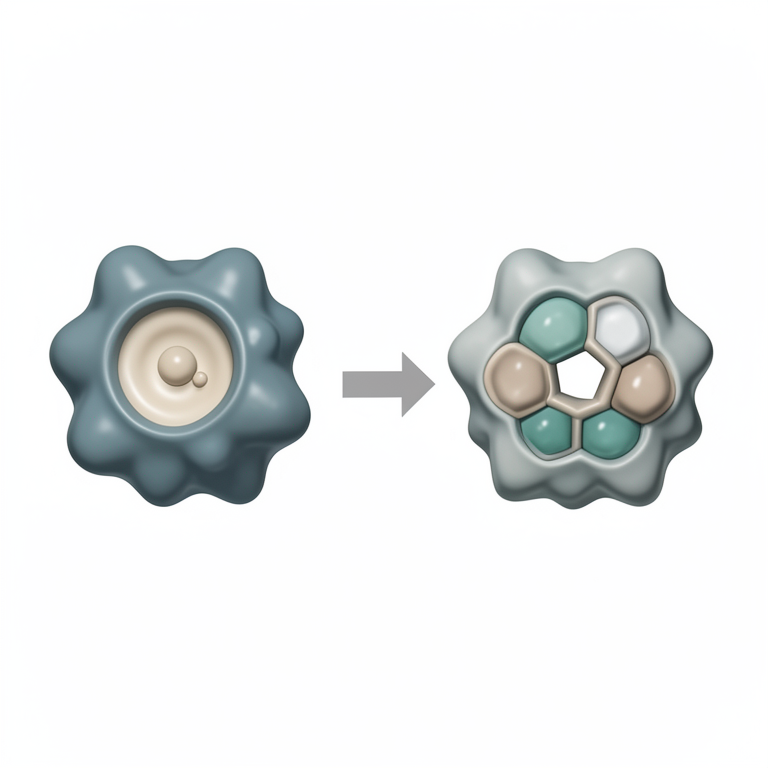
Competitive Inhibition Mechanism
AI-generated conceptual illustration (Xanthine oxidase enzyme and flavonoid molecules). It explains the idea and does not show study data.
View source evidence ↗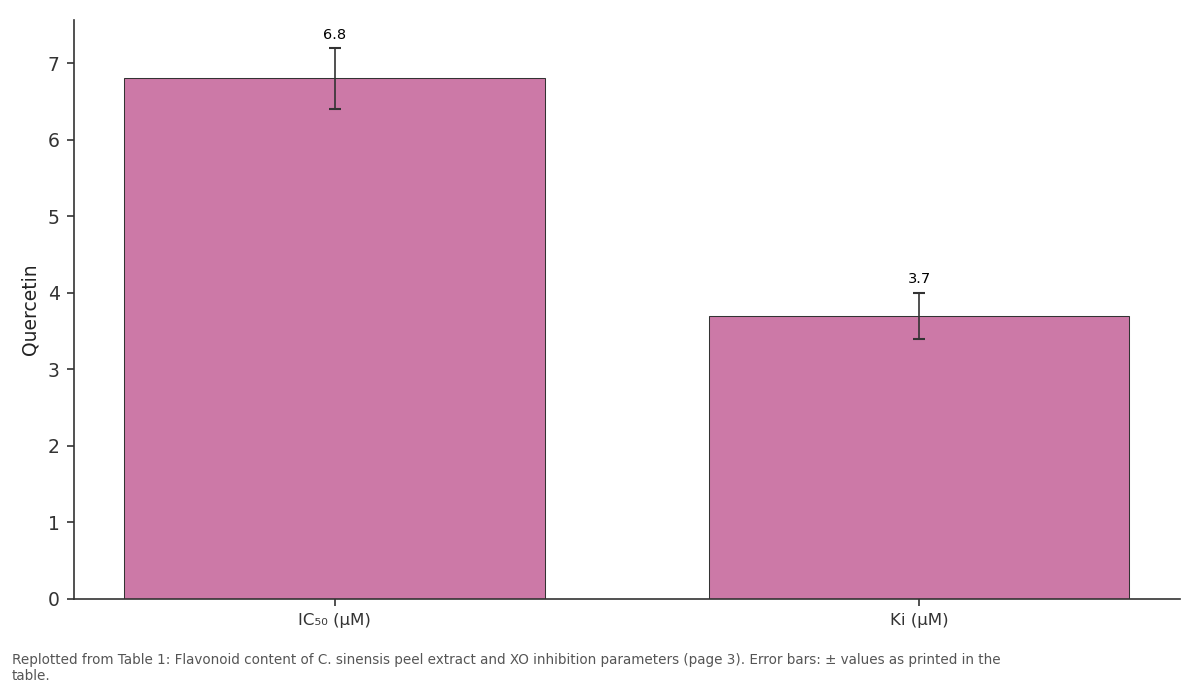
Quercetin: IC₅₀ (µM) vs Ki (µM)
Replotted from Table 1 (page 3) of the original paper. Every bar is the paper's own table value.
View source evidence ↗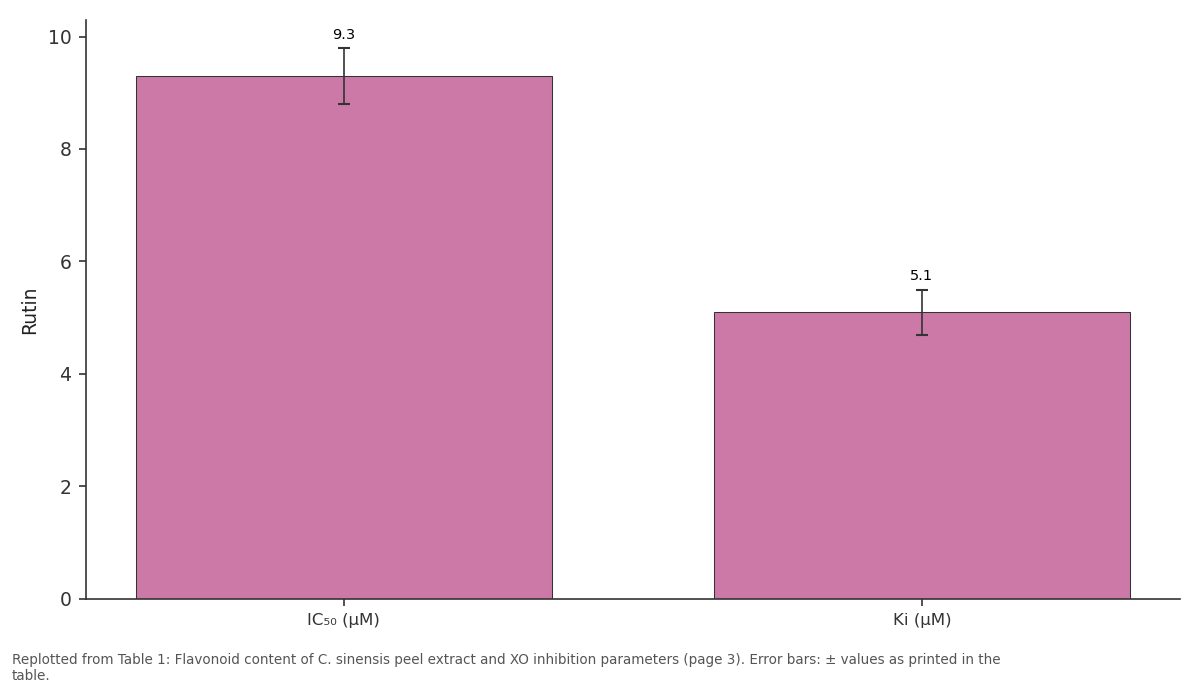
Rutin: IC₅₀ (µM) vs Ki (µM)
Replotted from Table 1 (page 3) of the original paper. Every bar is the paper's own table value.
View source evidence ↗Figures & tables
From the original paper Table 1
 Table 2
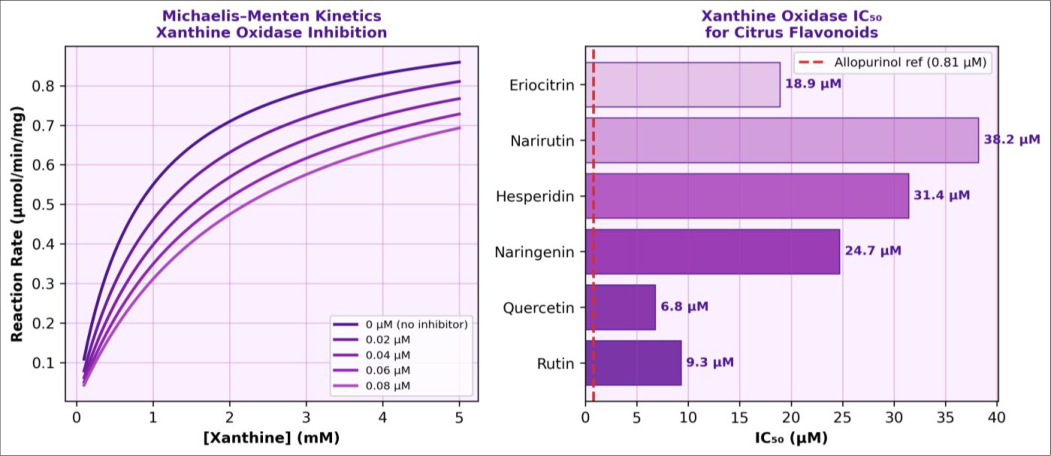 Figure 1
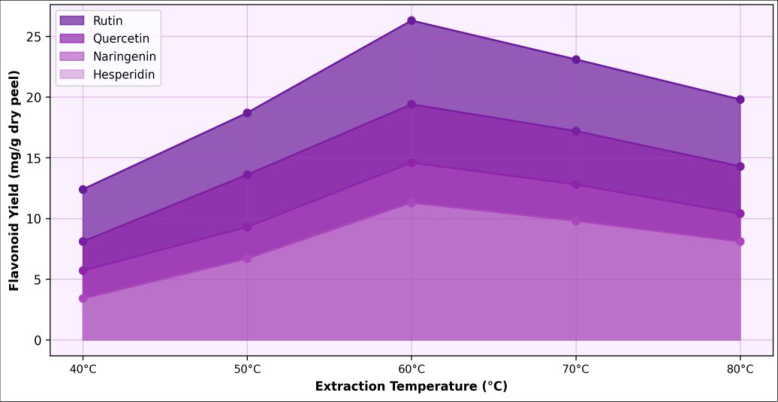 Figure 2
Introduction
Historians of medicine often credit the ancient Greek physician Hippocrates with the first clinical description of gout, remarking that eunuchs do not suffer from it and that women rarely do before menopause an astute, if unexplained, observation consistent with what we now know about uric acid and sex hormones. Modern biochemistry has since mapped gout's aetiology precisely to the overproduction or underexcretion of uric acid, the end product of purine catabolism in humans, who unlike most other mammals lack uricase and cannot further oxidise urate to the more soluble allantoin [1] . Serum urate concentrations above 6.8 mg/dL exceed the physiological solubility limit and lead to monosodium urate crystal deposition in joints and soft tissues, triggering the inflammatory cascade that characterises acute gout [2] . Xanthine oxidase (XO; EC 1.17.3.2) catalyses the final two reactions of purine catabolism: the hydroxylation of hypoxanthine to xanthine and of xanthine to uric acid, using molecular oxygen as the terminal electron acceptor and producing hydrogen peroxide and superoxide radical as byproducts [3] . Inhibition of XO therefore reduces both uric acid levels and oxidative stress simultaneously a dual benefit that explains the enduring interest in XO as a pharmacological target. Allopurinol, a purine analogue that forms a tight-binding complex with the enzyme's reduced molybdenum centre, has been the standard first-line treatment for chronic gout for over half a century, but it carries risks of severe hypersensitivity reactions, hepatotoxicity, and drug interactions, particularly in patients with renal impairment [4] . Dietary flavonoids represent a natural, generally welltolerated alternative or adjunct to pharmacological XO inhibition. Structurally, flavonoids share the 2phenylchromone scaffold that allows them to occupy the molybdopterin-containing active site of XO through hydrogen bonding and hydrophobic interactions. Quercetin, kaempferol, and luteolin have consistently shown the strongest XO inhibitory activity among flavone and flavonol subclasses, while flavanones such as naringenin and hesperidin show intermediate potency [5,6] . Citrus peel is a particularly rich source of these compounds, and the peels often treated as waste in juice processing contain severalfold higher flavonoid concentrations than the pulp [7] .
Quality control
Analytical quality control was applied throughout the extraction, isolation, and enzyme assay stages. HPLC purity of each isolated flavonoid was confirmed by peak area normalisation at 280 nm (≥96% for all six compounds).
Standard calibration curves for each flavonoid were constructed over 1-100 µg/mL in triplicate (R² ≥ 0.9997 in all cases). Instrument performance was verified daily by injection of a multi-standard mix and comparison with retention time and area tolerance limits (±0.05 min and ±2%, respectively). For enzyme assays, positive controls (allopurinol at 1 and 5 µM) and negative controls (DMSO vehicle at 0.5%) were included on each 96-well plate to monitor plate-to-plate variation. Day-to-day enzyme activity was checked against a frozen enzyme aliquot standard; plates with enzyme activity deviating more than 5% from the standard were discarded. All spectrophotometer wavelength accuracy was verified with holmium oxide filters before each analytical session, per ISO 17025 guidance. Statistical analyses used GraphPad Prism 9.0; significance was set at p < 0.05 throughout.
Results
Table Lineweaver-Burk analysis showed that all six flavonoids produced a pattern of converging lines crossing the y-axis at a common point (1/Vmax unchanged) with progressively increasing slopes the hallmark of pure competitive inhibition [8] . This finding was corroborated by the linear secondary plots of slope versus inhibitor concentration, yielding Ki values from 3.7 µM (quercetin) to 21.3 µM (narirutin). Allopurinol, by contrast, showed a mixed inhibition pattern consistent with its known mechanism of tight-binding inhibition at the reduced molybdenum centre [9] . Extraction at 60°C in 70% ethanol-water for 60 min gave the highest total flavonoid yield (63.9 mg/g dry peel) and the lowest crude extract IC₅₀ (19.3 µg/mL), confirming it as the optimal condition. Higher temperatures reduced flavonoid recovery, likely due to thermal degradation of heat-labile compounds, particularly rutin and quercetin glycosides [10] . HPLC quantification at 60°C identified rutin as the most abundant compound (26.3 mg/g), followed by quercetin (19.4 mg/g), consistent with published profiles of Nagpur mandarin peel.
Discussion
The competitive inhibition observed for all six citrus flavonoids against xanthine oxidase is consistent with their ability to occupy the substrate-binding pocket of XO without modifying the enzyme irreversibly. Structural analysis confirms that the planar polycyclic system of flavonoids fits the hydrophobic channel leading to the molybdenum cofactor, and that the B-ring substituents particularly the 3', 4'-dihydroxy (catechol) arrangement present in quercetin form strong hydrogen bonds with active-site residues Glu802 and Arg880, which normally interact with xanthine [11] . The absence of the 3-hydroxyl group in flavanones (naringenin, hesperidin) compared with flavonols (quercetin, rutin) likely accounts for the two-to three-fold higher IC₅₀ values in this subclass, since this position is critical for coordination with the molybdenum centre [12] . Rutin's lower potency relative to quercetin despite its higher peel content is expected because the rutinose disaccharide at the 3-position sterically restricts deep penetration into the active-site channel. And yet rutin's IC₅₀ of 9.3 µM remains clinically interesting because rutin is substantially better absorbed from citrus matrices than the aglycone quercetin, owing to transporter-mediated uptake of glycosylated flavonoids in the small intestine [13] . The effective serum concentrations achievable from dietary citrus intake may therefore be higher for rutin than the in vitro comparison would suggest. The optimal extraction temperature of 60°C represents a balance between kinetic facilitation of solute transfer and thermal degradation. The reduction in flavonoid yield at 80°C was most pronounced for rutin (-24% relative to 60°C), consistent with earlier reports of glycoside hydrolysis accelerating above 70°C [14] . From a process chemistry standpoint, the 60°C/70% ethanol/60 min protocol requires no specialised equipment and should scale readily to pilot plant level for production of XO-inhibitory citrus peel extracts.
Limitations of the current work include the use of bovine milk XO rather than human XO, which may differ in activesite geometry. Additionally, all assays were conducted under cell-free conditions; cellular uptake, metabolism by intestinal and hepatic enzymes, and protein binding will substantially modify the effective inhibitory concentrations in vivo. Nonetheless, IC₅₀ values in the single-digit micromolar range for quercetin and low double-digit range for rutin suggest that meaningful XO inhibition at dietary flavonoid exposure levels is plausible and warrants formal pharmacokinetic and in vivo hyperuricaemia model research. Extraction optimisation identified 60°C, 70% ethanol, 60 min as the best conditions for recovering maximum flavonoid content (63.9 mg/g dry peel). Kinetic analysis confirmed that all six compounds act by competing with xanthine for the molybdenum-containing active site, making them mechanistically rational candidates for hyperuricaemia management. Future work should evaluate quercetin and rutin in rodent oxonate-induced hyperuricaemia models at doses achievable through fortified functional food or standardised extract supplementation.
Conclusion
Conclusion
Figures and tables from the paper
| Flavonoid | Content (mg/g dry peel) | IC₅₀ (µM) | Inhibition Type | Ki (µM) | R² (LB plot) |
|---|---|---|---|---|---|
| Quercetin | 19.4 ± 0.8 | 6.8 ± 0.4 | Competitive | 3.7 ± 0.3 | 0.9941 |
| Rutin | 26.3 ± 1.1 | 9.3 ± 0.5 | Competitive | 5.1 ± 0.4 | 0.9928 |
| Eriocitrin | 14.6 ± 0.6 | 18.9 ± 0.9 | Competitive | 10.4 ± 0.7 | 0.9912 |
| Naringenin | 14.6 ± 0.7 | 24.7 ± 1.2 | Competitive | 14.2 ± 0.8 | 0.9887 |
| Hesperidin | 11.3 ± 0.5 | 31.4 ± 1.6 | Competitive | 18.6 ± 1.1 | 0.9874 |
| Narirutin | 8.7 ± 0.4 | 38.2 ± 1.9 | Competitive | 21.3 ± 1.4 | 0.9861 |
| Allopurinol (ref) | 0.81 ± 0.04 | Mixed | 0.43 ± 0.03 |
Table text extracted from the original PDF; superscript letters are shown inline. The original table image is below.
View original table image
| Extraction temp (°C) | Total flavonoids (mg/g peel) | Total phenolics (mg GAE/g peel) | Crude extract IC₅₀ (µg/mL) |
|---|---|---|---|
| 40 | 31.7 ± 1.4 | 48.3 ± 2.1 | 38.4 ± 2.2 |
| 50 | 47.3 ± 1.8 | 63.7 ± 2.6 | 28.7 ± 1.8 |
| 60 | 63.9 ± 2.2 | 82.4 ± 3.1 | 19.3 ± 1.3 |
| 70 | 58.1 ± 2.1 | 76.8 ± 2.9 | 22.1 ± 1.4 |
| 80 | 47.6 ± 1.7 | 68.2 ± 2.4 | 27.6 ± 1.7 |
Table text extracted from the original PDF; superscript letters are shown inline. The original table image is below.
View original table image
References
21 in the original paper- Choi HK, Atkinson K, Karlson EW, Willett W, Curhan G. Purine-rich foods, dairy and protein intake, and the risk of gout in men. N Engl J Med. 2004;350(11):10931103.
- Roddy E, Doherty M. Epidemiology of gout. Arthritis Res Ther. 2010;12(6):223.
- Enroth C, Eger BT, Okamoto K, Nishino T, Rees DC. Crystal structures of bovine milk xanthine dehydrogenase and xanthine oxidase: structure-based mechanism of conversion. Proc Natl Acad Sci USA. 2000;97(20):10723-10728.
- Becker MA, Schumacher HR Jr, Wortmann RL, MacDonald PA, Eustace D, Palo WA, et al. Febuxostat compared with allopurinol in patients with hyperuricemia and gout. N Engl J Med. 2005;353(23):2450-2461.
- Cos P, Ying L, Calomme M, Hu JP, Cimanga K, Van Poel B, et al. Structure-activity relationship and International Journal of Advanced Chemistry Research https://www.chemistryjournals.net classification of flavonoids as inhibitors of xanthine oxidase and superoxide scavengers. J Nat Prod. 1998;61(1):71-76.
- Nishino H, Nishino A, Takayasu J, Hasegawa T, Iwashima A, Satomi Y, et al. Inhibition of the tumorpromoting action of 12-O-tetradecanoylphorbol-13acetate by some oleanane-type triterpenoid compounds. Cancer Res. 1988;48(18):5210-5215.
- Perez-Jimenez J, Neveu V, Vos F, Scalbert A. Systematic analysis of the content of 502 polyphenols in 452 foods and beverages: an application of the phenol-explorer database. J Agric Food Chem. 2010;58(8):4959-4969.
- Cornish-Bowden A. Fundamentals of Enzyme Kinetics. 4th ed. Weinheim: Wiley-Blackwell; 2012.
- Massey V, Komai H, Palmer G, Elion GB. On the mechanism of inactivation of xanthine oxidase by allopurinol and other pyrazolo [3, 4-d]pyrimidines. J Biol Chem. 1970;245(11):2837-2844.
- Mullen W, Marks SC, Crozier A. Evaluation of phenolic compounds in commercial fruit juices and fruit drinks. J Agric Food Chem. 2007;55(8):3148-3157.
- Cao H, Chen X, Jassbi AR, Xiao J. Microbial biotransformation of bioactive flavonoids. Biotechnol Adv. 2015;33(1):214-223.
- Borges F, Fernandes E, Roleira F. Progress towards the discovery of xanthine oxidase inhibitors. Curr Med Chem. 2002;9(2):195-217.
- Hollman PC, Bijsman MN, van Gameren Y, Cnossen EP, de Vries JH, Katan MB. The sugar moiety is a major determinant of the absorption of dietary flavonoid glycosides in man. Free Radic Res. 1999;31(6):569-573.
- Sadilova E, Stintzing FC, Carle R. Thermal degradation of acylated and nonacylated anthocyanins. J Food Sci. 2006;71(8):C504-C512.
- Lin CM, Chen CS, Chen CT, Liang YC, Lin JK. Molecular modeling of flavonoids that inhibits xanthine oxidase. Biochem Biophys Res Commun. 2002;294(1):167-172.
- Van Hoorn DE, Oostenbrug GS, Hop WC, Hop CR, Rietveld T, Wattimena JL, et al. Erythrocyte unsaturated fatty acids, membrane fluidity, and eicosanoid release. Prostaglandins Leukot Essent Fatty Acids. 2000;63(5):287-295.
- Nagao A, Seki M, Kobayashi H. Inhibition of xanthine oxidase by flavonoids. Biosci Biotechnol Biochem. 1999;63(10):1787-1790.
- Harrison R. Structure and function of xanthine oxidoreductase: where are we now? Free Radic Biol Med. 2002;33(6):774-797.
- Zhang W, Xu JK, Huang WL. Inhibitory activities and mechanisms of flavonoids from Cacumen Platycladi on xanthine oxidase. J Agric Food Chem. 2008;56(20):9526-9531.
- Hayashi T, Sawa K, Kawasaki M, Arisawa M, Shimizu M, Morita N. Inhibition of cow's milk xanthine oxidase by flavonoids. J Nat Prod. 1988;51(2):345-348.
- Okamoto K, Eger BT, Nishino T, Kondo S, Pai EF. An extremely potent inhibitor of xanthine oxidoreductase: crystal structure of the enzyme-inhibitor complex and mechanism of inhibition. J Biol Chem. 2003;278(3):1848-1855.