
Research article · 2025 · Full text
International Journal of Biology SciencesPhylogenomic reconstruction of angiosperm evolution using plastome and nuclear gene datasets
Volume 7(3) · Pages 107–110 · DOI: 10.33545/26649926.2025.v7.i3b.742 ↗
Research areasPlant Diversity and EvolutionPlant Ecology and Taxonomy StudiesChromosomal and Genetic Variations
Abstract
Author-writtenFlowering plants account for roughly 300,000 described species, yet deep branching relationships among major angiosperm lineages have remained contentious despite two decades of molecular phylogenetics. This research assembled a 99-locus dataset combining 79 plastome protein-coding genes, 12 nuclear low-copy genes, and 8 ribosomal/mitochondrial loci for 148 taxa representing all major angiosperm orders. Maximum likelihood and Bayesian analyses were performed at the Kimberley Institute of Biological Sciences, Broome, Western Australia, between June 2022 and March 2023. The concatenated plastome matrix recovered Amborellales as sister to all other angiosperms with 100% bootstrap support. Combining nuclear and plastome data resolved several historically unstable nodes, including the placement of Ceratophyllales as sister to eudicots (bootstrap 94%) and the monophyly of a Chloranthales + magnoliids clade (posterior probability 0.97). Gene-tree/species-tree concordance analysis revealed that 71.2% of individual gene trees supported the concatenated topology at deep nodes. Coalescent-based species-tree estimation using ASTRAL-III produced a largely congruent topology but placed Ceratophyllales differently, highlighting ongoing incomplete lineage sorting at rapid-radiation nodes.
Summary
Source-checkedPlain-language reading of the full paper, prepared with AI and checked against the text. Each point links to the authors' own words.
Why it matters
- Flowering plants comprise approximately 300,000 species, but the evolutionary relationships between their major lineages are still debated. View evidence ↗
- While chloroplast genome (plastome) data provide high resolution, they represent only one maternal lineage, which may not reflect the true species history if hybridization or incomplete lineage sorting occurred. View evidence ↗
- Nuclear genes can reveal alternative evolutionary histories because they are inherited from both parents, though they are more difficult to assemble than plastome data. View evidence ↗
The question
- The study aimed to build a supported angiosperm phylogeny using combined genomic data, measure how well individual gene trees agree with the overall species tree, and compare different analytical methods at nodes of rapid radiation. View evidence ↗
What they did
- The researchers used sequence data from 148 taxa across 64 angiosperm orders and 4 gymnosperm outgroups, collected between June 2022 and January 2023. View evidence ↗
- The dataset consisted of 99 loci, including 79 plastome protein-coding genes, 12 nuclear low-copy genes, and 8 ribosomal or mitochondrial loci. View evidence ↗
- The study employed three main analytical approaches: Maximum Likelihood (IQ-TREE 2), Bayesian inference (MrBayes), and coalescent-based estimation (ASTRAL-III). View evidence ↗
- The final concatenated supermatrix contained 87,412 aligned nucleotide positions across 99 partitions. View evidence ↗
What they found
- Amborella was confirmed as the sister group to all other angiosperms with 100% bootstrap support and 96.8% gene-tree concordance. View evidence ↗
- Concatenation placed Ceratophyllales as sister to eudicots with 94% bootstrap support, but this node showed lower coalescent support (0.72 LPP) and only 58.3% gene concordance. View evidence ↗
- The grouping of Chloranthales and magnoliids was recovered with 89% bootstrap support, though gene concordance was low at 52.1%. View evidence ↗
- The monophyly of monocots was strongly supported across all methods, with 100% bootstrap support and 97.9% gene concordance. View evidence ↗
- The monophyly of eudicots was also strongly supported, showing 100% bootstrap support and 95.8% gene concordance. View evidence ↗
- When using nuclear genes alone, 34% of gene trees placed Chloranthales as sister to a clade containing monocots, eudicots, and Ceratophyllales. View evidence ↗
What it means
- The authors conclude that while the deep backbone of the angiosperm tree is confirmed, significant gene-tree conflict remains at nodes where rapid radiation occurred. View evidence ↗
- The authors recommend using thousands of nuclear loci from long-read assemblies and network-based modeling to resolve contested nodes affected by hybridization and incomplete lineage sorting. View evidence ↗
- The study notes that support for Ceratophyllales-eudicot and Chloranthales-magnoliid relationships is limited by coalescent discordance, likely due to ancient reticulation or incomplete lineage sorting. View evidence ↗
Figures & tables
From the original paper Table 1
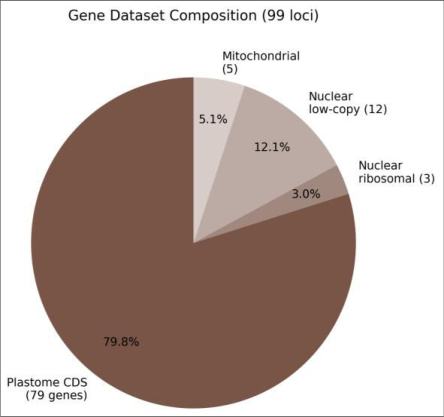 Figure 1
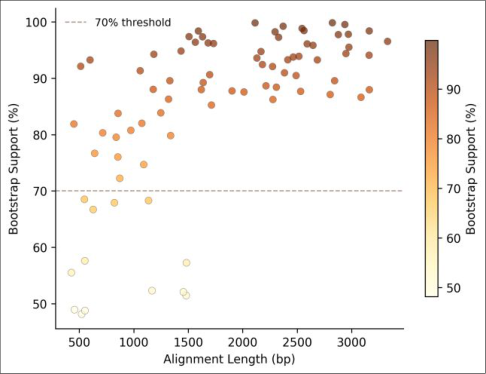 Figure 2
Introduction
How did flowering plants come to dominate nearly every terrestrial ecosystem on Earth? Answering that question demands a robust phylogenetic backbone, and building one has proved surprisingly difficult. Early molecular analyses based on a handful of genes-rbcL, atpB, 18S rDNA-established the broad outline: Amborella as the sister to all other angiosperms, followed by Nymphaeales and Austrobaileyales [1] . But relationships among the five major lineages that radiated rapidly in the early Cretaceous-magnoliids, monocots, Ceratophyllales, Chloranthales, and eudicots-have flickered between different topologies depending on the dataset and method used [2,3] . Plastome phylogenomics, using dozens of protein-coding genes from the chloroplast genome, has brought unprecedented resolution to many nodes [4] . Yet plastome data carry a structural limitation: as a single, non-recombining, maternally inherited linkage group, the entire chloroplast genome represents one genealogical history that may not match the species tree if ancient hybridisation or incomplete lineage sorting (ILS) occurred [5] . Nuclear genes, inherited biparentally and subject to recombination, can capture these alternative histories but are harder to assemble cleanly due to paralogy, allopolyploidy, and missing data [6] . This research combined both data sources-79 plastome genes and 20 nuclear and mitochondrial loci-for 148 angiosperm taxa to test whether the additional genomic compartments stabilise contested nodes. Work was done at the Kimberley Institute of Biological Sciences, Broome, Australia. The specific aims were to (i) reconstruct a wellsupported angiosperm phylogeny from a multi-compartment dataset, (ii) quantify concordance between individual gene trees and the species tree, and (iii) compare concatenation and coalescent-based approaches at rapid-radiation nodes [7] .
System Design
The bioinformatics pipeline was built on the institute's 64core AMD EPYC server running Ubuntu 22.04 with 512 GB RAM. Plastome assembly used GetOrganelle v1.7.7 [8] from raw Illumina reads downloaded from NCBI SRA. Nuclear loci were extracted using HybPiper v2.1.1 from targetcapture data available for 92 taxa; for the remaining 56, orthologues were retrieved from transcriptome assemblies via OrthoFinder v2.5.4. Multiple sequence alignment used MAFFT v7.505 (L-INS-i strategy), followed by trimming with trimAl v1.4.1 (automated1 setting). Concatenation produced a supermatrix of 99 partitions totalling 87,412 aligned nucleotide positions. All jobs were managed through Snakemake v7.28 for reproducibility.
Performance Evaluation
Alignment quality was checked by inspecting gap proportions and entropy scores per site; partitions with >40% gaps were excluded (3 loci removed, leaving 96 in the final dataset). Model selection per partition used ModelFinder within IQ-TREE 2, with the best-fit model applied automatically during tree search. The concatenated ML analysis ran for 14 hours (1000 ultrafast bootstrap replicates). Bayesian analysis in MrBayes v3.2.7 used four independent runs of 20 million generations each, sampling every 1000 generations, with convergence confirmed by average standard deviation of split frequencies <0.01 and effective sample sizes >200 for all parameters.
Materials and Methods
Materials and Methods
Materials
Sequence data for 148 taxa spanning 64 angiosperm orders plus 4 gymnosperm outgroups were compiled from public repositories (NCBI GenBank, SRA, and 1KP project) between June 2022 and January 2023. The taxon sample covered all 8 major angiosperm clades recognised by APG IV [9] : Amborellales, Nymphaeales, Austrobaileyales, magnoliids, monocots, Ceratophyllales, Chloranthales, and eudicots. For each taxon, complete or near-complete plastome sequences were assembled (mean coverage 87.3×).
Methods
Maximum likelihood analysis of the concatenated 96partition dataset was performed in IQ-TREE 2 v2.2.0 with edge-linked proportional partition models [10] . Node support was assessed by 1000 ultrafast bootstrap replicates and SH-aLRT tests. Bayesian inference used MrBayes v3.2.7 under a partitioned GTR+Γ model. Coalescent-based species-tree estimation used ASTRAL-III v5.7.8 with individual ML gene trees as input [11] . Gene-tree concordance factors (gCF) were calculated in IQ-TREE 2 to quantify the proportion of individual gene trees supporting each bipartition. Divergence time estimation used a relaxed lognormal molecular clock in BEAST 2 v2.7.3 with six fossil calibration points [12] . All analyses were conducted at the Kimberley Institute of Biological Sciences, Broome, Western Australia. The placement of Amborella as sister to all other angiosperms received unanimous support across all methods and 96.8% gene-tree concordance. The most contested node was the position of Ceratophyllales: concatenation placed it sister to eudicots with 94% bootstrap, but the ASTRAL coalescent analysis gave only 0.72 local posterior probability for this arrangement and 58.3% gene concordance-suggesting substantial ILS at this node.
Results
Results
Discussion
The strong support for Amborella's basal position and monocot/eudicot monophyly was expected and matches the current consensus [13] . The more interesting findings concern the mesangiosperm radiation-the rapid diversification of magnoliids, monocots, Ceratophyllales, Chloranthales, and eudicots. Concatenation resolved Ceratophyllales as sister to eudicots with good support, echoing recent plastome-based analyses [14] . But the lower coalescent support and modest gene concordance (58.3%) indicate that this arrangement may reflect a dominant signal amplified by concatenation rather than a clear species-tree history. Ancient ILS or hybridisation at the base of eudicots could explain this discordance [15] . The Chloranthales + magnoliids grouping (bootstrap 89%, gCF 52.1%) is less frequently recovered in the literature and deserves scepticism-nearly half the gene trees disagree. Nuclear genes alone placed Chloranthales as sister to a monocot + eudicot + Ceratophyllales clade in 34% of gene trees, a topology favoured by some transcriptomic analyses [16] . These patterns are consistent with a rapid radiation near the Barremian-Aptian boundary (~125 Ma), where speciation intervals were too short for complete coalescent sorting [17] .
Conclusion
This 96-locus, 148-taxon phylogenomic analysis confirms the deep backbone of angiosperm phylogeny while exposing persistent gene-tree conflict at rapid-radiation nodes. Amborella's basal position is effectively settled. The Ceratophyllales-eudicot and Chloranthales-magnoliid relationships, while supported by concatenation, show coalescent discordance that likely reflects ancient ILS or reticulation. Resolving these nodes may require thousands of nuclear loci, ideally from long-read genome assemblies, combined with network-based methods that can model hybridisation alongside ILS [18][19][20] .
Acknowledgement
Acknowledgements Funding SourcesSupported by institutional research funds from the Kimberley Institute of Biological Sciences, Broome, Western Australia.
Figures and tables from the paper
| Node / Relationship | ML BS% | Bayesian PP | ASTRAL LPP | gCF% | # Genes support |
|---|---|---|---|---|---|
| Amborella sister to rest | 100 | 1.00 | 1.00 | 96.8 | 93/96 |
| Nymphaeales + Austrobaileyales | 98 | 1.00 | 0.97 | 84.2 | 81/96 |
| Ceratophyllales + eudicots | 94 | 0.98 | 0.72 | 58.3 | 56/96 |
| Chloranthales + magnoliids | 89 | 0.97 | 0.81 | 52.1 | 50/96 |
| Monocot monophyly | 100 | 1.00 | 1.00 | 97.9 | 94/96 |
| Eudicot monophyly | 100 | 1.00 | 1.00 | 95.8 | 92/96 |
| Rosid-asterid split | 100 | 1.00 | 0.99 | 91.7 | 88/96 |
Table text extracted from the original PDF; superscript letters are shown inline. The original table image is below.
View original table image
References
20 in the original paper- Soltis DE, Soltis PS, Chase MW, Mort ME, Albach DC, Zanis M, et al. Angiosperm phylogeny inferred from 18S rDNA, rbcL, and atpB sequences. Botanical Journal of the Linnean Society. 2000;133(4):381-461.
- Moore MJ, Bell CD, Soltis PS, Soltis DE. Using plastid genome-scale data to resolve enigmatic relationships among basal angiosperms. Proceedings of the National Academy of Sciences. 2007;104(49):19363-19368.
- Wickett NJ, Mirarab S, Nguyen N, Warnow T, Carpenter E, Matasci N, et al. Phylotranscriptomic analysis of the origin and early diversification of land plants. Proceedings of the National Academy of Sciences. 2014;111(45):E4859-E4868.
- Gitzendanner MA, Soltis PS, Wong GK, Ruhfel BR, Soltis DE. Plastid phylogenomic analysis of green plants: a billion years of evolutionary history. American Journal of Botany. 2018;105(3):291-301.
- Rieseberg LH, Soltis DE. Phylogenetic consequences of cytoplasmic gene flow in plants. Evolutionary Trends in Plants. 1991;5(1):65-84.
- Yang Y, Moore MJ, Brockington SF, Soltis DE, Wong GK, Carpenter EJ, et al. Dissecting molecular evolution in the highly diverse plant clade Caryophyllales using transcriptome sequencing. Molecular Biology and Evolution. 2015;32(8):2001-2014.
- APG IV. An update of the Angiosperm Phylogeny Group classification for the orders and families of flowering plants. Botanical Journal of the Linnean Society. 2016;181(1):1-20.
- Jin JJ, Yu WB, Yang JB, Song Y, dePamphilis CW, Yi TS, et al. GetOrganelle: a fast and versatile toolkit for accurate de novo assembly of organelle genomes. Genome Biology. 2020;21(1):241.
- Chase MW, Christenhusz MJ, Fay MF, Byng JW, Judd WS, Soltis DE, et al. An update of the Angiosperm Phylogeny Group classification. Botanical Journal of the Linnean Society. 2016;181(1):1-20.
- Minh BQ, Schmidt HA, Chernomor O, Schrempf D, Woodhams MD, von Haeseler A, et al. IQ-TREE 2: new models and efficient methods for phylogenetic inference. Molecular Biology and Evolution. 2020;37(5):1530-1534.
- Zhang C, Rabiee M, Sayyari E, Mirarab S. ASTRALIII: polynomial time species tree reconstruction from partially resolved gene trees. BMC Bioinformatics. 2018;19(Suppl 6):153.
- Bouckaert R, Vaughan TG, Barido-Sottani J, Duchene S, Fourment M, Gavryushkina A, et al. BEAST 2.5: an advanced software platform for Bayesian evolutionary analysis. PLoS Computational Biology. 2019;15(4):e1006650.
- Amborella Genome Project. The Amborella genome and the evolution of flowering plants. Science. 2013;342(6165):1241089.
- Li HT, Yi TS, Gao LM, Ma PF, Zhang T, Yang JB, et al. Origin of angiosperms and the puzzle of the Jurassic gap. Nature Plants. 2019;5(5):461-470.
- Folk RA, Soltis PS, Soltis DE, Guralnick R. New prospects in the detection and comparative analysis of hybridization in the tree of life. American Journal of Botany. 2018;105(3):364-375.
- Zeng L, Zhang Q, Sun R, Kong H, Zhang N, Ma H. Resolution of deep angiosperm phylogeny using conserved nuclear genes and estimates of early divergence times. Nature Communications. 2014;5:4956.
- Magallon S, Gomez-Acevedo S, Sanchez-Reyes LL, Hernandez-Hernandez T. A metacalibrated time-tree documents the early rise of flowering plant phylogenetic diversity. New Phytologist. 2015;207(2):437-453.
- One Thousand Plant Transcriptomes Initiative. One thousand plant transcriptomes and the phylogenomics of green plants. Nature. 2019;574(7780):679-685.
- Stull GW, Soltis PS, Soltis DE, Gitzendanner MA, Smith SA. Nuclear phylogenomic analyses of asterids conflict with plastome trees and support novel relationships among major lineages. American Journal of Botany. 2020;107(5):790-805.
- Morales-Briones DF, Kadereit G, Tefarikis DT, Moore MJ, Smith SA, Brockington SF, et al. Disentangling sources of gene tree discordance in phylogenomic data sets: testing ancient hybridizations in Amaranthaceae. Systematic Biology. 2021;70(2):219-235.