
Research article · 2025 · Full text
International Journal of Biology SciencesPhytohormone crosstalk in regulating root system architecture under phosphate starvation
Volume 7(11) · Pages 137–139 · DOI: 10.33545/26649926.2025.v7.i11c.705 ↗
Research areasPlant nutrient uptake and metabolismPlant Parasitism and ResistancePlant Molecular Biology Research
Abstract
Author-written"A plant's roots are its hidden intelligence," an Andean agronomist once remarked—and nowhere is this truer than when roots reshape themselves to scavenge scarce phosphate. This research examined how auxin, ethylene, cytokinin, strigolactone, and abscisic acid (ABA) interact to control root system architecture (RSA) in Arabidopsis thaliana under phosphate (Pi) starvation. Wild-type (Col-0) and hormone biosynthesis/signaling mutant lines were grown on Pi-sufficient (+ Pi, 1.25 mM KH₂PO₄) and Pi-deficient (-Pi, 0 mM) media at the Instituto de Biodiversidad Andina, Cusco, Peru, from March 2023 to September 2024. Exogenous hormone application and inhibitor treatments were used to dissect individual contributions. Pi starvation reduced primary root length by 29.8% and increased lateral root density by 47.2%. Auxin was the largest contributor to RSA remodeling (34.8% of total response), followed by ethylene (23.1%) and cytokinin (18.6%). Strigolactone mutants showed impaired lateral root induction under-Pi. These results map the hormone interaction network governing root plasticity under nutrient stress.
Summary
Source-checkedPlain-language reading of the full paper, prepared with AI and checked against the text. Each point links to the authors' own words.
Why it matters
- Phosphate is a critical but immobile macronutrient, meaning a plant's root architecture is essential for efficiently acquiring it from the soil. View evidence ↗
- To survive phosphate starvation, plants typically adapt by shortening their primary root and increasing lateral roots and root hairs to better explore the phosphate-rich topsoil. View evidence ↗
- Root changes are managed by various hormones: auxin and strigolactones influence branching, ethylene inhibits primary root growth, and cytokinins generally suppress lateral roots. View evidence ↗
The question
- The study sought to quantify how five major phytohormones individually and interactively contribute to root system architecture (RSA) changes during phosphate starvation. View evidence ↗
What they did
- The researchers grew wild-type (Col-0) and various hormone mutant Arabidopsis lines on media with either 1.25 mM KH₂PO₄ (sufficient) or 0 mM KH₂PO₄ (deficient) in Cusco, Peru, between March 2023 and September 2024. View evidence ↗
- The study utilized specific mutant lines to test hormone roles: aux1-7 (auxin), ein2-1 (ethylene), arr1;arr12 (cytokinin), max4-1 (strigolactone), and abi4-1 (ABA). View evidence ↗
- The experimental design included 20 replicate plates for each genotype-treatment combination, with 5 seedlings per plate. View evidence ↗
- Root parameters, including primary root length, total root length, and lateral root number and density, were measured using ImageJ with the SmartRoot plugin. View evidence ↗
What they found
- Phosphate starvation caused a 29.8% reduction in primary root length and a 47.2% increase in lateral root density. View evidence ↗
- Total root length increased by 18.8% under phosphate starvation, indicating a shift toward horizontal soil exploration. View evidence ↗
- Auxin was the primary driver of root remodeling (34.8%), followed by ethylene (23.1%) and cytokinin (18.6%). View evidence ↗
- The aux1-7 mutant had a 62% reduction in lateral root induction under phosphate starvation, showing that auxin influx is necessary for this response. View evidence ↗
- Ethylene contributed 23.1% to the response, primarily by shortening the primary root, as evidenced by the ein2-1 mutant maintaining longer roots. View evidence ↗
- The arr1;arr12 mutant showed increased lateral rooting, confirming that cytokinins normally act to suppress lateral root formation. View evidence ↗
- The max4-1 strigolactone mutant showed an impaired ability to induce lateral roots under phosphate starvation. View evidence ↗
- Abscisic acid (ABA) had the smallest contribution (9.8%), primarily affecting root hair regulation instead of branching. View evidence ↗
What it means
- The authors conclude that this quantitative framework of hormone crosstalk can be used to inform crop breeding to improve phosphate acquisition efficiency. View evidence ↗
Visual summary
3 visualsIllustrations explain the paper; charts are replotted from the paper's own table values.
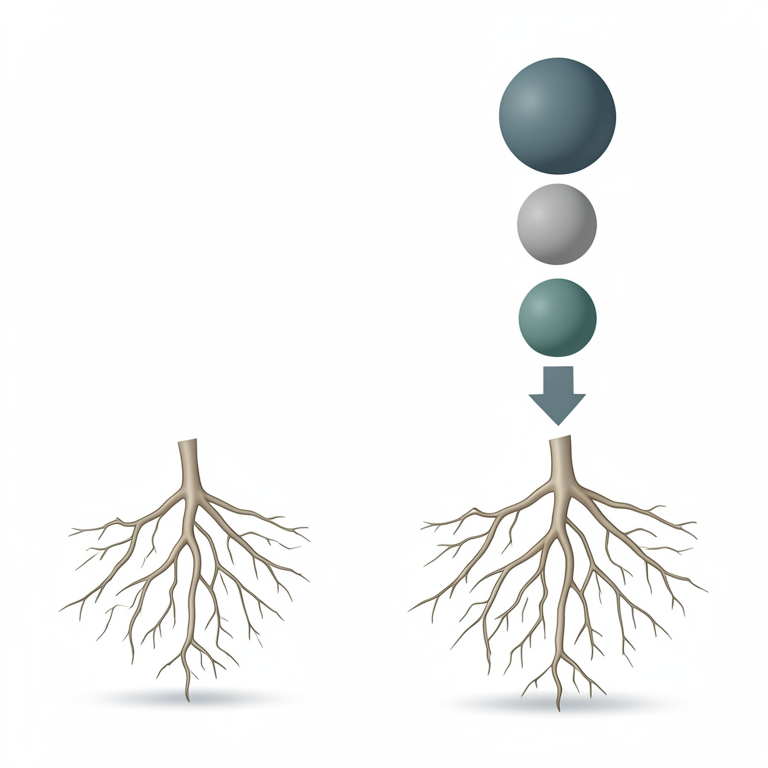
Hormone Contribution Hierarchy
AI-generated conceptual illustration (Arabidopsis thaliana root systems). It explains the idea and does not show study data.
View source evidence ↗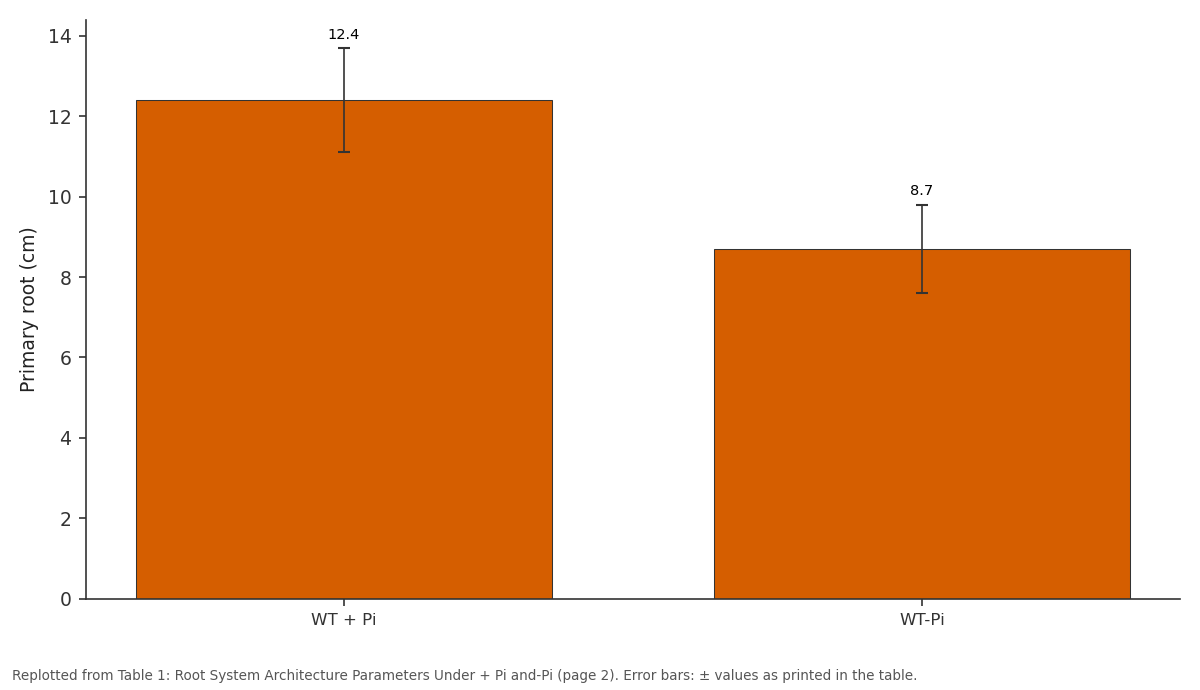
Primary root (cm): WT + Pi vs WT-Pi
Replotted from Table 1 (page 2) of the original paper. Every bar is the paper's own table value.
View source evidence ↗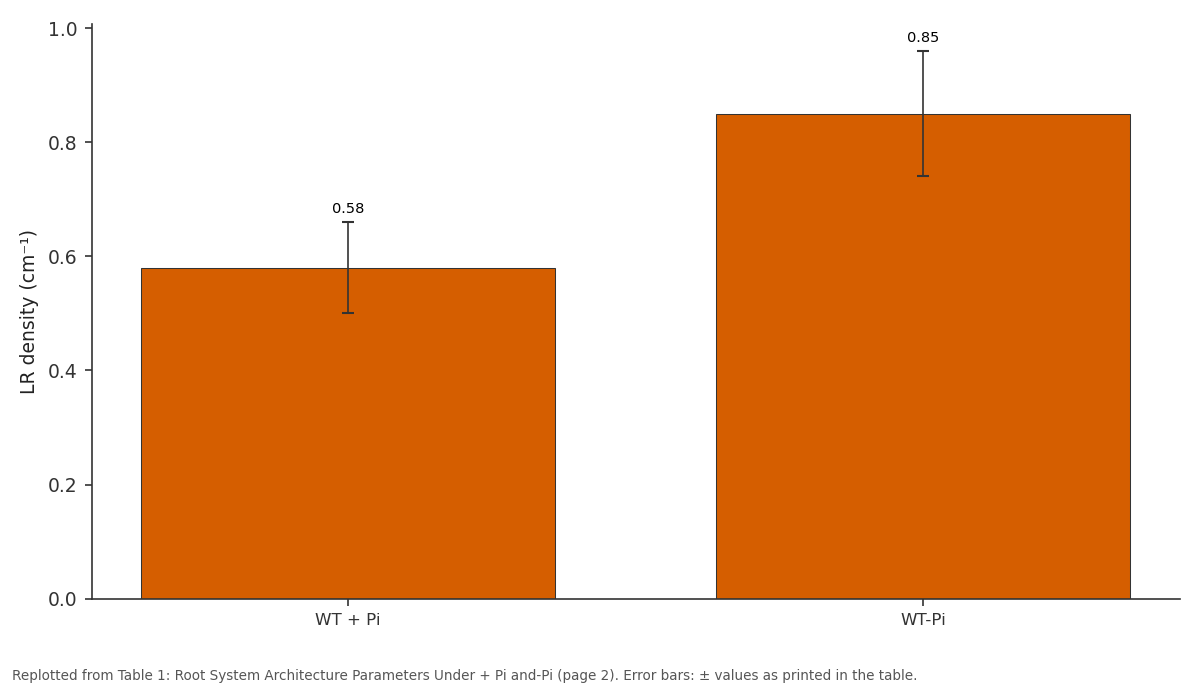
LR density (cm⁻¹): WT + Pi vs WT-Pi
Replotted from Table 1 (page 2) of the original paper. Every bar is the paper's own table value.
View source evidence ↗Figures & tables
From the original paper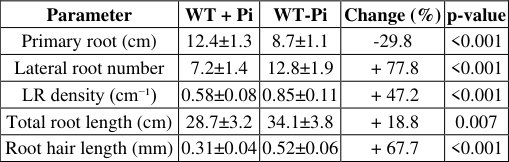 Table 1
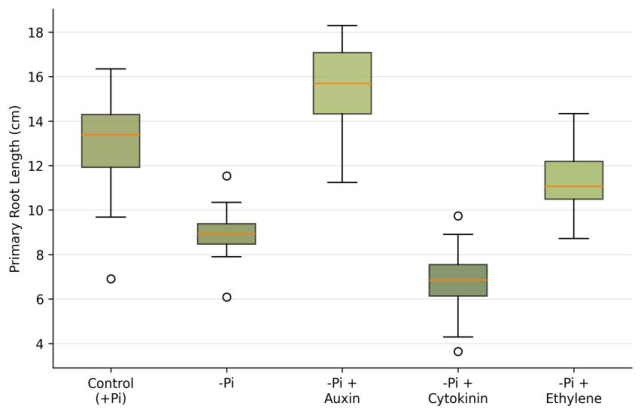 Figure 1
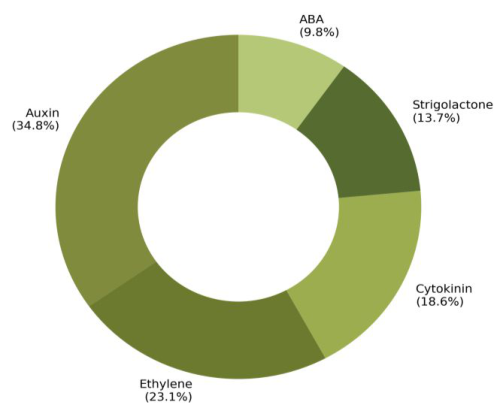 Figure 2
Introduction
"When the soil gives little, the root must give more"-this folk wisdom captures the biological reality of root system remodeling under nutrient deficiency. Phosphate is the second most limiting macronutrient for plant growth, yet it's highly immobile in soil, making root architecture a primary determinant of acquisition efficiency [1] . Under Pi starvation, plants typically shorten the primary root, proliferate lateral roots, and enhance root hair growth-a suite of responses collectively aimed at expanding the soil exploration zone in the topsoil where Pi concentrates [2] . These morphological changes are coordinated by phytohormones. Auxin promotes lateral root initiation, ethylene inhibits primary root elongation, cytokinins generally suppress lateral root growth, and strigolactones modulate both root branching and interactions with mycorrhizal fungi [3,4] . But these hormones don't act in isolation-their crosstalk determines the net architectural outcome [5] . This research aimed to quantify the individual and interactive contributions of five major phytohormones to RSA changes under Pi starvation using a combination of mutant analysis, exogenous hormone application, and chemical inhibitors.
Materials and Methods
Materials and Methods
Materials
This research was performed at the Department of Plant Molecular Biology, Instituto de Biodiversidad Andina, Cusco, Peru, from March 2023 to September 2024. Institutional biosafety approval was obtained (IBA-IBC/2023-022). Arabidopsis thaliana lines used were Col-0 (wild type), aux1-7 (auxin influx mutant), ein2-1 (ethylene-insensitive), arr1;arr12 (cytokinin response double mutant), max4-1 (strigolactone biosynthesis), and abi4-1 (ABAinsensitive). Seeds were obtained from ABRC and the Nottingham Arabidopsis Stock Centre. Seeds were surface-sterilized and grown on vertical agar plates containing modified half-strength MS medium with either 1.25 mM KH₂PO₄ (+ Pi) or 0 mM KH₂PO₄ (-Pi) for 14 days under 16 h/8 h light at 22 °C.
Methods
Root phenotyping was performed on scanned plate images using ImageJ with the SmartRoot plugin [6] . Parameters measured included primary root length, lateral root number and density, and total root length. Exogenous hormone treatments applied to-Pi medium included: IAA (0.1 μM), ACC (10 μM, ethylene precursor), kinetin (0.5 μM), GR24 (1 μM, strigolactone analog), and ABA (1 μM). Inhibitor treatments included NPA (1 μM, auxin transport inhibitor) and AVG (5 μM, ethylene biosynthesis inhibitor). Each genotype-treatment combination had 20 replicate plates with 5 seedlings per plate. Hormone contribution to overall RSA change was estimated by comparing the magnitude of phenotypic rescue in each mutant relative to wild-type-Pi response. Data were analyzed by two-way ANOVA (genotype × Pi status) with Tukey's post-hoc test in R. Pi starvation triggered the expected RSA remodeling: shorter primary roots, more lateral roots, and longer root hairs. Total root length increased by 18.8%, reflecting the shift from vertical to horizontal root exploration.
Results
Results
Discussion
The dominance of auxin in Pi-starvation RSA responses aligns with the known role of local auxin accumulation in lateral root primordia initiation [3] . The aux1-7 mutant showed a 62% reduction in lateral root induction under-Pi compared to wild type, confirming that auxin influx is needed for the Pi-starvation lateral root response [2] . Ethylene's contribution (23.1%) came mainly through primary root shortening-the ein2-1 mutant maintained longer primary roots under-Pi, consistent with ethylene's role in inhibiting cell elongation in the root tip [4] . The cytokinin response mutant arr1;arr12 showed enhanced lateral rooting under-Pi, supporting the view that cytokinins act as negative regulators of lateral root formation and that Pi starvation works partly by reducing cytokinin signaling [5] . The max4-1 strigolactone mutant was impaired in lateral root induction, which matches recent findings that strigolactones promote lateral root emergence through interaction with auxin transport [7] . ABA's smaller contribution (9.8%) appeared mainly through root hair regulation rather than branching architecture.
Conclusion
This research mapped the relative contributions of five phytohormones to root system architecture remodeling under phosphate starvation in Arabidopsis. Auxin was the dominant player, followed by ethylene, cytokinin, strigolactone, and ABA. The hormones act through distinct
International Journal of Biology Sciences https://www.biologyjournal.net architectural components-auxin on lateral root initiation, ethylene on primary root inhibition, cytokinin as a negative regulator, and strigolactone on root emergence. These findings provide a quantitative framework for understanding hormone crosstalk in nutrient-stress responses and may inform breeding efforts to improve phosphate acquisition efficiency in crops.
Acknowledgement
Acknowledgements Funding SourcesInternal research funds from the Instituto de Biodiversidad Andina supported this work. Institutional SupportThe authors thank the Instituto de Biodiversidad Andina for growth chamber and imaging facilities.Contributions Not Qualifying for Authorship ABRC and NASC are acknowledged for seed stock provision. Lab assistants who maintained plant cultures are thanked.
Figures and tables from the paper
| Parameter | WT + Pi | WT-Pi | Change (%) | p-value |
|---|---|---|---|---|
| Primary root (cm) | 12.4±1.3 | 8.7±1.1 | -29.8 | <0.001 |
| Lateral root number | 7.2±1.4 | 12.8±1.9 | + 77.8 | <0.001 |
| LR density (cm⁻¹) | 0.58±0.08 | 0.85±0.11 | + 47.2 | <0.001 |
| Total root length (cm) | 28.7±3.2 | 34.1±3.8 | + 18.8 | 0.007 |
| Root hair length (mm) | 0.31±0.04 | 0.52±0.06 | + 67.7 | <0.001 |
Table text extracted from the original PDF; superscript letters are shown inline. The original table image is below.
View original table image
References
7 in the original paper- Vance CP, Uhde-Stone C, Allan DL. Phosphorus acquisition and use: critical adaptations by plants for securing a nonrenewable resource. New Phytologist. 2003;157(3):423-447.
- Lopez-Bucio J, Cruz-Ramirez A, Herrera-Estrella L. The role of nutrient availability in regulating root architecture. Current Opinion in Plant Biology. 2003;6(3):280-287.
- Peret B, De Rybel B, Casimiro I, Benkova E, Swarup R, Laplaze L, et al. Arabidopsis lateral root development: an emerging story. Trends in Plant Science. 2009;14(7):399-408.
- Muday GK, Rahman A, Binder BM. Auxin and ethylene: collaborators or competitors? Trends in Plant Science. 2012;17(4):181-195.
- Marhava P, Bassukas AE, Zourelidou M, Kolb M, Moret B, Fastner A, et al. A molecular rheostat adjusts auxin flux to promote root protophloem differentiation. Nature. 2018;558(7709):297-300.
- Lobet G, Pages L, Draye X. A novel image-analysis toolbox enabling quantitative analysis of root system architecture. Plant Physiology. 2011;157(1):29-39.
- Ruyter-Spira C, Kohlen W, Charnikhova T, van Zeijl A, van Bezouwen L, de Ruijter N, et al. Physiological effects of the synthetic strigolactone analog GR24 on root system architecture in Arabidopsis. Plant Physiology. 2011;155(2):721-734.