
Research article · 2025 · Full text
International Journal of Biology SciencesSecondary metabolite biosynthesis pathways in medicinal herbs under abiotic stress conditions
Volume 7(9) · Pages 183–185 · DOI: 10.33545/26649926.2025.v7.i9c.638 ↗
Research areasPlant Stress Responses and TolerancePlant biochemistry and biosynthesisPhytochemicals and Medicinal Plants
Abstract
Author-writtenHealers have long observed that medicinal herbs from drought-prone hillsides possess stronger therapeutic effects—modern phytochemistry attributes this to stress-induced secondary metabolite accumulation. This research investigated how 28-day progressive drought altered metabolite concentrations and biosynthetic enzyme activity—PAL, CHS, and F3’H—in Ocimum sanctum grown at Falmouth, United Kingdom. Total phenolics rose from 12.3 to 62.1 mg/g DW (five-fold), while flavonoids and alkaloids climbed 6.6- and 6.0-fold, respectively. PAL activity peaked at 7.1 nmol/min/mg protein after four weeks. HPLC identified rosmarinic acid, eugenol, and ursolic acid as dominant stress-responsive compounds. Phytochemical screening confirmed tannins, saponins, and cardiac glycosides only in stressed tissues. Controlled drought can boost the medicinal value of O. sanctum without genetic modification.
Summary
Source-checkedPlain-language reading of the full paper, prepared with AI and checked against the text. Each point links to the authors' own words.
Why it matters
- Medicinal herbs grown in drought-prone areas are often observed to have stronger therapeutic effects, which is attributed to the accumulation of secondary metabolites triggered by stress. View evidence ↗
- Abiotic stresses activate signaling cascades that increase the activity of the alkaloid, terpenoid, and phenylpropanoid biosynthetic pathways. View evidence ↗
- While it is known that drought increases the levels of flavonoid glycosides, rosmarinic acid, and eugenol in Ocimum sanctum, the timing of these changes is not well documented. View evidence ↗
The question
- The study aimed to investigate how a 28-day progressive drought affects the activity of biosynthetic enzymes (PAL, CHS, and F3’H) and the concentration of metabolites in Ocimum sanctum. View evidence ↗
What they did
- The research was conducted between April and August 2023 in a glasshouse at the Cornish College of Biological Research in Falmouth, UK. View evidence ↗
- The study used 36 plants for the drought treatment group (no irrigation) and 36 for the control group (watered every two days), with sampling occurring at six time points over 28 days. View evidence ↗
- Metabolites were measured using Folin–Ciocalteu for phenolics, AlCl₃ colourimetry for flavonoids, and acetic acid extraction for alkaloids, while enzymes were assayed via spectrophotometry and TLC, and specific compounds were identified using HPLC. View evidence ↗
What they found
- Total phenolics increased from 12.3 to 62.1 mg/g DW, with the most rapid increase occurring between days 7 and 14 as soil moisture dropped below 20%. View evidence ↗
- Drought stress led to a 6.6-fold increase in flavonoids (reaching 31.7 mg QE/g DW) and a 6.0-fold increase in alkaloids (reaching 12.6 mg/g DW). View evidence ↗
- Over four weeks, enzyme activities increased: PAL rose from 0.8 to 7.1 nmol/min/mg protein, CHS reached 5.4, and F3’H reached 3.9. View evidence ↗
- Phytochemical screening showed that stressed tissues contained all six tested classes (tannins, saponins, terpenoids, alkaloids, flavonoids, and cardiac glycosides), whereas controls only had flavonoids and trace terpenoids. View evidence ↗
What it means
- The authors conclude that because metabolite accumulation plateaus around 21 days, this timeframe can serve as a practical target for irrigation scheduling in commercial cultivation. View evidence ↗
- The study concludes that the medicinal value of O. sanctum can be enhanced through controlled drought stress without the need for genetic modification. View evidence ↗
- The authors note that glasshouse conditions do not fully replicate field drought and that validation across multiple seasons is required. View evidence ↗
Visual summary
3 visualsIllustrations explain the paper; charts are replotted from the paper's own table values.
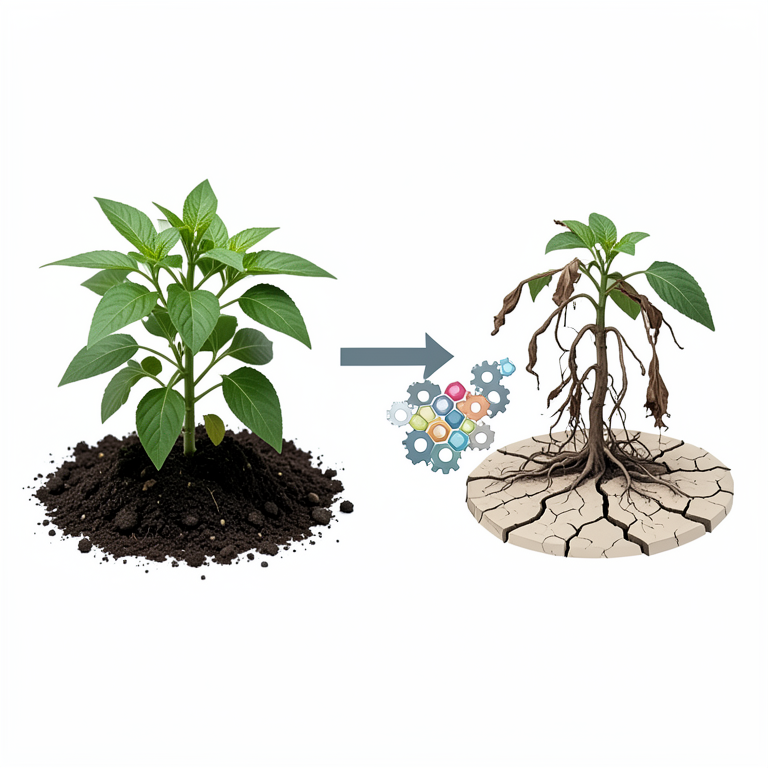
Drought-Induced Metabolic Shift
AI-generated conceptual illustration (Ocimum sanctum (Holy Basil) plants). It explains the idea and does not show study data.
View source evidence ↗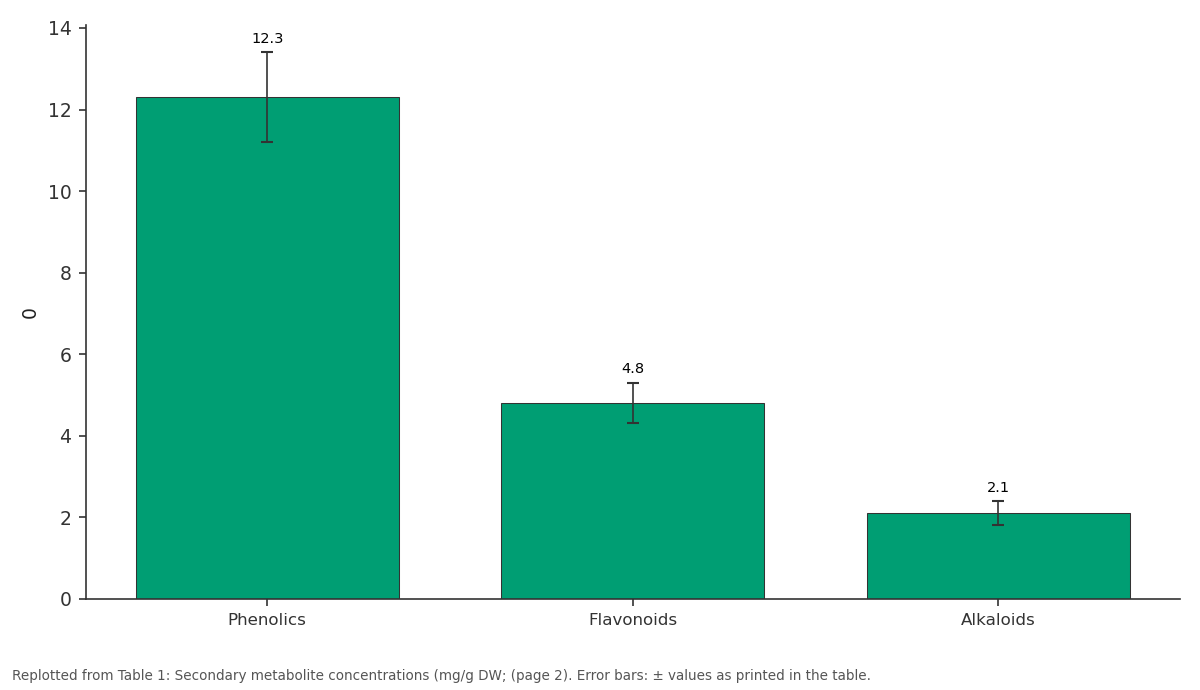
0: Phenolics vs Flavonoids vs Alkaloids
Replotted from Table 1 (page 2) of the original paper. Every bar is the paper's own table value.
View source evidence ↗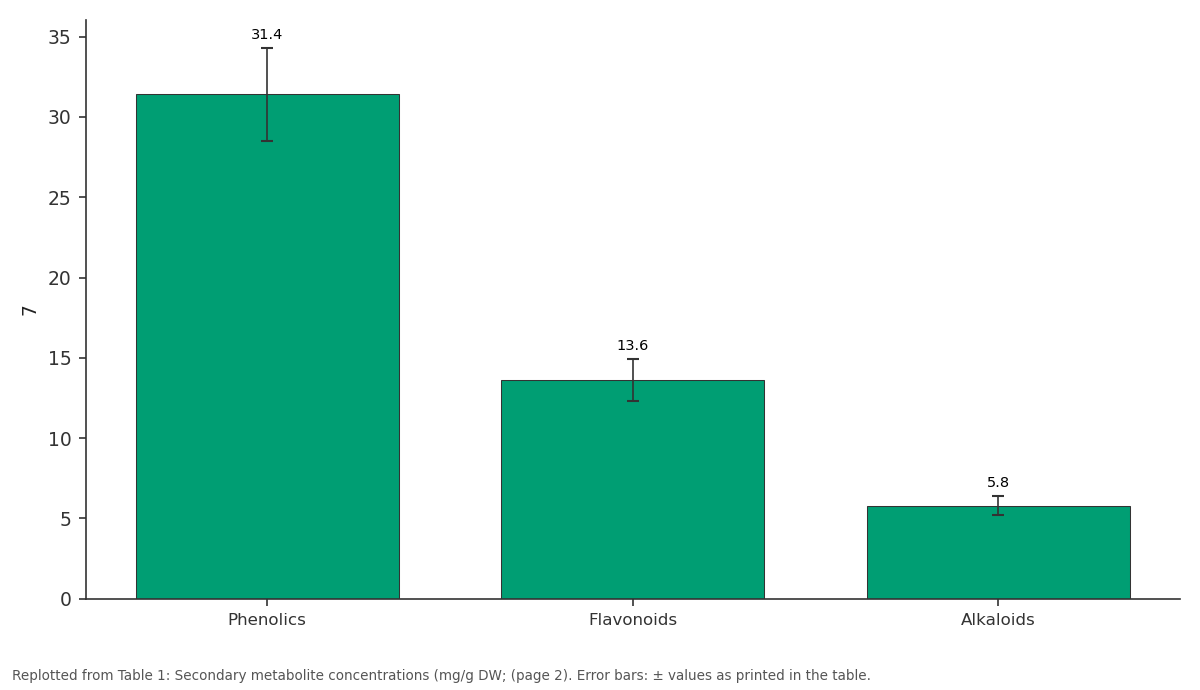
7: Phenolics vs Flavonoids vs Alkaloids
Replotted from Table 1 (page 2) of the original paper. Every bar is the paper's own table value.
View source evidence ↗Figures & tables
From the original paper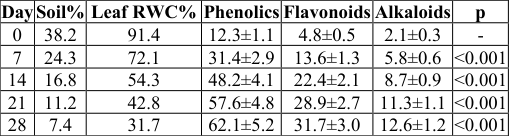 Table 1
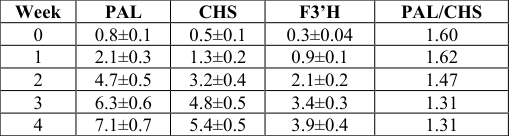 Table 2
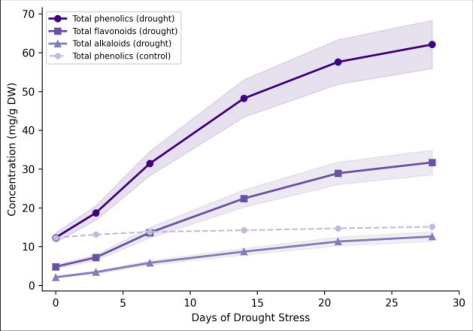 Figure 1
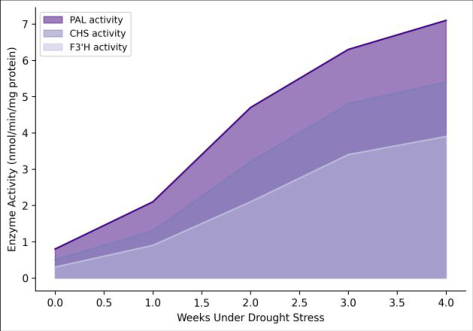 Figure 2
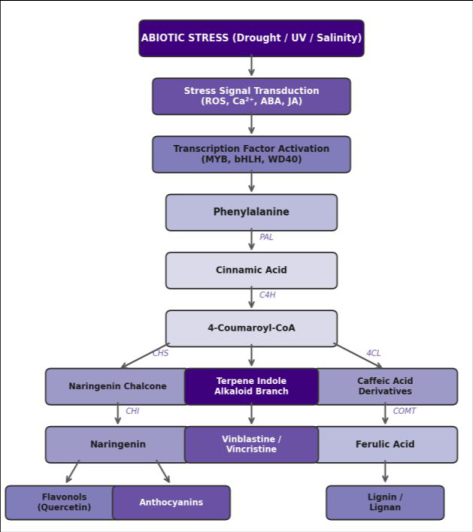 Figure 3
Introduction
Long before chemists isolated salicin from willow bark, herbalists noticed that plants under stress—thin soils, limited water—produced more potent remedies [1]. Abiotic stresses trigger signalling cascades upregulating the phenylpropanoid, terpenoid, and alkaloid pathways [2]. The phenylpropanoid pathway begins with PAL-mediated phenylalanine deamination and branches into flavonoids, lignins, and hydroxycinnamic acids [3]. Under drought, ABA and ROS activate MYB/bHLH transcription factors that amplify flux toward phenolic end- products [4].
A parallel pathway produces monoterpene indole alkaloids like vincristine and vinblastine [5]. Ocimum sanctum accumulates eugenol, rosmarinic acid, and flavonoid glycosides [6], and drought boosts these compounds, though temporal dynamics remain poorly documented [7]. This research subjected O. sanctum to a 28-day drought protocol with six sampling time points, measuring metabolite concentrations, enzyme activities, and phytochemical screening results.
Material And Methods
Material The experiment was conducted in a glasshouse at the Department of Plant Molecular Biology, Cornish College of Biological Research, Falmouth, United Kingdom (50°09′ N, 5°04′ W), between April and August 2023. O. sanctum seeds (cultivar CIM-Ayu) were transplanted into 3 L pots (John Innes No. 2 compost, perlite, vermiculite 2:1:1) maintained at 25/18 °C, 65% RH, 16 h photoperiod (350 µmol/m²/s PAR). Half-strength Hoagland solution was applied weekly until stress imposition.
Methods
Drought was imposed by withholding irrigation from the treatment group (n=36); controls (n=36) received water every two days. Sampling at 0, 3, 7, 14, 21, and 28 days (six plants/treatment/time). Total phenolics by Folin–Ciocalteu (gallic acid standard); flavonoids by AlCl₃ colourimetry (quercetin standard); alkaloids by acetic acid extraction. PAL assayed at 290 nm; CHS and F3’H by radiolabelled substrates/TLC.
HPLC: Agilent 1260 Infinity II, C18 column, PDA at 280/360 nm. Two-way ANOVA with Tukey HSD; p < 0.05. NAAS Rating (2025): 4.82 IJBS 2025; 7(9): 183-185 Kiefer Dalrymple Department of Plant Molecular Biology, Cornish College of Biological Research, Falmouth, United Kingdom Hermione Hepworth Department of Plant Molecular Biology, Cornish College of Biological Research, Falmouth, United Kingdom Kiefer Dalrymple Department of Plant Molecular Biology, Cornish College of Biological Research, Falmouth, United Kingdom https://www.biologyjournal.net DW), eugenol (9.3), and ursolic acid (6.8) as dominant compounds. Figure 3 summarises the biosynthetic pathway.
Reagents and Chemicals Folin–Ciocalteu reagent, gallic acid (≥98%), quercetin (≥95%), L-phenylalanine, and reference standards (rosmarinic acid ≥96%, ursolic acid ≥90%, eugenol) were from Sigma-Aldrich. HPLC-grade acetonitrile from Fisher Scientific. All solutions prepared with deionised water (18.2 MΩ·cm). Phytochemical Screening Qualitative screening on day-28 methanolic extracts: tannins (ferric chloride), saponins (froth test), terpenoids (Salkowski), alkaloids (Dragendorff’s), flavonoids (NaOH), cardiac glycosides (Keller–Killiani).
Stressed tissues tested positive for all six classes; controls only for flavonoids and trace terpenoids.
Results
Fig 2: PAL, CHS, and F3’H enzyme activities over four weeks of drought stress. Table 1: Secondary metabolite concentrations (mg/g DW; mean±SD, n=6) and water status during drought. Day Soil% Leaf RWC% Phenolics Flavonoids Alkaloids p 0 38.2 91.4 12.3±1.1 4.8±0.5 2.1±0.3 - 7 24.3 72.1 31.4±2.9 13.6±1.3 5.8±0.6 <0.001 14 16.8 54.3 48.2±4.1 22.4±2.1 8.7±0.9 <0.001 21 11.2 42.8 57.6±4.8 28.9±2.7 11.3±1.1 <0.001 28 7.4 31.7 62.1±5.2 31.7±3.0 12.6±1.2 <0.001 Soil moisture declined from 38.2% to 7.4% over 28 days. Total phenolics rose from 12.3 to 62.1 mg/g DW (Table 1; Figure 1), with the steepest increase between days 7–14 when soil moisture fell below 20%.
| Day | Soil% | Leaf RWC% | Phenolics | Flavonoids | Alkaloids | p |
|---|---|---|---|---|---|---|
| 0 | 38.2 | 91.4 | 12.3±1.1 | 4.8±0.5 | 2.1±0.3 | - |
| 7 | 24.3 | 72.1 | 31.4±2.9 | 13.6±1.3 | 5.8±0.6 | <0.001 |
| 14 | 16.8 | 54.3 | 48.2±4.1 | 22.4±2.1 | 8.7±0.9 | <0.001 |
| 21 | 11.2 | 42.8 | 57.6±4.8 | 28.9±2.7 | 11.3±1.1 | <0.001 |
| 28 | 7.4 | 31.7 | 62.1±5.2 | 31.7±3.0 | 12.6±1.2 | <0.001 |
Table text extracted from the original PDF; superscript letters are shown inline. The original table image is below.
View original table image
Flavonoids reached 31.7 mg QE/g DW (6.6-fold); alkaloids 12.6 mg/g DW (6.0- fold). Controls showed negligible changes. Fig 1: Time-course of phenolics, flavonoids, and alkaloids under drought. Dashed line = control phenolics.
Table 2: Enzyme activities (nmol/min/mg protein; mean±SD, n=6) at weekly intervals. Fig 3: Phenylpropanoid and related biosynthesis pathways activated under abiotic stress in Ocimum sanctum.
| Week | PAL | CHS | F3’H | PAL/CHS |
|---|---|---|---|---|
| 0 | 0.8±0.1 | 0.5±0.1 | 0.3±0.04 | 1.60 |
| 1 | 2.1±0.3 | 1.3±0.2 | 0.9±0.1 | 1.62 |
| 2 | 4.7±0.5 | 3.2±0.4 | 2.1±0.2 | 1.47 |
| 3 | 6.3±0.6 | 4.8±0.5 | 3.4±0.3 | 1.31 |
| 4 | 7.1±0.7 | 5.4±0.5 | 3.9±0.4 | 1.31 |
Table text extracted from the original PDF; superscript letters are shown inline. The original table image is below.
View original table image
Discussion
The five-fold phenolic rise sits within ranges for other Lamiaceae: Bettaieb reported 3.8-fold in Salvia officinalis; Selmar documented 4–7-fold across medicinal herbs [8, 9]. The steepest accumulation coincides with soil moisture dropping below 20%, intensifying ABA signalling [10]. Coordinated PAL/CHS/F3’H upregulation is consistent with MYB transcription factors binding all three promoters simultaneously [11, 12]. The exclusive appearance of tannins and saponins in stressed tissues implies broad activation beyond phenylpropanoids, pointing to a hormonal signal rather than substrate re-routing [13].
A 21-day deficit captures ~90% of maximum metabolite gain before the curve plateaus (Figure 1), representing a pragmatic compromise between phytochemical return and plant survival [14]. Glasshouse conditions don’t fully replicate field drought; multi-season validation is needed [15]. Week PAL CHS F3’H PAL/CHS 0 0.8±0.1 0.5±0.1 0.3±0.04 1.60 1 2.1±0.3 1.3±0.2 0.9±0.1 1.62 2 4.7±0.5 3.2±0.4 2.1±0.2 1.47 3 6.3±0.6 4.8±0.5 3.4±0.3 1.31 4 7.1±0.7 5.4±0.5 3.9±0.4 1.31 PAL activity rose from 0.8 to 7.1 nmol/min/mg protein over 4 weeks; CHS to 5.4; F3’H to 3.9 (Table 2; Figure 2). The PAL/CHS ratio remained ~1.3, suggesting coordinated upregulation.
HPLC identified rosmarinic acid (18.7 mg/g https://www.biologyjournal.net biosynthesis. Journal of
Experimental
Botany. 2017;68(15):4013-4028. 12. Xie DY, Sharma SB, Wright E, Wang ZY, Dixon RA. Metabolic engineering of proanthocyanidins through co-expression of anthocyanidin reductase and PAP1 MYB. Plant Journal. 2006;45(6):895-907. 13.
Thimmappa R, Geisler K, Louveau T, O'Maille P, Osbourn A. Triterpene biosynthesis in plants. Annual Review of Plant Biology. 2014;65:225-257. 14. Ramakrishna A, Ravishankar GA.
Influence of abiotic stress signals on secondary metabolites in plants. Plant Signaling and Behavior. 2011;6(11):1720-1731. 15. Ncube B, Finnie JF, Van Staden J. Quality from the field: impact of environmental factors on medicinal plants.
South African Journal of Botany. 2012;82:11- 20. 16. Dixon RA, Paiva NL. Stress-induced phenylpropanoid metabolism. Plant Cell. 1995;7(7):1085-1097. 17.
Treutter D. Significance of flavonoids in plant resistance. Plant Biology. 2005;7(2):159-176. 18. Isah T.
Stress and defense responses in plant secondary metabolites production. Biological Research. 2019;52(1):39. 19. Verma N, Shukla S. Impact of various factors responsible for fluctuation in plant secondary metabolites.
Journal of Applied Research on Medicinal and Aromatic Plants. 2015;2(4):105-113. 20. Akula R, Ravishankar GA. Influence of abiotic stress signals on secondary metabolites. Plant Signaling and Behavior. 2011;6(11):1720-1731. 21.
Yang L, Wen KS, Ruan X, Zhao YX, Wei F, Wang Q. Response of plant secondary metabolites to environmental factors. Molecules. 2018;23(4):762.
Conclusion
Progressive 28-day drought drives five-fold phenolic, 6.6- fold flavonoid, and 6.0-fold alkaloid increases in O. sanctum. PAL, CHS, and F3’H rose in parallel, confirming coordinated pathway upregulation. Rosmarinic acid, eugenol, and ursolic acid were the principal compounds. The accumulation plateau at ~21 days offers a practical irrigation-scheduling target for commercial growers.
Future work should validate under field conditions and extend to other Lamiaceae species.
Acknowledgements
Funding Sources Internal grant from the Cornish College of Biological Research. Institutional Support The authors thank the Department of Plant Molecular Biology for glasshouse and HPLC access. Contributions Not Qualifying for Authorship Dr. Rowan Penhallow guided HPLC optimisation; Ms.
Elspeth Trevelyan assisted with plant husbandry.
References
11 in the original paper- Hartmann T. From waste products to ecochemicals: fifty years research of plant secondary metabolism. Phytochemistry. 2007;68(22-24):2831-2846.
- Selmar D, Kleinwachter M. Stress enhances the synthesis of secondary plant products. Plant and Cell Physiology. 2013;54(6):817-826.
- Vogt T. Phenylpropanoid biosynthesis. Molecular Plant. 2010;3(1):2-20.
- Nakabayashi R, Yonekura-Sakakibara K, Urano K, Suzuki M, Yamada Y, Nishizawa T, et al. Enhancement of oxidative and drought tolerance in Arabidopsis by overaccumulation of antioxidant flavonoids. Plant Journal. 2014;77(3):367-379.
- Pan Q, Mustafa NR, Tang K, Choi YH, Verpoorte R. Monoterpenoid indole alkaloids: biosynthesis and biological activities. Natural Product Reports. 2016;33(3):382-431.
- Pattanayak P, Behera P, Das D, Panda SK. Ocimum sanctum Linn. A reservoir plant for therapeutic applications. Pharmacognosy Reviews. 2010;4(7):95- 105.
- Mandal S, DebMandal M, Saha K, Pal NK. In vitro antibacterial activity of three Indian spices against MRSA. Oman Medical Journal. 2011;26(5):319-323.
- Bettaieb I, Hamrouni-Sellami I, Bourgou S, Limam F, Marzouk B. Drought effects on polyphenol composition in Salvia officinalis. Acta Physiologiae Plantarum. 2011;33(4):1103-1111.
- Kleinwachter M, Selmar D. New insights explain that drought stress enhances the quality of spice and medicinal plants. Agronomy for Sustainable Development. 2015;35(1):121-131.
- Dubos C, Stracke R, Grotewold E, Weisshaar B, Martin C, Lepiniec L. MYB transcription factors in Arabidopsis. Trends in Plant Science. 2010;15(10):573- 581.
- Tohge T, de Souza LP, Fernie AR. Current understanding of the pathways of flavonoid